1Brown-Black-Red-Gold (1kΩ)
Inputs
Band 1Brown (1)
Band 2Black (0)
Band 3Red (×100)
ToleranceGold (±5%)
Result
Resistance1,000Ω (1kΩ)
Range950Ω – 1,050Ω
(1×10 + 0) × 100 = 1,000Ω. ±5% = 950–1,050Ω.
Resistance
1kΩ
Tolerance
±5%


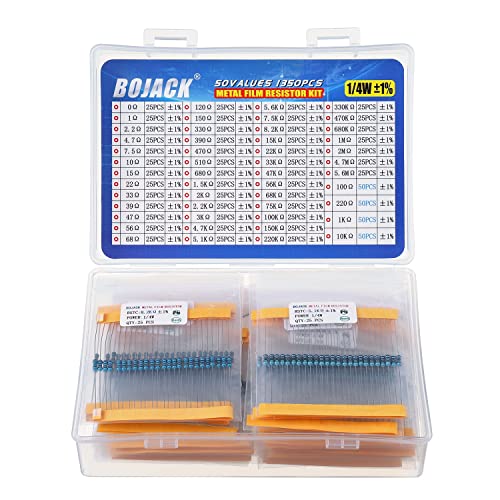
As an Amazon Associate, we earn from qualifying purchases.
Price as of Sep 16, 2026. Product prices and availability are accurate as of the date indicated and are subject to change. Any price and availability information displayed on Amazon at the time of purchase will apply.
Inputs
Result
(1×10 + 0) × 100 = 1,000Ω. ±5% = 950–1,050Ω.
Inputs
Result
R = 5 / 0.02 = 250Ω. P = 5 × 0.02 = 0.1W. Use 270Ω (next E24 value) rated 1/4W.
A 4-band resistor: Band 1 = first digit, Band 2 = second digit, Band 3 = multiplier (number of zeros), Band 4 = tolerance. Brown-Black-Red-Gold = 10 × 100 = 1kΩ ±5%.
| Color | Digit | Multiplier | Tolerance |
|---|---|---|---|
| Brown | 1 | ×10 | ±1% |
| Red | 2 | ×100 | ±2% |
| Orange | 3 | ×1k | — |
| Yellow | 4 | ×10k | — |
| Green | 5 | ×100k | ±0.5% |
Ohm's Law: R = V / I. If you need 20mA through an LED with 5V supply and 2V LED forward voltage: R = (5-2) / 0.02 = 150Ω.
For most hobby projects, 5% (gold band) is fine. Precision circuits (audio, measurement) need 1% (brown band). 10% (silver) resistors are cheap but imprecise.
Too low resistance = too much current, can burn components. Too high resistance = insufficient current, circuit may not work. Always calculate before installing.
Electronics, outdoor, and everyday tools
Last Updated: Sep 16, 2026
This calculator is provided for informational and educational purposes only. Results are estimates and should not be considered professional financial, medical, legal, or other advice. Always consult a qualified professional before making important decisions. UseCalcPro is not responsible for any actions taken based on calculator results.