UseCalcPro
Home
MathFinanceHealthConstructionAutoPetsGardenCraftsFood & BrewingToolsSportsMarineEducationTravel
Blog
  1. Home
  2. Tools

Subwoofer Frequency Calculator

Calculate sealed F3 cutoff and ported enclosure port length

Port Length

105.5"

Port Area

12.6 in²

Volume

56.6 L

Ported Enclosure

105.5"

Port length (267.9 cm)

Port Area

12.6 in²

Volume

56.6 L

Sealed Fb

160.2 Hz

⚠ Port air velocity may be high. Consider increasing port diameter to reduce port noise.

Enclosure Analysis

Sealed Fb160.2 Hz
Sealed F375.0 Hz
Ported Tuning35.0 Hz

Example Calculations

112" driver in 2.0 ft³ sealed box

Inputs

Enclosure TypeSealed
Fs30 Hz
Qts0.40
Vas55 ft³
Box Volume2.0 ft³

Result

Sealed F374.9 Hz
Sealed Fb160.3 Hz
Sealed Qtc2.14
Box Volume56.6 L

Vas in liters = 55 × 28.3168 = 1,557.4 L. Vb = 2.0 × 28.3168 = 56.6 L. Fb = 30 × sqrt(1557.4/56.6 + 1) = 30 × 5.34 = 160.3 Hz. Qtc = 0.40 × 5.34 = 2.14. F3 = 160.3 / 2.14 = 74.9 Hz. Note: Vas of 55 ft³ is extremely large; real 12" drivers typically have Vas of 1–3 ft³.

212" driver in 2.0 ft³ ported box tuned to 35 Hz

Inputs

Enclosure TypePorted
Fs30 Hz
Qts0.40
Box Volume2.0 ft³
Port Diameter4 in
Tuning Frequency35 Hz

Result

Port Length102.7"
Port Area12.6 in²
Port Length (cm)47.0 cm
Box Volume56.6 L

Port area = π × 2² = 12.57 in² = 0.00811 m². Vb = 56.6 L. L = (23562.5 × 0.00811) / (35² × 0.0566) – 0.825 × sqrt(0.00811) = 191.15 / 69.34 – 0.0743 = 2.683 m – 0.074 = 2.609 m. Port length = 2.609 m is very long; consider a larger box or higher tuning frequency.

Frequently Asked Questions

Q

How do I calculate sealed box resonant frequency?

Sealed box resonance (Fb) = Fs × sqrt(Vas/Vb + 1), where Fs is the driver free-air resonance, Vas is equivalent compliance volume, and Vb is box volume. A smaller box raises Fb, giving tighter but less deep bass.

  • Fb rises as box volume decreases
  • Qtc = Qts × sqrt(Vas/Vb + 1) controls damping
  • Ideal Qtc = 0.707 (Butterworth, flattest response)
  • Qtc > 0.707: Peaked response, boomy sound
  • Qtc < 0.577: Over-damped, weak bass output
Qtc ValueAlignmentSound CharacterBest For
0.50Over-dampedTight, rolled offAudiophile SQ
0.577BesselBest transientMusic production
0.707ButterworthFlattest responseGeneral use
1.00ChebyshevPeaked, punchyCar SPL
Q

How do I calculate port length for a ported subwoofer box?

Port length L = (23562.5 × port area) / (Fb² × Vb) – 0.825 × sqrt(port area), where Fb is tuning frequency, Vb is net box volume in liters, and port area is in square meters. Larger ports need longer tubes.

  • Larger port diameter reduces port noise (chuffing)
  • Longer port = lower tuning frequency
  • Minimum port diameter: 2" per 50W RMS
  • Port area should be 10–15 in² per ft³ of box volume
  • Round ports are quieter than slot ports at high SPL
Port DiameterPort AreaBest ForNoise Level
3"7.1 in²Low power (<100W)Moderate
4"12.6 in²Medium (100–300W)Low
6"28.3 in²High power (300W+)Very low
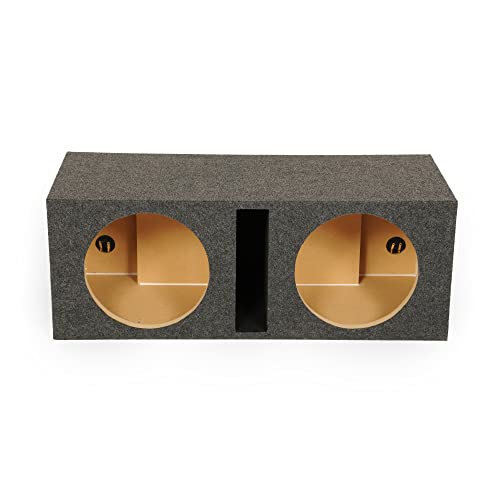
2×10" slot20 in²Space-constrainedLow–moderate
Q

What are Thiele-Small parameters and where do I find them?

Thiele-Small (T/S) parameters describe a speaker driver’s mechanical and electrical properties. The three most important are Fs (free-air resonance in Hz), Qts (total Q factor), and Vas (equivalent compliance volume). They are listed on the driver spec sheet.

  • Fs: Free-air resonance frequency (Hz)
  • Qts: Total quality factor (damping ratio)
  • Vas: Equivalent compliance volume (liters or ft³)
  • Qes and Qms: Electrical and mechanical Q (Qts combines both)
  • Find on manufacturer spec sheet or measure with DATS/Woofer Tester
ParameterLow ValueHigh ValueEffect on Design
Fs20–25 Hz35–45 HzLower = deeper extension
Qts0.25–0.350.45–0.60Lower = better for ported
Vas20–40 L80–200 LHigher = larger box needed
Q

Sealed vs ported subwoofer: which is better?

Sealed boxes offer tighter transient response and simpler construction but roll off at 12 dB/octave. Ported boxes extend bass 5–10 Hz lower and are 3 dB more efficient, but roll off steeply at 24 dB/octave below tuning frequency.

  • Sealed: Tighter bass, smaller box, forgiving of errors
  • Ported: Louder and deeper bass, larger box required
  • Sealed rolloff: 12 dB/octave (gentle)
  • Ported rolloff: 24 dB/octave below tuning (steep)
  • Ported needs subsonic filter to protect driver below Fb
FeatureSealedPorted
Bass extensionModerateDeeper (–5–10 Hz)
EfficiencyLower+3 dB louder
Transient responseTight, accurateSlightly slower
Box sizeSmallerLarger
Build complexitySimplePort must be precise
Q

What tuning frequency should I use for my ported box?

Tuning frequency (Fb) is usually set 5–10 Hz below the driver Fs for music, or at Fs for maximum SPL. For home theater, tune 5–15 Hz below Fs to extend infrasonic bass. Lower tuning gives deeper bass but needs a larger box and longer port.

  • Music (SQ): Fb = Fs – 5 to Fs – 10 Hz
  • SPL competition: Fb = Fs to Fs + 5 Hz
  • Home theater: Fb = Fs – 10 to Fs – 15 Hz
  • Lower tuning needs more box volume and port length
  • Never tune below 0.7 × Fs to avoid driver damage

Related Calculators

Subwoofer Box Calculator

Calculate sealed and ported box dimensions

Acoustic Treatment Calculator

Calculate panel coverage for target RT60

Noise Level Calculator

Combine dB levels and check OSHA limits

Reverb Time Calculator

Calculate room reverberation and pre-delay

Guitar Tuning Calculator \u2014 Frequency & String Tension by Tuning

Calculate guitar string frequencies and tension for any tuning. Choose standard, drop D, open G, or custom tunings with your preferred gauge and scale.

Guitar String Tension Calculator \u2014 Tension by Gauge & Tuning

Calculate string tension in pounds and kilograms from gauge, scale length, and tuning frequency. Covers all AWG gauges from .008 to .056 wound strings.

Related Resources

Subwoofer Box Calculator

Calculate box dimensions for subwoofer enclosures

Reverb Time Calculator

Calculate room acoustics and RT60

Noise Level Calculator

Combine decibel levels from multiple sources

More Tools & Utility Calculators

Explore audio, acoustics, and speaker design calculators

View All Tools

Last Updated: Mar 25, 2026

This calculator is provided for informational and educational purposes only. Results are estimates and should not be considered professional financial, medical, legal, or other advice. Always consult a qualified professional before making important decisions. UseCalcPro is not responsible for any actions taken based on calculator results.

UseCalcPro
FinanceHealthMath

© 2026 UseCalcPro