UseCalcPro
Home
MathFinanceHealthConstructionAutoPetsGardenCraftsFood & BrewingTools
Blog
  1. Home
  2. Tools

WiFi Coverage Calculator

Estimate wireless coverage radius, signal loss through walls, and mesh system needs

Coverage Radius (Good)

17 ft

Access Points Needed

5

Wall Loss

12.0 dB

Units

Number of interior walls between router and farthest room

Coverage Estimate

17 ft
Good signal radius (≥-65 dBm)
Moderate Range
29 ft
≥-70 dBm
Weak Range
93 ft
≥-80 dBm

Home Coverage Zones

Good Signal38%
Moderate Signal100%
Weak Signal100%

Percentage of home area within each signal quality zone

Signal Loss Breakdown

Router Transmit Power+20 dBm
Wall Attenuation (3 drywall / wood walls)−12.0 dB
Floor Attenuation (1 floor)−12.5 dB
Total Obstacle Loss−24.5 dB

Signal Strength by Distance

DistanceSignalQuality
10 ft-61 dBmGood
20 ft-67 dBmModerate
30 ft-70 dBmWeak
50 ft-75 dBmWeak
75 ft-78 dBmWeak
100 ft-81 dBmNo Signal

Recommendation

Access Points Needed: 5
A 5-node mesh system or enterprise-grade APs are recommended for full coverage.
Band Note
5 GHz offers faster speeds (up to ~2.4 Gbps) but shorter range and more wall penetration loss.

Wall Attenuation Reference

MaterialLoss per Wall
Drywall / Wood3–5 dB
Brick6–10 dB
Concrete10–15 dB
Metal15–25 dB
Glass2–3 dB
Floor / Ceiling10–15 dB

What You'll Need

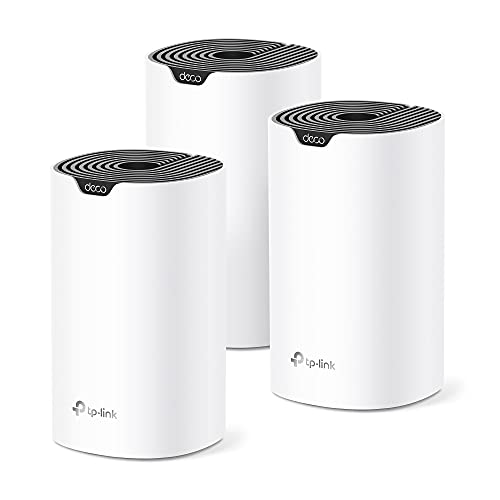
TP-Link Deco XE75 WiFi 6E Mesh System 3-Pack

TP-Link Deco XE75 WiFi 6E Mesh System 3-Pack

$200-$3004.4
View on Amazon
Jadaol Cat 6 Ethernet Cable 100ft Flat 10Gbps

Jadaol Cat 6 Ethernet Cable 100ft Flat 10Gbps

$14-$204.6
View on Amazon
TP-Link WiFi Extender RE220 AC750 Dual Band

TP-Link WiFi Extender RE220 AC750 Dual Band

$18-$254.2
View on Amazon
BOSCH GLM20 Blaze 65ft Laser Distance Measure

BOSCH GLM20 Blaze 65ft Laser Distance Measure

$30-$504.6
View on Amazon
Stanley FatMax 25ft Magnetic Tape Measure

Stanley FatMax 25ft Magnetic Tape Measure

$20-$304.6
View on Amazon
TP-Link Deco XE75 WiFi 6E Mesh System 3-Pack

TP-Link Deco XE75 WiFi 6E Mesh System 3-Pack

$200-$3004.4
View on Amazon
Jadaol Cat 6 Ethernet Cable 100ft Flat 10Gbps

Jadaol Cat 6 Ethernet Cable 100ft Flat 10Gbps

$14-$204.6
View on Amazon
TP-Link WiFi Extender RE220 AC750 Dual Band

TP-Link WiFi Extender RE220 AC750 Dual Band

$18-$254.2
View on Amazon
BOSCH GLM20 Blaze 65ft Laser Distance Measure

BOSCH GLM20 Blaze 65ft Laser Distance Measure

$30-$504.6
View on Amazon
Stanley FatMax 25ft Magnetic Tape Measure

Stanley FatMax 25ft Magnetic Tape Measure

$20-$304.6
View on Amazon

As an Amazon Associate, we earn from qualifying purchases.

Example Calculations

1Small Home — Single-Floor Drywall (2.4 GHz)

Inputs

Home Size1,500 sq ft
Floors1
Wall MaterialDrywall
Walls to Penetrate2
WiFi Band2.4 GHz
Router PlacementCenter

Result

Good Coverage Radius231 ft
Wall + Floor Loss8 dB
Access Points Needed1
Good Coverage100%

With only 8 dB total obstacle loss (2 drywall walls at 4 dB each), the effective transmit power is 12 dBm. At 2.4 GHz, the good-signal radius reaches 231 ft — far exceeding the ~19 ft home radius. A single centrally-placed router provides complete coverage.

2Medium Home — Two-Floor Drywall (5 GHz)

Inputs

Home Size2,500 sq ft
Floors2
Wall MaterialDrywall
Walls to Penetrate3
WiFi Band5 GHz
Router PlacementCenter

Result

Good Coverage Radius17 ft
Wall + Floor Loss24.5 dB
Access Points Needed6
Good Coverage~30%

At 5 GHz with 24.5 dB obstacle loss (3 drywall walls + 1 floor), the good-signal radius drops to just 17 ft. This illustrates why 5 GHz struggles in multi-floor homes with obstacles. Switching to 2.4 GHz or adding mesh nodes is recommended.

3Open-Plan Apartment — No Interior Walls (5 GHz)

Inputs

Home Size800 sq ft
Floors1
Wall MaterialDrywall
Walls to Penetrate0
WiFi Band5 GHz
Router PlacementCenter

Result

Good Coverage Radius278 ft
Wall + Floor Loss0 dB
Access Points Needed1
Good Coverage100%

With zero obstacles, the full 20 dBm transmit power yields a 278 ft good-signal radius at 5 GHz — more than enough for an 800 sq ft apartment. You get fast 5 GHz speeds throughout the space with a single router.

Frequently Asked Questions

Q

How far does WiFi reach through walls?

WiFi range through walls depends on the frequency band and wall material. At 2.4 GHz, a signal can travel 150–300 feet in open air, but each drywall reduces range by 3–5 dB, concrete by 10–15 dB, and brick by 6–10 dB. After 3 drywall walls, expect roughly 40–60% of the original range.

  • 2.4 GHz penetrates walls best — 150–300 ft open-air range, ~100–200 ft through 2 drywall walls
  • 5 GHz offers faster speeds but ~40% less range through obstacles vs 2.4 GHz
  • 6 GHz (WiFi 6E) has the shortest range — best for same-room, high-speed connections
  • Concrete and metal walls can reduce signal by 10–25 dB per wall, often killing the connection entirely
  • Each floor/ceiling adds 10–15 dB loss — equivalent to 2–3 drywall walls
Wall MaterialLoss per Wall (dB)Range Reduction
Drywall / Wood3–5 dB~15–25%
Brick6–10 dB~35–50%
Concrete10–15 dB~55–75%
Metal15–25 dB~80–95%
Glass2–3 dB~10–15%
Q

How many WiFi access points do I need for my house?

Most homes under 1,500 sq ft with drywall walls need just 1 router placed centrally. Homes between 1,500–3,000 sq ft typically need 2 access points, and homes over 3,000 sq ft or multi-story homes with concrete or brick walls may need 3 or more mesh nodes for reliable coverage.

  • Under 1,500 sq ft (1 floor, drywall): 1 router is usually enough if placed centrally
  • 1,500–3,000 sq ft or 2 floors: 2-pack mesh system (e.g., Google Nest, TP-Link Deco)
  • 3,000–5,000 sq ft or 3+ floors: 3-pack mesh system recommended
  • Concrete/brick homes may need 50–100% more APs than drywall homes of the same size
  • Place APs on each floor for multi-story homes — floor/ceiling loss is 10–15 dB
Home SizeFloorsRecommended APs
Under 1,500 sq ft11 router
1,500–2,500 sq ft1–22 mesh nodes
2,500–4,000 sq ft2–33 mesh nodes
4,000+ sq ft2+4+ mesh nodes or wired APs
Q

What is the difference between 2.4 GHz, 5 GHz, and 6 GHz WiFi?

2.4 GHz provides the best range and wall penetration but tops out around 600 Mbps with WiFi 6. 5 GHz offers speeds up to 2.4 Gbps with shorter range. 6 GHz (WiFi 6E/7) delivers up to 4.8 Gbps but has the shortest range and worst wall penetration, making it best for nearby devices.

  • 2.4 GHz: best range (150–300 ft), best wall penetration, max ~600 Mbps (WiFi 6), most congested band
  • 5 GHz: moderate range (50–150 ft), max ~2.4 Gbps, good balance of speed and range
  • 6 GHz: shortest range (30–75 ft), max ~4.8 Gbps, least interference, requires WiFi 6E/7 devices
  • Most modern routers are tri-band and broadcast on all three simultaneously
  • Use 2.4 GHz for IoT devices and distant rooms; 5/6 GHz for streaming and gaming near the router
BandMax Speed (WiFi 6/6E)Typical Indoor Range
2.4 GHz~600 Mbps150–300 ft
5 GHz~2,400 Mbps50–150 ft
6 GHz~4,800 Mbps30–75 ft
Q

Where should I place my WiFi router for best coverage?

Place your router in the center of your home, elevated on a shelf or mounted high on a wall. Avoid placing it in a corner, inside a cabinet, near metal objects, or next to a microwave. Central placement can provide up to 100% more coverage area compared to corner placement.

  • Center of home gives ~100% coverage; corner placement reduces effective area to ~50%
  • Elevate the router 4–6 feet off the ground — signals radiate outward and slightly downward
  • Keep away from microwaves, baby monitors, and cordless phones (2.4 GHz interference)
  • Avoid metal shelving, mirrors, and aquariums — they reflect and absorb WiFi signals
  • For multi-story homes, place the router on the middle floor for best vertical coverage
Q

What is Free Space Path Loss and how does it affect WiFi?

Free Space Path Loss (FSPL) is the natural signal weakening as radio waves travel through air. The formula is FSPL(dB) = 20×log10(d) + 20×log10(f) − 27.55, where d is distance in meters and f is frequency in MHz. Higher frequencies lose more signal over the same distance, which is why 5 GHz has shorter range than 2.4 GHz.

  • FSPL increases with both distance and frequency — doubling distance adds ~6 dB loss
  • 5 GHz has ~6 dB more FSPL than 2.4 GHz at the same distance
  • Typical router transmit power is 20 dBm (100 mW) by FCC regulation
  • Good signal requires ≥−65 dBm; moderate ≥−70 dBm; usable ≥−80 dBm
  • Wall and floor losses add on top of FSPL, further reducing effective range

Related Calculators

Internet Speed Calculator

Calculate speed requirements for your devices and usage

Bandwidth Calculator

Determine bandwidth needs for streaming and gaming

File Transfer Time Calculator

Estimate file download and upload times

Electricity Cost Calculator

Calculate running costs for your networking equipment

Tile Calculator

Calculate the number of tiles, boxes, and total cost for your floor or wall tiling project. Accounts for waste percentage, grout spacing, and pattern type.

Paint Calculator

Find out exactly how much paint you need for any room — accounts for doors, windows, multiple coats, and ceiling. Get gallons needed and cost estimates.

Related Resources

How Much Paint Do I Need for a Room? Complete Calculator Guide

Read our guide

Internet Speed Calculator

Test and calculate your internet speed requirements

Bandwidth Calculator

Calculate bandwidth needs for streaming, gaming, and work

File Transfer Time Calculator

Estimate how long file transfers will take

Electricity Cost Calculator

Calculate how much your router and devices cost to run

More Utility Tools

Network, conversion, and everyday calculators

View All Tools

Last Updated: Mar 16, 2026

This calculator is provided for informational and educational purposes only. Results are estimates and should not be considered professional financial, medical, legal, or other advice. Always consult a qualified professional before making important decisions. UseCalcPro is not responsible for any actions taken based on calculator results.

UseCalcPro
FinanceHealthMath

© 2026 UseCalcPro