How Much Paint Do I Need for a Room? Complete Calculator Guide
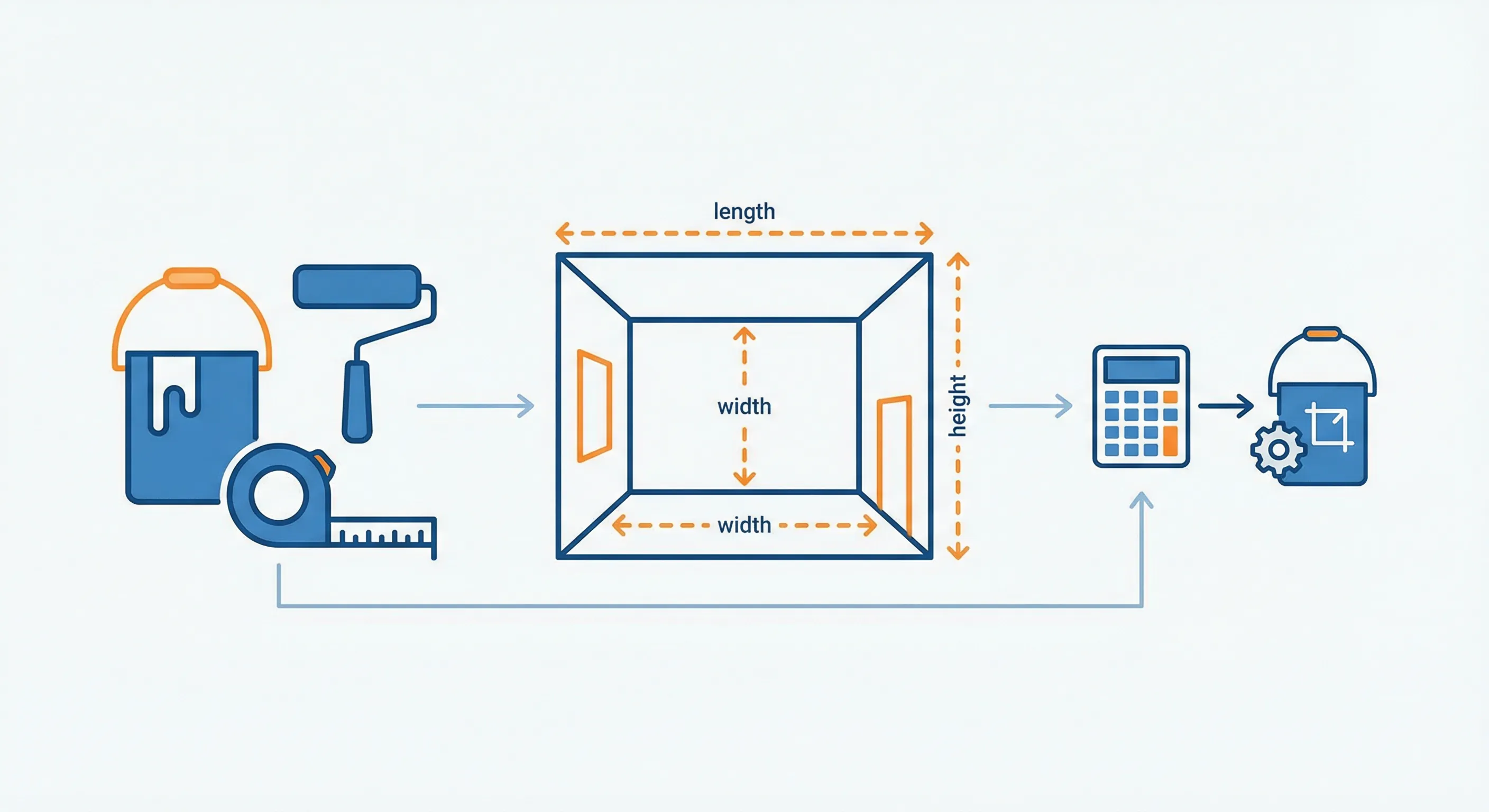
One gallon of paint covers approximately 350-400 square feet of wall space with one coat. For a standard 12x12 room with 8-foot ceilings, you'll need about 1.5 gallons for two coats after subtracting doors and windows. But the actual amount depends on your wall texture, paint type, and color change.
A realistic multi-room project shows why the buffer matters: painting four bedrooms and a hallway totaling 1,860 square feet of wall space calculates to about 10 gallons with two coats, but knockdown texture in one room can eat through paint so fast it needs an extra gallon just for that room. A project this size runs about $480 in premium eggshell paint -- proof that textured walls can increase paint needs by 20-25% over the manufacturer's label estimate.
Use our Paint Calculator to get an instant, accurate estimate for your specific project.
How to Calculate Paint for a Room
Calculating the right amount of paint involves measuring your walls, subtracting openings, and accounting for the number of coats you'll need.
Step 1: Measure Your Walls
To calculate wall area, multiply the perimeter of the room by the ceiling height.
Formula:
Wall Area = (Length + Width) × 2 × Ceiling Height
Example for a 12×14 room with 9-foot ceilings:
- Perimeter: (12 + 14) × 2 = 52 feet
- Wall area: 52 × 9 = 468 square feet
Step 2: Subtract Doors and Windows
Don't pay for paint you won't use. Subtract the area of doors and windows from your total.
| Opening Type | Average Size | Square Feet to Subtract |
|---|---|---|
| Standard door | 3' × 7' | 21 sq ft |
| Double door | 6' × 7' | 42 sq ft |
| Standard window | 3' × 4' | 12 sq ft |
| Large window | 4' × 5' | 20 sq ft |
| Sliding glass door | 6' × 7' | 42 sq ft |
Continuing our example:
- 2 windows (24 sq ft) + 1 door (21 sq ft) = 45 sq ft
- Paintable area: 468 - 45 = 423 sq ft
Step 3: Factor in Number of Coats
Most painting jobs require two coats for even coverage. Some situations require more:
| Scenario | Recommended Coats |
|---|---|
| Same color touch-up | 1 coat |
| Similar color over existing paint | 2 coats |
| Light color over light color | 2 coats |
| Dark color over light color | 2 coats |
| Light color over dark color | 3+ coats (or use primer) |
| New drywall | 1 primer + 2 coats |
| Textured walls | 2-3 coats |
Tip
Going from dark to light? Instead of buying extra paint, use a tinted primer first. Gray-tinted primer works well under most colors and can reduce your topcoats from 3-4 down to 2.
Step 4: Calculate Gallons Needed
Divide your total square footage (accounting for coats) by the paint's coverage rate.
Formula:
Gallons = (Paintable Area × Number of Coats) ÷ Coverage Rate
Our example with 2 coats:
- Total coverage needed: 423 × 2 = 846 sq ft
- At 375 sq ft/gallon: 846 ÷ 375 = 2.26 gallons
- Round up to 3 gallons (always round up!)
Paint Coverage Rates by Type
Not all paints cover the same area. Here's what to expect from different paint types:
| Paint Type | Coverage (sq ft/gallon) | Best For |
|---|---|---|
| Flat/Matte | 350-400 | Ceilings, low-traffic areas |
| Eggshell | 350-400 | Living rooms, bedrooms |
| Satin | 350-400 | Kitchens, bathrooms, hallways |
| Semi-gloss | 350-400 | Trim, doors, cabinets |
| High-gloss | 350-400 | Trim, furniture, accents |
| Primer | 300-350 | New drywall, color changes |
| Textured paint | 150-200 | Specialty finishes |
Important
Manufacturer ratings are optimistic. The 400 sq ft/gallon on the label assumes perfect conditions: smooth walls, ideal temperature, and professional application. Plan for 350 sq ft/gallon to be safe.
Room Size Quick Reference Chart
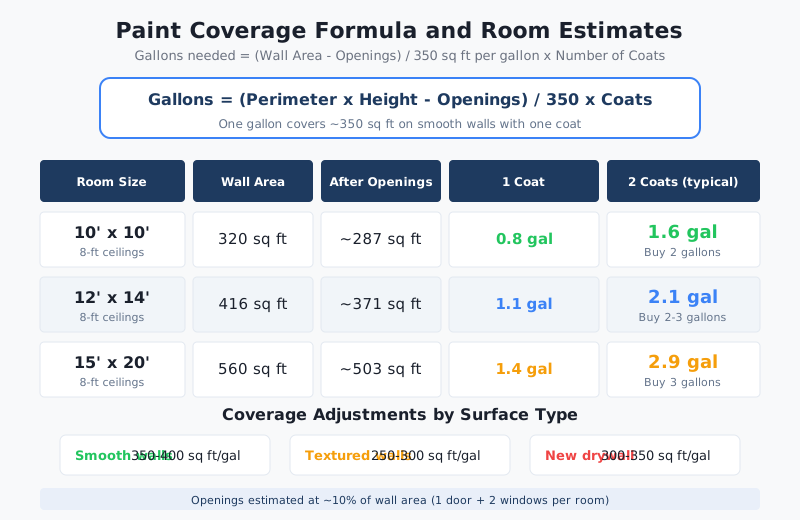
Use this chart for quick estimates. These assume 8-foot ceilings, standard doors/windows, and 2 coats:
| Room Size | Wall Area | Minus Openings | Gallons (2 coats) |
|---|---|---|---|
| 8×10 | 288 sq ft | ~250 sq ft | 1.5 gallons |
| 10×10 | 320 sq ft | ~280 sq ft | 1.5 gallons |
| 10×12 | 352 sq ft | ~310 sq ft | 2 gallons |
| 12×12 | 384 sq ft | ~340 sq ft | 2 gallons |
| 12×14 | 416 sq ft | ~370 sq ft | 2 gallons |
| 14×16 | 480 sq ft | ~430 sq ft | 2.5 gallons |
| 16×20 | 576 sq ft | ~520 sq ft | 3 gallons |
Factors That Affect Paint Coverage
Several factors can increase or decrease how much paint you'll need:
Wall Texture
| Texture Type | Coverage Adjustment |
|---|---|
| Smooth drywall | Standard (350-400 sq ft/gal) |
| Light orange peel | -10% coverage |
| Heavy orange peel | -15% coverage |
| Knockdown texture | -20% coverage |
| Popcorn ceiling | -25% to -50% coverage |
| Brick or concrete | -30% to -50% coverage |
Paint Color
| Color Change | Adjustment |
|---|---|
| White to white | No adjustment |
| Similar colors | No adjustment |
| Light to dark | No adjustment |
| Dark to light | +50% more paint (or primer) |
| Covering red/orange | +75% more paint (or gray primer) |
Warning
Red, orange, and deep yellow are notoriously difficult to cover. These colors have lower pigment opacity and often bleed through even after multiple coats. Always use a gray-tinted primer when covering these colors.
Application Method
| Method | Coverage | Paint Usage |
|---|---|---|
| Brush | Best control | Normal usage |
| Roller (3/8" nap) | Good for smooth walls | Normal usage |
| Roller (1/2" nap) | Good for textured walls | +10% more paint |
| Roller (3/4" nap) | Heavy texture | +20% more paint |
| Sprayer | Fastest | +25-50% more paint (overspray) |
How to Calculate Paint for Specific Areas
Ceiling Paint
Ceilings are straightforward since there are no doors or windows:
Formula:
Ceiling Area = Length × Width
Gallons = Ceiling Area × Coats ÷ Coverage Rate
Example (12×14 room):
- Ceiling area: 12 × 14 = 168 sq ft
- For 2 coats: 168 × 2 = 336 sq ft
- Gallons needed: 336 ÷ 350 = ~1 gallon
Tip
Ceiling paint is formulated differently. It's thicker to reduce drips and typically has a flat finish to hide imperfections. Don't substitute wall paint for ceiling paint.
Trim and Baseboards
For trim, measure the linear feet and multiply by the trim width:
Formula:
Trim Area = Linear Feet × Width (in feet)
Example (typical bedroom with 50 linear feet of 4" baseboards):
- Trim area: 50 × 0.33 = 16.5 sq ft
- Plus door frames (~20 sq ft) and window frames (~10 sq ft)
- Total: ~47 sq ft
- One quart covers ~100 sq ft of trim = sufficient
Accent Walls
For a single accent wall, just calculate that wall's area:
Example (12-foot wide × 9-foot tall accent wall):
- Wall area: 12 × 9 = 108 sq ft
- For 2 coats: 108 × 2 = 216 sq ft
- Gallons: 216 ÷ 375 = 0.58 → 1 gallon is sufficient
Common Paint Calculation Mistakes
Mistake 1: Not Buying Enough
Problem: Running out of paint mid-project can result in visible color differences between batches.
Solution: Always round up and buy an extra quart. Store it for touch-ups later.
Mistake 2: Forgetting About Primer
Problem: Skipping primer when painting over new drywall, stains, or dark colors leads to uneven coverage.
Solution: Factor primer into your calculations. New drywall absorbs the first coat like a sponge.
Mistake 3: Ignoring Texture
Problem: Textured walls can require 25-50% more paint than smooth walls.
Solution: Increase your estimate by 20-30% for textured surfaces. If you're renovating an entire room, painting walls before installing new floors saves cleanup headaches -- our flooring calculator guide can help you plan the next phase.
Mistake 4: Overestimating Door/Window Size
Problem: Subtracting too much for openings leaves you short on paint.
Solution: Use conservative estimates for openings. It's better to have leftover paint than to run short.
How to Use Our Paint Calculator
Our Paint Calculator makes the math easy:
- Enter room dimensions — length, width, and ceiling height
- Add doors and windows — specify quantity and sizes
- Select paint type — flat, eggshell, satin, or semi-gloss
- Choose number of coats — 1, 2, or 3 coats
- Get your estimate — exact gallons needed with a recommended buffer
The calculator automatically adjusts for different wall textures and provides both minimum and recommended amounts.
Paint Buying Tips
Buy Smart
- Buy all your paint at once — Different batches (even same color) can vary slightly
- Check the batch numbers — Ensure all cans are from the same batch
- Consider 5-gallon buckets — Cheaper per gallon for large projects
- Keep receipts — Most stores allow returns of unopened paint
How Much Extra to Buy
| Project Size | Extra Paint Buffer |
|---|---|
| Single room | +1 quart |
| Multiple rooms | +1 gallon |
| Whole house | +2 gallons |
| Textured walls | +25% of estimate |
| First time painter | +15% of estimate |
Info
Save your leftover paint. Store it in a cool, dry place for touch-ups. Label the can with the room name and date. Properly stored latex paint lasts 2-10 years.
Frequently Asked Questions
How many square feet does a gallon of paint cover?
A gallon of interior paint covers approximately 350-400 square feet with one coat on smooth surfaces. Textured surfaces, porous materials, and dark-to-light color changes will reduce coverage significantly.
How much paint do I need for a 12×12 room?
A 12×12 room with 8-foot ceilings has about 340 square feet of paintable wall space (after subtracting a door and window). For two coats, you'll need approximately 2 gallons of paint.
Should I buy a gallon or quart of paint?
Buy gallons for walls and full rooms. Quarts are best for trim, small accent walls, or touch-ups. A quart covers about 100 square feet, so it's only practical for very small areas.
How do I calculate paint for a room with vaulted ceilings?
For vaulted or cathedral ceilings, calculate the rectangular wall area first, then add the triangular portions. Use the formula: Triangle Area = (Base × Height) ÷ 2. Our Paint Calculator can handle irregular room shapes.
Is it better to have too much or too little paint?
Always err on the side of too much. Running out mid-project can result in color mismatches between batches. Leftover paint is useful for touch-ups and can be stored for years.
Do I need primer before painting?
Use primer when: painting new drywall, covering dark colors with light, painting over stains, or switching between oil and latex paint. For same-color refreshes or similar color changes, paint-and-primer combos are usually sufficient.
Related Calculators
- Wallpaper Calculator — Calculate rolls needed for wallpaper projects
- Flooring Calculator — Estimate flooring materials for any room
- Tile Calculator — Calculate tiles for floors and walls
If your renovation also involves tiling a backsplash or bathroom, our tile calculator guide covers waste factors and ordering strategies that follow the same measure-and-round-up approach.
Conclusion
Calculating the right amount of paint doesn't have to be complicated. Measure your walls, subtract openings, account for the number of coats, and divide by the coverage rate. When in doubt, round up — leftover paint is far better than running short.
Use our Paint Calculator for an instant, accurate estimate tailored to your specific project. And remember: quality paint with good coverage may cost more upfront, but it saves time and money by requiring fewer coats.
This guide provides general estimates for interior painting projects. Coverage rates vary by manufacturer, surface condition, and application method. Always check the specific coverage listed on your paint can.
This article is provided for informational and educational purposes only. Content should not be considered professional financial, medical, legal, or other advice. Always consult a qualified professional before making important decisions. UseCalcPro is not responsible for any actions taken based on the information in this article.
Try These Calculators
Find out exactly how much paint you need for any room — accounts for doors, windows, multiple coats, and ceiling. Get gallons needed and cost estimates.
Calculate grout needed for tile projects. Get exact estimates for grout quantity, bags required, and sealer amounts based on tile size, joint width, and area.
Estimate how many tubes of caulk you need for windows, doors, and bathrooms. Enter joint width, depth, and linear feet to get exact tube counts and cost.
Calculate thinset mortar needed for tile installation. Get accurate estimates for bags required based on tile size, trowel notch size, and coverage area.
Calculate stain, polyurethane, or oil finish needed for wood projects. Enter surface area, finish type, wood type, and coats to estimate quarts and cost.