Flooring Calculator: How Much Hardwood, Laminate, or LVP Do You Need?
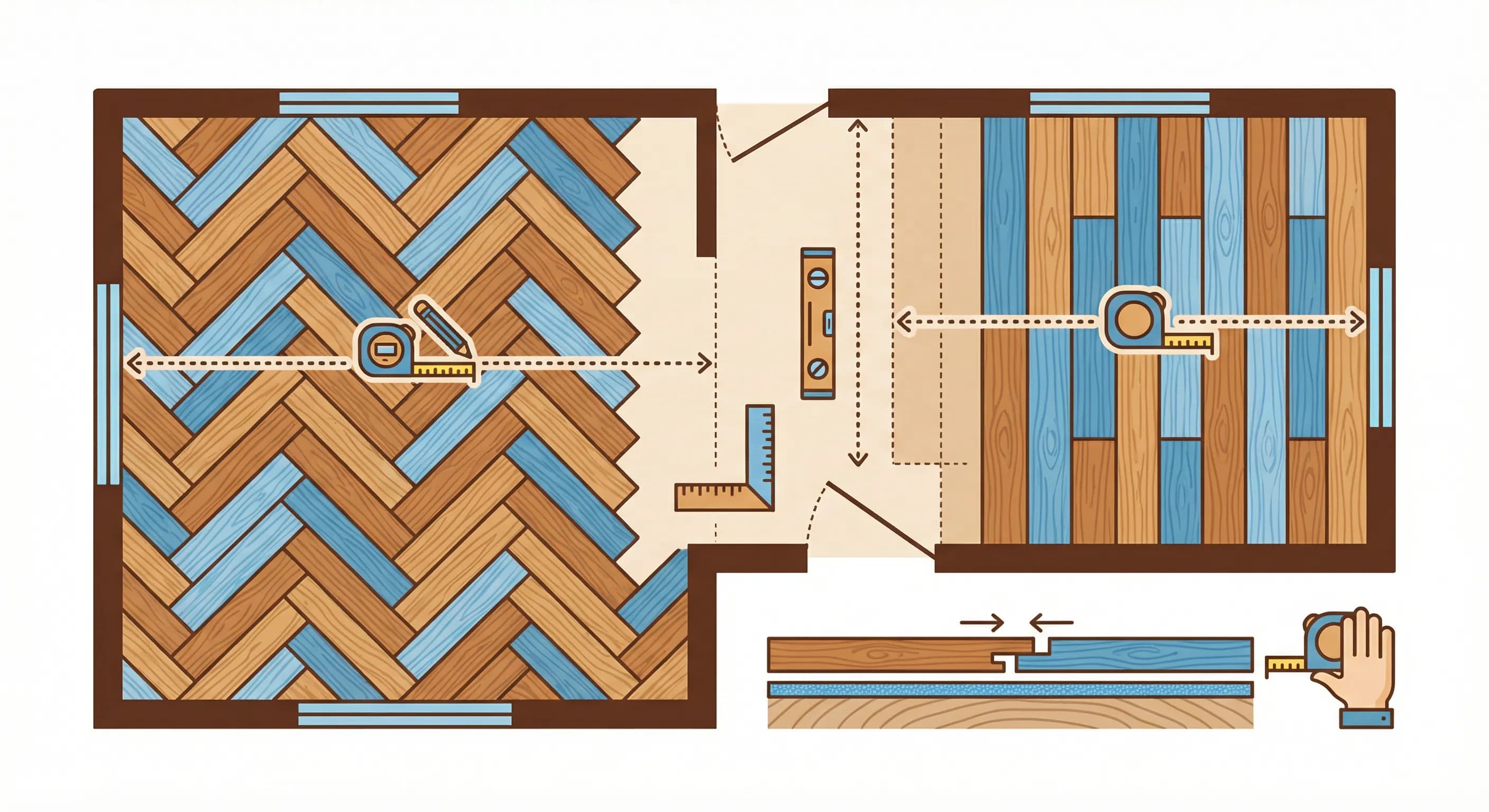
To calculate flooring, measure your room's square footage and add 10% for waste. A 12×15 foot room (180 sq ft) needs approximately 198 square feet of flooring material. For diagonal installations or complex patterns, add 15-20% instead.
Consider a representative case: installing LVP across 1,140 square feet of a main floor -- living room, kitchen, and hallway as one continuous run. Ordering 62 boxes at $3.50 per square foot, budgeting 10% waste, leaves exactly 3 boxes left over. The closets and hallway transitions add 85 square feet that are easy to forget to measure, which can leave a project short mid-install with a two-week backorder wait.
Use our Flooring Calculator to get precise material quantities for any room shape or installation pattern.
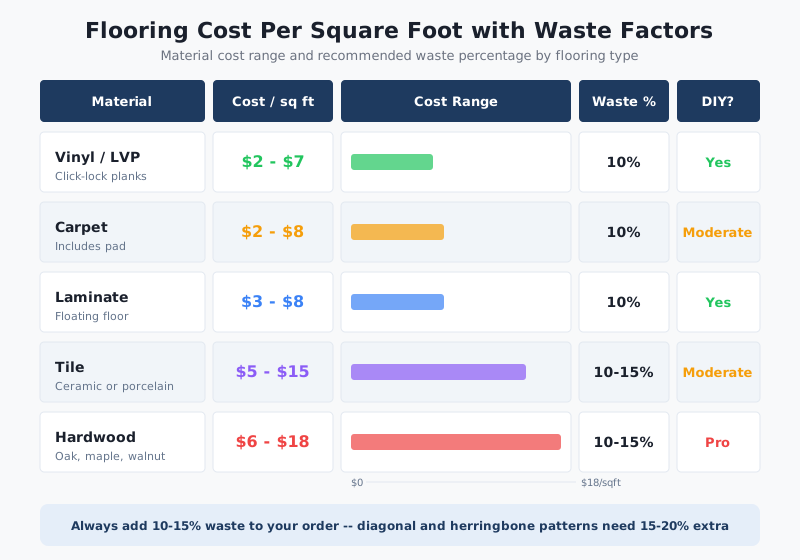
How to Calculate Flooring for Any Room
The basic formula is simple, but proper measurement technique makes all the difference.
Step 1: Measure Your Room
For rectangular rooms:
Square Footage = Length × Width
For L-shaped rooms: Break into rectangles, calculate each, then add together.
For irregular shapes: Create a grid overlay and count full squares, adding partial squares as half values.
Step 2: Measure Correctly
| Measurement Tip | Why It Matters |
|---|---|
| Measure at floor level | Walls aren't always plumb |
| Measure wall to wall | Include under door frames |
| Record the longest dimensions | Rooms rarely have perfectly parallel walls |
| Measure closets separately | They're often overlooked |
Example (L-shaped living room):
- Main area: 15' × 20' = 300 sq ft
- Bump-out: 8' × 6' = 48 sq ft
- Total: 300 + 48 = 348 sq ft
Step 3: Add Waste Factor
This is the most important step. Waste factor accounts for:
- Cuts at walls and doorways
- Damaged pieces during installation
- Pattern matching requirements
- Cutting mistakes
| Installation Type | Waste Factor |
|---|---|
| Standard straight lay | 10% |
| Diagonal installation | 15% |
| Herringbone pattern | 15-20% |
| Random width planks | 12% |
| Rooms with many angles | 15-20% |
| First-time installer | Add 5% extra |
Continuing our example (348 sq ft + 10% waste):
348 × 1.10 = 382.8 sq ft → Order 385 sq ft
Tip
Always round up to full boxes. If boxes contain 20 sq ft and you need 385 sq ft, order 20 boxes (400 sq ft). Those extras are valuable for future repairs.
Flooring Type Considerations
Different flooring types have specific calculation requirements:
Solid Hardwood
Solid hardwood planks vary in width and may require pattern matching:
| Plank Width | Typical Coverage | Waste Factor |
|---|---|---|
| 2-1/4" | Standard | 10% |
| 3" | Standard | 10% |
| 4-5" | Standard | 10% |
| Random widths | Variable | 12-15% |
Additional considerations:
- Boards are sold in random lengths
- Wider planks show imperfections more
- Pre-finished vs. site-finished affects layout planning
Engineered Hardwood
Engineered wood is more dimensionally stable and easier to install:
| Plank Style | Waste Factor |
|---|---|
| Click-lock | 10% |
| Glue-down | 10% |
| Floating with underlay | 10% |
| Herringbone | 18-20% |
Laminate Flooring
Laminate comes in boxes with precise square footage:
| Installation Method | Waste Factor |
|---|---|
| Standard floating | 10% |
| Diagonal | 15% |
| Complex room shapes | 12-15% |
Important
Acclimate laminate before installation. Store unopened boxes in the installation room for 48-72 hours to prevent expansion issues after installation.
Luxury Vinyl Plank (LVP/LVT)
LVP is popular for its water resistance and easy installation:
| Installation Type | Waste Factor |
|---|---|
| Click-lock floating | 10% |
| Glue-down | 10% |
| Loose lay | 10% |
| Pattern with direction changes | 15% |
Tile and Stone
Tile calculations require additional considerations:
| Pattern | Waste Factor |
|---|---|
| Straight lay | 10% |
| Diagonal | 15% |
| Herringbone | 20% |
| Complex patterns | 20-25% |
For detailed tile calculations, see our Tile Calculator Guide.
Room-by-Room Calculation Guide
Living Rooms
Large, open spaces are straightforward but may have features to account for:
Include:
- Main floor area
- Hallway connections (if continuous flooring)
- Closet floors
Measure around:
- Fireplace hearths
- Built-in cabinets
- Columns or pillars
Bedrooms
Bedrooms often have closets that are easy to forget:
Example (12×14 bedroom with 2×6 closet):
- Main room: 12 × 14 = 168 sq ft
- Closet: 2 × 6 = 12 sq ft
- Total: 168 + 12 = 180 sq ft
- With 10% waste: 198 sq ft
Kitchens
Kitchens have many obstacles to measure around:
Standard approach:
- Measure total floor area (island footprint usually counts toward flooring)
- Islands are typically installed before flooring OR flooring runs under island
Exception areas:
- Under permanently fixed appliances (optional)
- Under attached cabinets (usually not)
Bathrooms
Water-resistant flooring is essential. Measure carefully around:
- Toilets (floor runs under them)
- Vanity cabinets (typically floored before vanity installation)
- Tubs and showers (usually not floored under)
Hallways and Stairs
Hallways:
Area = Length × Width
Stairs (with treads and risers):
Per Stair = Tread Depth × Width + Riser Height × Width
Total = Per Stair × Number of Stairs
Add nosing if applicable
How Flooring is Sold and Packaged
Understanding packaging helps with accurate ordering:
Carton Coverage
| Flooring Type | Typical Box Size | Coverage per Box |
|---|---|---|
| Solid hardwood | Bundle | 20-24 sq ft |
| Engineered wood | Carton | 18-25 sq ft |
| Laminate | Carton | 18-24 sq ft |
| LVP/LVT | Carton | 20-30 sq ft |
Calculating Boxes Needed
Formula:
Boxes = Total Square Footage ÷ Coverage per Box (round up)
Example (385 sq ft, 20 sq ft/box):
385 ÷ 20 = 19.25 → Order 20 boxes
Warning
Don't mix production runs. Order all flooring at once from the same lot/batch. Different production runs can have subtle color variations that become obvious once installed.
Special Situations
Open Floor Plans
For continuous flooring through multiple rooms:
- Calculate each room separately
- Add them together
- Apply waste factor to total (not each room)
- Consider transition points
Example:
- Living room: 320 sq ft
- Dining area: 150 sq ft
- Kitchen: 200 sq ft
- Entry: 40 sq ft
- Total: 710 sq ft
- With 10% waste: 781 sq ft
Angled Walls
Rooms with non-90-degree angles require extra material:
- Add 5% to standard waste factor
- Measure at the widest points
- Our Flooring Calculator handles angled rooms
Multi-Level Homes
When calculating for an entire home:
- List each room by floor
- Calculate rooms individually
- Group by flooring type
- Order each type with appropriate waste factor
Underlayment and Accessories
Don't forget these essential items:
Underlayment
| Flooring Type | Underlayment Needed |
|---|---|
| Solid hardwood | Moisture barrier (if on concrete) |
| Engineered wood | Moisture barrier + sound reduction |
| Laminate | Required (foam or combination) |
| LVP | Usually built-in; check manufacturer |
Underlayment coverage: Typically 100-200 sq ft per roll
Transition Strips
Calculate linear feet for transitions between:
- Different flooring types
- Room thresholds
- Stair edges
- Sliding door tracks
Base Molding
Linear Feet = Room Perimeter - Door Openings
Example (15×20 room with two 3-foot doorways):
Perimeter: (15 + 20) × 2 = 70 linear feet
Minus doors: 70 - 6 = 64 linear feet of base molding
Common Flooring Calculation Mistakes
Mistake 1: Forgetting the Waste Factor
Problem: Ordering exactly the room square footage leaves you short after cuts and waste.
Solution: Always add 10-15% depending on installation complexity.
Mistake 2: Missing Closets and Alcoves
Problem: Small spaces are easy to overlook but add up quickly.
Solution: Walk through each room with a checklist. Measure every floor surface that will be covered.
Mistake 3: Not Accounting for Pattern Direction
Problem: Plank flooring should generally run the longest direction. Complex layouts may require more cuts.
Solution: Plan your layout before ordering. Consider how rooms connect and where transitions occur. If you're also painting the rooms before installation, check our paint calculator guide to estimate gallons while the floors are still bare -- it's much easier to paint before the new flooring goes down.
Mistake 4: Ordering from Different Lots
Problem: Color variations between production batches become visible after installation.
Solution: Order all flooring at once. Verify all boxes have the same lot number.
How to Use Our Flooring Calculator
Our Flooring Calculator makes estimation easy:
- Enter room dimensions — length and width in feet or meters
- Add multiple rooms — calculate whole-house projects at once
- Select flooring type — hardwood, laminate, LVP, or tile
- Choose installation pattern — straight, diagonal, or herringbone
- Get results — total square footage with waste factor included
The calculator also estimates boxes needed based on standard packaging sizes.
Cost Estimation Guide
Once you know your square footage, estimate costs:
| Flooring Type | Price Range (per sq ft) | 400 sq ft Project |
|---|---|---|
| Laminate | $0.50 - $3.00 | $200 - $1,200 |
| LVP | $2.00 - $5.00 | $800 - $2,000 |
| Engineered hardwood | $3.00 - $10.00 | $1,200 - $4,000 |
| Solid hardwood | $5.00 - $15.00 | $2,000 - $6,000 |
| Tile | $1.00 - $15.00 | $400 - $6,000 |
Don't forget installation costs:
- DIY: Material cost only
- Professional: Add $2-$8 per sq ft for labor
Frequently Asked Questions
How do I calculate flooring for a room?
Multiply the room's length by width to get square footage, then add 10% for waste and cuts. For a 12×15 room (180 sq ft), you need 198 sq ft of flooring. For diagonal installation, add 15% instead.
How many boxes of flooring do I need?
Divide your total square footage (including waste) by the coverage per box, then round up. If you need 385 sq ft and boxes cover 20 sq ft each, you need 20 boxes.
How much extra flooring should I order?
Order 10% extra for standard installations, 15% for diagonal patterns, and 15-20% for complex patterns like herringbone. Also keep a few planks for future repairs.
Should I include closets in flooring calculations?
Yes, always include closets, alcoves, and any floor space that will be covered. These areas are often forgotten but can add significant square footage.
How much does professional flooring installation cost?
Professional installation typically costs $2-$8 per square foot depending on flooring type and complexity. Hardwood refinishing adds $3-$5 per sq ft. Get at least three quotes.
Can I mix flooring from different boxes?
You should mix planks from multiple boxes during installation to blend color variations. However, never mix flooring from different lot numbers — verify all boxes have matching lot codes.
Related Calculators
- Tile Calculator — Calculate tiles for floors and walls
- Paint Calculator — Calculate paint for walls and ceilings
- Concrete Calculator — Estimate concrete for slabs and foundations
Conclusion
Calculating flooring accurately saves money and prevents mid-project material runs. Measure each room carefully, include closets and alcoves, and always add a waste factor appropriate for your installation pattern. Round up to full boxes, order everything from the same lot, and keep extras for future repairs.
Use our Flooring Calculator for instant, accurate estimates. Whether you're installing a single room or an entire home, getting the material quantity right is the foundation of a successful flooring project.
Flooring calculations are estimates based on standard installation practices. Actual requirements may vary based on room geometry, installation pattern, and installer experience. Always verify measurements before ordering.
This article is provided for informational and educational purposes only. Content should not be considered professional financial, medical, legal, or other advice. Always consult a qualified professional before making important decisions. UseCalcPro is not responsible for any actions taken based on the information in this article.
Try These Calculators
Estimate materials for hardwood, laminate, vinyl, or carpet floors. Get box counts, waste allowance, and full cost breakdowns for your flooring project.
Estimate 2026 laminate floor installation cost by room size and quality. Budget to waterproof laminate quotes typically range from $1,500 to $6,000 total.
Calculate linear feet of baseboard trim and boards needed for any room. Get board counts, corner pieces, waste allowance, and material cost estimates.
Calculate countertop square footage, edge profiling length, cutouts, and installed cost for granite, quartz, marble, laminate, or butcher block materials.
Estimate 2026 hardwood floor installation cost by size, species, and region. Oak, maple, and exotic wood quotes typically run $4,500 to $18,000 installed.