UseCalcPro
Home
MathFinanceHealthConstructionAutoPetsGardenCraftsFood & BrewingToolsSportsMarineEducationTravel
Blog
  1. Home
  2. Auto

RV Inverter Sizing Calculator — Find the Right Wattage

Size your RV inverter based on actual appliance loads, surge demands, and battery capacity

Minimum Inverter

888 W

Running

740 W

Surge

740 W

Runtime

2.5 hrs

1
1
1

Custom Appliance (optional)

W
W
Ah

Minimum Inverter Size

888 W

Recommended: 1,000 W inverter

Running Load

740 W

Surge Load

740 W

Battery Draw

68.5 A

Est. Runtime

2.5 hrs

Calculations use 90% inverter efficiency and a 20% safety margin. Actual runtime depends on battery state of charge and temperature.

Frequently Asked Questions

Q

What size inverter do I need for my RV?

Inverter size depends on which appliances you run simultaneously. Add the running wattage of all devices, then multiply by 1.2 for a safety margin. Most RVers need 2,000–3,000W for microwave, coffee maker, and small appliances.

  • 1,000W: phones, laptops, lights, CPAP — minimal boondocking
  • 2,000W: coffee maker, TV, blender, laptop — weekend camping
  • 3,000W: microwave (1,000W), hair dryer, most kitchen appliances — full-time RV
  • 5,000W: RV AC (13,500 BTU), multiple large appliances — off-grid living
  • Always check surge requirements — motors can draw 2–3x running watts at startup
Inverter SizeRunning WattsTypical LoadBattery Draw (12V)
1,000W~800W usableBasic electronics~74A
2,000W~1,600W usableSmall appliances~148A
3,000W~2,400W usableKitchen + entertainment~222A
5,000W~4,000W usableAC + major appliances~370A
Q

What is the difference between pure sine and modified sine wave inverters?

Pure sine wave inverters produce clean AC power identical to grid power, while modified sine wave inverters produce a stepped approximation. Pure sine wave is required for sensitive electronics like CPAP machines, laptop chargers, and modern TVs.

  • Pure sine wave: 90% efficiency, safe for all electronics, no buzzing or interference
  • Modified sine wave: 85% efficiency, can cause motor overheating and screen flickering
  • CPAP, medical devices, and variable-speed tools require pure sine wave
  • Modified sine wave is 30–50% cheaper but incompatible with many modern devices
  • Pure sine wave is the standard recommendation for RV use
Q

How long will my RV battery last with an inverter?

Runtime depends on battery capacity, inverter load, and depth of discharge. A 200Ah lead-acid battery at 50% DOD provides 100 usable Ah. At 500W load on a 12V system with 90% efficiency, draw is ~46A, giving roughly 2.2 hours of runtime.

  • Lead-acid batteries: 50% depth of discharge (DOD) maximum for longevity
  • Lithium (LiFePO4): 80–90% DOD safely, nearly doubling usable capacity
  • Battery draw formula: Amps = Watts / (Voltage x Efficiency)
  • 200Ah lead-acid at 500W = ~2.2 hours; 200Ah lithium at 500W = ~3.5 hours
  • Temperature affects capacity — cold reduces lead-acid output by 10–20%
Battery Type200Ah UsableRuntime at 500W (12V)Cycle Life
Lead-Acid100Ah (50% DOD)~2.2 hrs200–500 cycles
AGM100Ah (50% DOD)~2.2 hrs400–800 cycles
Lithium170Ah (85% DOD)~3.5 hrs3,000–5,000 cycles
Q

Can I run my RV air conditioner on an inverter?

Yes, but you need a large inverter (3,000–5,000W) and substantial battery capacity. A 13,500 BTU RV AC draws about 1,500W running with a 3,500W surge at startup. This requires at least a 3,000W pure sine inverter and 400+ Ah of lithium batteries for meaningful runtime.

  • 13,500 BTU AC: 1,500W running, 3,500W surge — minimum 3,000W inverter
  • 15,000 BTU AC: 1,800W running, 4,500W surge — minimum 4,000W inverter
  • A soft-start kit reduces surge by 60–70%, allowing smaller inverters
  • At 1,500W on 12V, battery draw is ~139A — drains 200Ah lithium in ~1.2 hours
  • Solar + inverter + lithium combo is the most practical off-grid AC solution
Q

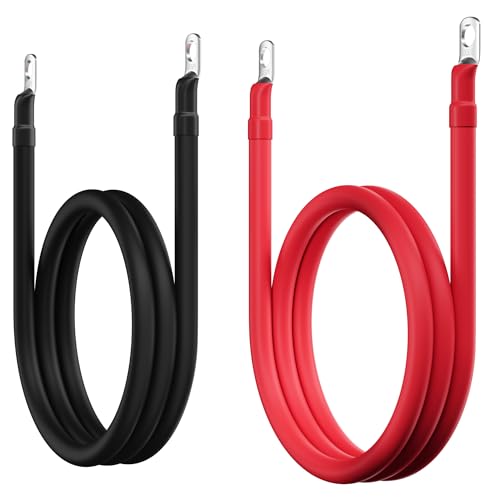
What wire gauge do I need between battery and inverter?

Wire gauge depends on current draw and cable length. A 2,000W inverter on 12V draws ~185A at full load, requiring 2/0 AWG copper cable for runs up to 5 feet. Undersized wire causes voltage drop, heat buildup, and fire risk.

  • 1,000W at 12V = ~93A: use 4 AWG for short runs (3 ft), 2 AWG for longer
  • 2,000W at 12V = ~185A: use 2/0 AWG for up to 5 ft, 4/0 for longer runs
  • 3,000W at 12V = ~278A: use 4/0 AWG minimum, consider 24V system to halve current
  • Always include a fuse within 18 inches of the battery positive terminal
  • Keep cable runs as short as possible — every foot of cable adds resistance

Example Calculations

1Weekend Camping Setup

Inputs

AppliancesCoffee Maker (600W) + TV (120W) + Phone Charger (20W)
Battery12V, 200Ah Lithium
Inverter TypePure Sine Wave (90%)

Result

Minimum Inverter888 W
Running Load740 W
Battery Draw68.5 A
Est. Runtime2.5 hrs

Total running watts: 600 + 120 + 20 = 740W. Safety margin: 740 x 1.2 = 888W. Battery draw: 740 / (12 x 0.90) = 68.5A. Runtime at 85% DOD: (200 x 0.85) / 68.5 = 2.5 hrs. A 1,000W inverter covers this load.

2Full-Time RV Kitchen

Inputs

AppliancesMicrowave (1000W) + Coffee Maker (600W) + Laptop (65W)
Battery12V, 400Ah Lithium
Inverter TypePure Sine Wave (90%)

Result

Minimum Inverter1,998 W
Running Load1,665 W
Battery Draw154.2 A
Est. Runtime2.2 hrs

Total running watts: 1000 + 600 + 65 = 1,665W. Safety margin: 1,665 x 1.2 = 1,998W. Battery draw: 1,665 / (12 x 0.90) = 154.2A. Runtime: (400 x 0.85) / 154.2 = 2.2 hrs. A 2,000W inverter is the minimum.

3Off-Grid with AC Unit

Inputs

AppliancesRV AC 13,500 BTU (1500W) + TV (120W) + Phone Charger (20W)
Battery12V, 600Ah Lithium
Inverter TypePure Sine Wave (90%)

Result

Minimum Inverter1,968 W
Running Load1,640 W
Surge Load3,640 W
Est. Runtime3.3 hrs

Running watts: 1500 + 120 + 20 = 1,640W. Safety margin: 1,640 x 1.2 = 1,968W. Surge: 3500 + 120 + 20 = 3,640W. Battery draw: 1,640 / (12 x 0.90) = 151.9A. Runtime: (600 x 0.85) / 151.9 = 3.4 hrs. A 3,000W+ inverter is needed for the AC surge.

Formulas Used

Minimum Inverter Size

Inverter Watts = Total Running Watts × 1.2

Calculates the minimum continuous wattage rating for the inverter by adding a 20% safety margin to the total running load.

Where:

Total Running Watts= Sum of all appliance running wattages to be used simultaneously
1.2= 20% safety factor to account for efficiency losses and measurement tolerance

Battery Current Draw

Amps = Watts / (Voltage × Efficiency)

Determines the DC current drawn from the battery bank by the inverter under load.

Where:

Watts= Total AC wattage being consumed by appliances
Voltage= Battery bank voltage (12V, 24V, or 48V)
Efficiency= Inverter conversion efficiency (0.90 for pure sine, 0.85 for modified sine)

Estimated Runtime

Hours = (Ah × DOD) / Amps

Estimates how long the battery bank can sustain a given load before reaching the depth of discharge limit.

Where:

Ah= Total battery capacity in amp-hours
DOD= Maximum depth of discharge (0.50 for lead-acid, 0.85 for lithium)
Amps= DC current draw calculated from the battery draw formula

RV Inverter Sizing: A Complete Guide to Off-Grid Power

An RV inverter converts your battery’s DC power into AC household power, letting you run appliances like coffee makers, microwaves, and laptops while boondocking. Choosing the right inverter size is critical — too small and it can’t handle your loads; too large and you waste money and space on capacity you’ll never use.

The sizing process starts by listing every appliance you plan to run simultaneously and adding up their running wattage. Multiply that total by 1.2 (a 20% safety margin) to get your minimum inverter size. But running watts are only half the equation — motors in devices like AC compressors and refrigerators can draw 2–3x their rated wattage during startup (surge), so your inverter must handle that peak demand too.

Battery capacity determines how long your inverter can run. The formula is straightforward: Amps = Watts / (Voltage x Efficiency). A 200Ah lithium battery bank powering a 500W load through a 12V pure sine inverter at 90% efficiency draws about 46A, providing roughly 3.5 hours of runtime at 85% depth of discharge. Lead-acid batteries should only be discharged to 50%, cutting that runtime nearly in half.

Related Calculators

EV Charging Calculator

Calculate charging time and costs

Electrical Load Calculator

Size circuits and breakers

RV Tire Pressure Calculator

Pressure from axle weight and load range

RV Holding Tank Calculator

Estimate days before dump

Event Power Calculator \u2014 Generator Sizing by Equipment Load

Calculate event power requirements and generator size. Add your equipment loads to get total wattage, amperage, circuit count, and generator recommendation.

RV Solar Calculator \u2014 Panel, Battery & Controller Sizing

Size your RV solar system with panel count, battery bank Ah, and charge controller amps. Compare lithium vs AGM batteries for boondocking and off-grid camping.

Related Resources

Pregnancy Week by Week: Complete Trimester Guide and Fetal Development

Read our guide

Car Payment Calculator: How to Calculate Monthly Auto Loan Payments

Read our guide

Gas Mileage Calculator: How to Calculate MPG and Fuel Economy

Read our guide

EV Charging Calculator

Calculate EV charging time and electricity costs

Electrical Load Calculator

Size electrical circuits for your setup

RV Tire Pressure Calculator

Find the right tire pressure for your loaded RV

RV Holding Tank Calculator

Estimate how long before you need to dump

More Auto Calculators

Explore all our free auto and vehicle calculators

View All Auto Calculators

Last Updated: Mar 25, 2026

This calculator is provided for informational and educational purposes only. Results are estimates and should not be considered professional financial, medical, legal, or other advice. Always consult a qualified professional before making important decisions. UseCalcPro is not responsible for any actions taken based on calculator results.

UseCalcPro
FinanceHealthMath

© 2026 UseCalcPro