UseCalcPro
Home
MathFinanceHealthConstructionAutoPetsGardenCraftsFood & BrewingToolsSportsMarineEducationTravel
Blog
  1. Home
  2. Marine

Trolling Speed Calculator

Dial in trolling speed and lure depth for your target species

Units
Using Downrigger?

Optimal Trolling Speed (Walleye)

1.5 mph

Range: 1–2.5 mph

Lure Depth

78.6 ft

Line Angle

51.8°

Speed Assessment

StatusOptimal
Effective Depth78.6 ft (23.9 m)
Line Angle from Vertical51.8°

Lure Depth by Speed

1 mph94 ft
2 mph58 ft
3 mph30 ft
4 mph18 ft
6 mph8 ft
8 mph4 ft

Trolling Speed by Species

SpeciesSpeed (mph)OptimalTypical Depth
Walleye1–2.51.510–40 ft
Trout / Salmon1.5–3.52.510–40 ft
Bass (Largemouth)1.5–42.510–40 ft
Musky / Pike2–53.520–80 ft
Striped Bass2–5310–40 ft
King Mackerel4–8620–80 ft
Wahoo6–151030–200 ft
Tuna5–10730–200 ft

What You'll Need

Garmin Striker 4 GPS Fish Finder with CHIRP Sonar

$100-$1504.4
View on Amazon

Standard Horizon HX210 Floating Handheld VHF Radio

$120-$1604.5
View on Amazon

Hondex Portable Digital Depth Sounder

$150-$2004.3
View on Amazon

Star Brite Ultimate Aluminum Cleaner & Restorer 64oz

$18-$254.5
View on Amazon

3M Marine Adhesive Sealant 5200 Fast Cure White 3oz

$14-$204.5
View on Amazon

Shoreline Marine Bilge Pump 600 GPH 12V

$15-$254.3
View on Amazon

Garmin Striker 4 GPS Fish Finder with CHIRP Sonar

$100-$1504.4
View on Amazon

Standard Horizon HX210 Floating Handheld VHF Radio

$120-$1604.5
View on Amazon

Hondex Portable Digital Depth Sounder

$150-$2004.3
View on Amazon

Star Brite Ultimate Aluminum Cleaner & Restorer 64oz

$18-$254.5
View on Amazon

3M Marine Adhesive Sealant 5200 Fast Cure White 3oz

$14-$204.5
View on Amazon

Shoreline Marine Bilge Pump 600 GPH 12V

$15-$254.3
View on Amazon

As an Amazon Associate, we earn from qualifying purchases.

Frequently Asked Questions

Q

What is the best trolling speed for my target species?

Optimal trolling speed varies widely by species. Walleye and trout prefer 1.0–3.5 mph, while offshore species like wahoo and marlin need 6–15 mph. Speed also affects lure action—too slow and lures won’t swim properly, too fast and fish can’t catch them.

  • Walleye: 1.0–2.5 mph, optimal at 1.5 mph for live bait rigs
  • Trout and salmon: 1.5–3.5 mph, optimal at 2.5 mph for spoons and plugs
  • Bass and musky: 2.0–5.0 mph, optimal at 3.0–3.5 mph for crankbaits
  • King mackerel and mahi: 4.0–8.0 mph, optimal at 6.0 mph for skirted lures
  • Wahoo and marlin: 6.0–15.0 mph, high-speed trolling with heavy tackle
SpeciesSpeed RangeOptimalLure Type
Walleye1.0–2.5 mph1.5 mphCrawler harness
Trout/Salmon1.5–3.5 mph2.5 mphSpoons, plugs
Musky2.0–5.0 mph3.5 mphLarge crankbaits
Tuna5.0–10.0 mph7.0 mphCedar plugs
Q

How do I calculate lure running depth when trolling?

Lure depth depends on line length deployed, line diameter, lure weight, and boat speed. Heavier lures and slower speeds run deeper. More line out also increases depth, but with diminishing returns due to line drag. The catenary curve approximation models this relationship.

  • More line out = deeper, but each additional foot adds less depth
  • Heavier lures run deeper at any given speed and line length
  • Thicker line creates more drag, reducing lure depth at speed
  • Slower speeds allow lures to sink deeper on the same amount of line
  • At 1.5 mph with 100 ft of 15 lb line and 1 oz lure, expect ~79 ft depth
Q

What is the catenary curve and how does it apply to trolling?

A catenary is the curve formed by a flexible line under uniform loading—like a trolling line affected by water drag. The line forms a curve from the rod tip to the lure, and the angle of this curve determines how deep the lure runs relative to the line length deployed.

  • At slow speeds, the line hangs nearly vertical—lure depth approaches line length
  • At high speeds, water drag pulls the line nearly horizontal—depth is minimal
  • Line diameter is the biggest factor in drag because thicker line catches more water
  • The angle from vertical increases with speed squared
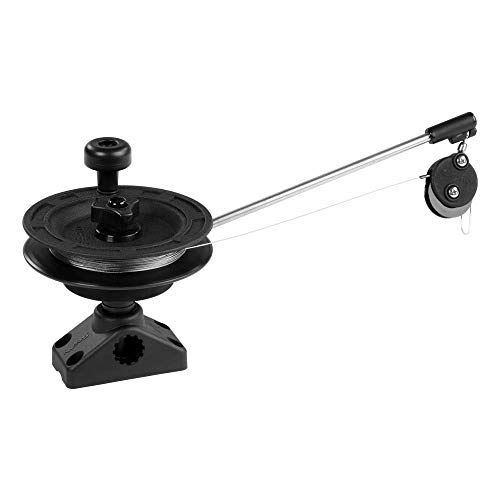
  • Downriggers bypass the catenary problem by mechanically setting depth
Q

When should I use a downrigger instead of free-line trolling?

Downriggers are best when you need precise depth control, especially in deep water or at higher trolling speeds where free-line trolling can’t reach the target depth. They also eliminate the variable of line drag, making presentations more consistent.

  • Target depth over 50 ft: downriggers are more practical than adding heavy weights
  • Thermocline fishing: precise depth matters when fish hold in a narrow temperature band
  • High-speed trolling: free line runs too shallow, downrigger sets exact depth
  • Multiple rods: downriggers let you stagger depths precisely on a spread
  • Cost: quality downrigger systems run $200–$800 per unit
Q

How does line weight and diameter affect trolling depth?

Heavier (thicker) line creates more water resistance, which reduces lure running depth. Switching from 30 lb mono to 15 lb mono can increase depth by 20–40% at the same speed and line length because thinner line cuts through water with less drag.

  • 6 lb test (0.22 mm): deepest running, best for light freshwater trolling
  • 15 lb test (0.35 mm): good balance for walleye and trout trolling
  • 30 lb test (0.50 mm): needed for musky and stripers, shallower presentation
  • 50 lb test (0.60 mm): offshore species, heavy drag reduces depth significantly
  • Lead core line: built-in weight, sinks 5 ft per 10-yard color section

Example Calculations

1Walleye Trolling with Crawler Harness

Inputs

Target SpeciesWalleye
Line Out100 ft
Line Weight15 lb test (0.35 mm)
Lure Weight1 oz
Speed1.5 mph (optimal)

Result

Lure Running Depth78.6 ft
Line Angle51.8°
Speed Range1.0–2.5 mph

Drag = 0.35 × 100 × 1.5² × 0.01 = 0.79. Angle = arctan(1 / 0.79) = 51.8°. Depth = 100 × sin(51.8°) = 78.6 ft.

2Offshore Tuna Trolling with Cedar Plug

Inputs

Target SpeciesTuna
Line Out200 ft
Line Weight50 lb test (0.60 mm)
Lure Weight4 oz
Speed7.0 mph (optimal)

Result

Lure Running Depth13.6 ft
Line Angle3.9°
Speed Range5.0–10.0 mph

Drag = 0.60 × 200 × 7.0² × 0.01 = 58.8. Angle = arctan(4 / 58.8) = 3.9°. Depth = 200 × sin(3.9°) = 13.6 ft. At 7 mph, line trails nearly flat.

Formulas Used

Line Drag Force

Drag = Line Dia × Line Length × Speed² × 0.01

Estimates the hydrodynamic drag force on the trolling line, which opposes the lure weight pulling it down.

Where:

Line Dia= Line diameter in millimeters
Line Length= Amount of line deployed in feet
Speed= Trolling speed in miles per hour

Lure Running Depth (Catenary Approximation)

Depth = Line Length × sin(arctan(Lure Weight / Drag))

Calculates how deep the lure runs using a simplified catenary curve model based on the balance of lure weight and line drag.

Where:

Line Length= Amount of line deployed in feet
Lure Weight= Lure weight in ounces (acts as downward force)
Drag= Hydrodynamic drag force on the line from the drag formula

Mastering Trolling Speed and Depth

Trolling is one of the most effective techniques for covering water and locating fish. The two critical variables—speed and lure depth—must be matched to your target species for success. Getting either wrong means you’re pulling lures through empty water while fish feed at a different depth or ignore lures moving at the wrong speed.

Speed controls both lure action and depth. Each lure has an optimal speed range where it swims with the right wobble or flash to trigger strikes. Too slow and most lures lose their action; too fast and the presentation looks unnatural. Species also have preferred chase speeds—walleye rarely strike lures moving faster than 2.5 mph, while wahoo won’t look at anything under 6 mph.

Depth is governed by the catenary curve your line forms between the rod tip and the lure. At slow speeds with heavy lures, the line hangs nearly vertical and depth approaches the amount of line deployed. As speed increases, water drag pulls the line increasingly horizontal, and depth drops dramatically. Downriggers solve this problem by mechanically setting the depth independent of speed and line characteristics.

Related Calculators

Fishing Hook Size Calculator

Hook size for species

Fishing Weight Calculator

Right sinker weight

Boat Fuel Calculator

Fuel burn and range

Hull Speed Calculator

Theoretical max speed

Water Depth Sonar Calculator

Calculate water depth from sonar ping time using speed of sound in water. Adjust for temperature and salinity effects on acoustic velocity for accurate depths.

Dock Line Calculator

Calculate the right dock line diameter and length for your boat's displacement. Size bow, stern, breast, and spring lines with working load safety margins.

Related Resources

Fishing Hook Size Calculator

Match hook size to your target species

Fishing Weight Calculator

Calculate sinker weight for bottom fishing

Boat Fuel Calculator

Estimate fuel burn and cruising range

More Marine Calculators

Explore all marine and boating tools

View All

Last Updated: Mar 25, 2026

This calculator is provided for informational and educational purposes only. Results are estimates and should not be considered professional financial, medical, legal, or other advice. Always consult a qualified professional before making important decisions. UseCalcPro is not responsible for any actions taken based on calculator results.

UseCalcPro
FinanceHealthMath

© 2026 UseCalcPro