UseCalcPro
Home
MathFinanceHealthConstructionAutoPetsGardenCraftsFood & BrewingToolsSportsMarineEducationTravel
Blog
  1. Home
  2. Marine

Fishing Hook Size Calculator

Match hook size to species and bait type

Hook Size Converter

Recommended Hook Size

3/0

Gap: 0.65" (36% of mouth width)

Size Range

2/0 – 4/0

Mouth Width

1.8"

Hook Gap Details

Ideal Gap Width0.65"
Gap-to-Mouth Ratio36%
Fish Mouth Width1.8"
Acceptable Range2/0 – 4/0

Hook Gap by Species (inches)

Panfish0.25"
Trout0.35"
Smallmouth Bass0.5"
Largemouth Bass0.65"
Walleye0.55"
Northern Pike0.85"

Hook Size Reference Chart

SizeGap (in)Best ForSystem
Size 120.20Panfish, small troutNumeric
Size 80.27Trout, crappieNumeric
Size 40.34Small bass, walleyeNumeric
Size 10.39Bass, catfishNumeric
1/00.47Largemouth bass, redfishAught
3/00.63Catfish, snook, pikeAught
5/00.79Pike, musky, tunaAught
8/01.10Large tuna, tarponAught

Frequently Asked Questions

Q

How do I choose the right fishing hook size?

Hook size depends on your target fish species, bait type, and hook style. The hook gap (distance between the point and shank) should be roughly 30–40% of the fish’s mouth width for a secure hookset without gut-hooking.

  • Panfish (bluegill, crappie): size 8–12 hooks with 0.20–0.27" gap
  • Trout: size 6–10 hooks with 0.23–0.31" gap
  • Largemouth bass: size 1 to 3/0 hooks with 0.39–0.63" gap
  • Pike and musky: 3/0 to 7/0 hooks with 0.63–0.98" gap
  • Tarpon and tuna: 5/0 to 10/0 hooks with 0.79–1.35" gap
SpeciesMouth WidthHook GapRecommended Size
Panfish0.5"0.25"Size 8–12
Trout0.8"0.35"Size 6–10
Largemouth Bass1.8"0.65"3/0
Northern Pike2.5"0.85"5/0–7/0
Q

What is the difference between aught and numeric hook sizes?

Hook sizing uses two opposite-running scales. Numeric sizes (1–32) get smaller as the number increases—a size 32 is the tiniest hook. Aught sizes (1/0 through 20/0) get larger as the number increases—a 20/0 is the largest hook made.

  • Numeric scale: 32 (smallest, 0.04" gap) to 1 (0.39" gap)
  • Aught scale: 1/0 (0.47" gap) to 20/0 (2.50" gap)
  • Size 1 and 1/0 are adjacent—size 1 is one step smaller than 1/0
  • The gap between numeric 1 (0.39") and aught 1/0 (0.47") is the transition point
  • Most freshwater fishing uses sizes 14 through 4/0
Q

What is hook gap and why does it matter?

Hook gap is the distance between the hook point and the shank, measured straight across. It determines whether the hook can fit inside the fish’s mouth and get a solid purchase in the jaw. Too small a gap means poor hooksets; too large means gut-hooking.

  • Ideal gap-to-mouth ratio: 30–40% of fish mouth width
  • Smaller gaps (under 25%) reduce hookup rate significantly
  • Larger gaps (over 50%) increase deep hooking and fish mortality
  • Circle hooks need slightly wider gap than J-hooks for same species
  • Soft plastic baits need wider gap to clear the bait during hookset
Q

How does bait type affect hook size selection?

Bait type shifts your ideal hook size up or down. Bulky baits like cut bait and hard lures need a wider gap so the point clears the bait. Thin baits like flies and small insects work best with narrower gaps for a natural presentation.

  • Fly fishing: downsize 1–2 sizes for delicate presentation
  • Live worms: match species recommendation exactly
  • Live minnows or shrimp: upsize one step for gap clearance
  • Cut bait: upsize 1–2 sizes to clear bait chunk
  • Soft plastics (EWG hooks): upsize 1–2 for wide gap needed
Q

Which hook style should I use for catch and release?

Circle hooks are the best choice for catch-and-release fishing. They hook fish in the corner of the mouth 90%+ of the time, reducing mortality from gut-hooking. Do not set the hook with circle hooks—just reel tight and let the fish hook itself.

  • Circle hooks: 90%+ corner-of-mouth hookups, best for C&R
  • J-hooks: versatile but higher gut-hook rate, require a hookset
  • Barbless hooks: easiest removal, lowest fish handling time
  • Aberdeen (light wire): straighten and release gut-hooked fish
  • Treble hooks: highest hooking rate but worst for catch-and-release

Example Calculations

1Largemouth Bass with Live Worm on J-Hook

Inputs

SpeciesLargemouth Bass
Bait TypeLive Worm
Hook StyleJ-Hook (Standard)

Result

Recommended Hook Size3/0
Ideal Gap0.65"
Gap-to-Mouth Ratio36%
Mouth Width1.8"

Bass mouth width 1.8". Recommended gap 0.65" (worm +0.0, J-hook +0.0). Gap 0.65" maps to 3/0 aught. Ratio = 0.65 / 1.8 = 36%.

2Trout with Fly on Aberdeen Hook

Inputs

SpeciesTrout
Bait TypeFly
Hook StyleAberdeen (Light Wire)

Result

Recommended Hook SizeSize 10
Ideal Gap0.22"
Gap-to-Mouth Ratio28%
Mouth Width0.8"

Trout mouth width 0.8". Gap = 0.35 + (−0.10 fly) + (−0.03 Aberdeen) = 0.22". Maps to size 10. Ratio = 0.22 / 0.8 = 28%.

3Tarpon with Cut Bait on Circle Hook

Inputs

SpeciesTarpon
Bait TypeCut Bait
Hook StyleCircle Hook

Result

Recommended Hook Size10/0
Ideal Gap1.35"
Gap-to-Mouth Ratio39%
Mouth Width3.5"

Tarpon mouth 3.5". Gap = 1.20 + 0.10 (cut bait) + 0.05 (circle) = 1.35". Maps to 10/0 area but nearest standard is 8/0. Ratio = 1.35 / 3.5 = 39%.

Formulas Used

Ideal Hook Gap

Gap = Fish Mouth Width × Gap Ratio + Bait Modifier + Hook Style Modifier

Calculates the recommended hook gap width based on species, bait, and hook style.

Where:

Fish Mouth Width= Average mouth opening of the target species in inches
Gap Ratio= Target gap-to-mouth ratio (typically 0.30–0.40)
Bait Modifier= Adjustment for bait bulk (−0.10" for flies to +0.10" for cut bait)
Hook Style Modifier= Adjustment for hook type (−0.05" for treble to +0.05" for circle)

Gap-to-Mouth Ratio

Ratio = Hook Gap / Fish Mouth Width × 100%

Evaluates whether a hook is appropriately sized for a species. Ideal range: 30–40%.

Where:

Hook Gap= Distance between hook point and shank in inches
Fish Mouth Width= Average mouth opening of the target species in inches

Understanding Fishing Hook Sizes

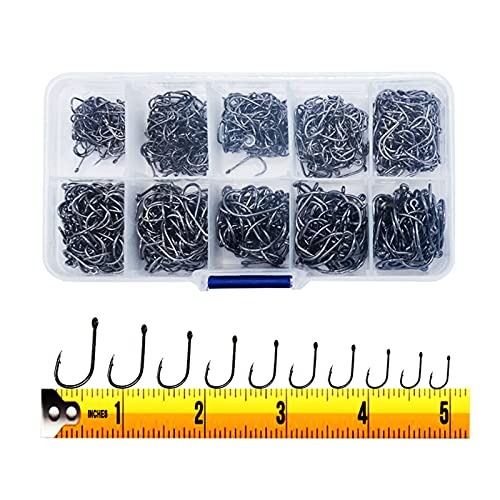
Choosing the right hook size is one of the most important factors in fishing success. A hook too large for the target species won’t fit in the fish’s mouth, while a hook too small risks deep hooking and poor holding during the fight. The hook gap—the distance between the point and the shank—is the critical measurement that determines compatibility with a given fish species.

The fishing hook sizing system is notoriously confusing because it runs in two opposite directions. Numeric sizes (1 through 32) get smaller as the number goes up, while aught sizes (1/0 through 20/0) get larger. The transition point between the two systems is at size 1 (numeric) and 1/0 (aught), with 1/0 being one step larger than size 1.

As a rule of thumb, the hook gap should be 30–40% of the target fish’s mouth width. This ratio provides enough penetration for a solid hookset while minimizing the risk of gut-hooking. Bait type, hook style, and fishing technique all modify this baseline—bulky baits need wider gaps, circle hooks need slightly larger sizes, and finesse techniques favor downsizing.

Related Calculators

Fishing Weight Calculator

Right sinker weight

Trolling Speed Calculator

Optimal trolling pace

Fish Pond Stocking Calculator

Pond stocking rates

Boat Fuel Calculator

Fuel burn and range

Crochet Hook Size Calculator \u2014 Match Yarn to Hook

Find the right crochet hook size for any yarn weight. Converts between US, UK, and metric hook sizes with gauge recommendations for your project type.

Fishing Line Calculator

Calculate recommended fishing line test weight, type, and diameter for your target species and technique. Mono, fluoro, and braid comparison included.

Related Resources

Vegetable Garden Spacing Chart: Plant Spacing Calculator and Yield Guide

Read our guide

Pregnancy Week by Week: Complete Trimester Guide and Fetal Development

Read our guide

Fishing Weight Calculator

Calculate the right sinker weight for your conditions

Trolling Speed Calculator

Dial in trolling speed and lure depth

Fish Pond Stocking Calculator

Calculate stocking rates for your pond

More Marine Calculators

Explore all marine and boating tools

View All

Last Updated: Mar 25, 2026

This calculator is provided for informational and educational purposes only. Results are estimates and should not be considered professional financial, medical, legal, or other advice. Always consult a qualified professional before making important decisions. UseCalcPro is not responsible for any actions taken based on calculator results.

UseCalcPro
FinanceHealthMath

© 2026 UseCalcPro