1Find voltage: 2A through 6Ω
Inputs
Current2 A
Resistance6 Ω
Result
Voltage12.000 V
Power24.000 W
V = I × R = 2 × 6 = 12V. P = V × I = 12 × 2 = 24W.
Voltage
12.000 V
V
12.000 V
P
24.000 W
Voltage
12.000 V
Voltage
12.000 V
Current
2.000 A
Resistance
6.000 Ω
Power
24.000 W
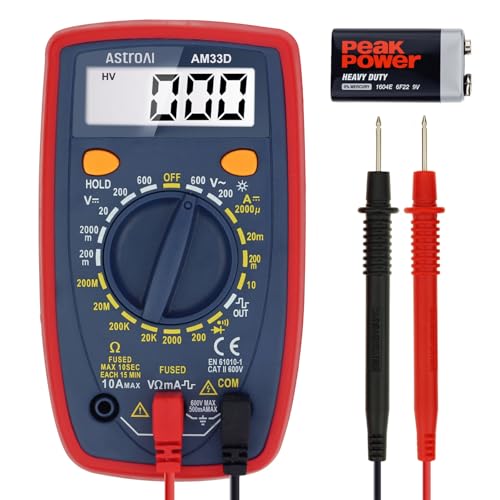
Affiliate link — we may earn a commission at no extra cost to you. Price shown as of the last refresh.


As an Amazon Associate, we earn from qualifying purchases.
Price as of Sep 17, 2026. Product prices and availability are accurate as of the date indicated and are subject to change. Any price and availability information displayed on Amazon at the time of purchase will apply.
Inputs
Result
V = I × R = 2 × 6 = 12V. P = V × I = 12 × 2 = 24W.
Inputs
Result
R = V / I = 5 / 0.02 = 250Ω. P = 5 × 0.02 = 0.1W = 100mW.
Ohm's law states V = I × R: voltage equals current times resistance. Combined with P = V × I, you can solve for any electrical quantity from two knowns.
| Known Values | Formula for V | Formula for I | Formula for R | Formula for P |
|---|---|---|---|---|
| V and I | — | — | V/I | V×I |
| V and R | — | V/R | — | V²/R |
| I and R | I×R | — | — | I²×R |
| P and I | P/I | — | P/I² | — |
Divide voltage by current: R = V / I. For example, 12V across a component drawing 2A means R = 12/2 = 6Ω.
Power (watts) = voltage × current. A 12V supply delivering 2A provides 24W. Power also equals I²R or V²/R.
Ohm's law applies to linear (ohmic) devices like resistors. Non-linear components like diodes, transistors, and LEDs don't follow V=IR directly—they have voltage-current curves instead.
Electronics, outdoor, and everyday tools
Last Updated: Sep 17, 2026
This calculator is provided for informational and educational purposes only. Results are estimates and should not be considered professional financial, medical, legal, or other advice. Always consult a qualified professional before making important decisions. UseCalcPro is not responsible for any actions taken based on calculator results.