1. Calculate
Choose your project scope and see the estimated price range.
Get a realistic 2026 estimate to fix a clothes dryer by symptom, fuel type, brand tier, and age — then compare quotes from local appliance repair pros.
Instant project estimate
The estimate is free. Additional details are optional.
Complete the project details and calculate to see a price range and next steps.
Clear next step
Choose your project scope and see the estimated price range.
Understand the cost drivers and what impacts your final quote.
Carry your scope into a local quote request if you choose.
![[UPGRADED] 279838 Dryer Heating Element for Whirlpool Kenmore Maytag Amana Roper, Dryer Heating Element Parts Include Dryer Thermostat Thermal Fuse, Replaces 2406026 3403585 w10724237](https://m.media-amazon.com/images/I/51KK+2MbciL._SL500_.jpg)
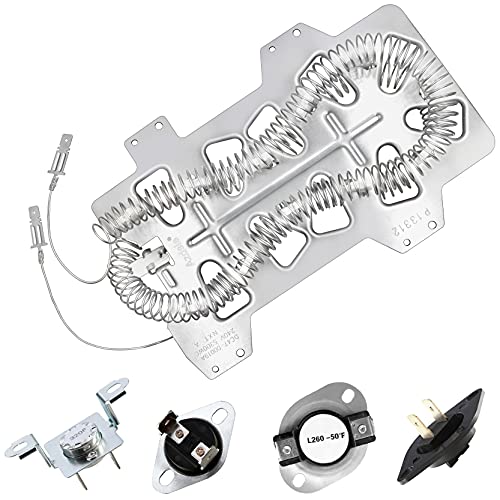

As an Amazon Associate, we earn from qualifying purchases.
Price as of Sep 17, 2026. Product prices and availability are accurate as of the date indicated and are subject to change. Any price and availability information displayed on Amazon at the time of purchase will apply.
Clothes dryer repair costs $130 to $430 total in 2026 for most US households, averaging about $180. A no-heat heating-element fix runs $150-$350, a drum belt $100-$250, and a thermostat $100-$300, plus a $50-$100 diagnostic service call that is often credited toward the repair.
Most US households pay $130 to $430 to repair a dryer in 2026, with the typical bill landing near $180. That total includes a $50 to $100 diagnostic service call (usually credited toward the work), labor of $100 to $200, and the part itself. A simple thermal-fuse or belt swap sits near the floor, while a control board or motor replacement on a premium brand pushes toward the top. Gas dryers generally cost $50 to $100 more than electric because parts are less common and some repairs need a gas-certified technician.
| Repair Type | Typical Cost | Notes |
|---|---|---|
| Thermal fuse | $75-$150 | Common no-heat cause |
| Drum belt | $100-$250 | Causes won't-tumble / squeal |
| Heating element | $150-$350 | Top no-heat repair |
| Motor | $150-$350 | Won't start / hum |
| Control board | $250-$500 | Most expensive common fix |
No heat is the single most common dryer complaint, and it usually traces to one of three parts: a blown thermal fuse ($75-$150), a failed heating element ($150-$350 on electric models), or a bad thermostat ($100-$300). On gas dryers the culprit is often the igniter or gas valve coils, which run $150-$300 installed. A technician tests these in minutes during the diagnostic visit, so the service call almost always pays for itself by pinpointing the exact part instead of guessing.
Use the 50% rule: if the repair costs more than half the price of a comparable new dryer, replacement usually wins, especially on a unit over 10 years old. A new electric dryer runs $450 to $1,500, so a $200 belt or heating-element fix on a 6-year-old machine is clearly worth doing. But a $450 control board on a 12-year-old budget dryer is not — you would spend most of a new unit's price to extend a machine near the end of its 10-to-13-year lifespan. Premium brands like Speed Queen or Miele justify higher repair spending because the machines last far longer.
| Scenario | Repair | Replace |
|---|---|---|
| Belt on 5-yr dryer | $150 — do it | Not worth it |
| Element on 7-yr dryer | $250 — do it | Optional |
| Board on 12-yr budget unit | $450 — skip | Replace |
Appliance repair technicians charge a $50 to $100 diagnostic or service-call fee just to come out and identify the problem. Most companies credit that fee toward the repair if you approve the work, so it is effectively free once you proceed. Labor beyond the diagnosis runs $100 to $200 per visit, billed either flat-rate by repair or at $80 to $150 per hour. Always ask up front whether the service call is waived with the repair and whether the quote is flat-rate or hourly.
Yes. Budget brands (Amana, Roper, GE base models) have cheap, widely stocked parts, so repairs sit at the low end. Mainstream brands (Whirlpool, Maytag, LG, Samsung) are mid-range. Premium and commercial-grade machines (Bosch, Miele, Speed Queen) use proprietary parts that cost more and sometimes require a brand-authorized tech, adding $50 to $200. Age matters too: an older dryer may need a second repair within a year, which is why the 50% rule weighs replacement more heavily once a unit passes 10 years.
Inputs
Result
A no-heat electric dryer on a mainstream brand almost always needs a heating element or thermostat. With the diagnostic credited toward the work, the all-in total lands near the national average of $180-$300.
Inputs
Result
A won't-start gas dryer can mean a motor, switch, or control board. Premium proprietary parts plus gas-certified labor push the total up, and at 10+ years the 50% rule starts to favor replacement.
Inputs
Result
Squealing on a young budget dryer is almost always a worn drum belt or idler. Cheap, stocked parts and a young machine make this an easy keep-it repair near the bottom of the range.
Total = Service call + Labor + Part cost; service call often credited if you approve the workA dryer repair bill is the diagnostic service call, plus labor to install, plus the part itself. Most shops credit the service call toward the repair, so start from the part-plus-labor figure and add the call only if you decline the work.
Where:
Service call= Diagnostic / trip fee, $50-$100, usually credited toward the repair if approvedLabor= $100-$200 per visit, or $80-$150 per hour, on top of the diagnosisPart cost= Belt $10-$70, heating element $40-$120, control board $130-$400 for the part aloneFuel / brand adjust= Gas adds $50-$100; premium proprietary parts add $50-$200Replace if Repair cost > 0.5 x New dryer price, especially when age > 10 yearsCompare the quoted repair to half the price of a comparable new dryer. If the fix exceeds that threshold and the machine is past 10 years, replacement usually beats repair over the remaining lifespan.
Where:
Repair cost= The all-in quote: service call + labor + partNew dryer price= Electric $450-$1,500; gas $500-$1,700 installed0.5 threshold= Industry rule of thumb — repairs above half of new price rarely pay offAge= Average dryer lifespan is 10-13 years; older units face repeat repairsWhen a clothes dryer quits, the first question is always the same: is this a $150 fix or a $450 one? In 2026 the honest answer for most US households is somewhere in between — the typical repair runs $130 to $430 all-in, with the national average landing right around $180. That figure bundles three things: the diagnostic service call, the labor to install, and the part itself. Knowing how those three pieces add up is the difference between approving a fair quote and overpaying for a guess.
The biggest swing factor is which part failed. A blown thermal fuse or a worn drum belt sits near the floor at $75 to $250, because the parts are cheap and the labor is quick. A heating element, thermostat, or motor lands in the middle at $100 to $350. A control board — the dryer's computer — is the most expensive common repair at $250 to $500, and on an older machine that single line item is often what tips the decision toward replacement. Use the calculator above to estimate your specific symptom, fuel type, and brand, then read on to understand what each input is really pricing.
Two structural costs apply to almost every job. The diagnostic or service call runs $50 to $100 just to send a technician out, and the good news is that most shops credit that fee toward the repair if you approve the work — so it is effectively free once you proceed. Labor beyond the diagnosis adds $100 to $200 per visit, billed either flat-rate by repair or at $80 to $150 per hour. When you compare two quotes, confirm whether the service call is waived and whether the price is flat-rate, because those two details can swing the real total by a hundred dollars.
| Repair | Part Alone | Total Installed | Common Symptom |
|---|---|---|---|
| Thermal fuse | $5-$30 | $75-$150 | No heat |
| Drum belt | $10-$70 | $100-$250 | Won't tumble / squeal |
| Thermostat | $10-$60 | $100-$300 | No heat / runs cold |
| Heating element | $40-$120 | $150-$350 | No heat (electric) |
| Motor | $50-$200 | $150-$350 | Won't start / hum |
| Control board | $130-$400 | $250-$500 | No power / erratic |
The service call is not wasted money. A technician can test the heating element, thermostat, and thermal fuse in minutes, so the $50-$100 diagnostic almost always pays for itself by pinpointing the exact part instead of replacing the wrong one.
Two households with the same broken dryer can get quotes that differ by a hundred dollars or more, and the variance is rarely random. The shop prices from the failed part, then adjusts for fuel type, brand, your region's labor rate, and how the symptom maps to a repair. Read every quote against the list below — if a technician cannot connect your symptom to a specific part and price, the number is a placeholder that will move once they open the cabinet.
Fuel type is the cleanest example. Gas dryers cost $50 to $100 more to repair than electric ones because gas-specific parts like igniters and valve coils are less common, and some jobs require a gas-certified technician. Brand is the next lever: budget machines use cheap, widely stocked parts, while premium and commercial units use proprietary components that add $50 to $200 and sometimes force a brand-authorized service call.
Before paying for any heating repair, rule out a clogged vent. Restricted airflow makes a perfectly good dryer run cold or shut off on a thermal limit — a $100-$200 vent cleaning can save you a needless $300 parts bill.
Every dryer repair starts with a symptom, and the symptom narrows the likely part — which is exactly what the calculator above uses to estimate your range. No heat is the most common complaint and usually traces to a thermal fuse, heating element, or thermostat on electric models, or an igniter and valve coils on gas. A dryer that won't start points to the door switch, thermal fuse, start switch, or motor. Loud squealing or grinding is almost always a worn drum belt, idler pulley, or support rollers. A drum that won't tumble is the belt or motor, and a machine that takes too long or runs cold is frequently a venting or airflow problem rather than a failed part at all.
That last case is worth dwelling on, because it is where homeowners waste the most money. A dryer that suddenly takes two cycles to dry a load often has a lint-clogged vent, not a broken heating element. Restricted airflow trips the high-limit thermostat and makes the machine cycle cold. Cleaning the vent — see the dryer vent cleaning cost calculator — is far cheaper than a heating repair and is the first thing a good technician checks. It is also a safety issue: clogged vents are a leading cause of dryer fires.
Matching symptom to part also lets you sanity-check a quote. If a technician says your no-heat electric dryer needs a $450 control board, that is a red flag — no-heat is rarely a board failure, and you should ask why the cheaper thermal fuse and element were ruled out. The table below maps the five most common symptoms to their usual culprits and installed cost so you can walk into the conversation knowing roughly what you should be paying.
| Symptom | Likely Part(s) | Typical Installed Cost |
|---|---|---|
| No heat / not drying | Thermal fuse, element, thermostat | $75-$350 |
| Won't start / no power | Door switch, start switch, motor | $100-$350 |
| Loud noise / squealing | Belt, idler pulley, rollers | $100-$250 |
| Drum won't tumble | Drum belt, motor | $100-$350 |
| Takes too long / runs cold | Vent cleaning, thermostat | $100-$300 |
Match the quote to the symptom. No-heat is almost never a control-board failure, and a won't-start is rarely the heating element — if the diagnosis does not fit the symptom, get a second opinion before approving the work.
Once you have a quote, the next decision is whether to spend it at all. The standard guideline is the 50% rule: if the repair costs more than half the price of a comparable new dryer, replacement usually wins. A new electric dryer runs $450 to $1,500 installed and a gas model $500 to $1,700, so the break-even point on a mid-range machine sits around $300 to $500. A $200 belt or heating-element fix is an easy yes; a $450 control board on a budget unit is a hard no.
Age tightens the math. The average dryer lasts 10 to 13 years, so a repair on a 5-year-old machine buys you most of a second life and is almost always worth it. A repair on a 12-year-old machine buys you maybe a year or two before the next failure, which is why the same dollar amount can be smart on a young dryer and wasteful on an old one. If you do decide to replace, factor in hauling away the old unit — the junk removal service cost calculator prices that disposal, and many delivery services will take the old dryer for a small fee.
Brand quality is the final wrinkle. A premium or commercial-grade machine like a Speed Queen or Miele is built to run 20-plus years, so spending $400 on a repair makes sense in a way it never would on a $450 builder-grade unit. If you are weighing a replacement against another big-ticket appliance decision, the water heater install cost calculator walks the same repair-versus-replace logic for your water heater.
The cheapest dryer repair is the one done right the first time, so vet the technician on transparency, not just headline price. Get the diagnosis in writing with the specific part named, the part cost separated from labor, and a clear statement of whether the service call is credited toward the work. A quote that is dramatically lower than the others often excludes the trip fee or assumes the easiest possible part — the gap reappears once the cabinet is open.
Ask about flat-rate versus hourly billing before the visit. Flat-rate pricing by repair protects you from a slow technician, while hourly billing at $80 to $150 an hour can balloon on a stubborn job. Confirm the shop warranties both parts and labor — 90 days on labor and a year on parts is standard — and check that they service your brand, especially for gas or premium units that need a certified or authorized tech. The steps below put the hiring decision in order.
Finally, do the cheap diagnostics yourself before the tech arrives. Clean the lint screen and the vent, confirm the outlet has power and the breaker has not tripped, and make sure the door latches. These five-minute checks resolve a surprising share of no-heat and won't-start complaints and can save you the entire service call. When you do book a pro, comparing two or three written quotes with the same scope is the single most reliable way to land a fair 2026 price.
Never approve a repair that exceeds half the price of a new dryer on a machine over 10 years old. The $100 you save fixing it once is usually erased by the next failure — replacement buys a fresh warranty and a full lifespan instead.
Run the free checks first
Clean the lint screen and vent, confirm power and the breaker, and check the door latch before booking anyone.
Describe the exact symptom
Tell the shop whether it is no-heat, won't-start, noise, or slow drying so they bring the likely parts.
Get the quote in writing
Insist on the named part, part cost split from labor, and whether the service call is credited.
Confirm flat-rate vs hourly
Prefer flat-rate by repair; if hourly, ask for an estimated cap before work begins.
Check the warranty and brand fit
Look for 90-day labor / 1-year parts coverage and confirm they service gas or premium brands.
Read our guide
Read our guide
Read our guide
Price appliance repairs, installations, and home projects, then compare quotes from local pros before you commit.
Last Updated: Sep 17, 2026
This calculator is provided for informational and educational purposes only. Results are estimates and should not be considered professional financial, medical, legal, or other advice. Always consult a qualified professional before making important decisions. UseCalcPro is not responsible for any actions taken based on calculator results.