UseCalcPro
Home
MathFinanceHealthConstructionAutoPetsGardenCraftsFood & BrewingTools
Blog
  1. Home
  2. Food & Brewing

Rennet Dosing Calculator — Amount by Milk Volume, pH & Cheese Type

Get the precise rennet dose for your milk volume, pH, and target cheese style

Rennet

1.20 ml

Drops

24

Set

40 min

Rennet Dose

1.20
ml (24 drops)
Dilute Water

24 ml

Set Time

40 min

What You'll Need

Standing Stone Farms Ultimate Cheese & Butter Making Kit

Standing Stone Farms Ultimate Cheese & Butter Making Kit

$45-$604.4
View on Amazon
Lehman's Stainless Steel Cheese Press

Lehman's Stainless Steel Cheese Press

$80-$1204.3
View on Amazon
Cheese Molds Set of 4 Rectangular Draining Baskets

Cheese Molds Set of 4 Rectangular Draining Baskets

$15-$254.5
View on Amazon
Standing Stone Farms Ultimate Cheese & Butter Making Kit

Standing Stone Farms Ultimate Cheese & Butter Making Kit

$45-$604.4
View on Amazon
Lehman's Stainless Steel Cheese Press

Lehman's Stainless Steel Cheese Press

$80-$1204.3
View on Amazon
Cheese Molds Set of 4 Rectangular Draining Baskets

Cheese Molds Set of 4 Rectangular Draining Baskets

$15-$254.5
View on Amazon

As an Amazon Associate, we earn from qualifying purchases.

Example Calculations

12 Gallons, Semi-Hard Cheese, pH 6.5

Inputs

Milk2 gallons
RennetSingle Strength Liquid
CheeseSemi-Hard
pH6.5

Result

Rennet Dose1.20 ml
Drops24
Dilute Water24 ml
Set Time40 min

Base = 2 gal × 0.5 ml/gal = 1.0 ml. Semi-hard factor = 1.2. pH 6.5 is in normal range (1.0x). Dose = 1.0 × 1.2 × 1.0 = 1.20 ml. Drops = 1.20 × 20 = 24.

25 Gallons, Soft Cheese, pH 6.1

Inputs

Milk5 gallons
RennetVegetable Rennet
CheeseSoft
pH6.1

Result

Rennet Dose2.04 ml
Drops41
Set Time60 min

Base = 5 × 0.6 ml/gal (veg) = 3.0 ml. Soft factor = 0.8. pH 6.1 factor = 0.85. Dose = 3.0 × 0.8 × 0.85 = 2.04 ml.

Frequently Asked Questions

Q

How much rennet do I need per gallon of milk?

For single-strength liquid rennet, use about 0.5 ml per gallon for semi-soft cheeses and up to 0.75 ml per gallon for hard cheeses. Double-strength rennet uses half that amount. The exact dose varies with cheese style, milk pH, and rennet type.

  • Single-strength liquid: 0.5 ml/gal for soft, 0.75 ml/gal for hard
  • Double-strength liquid: 0.25 ml/gal for soft, 0.375 ml/gal for hard
  • Tablet rennet: 1 tablet per 5 gallons (approximate)
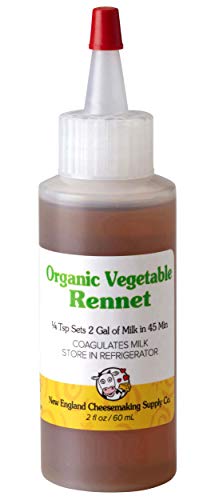
  • Vegetable rennet: 0.6 ml/gal (slightly more than animal rennet)
Rennet TypeDose/GallonStrengthBest For
Single Liquid0.5 ml1xAll cheeses
Double Liquid0.25 ml2xLarge batches
Tablet1 tab/5 galVariesBeginners
Vegetable0.6 ml1xVegetarian cheese
Q

Does milk pH affect rennet dosing?

Yes. Lower pH (more acidic) milk requires less rennet because acid helps coagulation. At pH 6.2 or below, reduce rennet by 15%. At pH 6.6 or above, increase by 15%. Most cultured milk reaches pH 6.3–6.5 before rennet addition.

  • pH below 6.2: reduce rennet by 15% (acid assists coagulation)
  • pH 6.2–6.6: standard dose (no adjustment needed)
  • pH above 6.6: increase rennet by 15% (needs more coagulant)
  • Always check pH after culture ripening, before adding rennet
Q

How long should I wait for rennet to set?

Set time varies by cheese type: 35–40 minutes for hard cheeses, 45 minutes for semi-soft, and 60 minutes for soft cheeses. Check for a clean break by inserting a knife at 45 degrees — the curd should split cleanly with clear whey filling the cut.

  • Hard cheese (Parmesan): 35 min set time
  • Semi-hard (Cheddar): 40 min set time
  • Semi-soft (Gouda): 45 min set time
  • Soft (Brie): 60 min set time
  • Clean break test: knife cut shows clear whey, not milky
Q

Should I dilute rennet before adding to milk?

Always dilute rennet in 20x its volume of cool, non-chlorinated water before adding to milk. This ensures even distribution throughout the pot. Chlorinated water deactivates rennet — use distilled, spring, or filtered water.

  • Dilute rennet in 20x its volume of cool water
  • Use non-chlorinated water (chlorine kills rennet)
  • Stir diluted rennet into milk for exactly 1 minute
  • Stop stirring and do not disturb during set time

Related Calculators

Cheese Making Calculator

Full cheese making guide

Cheese Brine Calculator

Brine for aging cheese

Cheese Aging Calculator

Aging time and conditions

Yogurt Starter Calculator \u2014 Culture Ratio & Incubation Guide

Calculate the exact amount of yogurt starter culture per quart of milk. Get incubation time, temperature, and culture-to-milk ratios for homemade yogurt.

Cream Cheese Calculator \u2014 Milk, Culture & Yield Estimator

Calculate milk, culture, acid, and salt needed for homemade cream cheese. Get yield estimates by milk type with step-by-step culturing and timing guidance.

Ricotta Calculator \u2014 Milk or Whey to Ricotta Yield Estimator

Calculate the acid, salt, and yield for homemade ricotta cheese from whole milk or leftover whey. Covers lemon juice, vinegar, and citric acid methods.

Related Resources

Protein Calculator: How Much Protein Do You Need Per Day?

Read our guide

How Much Paint Do I Need for a Room? Complete Calculator Guide

Read our guide

Protein Intake Guide: How Much Protein Do You Really Need?

Read our guide

Cheese Making Calculator

Full cheese recipes with milk and culture amounts

Cheese Brine Calculator

Salt brine ratios for aging cheese

Cheese Aging Calculator

Aging time and conditions by cheese type

More Food & Cooking Calculators

Explore all our free food, baking, and brewing calculators

View All Food Calculators

Last Updated: Mar 19, 2026

This calculator is provided for informational and educational purposes only. Results are estimates and should not be considered professional financial, medical, legal, or other advice. Always consult a qualified professional before making important decisions. UseCalcPro is not responsible for any actions taken based on calculator results.

UseCalcPro
FinanceHealthMath

© 2026 UseCalcPro