UseCalcPro
Home
MathFinanceHealthConstructionAutoPetsGardenCraftsFood & BrewingTools
Blog
  1. Home
  2. Garden

Bat House Calculator

Design the right bat house for your property with proper dimensions, chamber count, and placement

Bat House Size

20×28×5"

Chambers

4

Facing

South-Southeast

Height

12–15 ft

Dimensions

20×28×5"

Chambers

4

Orientation

South-Southeast (170°)

Mount Height

12–15 ft

Color: Medium brown

Balances heat absorption and reflection for 80–100°F range

Good sun exposure for bat house success

Estimated Insect Reduction

Mosquitoes/Night$50,000

A single bat can eat 1,000+ mosquitoes per hour

Example Calculations

1Backyard Mosquito Control (2-Chamber)

Inputs

Property Size0.25 acres
Pest PriorityMosquitoes
Climate ZoneTemperate
Mounting SurfaceHouse wall

Result

Recommended House2-Chamber (16×24 in)
Bat Capacity50–100 bats
Mounting Height15 feet
Facing DirectionSouth/Southeast

A quarter-acre yard benefits from a 2-chamber house supporting 50–100 bats. This colony can consume 50,000+ insects per night, providing solid mosquito reduction.

2Farm Pest Management (Rocket Box)

Inputs

Property Size5 acres
Pest PriorityCrop pests & mosquitoes
Climate ZoneWarm
Mounting SurfacePole

Result

Recommended House4-Chamber Rocket Box (24×24 in)
Bat Capacity100–200 bats
Mounting Height18–20 feet
Number Recommended2 houses

A 5-acre farm benefits from two 4-chamber rocket boxes placed 200+ feet apart. Two colonies of 100–200 bats each can consume 200,000+ crop pests nightly.

Frequently Asked Questions

Q

What size bat house do I need?

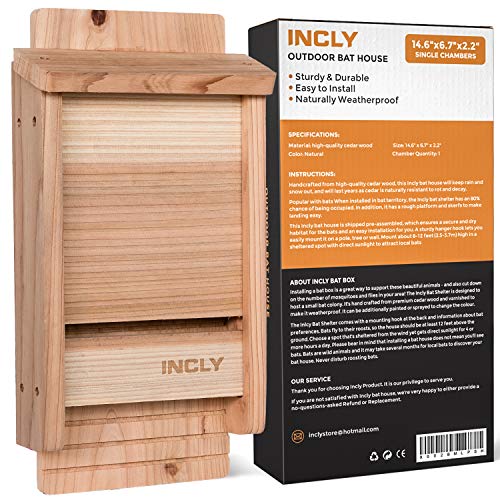
A standard single-chamber bat house is 24 inches tall, 14 inches wide, and 3.5 inches deep, holding 25–50 bats. Multi-chamber rocket boxes (4 chambers) hold 100–200 bats. For effective mosquito control, a 4-chamber house is recommended since a single bat eats 1,000+ insects per night.

  • Single chamber (14×24 in): holds 25–50 bats – good for small yards
  • Two-chamber (16×24 in): holds 50–100 bats – moderate pest control
  • Four-chamber rocket box (24×24 in): holds 100–200 bats – best mosquito control
  • Nursery houses (24×32 in): holds 200–300 bats for maternity colonies
  • Minimum chamber gap: 0.75 inches (3/4 in) for most North American species
House TypeDimensionsBat Capacity
Single chamber14×24×3.5 in25–50 bats
Two chamber16×24×5 in50–100 bats
Four-chamber rocket24×24×7 in100–200 bats
Nursery colony24×32×7 in200–300 bats
Q

How high should I mount a bat house?

Mount bat houses 12–20 feet above ground for best occupancy rates. Bat Conservation International research shows houses mounted at 15+ feet have 2–3× higher occupancy than those under 10 feet. South- or southeast-facing walls and poles work best.

  • Minimum height: 10 feet – but occupancy rates are much lower
  • Optimal height: 15–20 feet for highest occupancy
  • Mounting on buildings: 2× more likely to be occupied than tree-mounted
  • Pole-mounted: use a 4×4 or 4×6 treated post with predator guard
  • Face south to southeast for 6–10 hours of direct sun in northern climates
Mounting LocationOccupancy RateBest Height
Building wall50–70%15–20 ft
Wooden pole40–60%15–20 ft
Tree trunk20–30%12–15 ft
Q

How many insects does a bat house eliminate?

A single bat eats 1,000–1,200 insects per night, including mosquitoes, moths, and beetles. A 100-bat colony can consume 70,000+ insects nightly. Studies show properties with bat houses see 30–50% fewer mosquitoes during summer months.

  • One bat: 1,000–1,200 insects per night (up to 6,000 for big brown bats)
  • 50-bat colony: 50,000+ insects per night
  • 200-bat colony: 200,000+ insects per night
  • Primary prey: mosquitoes, moths, beetles, and agricultural pests
  • Farms with bat houses report 20–40% less crop pest damage
Colony SizeInsects/NightCoverage Area
25 bats25,000–30,000Small yard
100 bats100,000–120,0001–2 acres
200 bats200,000–240,0003–5 acres
Q

How long does it take bats to find a new bat house?

Bats typically discover and occupy a new bat house within 1–2 years. About 35% of houses are occupied in the first year, 60% by the second year, and 80% by the third year. Proper placement (sunny, 15+ ft high, near water) dramatically speeds colonization.

  • Year 1: about 35% of properly placed houses get occupants
  • Year 2: cumulative 60% occupancy rate
  • Year 3+: 80% or higher with correct placement
  • Near water (within 1/4 mile): 2.5× faster colonization
  • Never use chemicals or attractants inside – bats find houses by echolocation
FactorTime to OccupancySuccess Rate
Ideal placement6–12 months70–80%
Good placement1–2 years50–60%
Poor placement3+ years or never10–20%

Related Calculators

Bird Feeder Calculator

Calculate bird feeder sizing and seed amounts

Pollinator Garden Calculator

Plan a pollinator-friendly garden layout

Companion Planting Calculator

Plan companion planting combinations

Garden Fence Calculator

Estimate fencing materials and costs

Worm Bin Calculator — Size & Setup

Size your worm bin by household waste output and worm species. Get worm count, bin dimensions, bedding weight, monthly compost output, and startup costs.

Seed Spacing Calculator

Plan your garden layout with correct plant and row spacing. Enter bed dimensions and crop type to get exact plant counts, row counts, and seed quantities.

Related Resources

Vegetable Garden Spacing Chart: Plant Spacing Calculator and Yield Guide

Read our guide

Composting for Beginners: C:N Ratios, Methods & Calculator Guide

Read our guide

Garden Watering Calculator: How Much Water Does Your Garden Really Need?

Read our guide

Bird Feeder Calculator

Pollinator Garden Calculator

Garden Fence Calculator

Explore Garden Calculators

Tools for garden planning, wildlife habitat, fencing, soil, and landscape projects.

View All Garden Calculators

Last Updated: Mar 9, 2026

This calculator is provided for informational and educational purposes only. Results are estimates and should not be considered professional financial, medical, legal, or other advice. Always consult a qualified professional before making important decisions. UseCalcPro is not responsible for any actions taken based on calculator results.

UseCalcPro
FinanceHealthMath

© 2026 UseCalcPro