1. Calculate
Choose your project scope and see the estimated price range.
Get a realistic 2026 chimney sweep and inspection estimate by service level, creosote buildup, and chimney type — then connect with CSIA-certified sweeps near you.
Instant project estimate
The estimate is free. Additional details are optional.
Complete the project details and calculate to see a price range and next steps.
Clear next step
Choose your project scope and see the estimated price range.
Understand the cost drivers and what impacts your final quote.
Carry your scope into a local quote request if you choose.

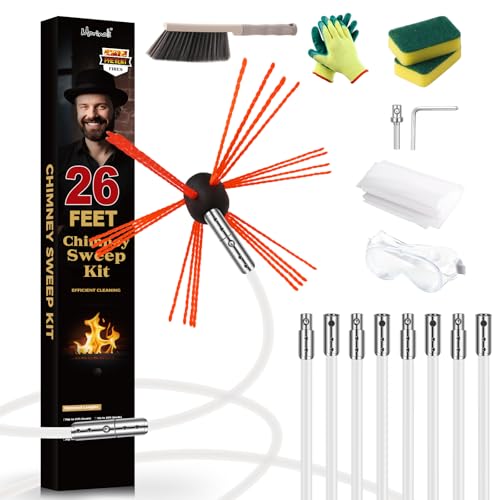

As an Amazon Associate, we earn from qualifying purchases.
Price as of Sep 18, 2026. Product prices and availability are accurate as of the date indicated and are subject to change. Any price and availability information displayed on Amazon at the time of purchase will apply.
A standard chimney sweep plus Level 1 inspection runs $200–$350 for most homes in 2026, with a national average near $272. A basic sweep alone (no inspection) costs $133–$200, while a deep clean for heavy creosote buildup typically runs $300–$500. The full range across all service types and regions spans roughly $133–$390.
| Service | Typical Low | Typical High |
|---|---|---|
| Basic sweep only | $133 | $200 |
| Sweep + Level 1 inspection | $200 | $350 |
| Deep clean (heavy creosote) | $300 | $500 |
| Level 2 camera inspection | $300 | $600 |
Level 1 is a visual check of accessible areas included with most annual sweeps ($0–$50 add-on). Level 2 adds a video camera scan of the flue interior and is required when selling a home, after a chimney fire, or after an earthquake ($100–$200 extra). Level 3 is a destructive inspection that involves opening walls or removing components — it is ordered only when Levels 1 and 2 find evidence of serious hidden damage, and typically costs $1,000+.
| Level | Scope | When Required | Typical Cost Add-On |
|---|---|---|---|
| Level 1 | Visual, accessible | Annual maintenance | Included–$50 |
| Level 2 | Camera scan of flue | Selling home, post-fire | $100–$200 |
| Level 3 | Destructive, walls opened | Hidden damage suspected | $1,000+ |
The National Fire Protection Association (NFPA 211) recommends a chimney inspection at least once a year and sweeping as needed based on use. As a rule of thumb: sweep annually if you burn one cord or more of wood per season, or if your fireplace or wood stove is your primary heat source. Light users (fewer than 20 fires per year) can stretch to every two years, but should still get the annual Level 1 visual inspection.
Creosote is a flammable tar-like residue that condenses in the flue when wood smoke cools. It accumulates in three degrees: first-degree (flaky, easy to brush) adds no extra cost; second-degree (crunchy tar) typically adds 20% for longer brushing time; third-degree (glazed, hardened) can add 50% or more because it requires chemical treatment between passes and sometimes a rotary power sweep system that sweeps charge $300–$600 separately.
No. A chimney sweep cleans soot and creosote from the flue and performs a visual or camera inspection. Chimney repair covers structural work: repairing cracked mortar (tuckpointing), replacing a deteriorated liner, rebuilding the firebox, or fixing a leaning chimney crown. Repair costs start at $150 for minor tuckpointing and can reach $10,000+ for a full liner replacement or chimney rebuild. Always get a sweep and inspection first to see whether repair is needed.
| Service Category | What It Covers | Typical Cost |
|---|---|---|
| Sweep & Inspection | Cleaning + visual/camera | $133–$500 |
| Tuckpointing | Mortar joint repair | $300–$2,500 |
| Liner replacement | Stainless steel liner | $2,500–$7,000 |
| Firebox rebuild | Firebox brick/mortar | $1,500–$4,000 |
Yes — the Chimney Safety Institute of America (CSIA) certification is the industry gold standard. CSIA-certified sweeps pass written exams, carry liability insurance, and must renew every three years. They typically charge 10–20% more than uncertified sweeps, but are far less likely to miss a cracked liner or underestimate creosote degree. For a Level 2 inspection tied to a real estate sale, most insurers require a CSIA- or NFI-certified technician.
Inputs
Result
This is the most common chimney sweep scenario in the US. Scheduling in late summer before heating season locks in lower rates and your choice of CSIA-certified sweeps.
Inputs
Result
Third-degree glazed creosote requires chemical treatment between power-sweep passes, significantly raising labor time. Northeastern labor rates add another 15–25%. This scenario ($562–$937 mid-calc) is common in homes where wood is the primary heat source and the chimney was neglected for several seasons.
Inputs
Result
Prefab metal chimneys are shorter and easier to access than masonry, and Southern labor rates sit below the national average. Without an inspection, this is the floor for a professional cleaning — add a Level 1 visual for $20–50 and get peace of mind for the season.
Total = Base(service_level) × Buildup_multiplier × Type_multiplier × Inspection_multiplierThe base cost is set by service level (sweep only, sweep+inspection, or deep clean). Each additional factor — creosote buildup, chimney type, and inspection depth — applies a multiplicative adjustment.
Where:
Base(service_level)= Basic sweep: $133–$200; Sweep+Level 1 inspection: $200–$350; Deep clean: $300–$500Buildup_multiplier= Light: 1.0; Moderate: 1.2; Heavy creosote: 1.5Type_multiplier= Masonry: 1.0; Prefab/metal: 0.85 (shorter, easier access)Inspection_multiplier= None: 0.9; Level 1 visual: 1.0; Level 2 camera: 1.25Effective cost = Standard quote × (1 + Creosote_premium)Heavy third-degree creosote requires chemical treatment (e.g., Poultice Creosote Remover) applied before and after mechanical brushing, effectively doubling labor time and requiring a re-sweep. The premium compounds with inspection level.
Where:
Light (1st degree)= Flaky, brushes out — 0% premiumModerate (2nd degree)= Crunchy tar, longer brushing — +20% premiumHeavy (3rd degree)= Glazed, chemical treatment needed — +50% premiumThe most common scenario — a sweep plus Level 1 visual inspection on a masonry fireplace with light annual creosote — runs $200–$350 in most US markets. That range reflects pricing aggregated from CSIA-certified sweeps, HomeAdvisor/Angi data, and regional contractor surveys. The national average across all chimney types and service levels is approximately $272, though the spread is wide: a basic sweep on a prefab metal chimney with no inspection in a Southern market can run as low as $100, while a deep clean with Level 2 video camera inspection in a Northeast metro can reach $940 or more.
The three primary levers are service level (what work is done), creosote buildup (how hard the work is), and chimney type (masonry vs prefab). Regional labor rates add a secondary adjustment of roughly −15% in the South to +25% in coastal metros. The table below shows how each service tier stacks up before buildup and regional adjustments.
| Service Level | Typical Low | Typical High | Best For |
|---|---|---|---|
| Basic sweep only | $133 | $200 | Light users, prefab chimneys |
| Sweep + Level 1 inspection | $200 | $350 | Annual maintenance, most homeowners |
| Deep clean (heavy creosote) | $300 | $500 | Neglected chimneys, primary heat source |
| Sweep + Level 2 inspection | $300 | $600 | Home sales, post-fire or earthquake |
Schedule in late summer (July–September) to avoid the October–November price surge. Off-peak scheduling typically saves 15–25% and guarantees you get a CSIA-certified sweep on your preferred date.
A chimney sweep quote is not arbitrary — it breaks into four clear drivers that any certified sweep can explain line by line. Understanding them lets you compare bids intelligently and avoid paying for services you do not need.
Creosote is the single biggest variable in a chimney sweep quote. It condenses from wood smoke when flue temperatures drop below 250°F — the result of slow-burning fires, unseasoned wet wood, or a flue that is too large for the insert. It builds up in three stages, each requiring more labor and equipment than the last.
First-degree creosote is the fine, flaky black dust that brushes out easily with a standard rotary brush in 30–45 minutes. Second-degree is a tar-like crunchy layer that has partially solidified; it requires longer brushing passes and a stiffer brush, adding 15–30 minutes of labor and typically 20% to the quote. Third-degree is fully glazed and hardened — it resists mechanical brushing and must be treated with a chemical solvent like Poultice Creosote Remover (PCR), left to cure 24–48 hours, and then re-swept in a second visit. That two-visit process can add 40–60% over the base price.
The best prevention: burn only seasoned hardwood (moisture content below 20%), build hot fires rather than smoldering ones, and have your chimney swept before every heating season. A $250 annual sweep prevents a $2,500 liner replacement.
The inspection level choice has the biggest impact on price after service level itself. Level 1 is a visual check of all accessible areas — the firebox, damper, visible flue interior, and the exterior crown and cap. It is included in most standard sweep packages at no extra charge or for a $25–50 add-on, and it is sufficient for homeowners who have been using the chimney regularly without issues.
Level 2 requires a camera to scan the full interior of the flue from bottom to top. NFPA 211 mandates Level 2 whenever there has been a change of ownership, after any chimney fire or seismic event, or when a liner change is being considered. Real estate transactions are the most common trigger — a buyer’s inspector will often call for it, and having it done proactively can prevent the sale from stalling over a flagged chimney. Budget $100–$200 extra for Level 2 over the sweep price, or $300–$600 for Level 2 alone without a full sweep.
The most common cost confusion homeowners face is conflating chimney cleaning with chimney repair. A sweep removes combustion byproducts and checks condition. Repair covers anything structural: repointing deteriorated mortar joints (tuckpointing, $300–$2,500), replacing a cracked or missing liner ($2,500–$7,000 for stainless steel), rebuilding a damaged firebox ($1,500–$4,000), or restoring a spalling chimney crown ($200–$1,500).
The sweep is often what reveals the need for repair. A Level 1 or Level 2 inspection finding a cracked tile liner or deteriorating mortar will generate a separate repair estimate. Do not let a sweep company quote both the cleaning and the repair on the first visit without getting a second opinion on the repair scope — because sweeps have a financial incentive to find repair-level problems, it is worth having a second CSIA sweep confirm the diagnosis before authorizing $3,000+ in liner work.
Timing is the easiest lever. The sweep industry follows a clear seasonal demand curve: low demand from April through August, then surging demand in September through November as homeowners prepare for heating season. Scheduling in July or August typically saves 15–25% compared to calling in October. Some CSIA sweeps offer a direct discount for off-season bookings; others simply have immediate availability instead of 3–4 week wait times.
Bundling is the second lever. Many sweeps also clean dryer vents or gutters, and offer combo discounts of $30–60 when multiple services are done on the same visit. The dryer vent cleaning market overlaps significantly with the chimney sweep market — both are combustion-safety services performed by technicians with the same access equipment — and the marginal time for a sweep to run a dryer vent line while already on your property is small.
Read our guide
Read our guide
Read our guide
Estimate costs for chimney repair, roofing, gutters, siding, and dozens of other home maintenance and remodeling projects.
Last Updated: Sep 18, 2026
This calculator is provided for informational and educational purposes only. Results are estimates and should not be considered professional financial, medical, legal, or other advice. Always consult a qualified professional before making important decisions. UseCalcPro is not responsible for any actions taken based on calculator results.