UseCalcPro
Home
MathFinanceHealthConstructionAutoPetsGardenCraftsFood & BrewingTools
Blog
  1. Home
  2. Crafts

Jewelry Casting Calculator — Lost-Wax Metal Weight & Cost

Convert wax model weight to metal weight, estimate material costs, and plan your burnout cycle

Metal per Piece

53.4 g

Total Batch

66.8 g

Metal Cost

$66.75

Weigh your carved or 3D-printed wax on a gram scale

Metal Required

53.4 g
per piece (Sterling Silver)
Total Batch
66.8 g
1 piece + sprues
Metal Cost
$66.75
$1/g

Weight Breakdown (per piece)

Net metal (piece)
53.40 g
Sprue allowance
13.35 g
Total per piece66.75 g

Wax-to-Metal Conversion (5 g wax)

MetalFactorWeightCost
Sterling Silver×10.753.4 g$53.40
14K Yellow Gold×13.567.4 g$2,560.10
18K Yellow Gold×16.180.3 g$4,176.08
14K White Gold×14.472.2 g$2,742.27
Brass×8.843.8 g$0.88
Bronze×9.145.4 g$1.36
Copper×9.246.2 g$0.46
Pewter×7.537.6 g$1.88

Metal Cost Comparison (5 g wax)

Pewter$1.88
Brass$0.88
Bronze$1.36
Copper$0.46
Sterling Silver$53.40
14K Yellow Gold$2,560.10
18K Yellow Gold$4,176.08

Investment (Plaster)

Flask volume322 cm³
Investment powder281 g
Water112 mL

Burnout Schedule

1
300°F (150°C)2 hours
Wax elimination
2
700°F (370°C)2 hours
Carbon burnout
3
1350°F (730°C)2–3 hours
Flask heat soak
4
1000°FHold until pour
Cool to casting temp (Sterling Silver)

Casting Tips

Degas investment: Vacuum or vibrate mixed investment for 60–90 seconds to remove air bubbles that cause surface pitting.
Centrifugal vs vacuum: Centrifugal casting forces metal into fine details. Vacuum casting pulls metal gently—better for delicate filigree.
Pickle solution: After casting, quench in water and soak in warm pickle (sodium bisulfate) for 10–30 minutes to remove oxides.
Never cast wet: A wet flask causes steam explosions. Complete the full burnout cycle and verify the flask is dry before pouring metal.

Example Calculations

1Sterling Silver Ring (5 g wax, standard sprue)

Inputs

Wax Model Weight5 g
Target MetalSterling Silver (10.36 g/cm³)
Pieces1
Sprue FactorStandard (25%)

Result

Metal per Piece53.4 g
Sprue Allowance13.4 g
Total Metal Needed66.8 g
Metal Cost$66.75
Conversion Factor×10.7

A 5 g wax ring cast in sterling silver weighs 53.4 g. With 25% sprue allowance, you need 66.8 g of silver for the pour. Sprue metal is recovered after cutting.

214K Gold Earring Pair (2 g wax each, minimal sprue)

Inputs

Wax Model Weight2 g
Target Metal14K Yellow Gold (13.07 g/cm³)
Pieces2
Sprue FactorMinimal (15%)

Result

Metal per Piece26.9 g
Sprue Allowance4.0 g per piece
Total Metal Needed61.9 g
Metal Cost$2,353.55
Conversion Factor×13.5

Two 2 g wax earrings cast in 14K gold each weigh 26.9 g. With minimal 15% sprue, you need 61.9 g total. Gold’s high cost makes accurate wax weighing critical.

3Brass Pendant Batch (5 g wax, complex tree, 6 pieces)

Inputs

Wax Model Weight5 g
Target MetalBrass (8.50 g/cm³)
Pieces6
Sprue FactorComplex (35%)

Result

Metal per Piece43.8 g
Sprue Allowance15.3 g per piece
Total Metal Needed354.9 g
Metal Cost$7.10
Conversion Factor×8.8

Six 5 g wax pendants on a complex tree need 354.9 g of brass. At $0.02/g, the entire batch costs just $7.10 — making brass ideal for production runs and practice.

Frequently Asked Questions

Q

How do you calculate metal weight from a wax model?

Divide the wax weight by the wax density (0.97 g/cm³) to get volume in cubic centimeters, then multiply that volume by the target metal’s density. For example, a 5 g wax model cast in sterling silver (10.36 g/cm³) produces a piece weighing about 53.4 g. Add 15–35% for sprues depending on tree complexity.

  • Wax density: 0.97 g/cm³ (injection or carving wax)
  • Sterling silver density: 10.36 g/cm³ — conversion factor ×10.7
  • 14K yellow gold density: 13.07 g/cm³ — conversion factor ×13.5
  • Brass density: 8.50 g/cm³ — conversion factor ×8.8
  • Always add 15–35% extra for sprues, button, and feed channels
MetalDensity (g/cm³)Factor (× wax)5 g wax → metal
Sterling Silver10.3610.753.4 g
14K Yellow Gold13.0713.567.4 g
18K Yellow Gold15.5816.180.3 g
Brass8.508.843.8 g
Bronze8.809.145.4 g
Pewter7.307.537.6 g
Q

What is the standard sprue factor for jewelry casting?

A standard sprue factor is 25%, meaning you need 25% more metal than the finished piece weighs to account for sprues, the button, and feed channels. Minimal single-piece setups use 15%, while complex multi-piece trees with long sprues need 35%. Sprue metal is recoverable after cutting and can be remelted.

  • Minimal (15%): single piece, short direct sprue, small button
  • Standard (25%): typical sprue tree with main trunk and branches
  • Complex (35%): multi-piece tree, long feed channels, heavy button
  • Sprue metal is recovered: cut, pickle, and remelt for future casts
  • Always weigh actual sprue waste after first cast to calibrate future estimates
Q

What is the burnout schedule for lost-wax casting?

A standard burnout ramps from room temperature to 300°F for 2 hours (wax elimination), then to 700°F for 2 hours (carbon burnout), then to 1350°F for 2–3 hours (heat soak). The flask is then cooled to the metal’s casting temperature: 1000°F for silver, 1050°F for gold, or 1100°F for brass and bronze.

  • Stage 1 (300°F / 150°C, 2 hrs): melts and drains wax from the mold cavity
  • Stage 2 (700°F / 370°C, 2 hrs): burns off residual carbon and wax ash
  • Stage 3 (1350°F / 730°C, 2–3 hrs): brings flask to full heat soak temperature
  • Stage 4: cool to casting temp — silver 1000°F, gold 1050°F, brass 1100°F
  • Total cycle: 8–10 hours from room temperature to casting-ready flask
StageTemperatureHold TimePurpose
1300°F (150°C)2 hoursWax elimination
2700°F (370°C)2 hoursCarbon burnout
31350°F (730°C)2–3 hoursHeat soak
4Cast tempHoldCool to pour temp
Q

How much investment plaster do I need for jewelry casting?

Investment powder is mixed at roughly 38% of the flask volume by weight, with water at 40% of the powder weight. A small 2.5″×4″ flask holds about 322 cm³ and needs around 281 g of investment powder mixed with 112 mL of water. Vacuum-degas the mixed investment for 60–90 seconds to prevent surface pitting.

  • Small flask (2.5" × 4"): ~322 cm³ volume, ~281 g powder, ~112 mL water
  • Medium flask (3.5" × 5"): ~788 cm³ volume, ~689 g powder, ~276 mL water
  • Investment powder ratio: 38% of flask volume (Kerr Satin Cast 20 standard)
  • Water ratio: 40% of powder weight for proper slurry consistency
  • Degas under vacuum or vibrate 60–90 seconds before pouring into flask
Q

What metals can be used for lost-wax jewelry casting?

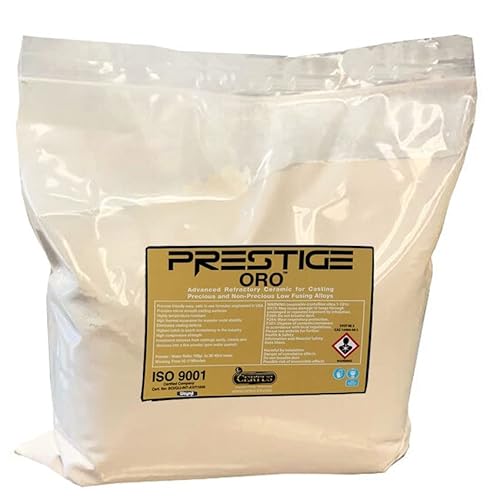
The most common metals for lost-wax casting are sterling silver, 14K and 18K gold (yellow and white), brass, bronze, copper, and pewter. Each has a different density, melting point, and cost per gram. Sterling silver is the most popular for beginners due to moderate cost and forgiving casting properties.

  • Sterling silver (10.36 g/cm³): ~$1.00/g, best for beginners, good detail capture
  • 14K gold (13.07 g/cm³): ~$38/g, professional standard for fine jewelry
  • 18K gold (15.58 g/cm³): ~$52/g, highest gold content for luxury pieces
  • Brass (8.50 g/cm³): ~$0.02/g, ideal for practice and costume jewelry
  • Bronze (8.80 g/cm³): ~$0.03/g, excellent patina, popular for art casting
Q

How much does it cost to cast a silver ring?

A typical silver ring uses about 5 g of wax, which converts to roughly 53 g of sterling silver. At approximately $1.00 per gram, the metal cost is about $53. Adding 25% for sprues brings the total to about $67 in silver. Sprue metal is recovered, so the net cost per ring is closer to $53–$55 after reclaiming and remelting.

  • Wax ring model: typically 4–7 g depending on band width and size
  • Silver weight: 5 g wax × 10.7 conversion factor = ~53.4 g silver
  • Sprue allowance (25%): adds ~13.4 g, total pour ~66.8 g
  • Metal cost at $1.00/g: ~$66.75 (sprues recovered and remelted)
  • Net cost per ring: $53–$55 after reclaiming sprue metal

Related Calculators

Wire Jewelry Calculator

Calculate wire length, weight, and cost for rings, pendants, and bangles in silver, copper, and gold-filled wire.

Jewelry Wire Gauge Calculator

Calculate wire length, weight, and cost by AWG gauge and material for jewelry making projects.

Resin Calculator

Calculate resin and hardener amounts for casting, coating, and art projects.

Candle Wax Calculator

Determine wax, fragrance oil, and wick size for any candle container and wax type.

Wire Wrapping Calculator \u2014 Wire Length, Gauge & Cost Estimator

Calculate wire length and cost for wire-wrapped jewelry. Covers pendant, ring, bracelet, and earring projects with copper, sterling, or gold-filled wire.

Candle Mold Calculator \u2014 Wax Volume, Fragrance & Cost Estimator

Calculate wax weight for any candle mold shape, fragrance oil load, dye amount, and wick size. Covers soy, paraffin, beeswax, and coconut wax candles.

Related Resources

How Much Roofing Material Do I Need? Shingles, Bundles & Cost Guide

Read our guide

Wire Jewelry Calculator

Jewelry Wire Gauge Calculator

Resin Calculator

Candle Wax Calculator

Explore Crafts Calculators

Discover tools for jewelry making, candle crafting, resin art, fiber arts, and more.

View All Crafts Calculators

Last Updated: Mar 9, 2026

This calculator is provided for informational and educational purposes only. Results are estimates and should not be considered professional financial, medical, legal, or other advice. Always consult a qualified professional before making important decisions. UseCalcPro is not responsible for any actions taken based on calculator results.

UseCalcPro
FinanceHealthMath

© 2026 UseCalcPro