How Much Roofing Material Do I Need? Shingles, Bundles & Cost Guide
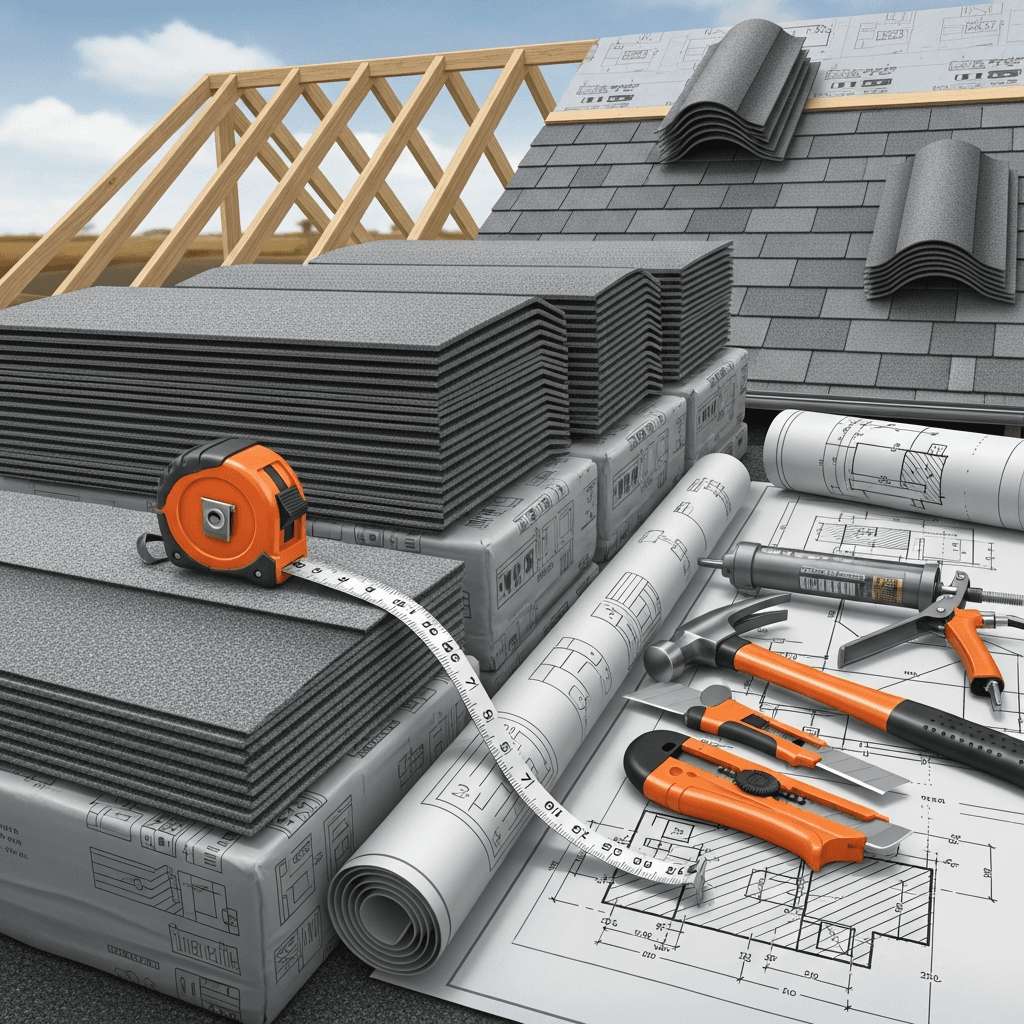
A roofing "square" covers 100 square feet of roof area. Most asphalt shingle roofs require 3 bundles per square, so a 2,000-square-foot roof needs roughly 60 bundles (20 squares). You must also factor in roof pitch, waste from hip and valley cuts, and starter and ridge cap shingles to arrive at an accurate material order.
A 1,800-square-foot workshop re-roof shows the gap clearly: the flat area measures 18 squares, but the material order comes to 20 squares because a steep 8/12 pitch adds nearly 12% to the actual surface area. Even with that cushion, hip-and-valley waste from an L-shaped footprint can consume an extra 2 squares worth of shingles -- pushing the total to 66 bundles and $4,150 for architectural shingles, underlayment, and ridge vent combined. That gap between footprint and final order shows how much roof geometry matters beyond a simple square-footage number.
Use our Roofing Calculator to get precise bundle counts, cost estimates, and waste allowances for your specific roof.
Understanding Roofing Squares, Bundles & Coverage
Before ordering a single shingle, you need to understand three core units that the roofing industry uses to measure materials.
What Is a Roofing Square?
A roofing square is the standard unit of roof measurement. One square equals 100 square feet of roof surface. The term exists because quoting thousands of square feet is unwieldy -- saying "24 squares" is simpler than "2,400 square feet" when talking to a supplier.
Bundles Per Square
The number of bundles per square depends on the shingle type:
| Shingle Type | Bundles per Square | Weight per Bundle | Coverage per Bundle |
|---|---|---|---|
| 3-Tab Asphalt | 3 | 60-70 lbs | 33.3 sq ft |
| Architectural (Dimensional) | 3-4 | 65-80 lbs | 25-33.3 sq ft |
| Premium/Designer | 4-5 | 70-90 lbs | 20-25 sq ft |
| Metal Panels (standing seam) | N/A (linear ft) | Varies | Panel-dependent |
Tip
Always check the manufacturer's label. While 3 bundles per square is the standard for 3-tab and most architectural shingles, heavier laminated or designer shingles can require 4 or even 5 bundles per square. The bundle wrapper lists exact coverage.
Additional Materials You Will Need
Shingles are only part of the equation. A complete roofing job also requires:
- Underlayment (felt or synthetic): 1 roll per 4 squares (400 sq ft)
- Starter strip shingles: 1 bundle per 100-120 linear feet of eave and rake
- Ridge cap shingles: 1 bundle per 30-35 linear feet of hip and ridge
- Drip edge flashing: Sold in 10-foot lengths
- Ice and water shield: Required in cold climates for the first 3 feet from the eave
- Roofing nails: 2-2.5 lbs of nails per square (4 nails per shingle standard, 6 in high-wind zones)
How Roof Pitch Affects Material Needs
Roof pitch is the angle of your roof expressed as a ratio of vertical rise to 12 inches of horizontal run. A 6/12 pitch rises 6 inches for every 12 inches of horizontal distance. Pitch matters because a steeper roof has more surface area than the flat footprint below it.
Pitch Multiplier Table
To convert flat (footprint) area to actual roof surface area, multiply by the pitch factor:
| Roof Pitch | Multiplier | Angle (degrees) | Walkability | Recommended Material |
|---|---|---|---|---|
| 4/12 | 1.054 | 18.4° | Easy -- walkable | Any shingle type |
| 5/12 | 1.083 | 22.6° | Easy -- walkable | Any shingle type |
| 6/12 | 1.118 | 26.6° | Moderate -- use caution | Any shingle type |
| 7/12 | 1.158 | 30.3° | Moderate -- roof jacks advised | Architectural or metal |
| 8/12 | 1.202 | 33.7° | Difficult -- roof jacks required | Architectural or metal |
| 9/12 | 1.250 | 36.9° | Difficult -- harness recommended | Metal or tile |
| 10/12 | 1.302 | 39.8° | Steep -- harness required | Metal or tile |
| 12/12 | 1.414 | 45.0° | Very steep -- professional only | Metal standing seam or tile |
Example: A house with a 1,500-square-foot footprint and an 8/12 pitch has:
Actual roof area = 1,500 × 1.202 = 1,803 sq ft = 18.03 squares
You would need at least 19-20 squares of material (including waste) instead of the 15 squares a flat-footprint estimate would suggest.
Warning
Never skip the pitch multiplier. Ordering shingles based on the house footprint alone is one of the most common mistakes homeowners make. A 12/12 pitch adds over 41% more surface area compared to a flat roof.
How to Determine Your Roof Pitch
If you don't have architectural plans, you can measure pitch from the attic or ground:
- From the attic: Place a level horizontally against a rafter, mark 12 inches, then measure the vertical distance from the level to the rafter at that point. That vertical distance is the rise (e.g., 6 inches = 6/12 pitch).
- From the ground: Use a smartphone inclinometer app aimed at the roof edge, then convert the angle to a pitch ratio.
- From a tape measure: Measure the run (half the building width) and the rise (from eave to ridge height), then calculate: Pitch = (Rise / Run) × 12.
Our Rafter Calculator can also help you determine rafter length and roof geometry based on pitch and span.
Step-by-Step: Calculate Your Roofing Materials
Follow these steps to arrive at an accurate material list.
Step 1: Measure the Roof Footprint
Measure the length and width of each rectangular section of your roof from the ground or on a scaled drawing. For complex roofs, break the shape into rectangles and triangles.
Footprint Area = Length × Width (for each section)
Total Footprint = Sum of all sections
If you need help calculating irregular areas, our Square Footage Calculator handles rectangles, triangles, and circles.
Step 2: Apply the Pitch Multiplier
Look up your pitch in the table above and multiply:
Actual Roof Area = Footprint Area × Pitch Multiplier
Step 3: Convert to Squares
Number of Squares = Actual Roof Area ÷ 100
Step 4: Add Waste Factor
Waste depends on roof complexity:
| Roof Type | Waste Factor | When to Use |
|---|---|---|
| Simple gable (2 planes) | 5-10% | Minimal cutting required |
| Cross-gable (4+ planes) | 10-15% | Moderate valley and hip cuts |
| Hip roof | 12-15% | Significant cutting at hips |
| Complex/multi-level | 15-20% | Many valleys, dormers, angles |
Adjusted Squares = Squares × (1 + Waste Factor)
Step 5: Calculate Bundles and Accessories
Bundles = Adjusted Squares × 3 (for standard shingles)
Underlayment Rolls = Adjusted Squares ÷ 4
Starter Strip Bundles = Eave + Rake Linear Feet ÷ 100
Ridge Cap Bundles = Hip + Ridge Linear Feet ÷ 33
Important
Round up on every line item. You cannot buy partial bundles or half-rolls. Leftover material is far cheaper than a second delivery or an emergency hardware store run mid-project.
Worked Example
A ranch home with a 40×30-foot footprint, cross-gable roof at 6/12 pitch:
- Footprint: 40 × 30 = 1,200 sq ft
- Pitch multiplier: 1,200 × 1.118 = 1,341.6 sq ft
- Squares: 1,341.6 ÷ 100 = 13.4 squares
- Waste (12% for cross-gable): 13.4 × 1.12 = 15.0 squares
- Bundles: 15 × 3 = 45 bundles
- Underlayment: 15 ÷ 4 = 3.75 → 4 rolls
- Starter strip: ~140 linear feet of eave/rake → 2 bundles
- Ridge cap: ~70 linear feet → 3 bundles
Roofing Material Cost Comparison
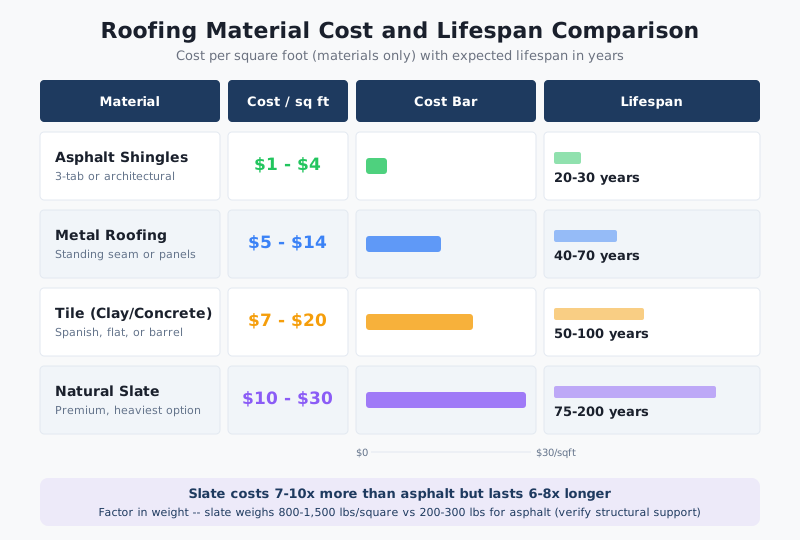
Material choice affects not only upfront cost but also longevity and energy performance. According to the National Roofing Contractors Association (NRCA), homeowners should evaluate the total cost of ownership -- not just price per square.
| Material | Cost per Square (installed) | Lifespan | Pros | Cons |
|---|---|---|---|---|
| 3-Tab Asphalt | $150-250 | 15-20 years | Lowest cost, easy to install | Shortest lifespan, less wind resistance |
| Architectural Asphalt | $250-400 | 25-30 years | Good balance of cost and durability, attractive | Heavier than 3-tab, moderate cost |
| Metal Standing Seam | $600-1,200 | 40-70 years | Extremely durable, energy efficient, fire resistant | High upfront cost, specialized installation |
| Clay/Concrete Tile | $800-1,500 | 50-100+ years | Longest lifespan, classic appearance, fire resistant | Very heavy (requires structural assessment), expensive |
| Wood Shake | $400-700 | 20-30 years | Natural aesthetic, good insulation | Fire risk, high maintenance, limited by code in some areas |
Tip
Consider lifetime cost. Architectural shingles at $350 per square lasting 30 years cost about $11.67 per square per year. Metal at $900 per square lasting 60 years costs $15 per square per year -- but you avoid a second tear-off and never worry about storm damage. Energy Star-rated reflective roofing can also reduce cooling costs by 10-15%, which further offsets the higher price of metal or tile.
Regional Price Variations
Roofing costs vary significantly by location:
- Southeast US: Lower labor costs, but frequent storm damage increases demand
- Northeast US: Higher labor and material costs, plus ice dam prevention adds expense
- West Coast: Premium pricing due to labor costs, but less storm wear
- Midwest: Moderate costs, but extreme temperature swings shorten shingle life
Understanding Rafters and Roof Framing Basics
Your roofing material sits on a structural framework of rafters or trusses. Understanding the framing helps you evaluate whether your roof can support heavier materials like tile or double-layered shingles.
Rafter Spacing and Load Capacity
Standard residential rafters are spaced 16 or 24 inches on center. The load capacity depends on rafter size, spacing, span, and wood species:
- 2×6 rafters at 16" OC: Suitable for asphalt shingles with moderate snow loads
- 2×8 rafters at 16" OC: Can handle tile or heavier materials on moderate spans
- 2×10 or 2×12 rafters: Required for long spans or heavy loads
Before choosing clay tile or concrete tile (which weigh 900-1,200 lbs per square versus 250-350 lbs for asphalt), have a structural engineer verify your framing. Use our Rafter Calculator to determine rafter sizing and spacing requirements.
Roof Deck Condition
The plywood or OSB sheathing beneath the shingles must be in good condition. During a re-roof, inspect for:
- Soft spots indicating rot or delamination
- Sagging between rafters suggesting undersized sheathing
- Water stains on the underside (visible from the attic)
Budget 5-10% extra for sheathing replacement. Most re-roofs require replacing at least a few sheets.
Siding Tie-Ins: When to Replace Both
Roofing and siding projects often overlap. If your siding is aging alongside your roof, combining the projects can save money on labor, scaffolding, and contractor mobilization.
When It Makes Sense to Replace Both
- Age alignment: If your siding is within 5 years of its expected lifespan
- Storm damage: Insurance claims often cover both roof and siding
- Flashing integration: New roofing flashing integrates better with new siding
- Color coordination: Matching new materials ensures a cohesive look
Our Siding Calculator can help you estimate materials and cost if you decide to bundle the projects. For more on exterior renovation planning, see our deck building complete guide, which covers similar project-sequencing decisions.
Counter-Flashing Considerations
Where the roof meets a wall (as on dormers or second-story walls), step flashing must integrate with the siding. If you replace the roof but not the siding, the roofer has to work the new flashing behind the existing siding -- a step that adds labor cost and creates potential leak points. Replacing both simultaneously eliminates this issue.
DIY vs Hiring a Roofing Contractor
When DIY Is Reasonable
- Low-pitch roof (4/12 or 5/12): Safe to walk on without special equipment
- Simple gable with one layer: Tear-off and replacement is straightforward
- Small area (under 15 squares): Manageable for a weekend with 2-3 helpers
- Budget savings: DIY can cut total cost by 40-60% (labor is typically 50-65% of a roofing bid)
When to Hire a Professional
- Steep pitch (8/12 or higher): Fall risk is significant
- Multiple layers to remove: Double or triple tear-off is heavy, exhausting work
- Complex geometry: Many valleys, dormers, skylights, or chimneys require skilled flashing work
- Warranty requirements: Some manufacturers void material warranties if not installed by a certified contractor
Warning
Roofing is one of the most dangerous DIY jobs. According to FEMA and the Bureau of Labor Statistics, falls from roofs account for a significant portion of construction fatalities. If your pitch exceeds 6/12, strongly consider hiring professionals with proper safety equipment and insurance.
Cost Breakdown: DIY vs Pro
For a 20-square architectural shingle re-roof on a simple gable:
| Cost Category | DIY | Professional |
|---|---|---|
| Shingles (60 bundles) | $2,400 | $2,400 |
| Underlayment, flashing, nails | $600 | $600 |
| Dumpster rental | $400 | Included |
| Tool rental (nail gun, etc.) | $200 | N/A |
| Labor | $0 (your time) | $4,000-6,000 |
| Total | $3,600 | $7,000-9,600 |
The DIY route saves $3,400-6,000 but requires 2-4 full days of hard labor for a crew of 3-4 people. Factor in the cost of your time and the risk before committing.
How to Use Our Roofing Calculator
Our Roofing Calculator takes the guesswork out of material estimation:
Step 1: Enter your roof footprint dimensions (length and width for each section).
Step 2: Select your roof pitch from the dropdown or enter a custom value. The calculator automatically applies the correct pitch multiplier.
Step 3: Choose your shingle type (3-tab, architectural, or premium). The calculator adjusts bundles-per-square accordingly.
Step 4: Select your roof complexity (simple, moderate, complex). This sets the appropriate waste factor.
Step 5: Review your results: total squares, bundles needed, underlayment rolls, and estimated cost range.
The calculator also provides a complete accessories list including starter strips, ridge caps, drip edge, and nail quantities -- so you can walk into the supply yard with a single order sheet. For related structural calculations, try our Rafter Calculator to verify rafter sizing before adding new material weight.
Tips for Ordering and Storing Roofing Materials
Ordering Best Practices
- Order all shingles from the same production lot to ensure consistent color
- Buy 10-15% more than calculated -- leftover bundles are valuable for future repairs
- Schedule delivery 1-2 days before the project starts to avoid weather exposure
- Have materials staged on the roof by the delivery truck's boom if possible (saves hours of carrying)
Storing Shingles
- Store flat on a solid surface (not directly on dirt or grass)
- Keep out of direct sunlight before installation -- heat can cause bundles to fuse together
- Stack no more than 4 feet high to prevent deformation
- Cover with a tarp if stored outdoors, but allow air circulation
Understanding insulation values is also important when you have the roof open during a re-roof. Our insulation R-value guide explains how to evaluate and upgrade attic insulation while you have easy access from above.
Frequently Asked Questions
How many bundles of shingles do I need per square?
For standard 3-tab and most architectural shingles, you need 3 bundles per roofing square (100 square feet). Premium and designer shingles may require 4-5 bundles per square -- always check the manufacturer's coverage information printed on the bundle wrapper. As a quick rule: multiply the number of squares by 3 for standard shingles, then add 10-15% for waste.
How do I measure my roof from the ground without climbing up?
You can estimate roof area from the ground using two methods. First, measure the building footprint (length and width at ground level) and multiply by the pitch factor from the table in this article. Second, use satellite imagery from Google Maps or similar services -- measure the footprint on screen and apply the pitch multiplier. For the most accurate results, use our Roofing Calculator with your footprint measurements and pitch estimate.
When should I replace my roof instead of repairing it?
Consider full replacement when shingles are curling, cracking, or losing granules across large areas; when the roof is within 5 years of its expected lifespan; when you see daylight through the roof deck from the attic; or when more than 30% of the surface shows damage. Isolated damage from a fallen branch or a few missing shingles after a storm can usually be repaired. If repair costs exceed 30-40% of replacement cost, replacement is typically the better investment.
What type of shingle is best for my home?
Architectural (dimensional) shingles offer the best balance of cost, appearance, and durability for most homeowners. They cost 20-40% more than 3-tab shingles but last 10-15 years longer and provide better wind resistance (rated for 110-130 mph versus 60-70 mph for 3-tab). For areas prone to hurricanes or severe storms, consider impact-resistant shingles rated Class 3 or Class 4 by Underwriters Laboratories (UL).
Can I install new shingles over old ones?
Most building codes allow a maximum of two layers of asphalt shingles. However, roofing over (also called a "roof-over" or "overlay") has drawbacks: it adds weight to the structure, hides underlying deck damage, voids some manufacturer warranties, and shortens the new layer's lifespan because heat builds up between layers. A full tear-off down to the deck is almost always the better long-term choice, even though it adds $1,000-3,000 to the project cost.
How long does a new roof last?
Lifespan depends primarily on material and climate. Three-tab asphalt shingles last 15-20 years, architectural shingles 25-30 years, metal roofing 40-70 years, and clay or concrete tile 50-100+ years. Extreme heat, repeated freeze-thaw cycles, heavy snowfall, and coastal salt air all shorten lifespan. Proper attic ventilation is one of the most impactful factors -- poor ventilation can cut shingle life by 25-40% due to excessive heat buildup.
Related Calculators
- Roofing Calculator -- Calculate shingles, bundles, and costs for your roof
- Rafter Calculator -- Determine rafter length, spacing, and sizing
- Siding Calculator -- Estimate siding materials for exterior walls
- Square Footage Calculator -- Calculate area for any shape
Related Articles
- Concrete Calculator Guide -- How much concrete you need for slabs, footings, and posts
- Paint Calculator Guide -- Estimate paint gallons for interior and exterior projects
- Deck Building Complete Guide -- Plan materials and costs for a new deck
- Insulation R-Value Guide -- Understand insulation ratings and choose the right type
This article provides general guidance for residential roofing estimation. Actual material requirements vary based on roof geometry, local building codes, and installation methods. Consult with a licensed roofing contractor or structural engineer for project-specific recommendations.
This article is provided for informational and educational purposes only. Content should not be considered professional financial, medical, legal, or other advice. Always consult a qualified professional before making important decisions. UseCalcPro is not responsible for any actions taken based on the information in this article.
Try These Calculators
Estimate shingles, bundles, and roofing squares based on your roof dimensions and pitch. Includes waste factor and coverage tables for common materials.
Calculate metal roofing panels, screws, and trim needed for standing seam, corrugated, or ribbed roofs. Get accurate material lists and cost estimates.
Calculate how many shingle bundles and squares you need for your roof replacement. Enter dimensions or area with pitch for accurate material estimates.
Calculate roof pitch from rise and run measurements, convert between degrees and ratio. Find the slope multiplier for accurate roofing material estimates.
Calculate stucco materials and costs for your project. Estimate cement, sand, lath, labor, and total installed price for traditional, 1-coat, or EIFS stucco.