How Much Concrete Do I Need? Concrete Calculator for Slabs & Footings
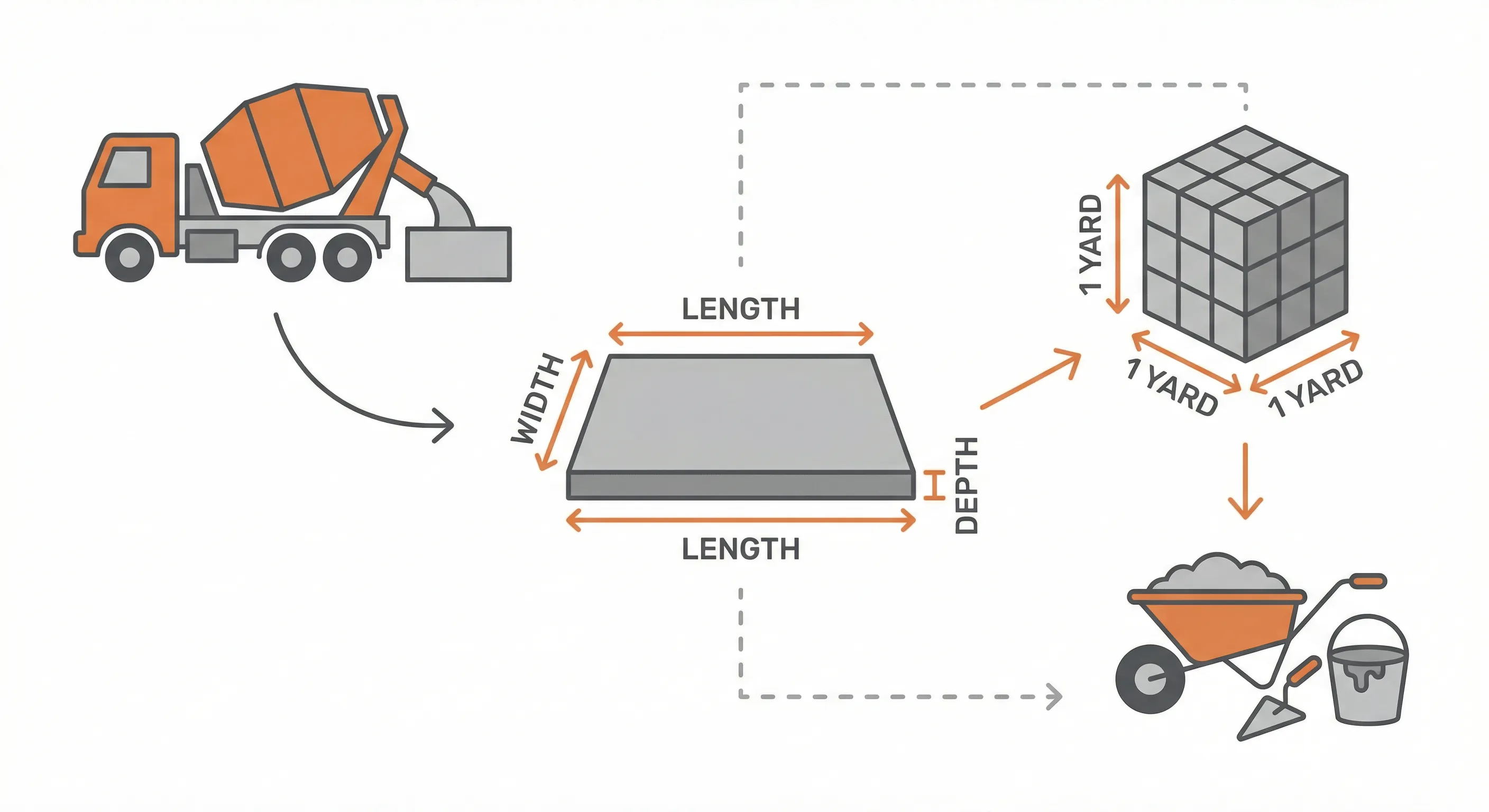
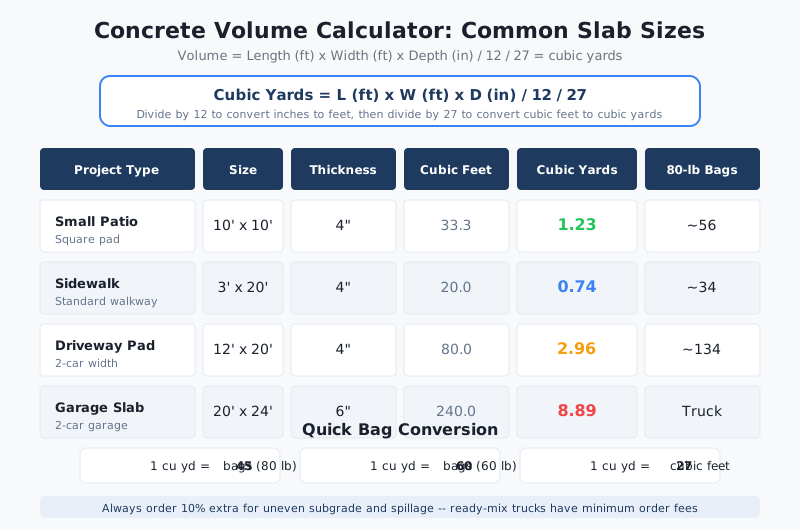
Concrete is calculated in cubic yards. For a 4-inch thick slab, you need approximately 1.23 cubic yards per 100 square feet. A typical 10×10 patio slab requires about 1.3 cubic yards of concrete, or approximately thirty 80-pound bags if mixing by hand.
On a typical 12x20-foot driveway extension, the formula calculates 3.3 cubic yards, but ordering 3.75 to account for uneven ground is the safer call. The total comes to $565 in ready-mix concrete, and that extra often gets used in full -- subgrade low spots can swallow nearly half a yard more than the formula predicts. That gap is why rounding up matters more than any waste percentage chart.
Use our Concrete Calculator to get precise quantities for slabs, footings, columns, and more.
Understanding Concrete Measurements
Concrete is sold two ways: by the cubic yard from ready-mix suppliers, or in bags from hardware stores. Knowing which to choose and how much you need prevents costly mistakes.
Cubic Yards vs. Bags
| Project Size | Best Option | Why |
|---|---|---|
| Under 1 cubic yard | Bags | More practical for small jobs |
| 1-2 cubic yards | Either | Depends on timeline and budget |
| Over 2 cubic yards | Ready-mix truck | More economical, consistent quality |
Quick conversions:
- 1 cubic yard = 27 cubic feet
- 1 cubic yard ≈ 45 bags (80 lb each)
- 1 cubic yard ≈ 60 bags (60 lb each)
Tip
Ready-mix has a minimum order. Most concrete companies require a minimum of 1 cubic yard and charge short-load fees for orders under 3-4 yards. Factor this into your decision.
How to Calculate Concrete for a Slab
The basic formula for any rectangular slab is:
Volume = Length × Width × Thickness
Step 1: Measure in Feet
Convert all measurements to feet:
- 4 inches = 0.33 feet
- 6 inches = 0.5 feet
- 12 inches = 1 foot
Step 2: Calculate Cubic Feet
Example (10×12 foot patio, 4 inches thick):
Volume = 10 × 12 × 0.33 = 39.6 cubic feet
Step 3: Convert to Cubic Yards
Cubic Yards = Cubic Feet ÷ 27
Continuing our example:
39.6 ÷ 27 = 1.47 cubic yards
Step 4: Add Waste Factor
Always add 5-10% for waste, spillage, and slightly uneven ground:
1.47 × 1.10 = 1.62 cubic yards
Order 1.75 cubic yards (round up to nearest quarter yard for ready-mix orders).
Slab Thickness Guide
Different applications require different thicknesses:
| Application | Thickness | Cubic Yards per 100 sq ft |
|---|---|---|
| Walkways (light traffic) | 4" | 1.23 |
| Patios | 4" | 1.23 |
| Driveways (passenger vehicles) | 4" | 1.23 |
| Driveways (trucks/RVs) | 6" | 1.85 |
| Garage floors | 4-6" | 1.23-1.85 |
| Shed foundations | 4" | 1.23 |
| Hot tub pads | 4-6" | 1.23-1.85 |
| Heavy equipment pads | 6-8" | 1.85-2.47 |
Important
Don't underestimate thickness requirements. A driveway that's too thin will crack under vehicle weight. When in doubt, go thicker — the cost difference is minimal compared to replacement.
Quick Reference: Concrete for Common Slabs
Use this table for quick estimates (includes 10% waste):
| Slab Size | 4" Thick | 6" Thick |
|---|---|---|
| 8×8 | 0.9 cu yd | 1.3 cu yd |
| 10×10 | 1.4 cu yd | 2.1 cu yd |
| 10×12 | 1.6 cu yd | 2.5 cu yd |
| 12×12 | 2.0 cu yd | 2.9 cu yd |
| 12×20 | 3.3 cu yd | 4.9 cu yd |
| 16×20 | 4.4 cu yd | 6.5 cu yd |
| 20×20 | 5.5 cu yd | 8.2 cu yd |
| 20×24 | 6.6 cu yd | 9.9 cu yd |
Calculating Concrete for Footings
Footings support structures and require careful calculation:
Continuous Footings (Foundation Walls)
Formula:
Volume = Width × Depth × Total Linear Feet
Example (8" wide × 12" deep footing, 60 linear feet for a shed):
Volume = 0.67 × 1.0 × 60 = 40 cubic feet
40 ÷ 27 = 1.48 cubic yards
Add 10%: 1.63 cubic yards → Order 1.75 cubic yards
Square Footings (Deck Posts)
Formula:
Volume = Length × Width × Depth × Number of Footings
Example (four 16"×16"×12" footings for a deck):
Each footing: 1.33 × 1.33 × 1.0 = 1.77 cubic feet
Total: 1.77 × 4 = 7.08 cubic feet
7.08 ÷ 27 = 0.26 cubic yards
For small quantities like this, use bags:
- 0.26 cubic yards ≈ 12 bags (80 lb)
Calculating Concrete for Round Columns and Posts
For round forms like sonotubes:
Formula:
Volume = π × radius² × depth
Example (12" diameter × 48" deep post hole):
Radius = 6 inches = 0.5 feet
Volume = 3.14159 × 0.5² × 4 = 3.14 cubic feet per post
Common Sonotube Sizes
| Diameter | Depth | Cubic Feet | 80-lb Bags per Post |
|---|---|---|---|
| 8" | 36" | 1.05 | 2 bags |
| 8" | 48" | 1.40 | 3 bags |
| 10" | 36" | 1.64 | 3 bags |
| 10" | 48" | 2.18 | 4 bags |
| 12" | 36" | 2.36 | 4 bags |
| 12" | 48" | 3.14 | 5 bags |
Tip
Sonotube tip: When filling sonotubes, slightly overfill and mound the top to allow for settling. The concrete will compact as it cures.
Calculating Concrete for Walls
For poured concrete walls:
Formula:
Volume = Length × Height × Thickness
Example (retaining wall 20' long × 4' tall × 8" thick):
Volume = 20 × 4 × 0.67 = 53.6 cubic feet
53.6 ÷ 27 = 1.98 cubic yards
Add 10%: 2.18 cubic yards → Order 2.25 cubic yards
Concrete Coverage by Bag Size
When using bags instead of ready-mix:
| Bag Size | Weight | Coverage (cu ft) | Bags per Cu Yd |
|---|---|---|---|
| Small | 40 lb | 0.30 | 90 |
| Medium | 60 lb | 0.45 | 60 |
| Large | 80 lb | 0.60 | 45 |
| Extra Large | 90 lb | 0.68 | 40 |
Bags Needed Calculator
Formula:
Bags = (Cubic Feet ÷ Bag Coverage) × 1.10
Example (40 cubic feet with 80-lb bags):
Bags = (40 ÷ 0.60) × 1.10 = 73.3 → Order 74 bags
Warning
Mixing by hand is labor-intensive. Anything over 20 bags (about 0.5 cubic yards) becomes exhausting. Consider renting a mixer or ordering ready-mix for larger projects.
Ready-Mix Concrete Ordering Tips
What to Tell the Dispatcher
- Total cubic yards needed (rounded up)
- Project type (slab, footing, wall)
- Desired slump (typically 4-5" for residential)
- Any additives (fiber reinforcement, accelerator, retarder)
- Access considerations (truck reach, slopes, obstacles)
Standard Concrete Mixes
| Mix Type | PSI Rating | Best For |
|---|---|---|
| Standard | 2500 PSI | Footings, fill |
| Residential | 3000 PSI | Patios, walkways, shed slabs |
| Driveway | 3500 PSI | Driveways, garage floors |
| High-Strength | 4000+ PSI | Structural applications |
Timing Your Pour
- Order early — Schedule at least 2-3 days in advance
- Weather check — Avoid pouring in rain, extreme heat, or freezing temperatures
- Have help ready — You'll have 60-90 minutes of working time
- Prep forms completely — The clock starts when the truck arrives
Common Concrete Calculation Mistakes
Mistake 1: Forgetting the Waste Factor
Problem: Ordering exactly the calculated amount leaves you short due to uneven ground, spillage, and form bulging.
Solution: Always add 5-10% to your calculation. For rough terrain, add 15%.
Mistake 2: Measuring in Wrong Units
Problem: Mixing inches and feet in calculations leads to wildly wrong results.
Solution: Convert everything to feet first. Our Concrete Calculator handles unit conversions automatically. This same unit-confusion issue comes up frequently in other home improvement projects -- see our tile calculator guide for how to avoid measurement pitfalls when tiling.
Mistake 3: Underestimating Ground Conditions
Problem: Uneven or rocky soil can significantly increase concrete needs.
Solution: Dig to consistent depth and compact the base thoroughly. Add extra for low spots.
Mistake 4: Ordering Too Little Ready-Mix
Problem: Running short mid-pour creates a cold joint (weak point) when you wait for more concrete.
Solution: Order 10-15% more than calculated. Unused concrete can create stepping stones or other projects.
How to Use Our Concrete Calculator
Our Concrete Calculator simplifies the entire process:
- Select project type — slab, footing, column, or wall
- Enter dimensions — length, width, thickness/depth
- Choose units — feet, inches, or meters
- Get results — cubic yards and bag counts instantly
The calculator automatically adds a 10% waste factor and provides both ready-mix quantities and bag equivalents.
Cost Comparison: Bags vs. Ready-Mix
| Quantity | Bags (80-lb @ $6) | Ready-Mix (@ $150/yd) |
|---|---|---|
| 0.5 cu yd | $135 (23 bags) | $150 + short fee |
| 1.0 cu yd | $270 (45 bags) | $150 + short fee |
| 2.0 cu yd | $540 (90 bags) | $300 |
| 3.0 cu yd | $810 (135 bags) | $450 |
| 4.0 cu yd | $1,080 (180 bags) | $600 |
Info
Break-even point is typically 1-2 cubic yards. Above that, ready-mix is usually cheaper and significantly easier. Below that, bags may be more economical despite the labor.
Once your slab or foundation is complete, you may be planning the next phase of the project. Our flooring calculator guide walks through material estimation for hardwood, laminate, or LVP that you might install on top of a finished concrete subfloor.
Reinforcement Requirements
Most concrete slabs benefit from reinforcement:
Wire Mesh
- Coverage: Typically sold in 5×10' sheets
- Placement: Position at 1/3 from top of slab
- Overlap: Minimum 6" overlap between sheets
Rebar
- Slab on grade: #3 or #4 rebar on 18-24" centers
- Footings: #4 or #5 rebar, continuous with proper lap splices
- Walls: Horizontal and vertical rebar per engineer specifications
Fiber Reinforcement
- Coverage: One bag per cubic yard of concrete
- Benefit: Reduces cracking, improves durability
- Not a substitute for: Wire mesh or rebar in structural applications
Frequently Asked Questions
How many bags of concrete do I need for a 10×10 slab?
For a 10×10 foot slab at 4 inches thick, you need approximately 1.4 cubic yards or about 63 bags of 80-pound concrete mix. Including 10% waste, order 70 bags or 1.5 cubic yards of ready-mix.
How do you calculate concrete in cubic yards?
Calculate cubic feet first (Length × Width × Thickness in feet), then divide by 27 to convert to cubic yards. For example: 12×12×0.33 = 47.52 cubic feet ÷ 27 = 1.76 cubic yards.
How thick should a concrete driveway be?
A residential driveway for passenger vehicles should be 4 inches thick minimum. For heavy vehicles like trucks or RVs, increase to 6 inches. Always use 3500 PSI concrete or higher for driveways.
How much does a cubic yard of concrete cover?
One cubic yard of concrete covers: 81 square feet at 4 inches thick, 54 square feet at 6 inches thick, or 27 square feet at 12 inches thick.
Should I order extra concrete?
Yes, always order 5-10% more than your calculation. For uneven terrain or first-time pours, add 15%. Leftover concrete can be used for stepping stones or disposed of in forms you've set aside.
How long does concrete need to cure?
Concrete reaches working strength in 24-48 hours, but full cure takes 28 days. Keep the surface moist for the first 7 days by misting with water or covering with plastic sheeting.
Related Calculators
- Bricks Calculator — Calculate bricks and mortar for walls
- Flooring Calculator — Estimate flooring materials
- Paint Calculator — Calculate paint for any room
Conclusion
Calculating concrete accurately prevents costly overages and frustrating shortages. Measure carefully, add your waste factor, and round up to the nearest quarter yard for ready-mix orders. For small projects under a cubic yard, bags are practical. For anything larger, ready-mix saves time, labor, and often money.
Use our Concrete Calculator for instant, accurate estimates. And remember: it's always better to have a little concrete left over than to stop mid-pour.
Concrete calculations are estimates based on standard conditions. Actual requirements may vary based on ground conditions, form construction, and pour technique. Consult with your concrete supplier for project-specific recommendations.
This article is provided for informational and educational purposes only. Content should not be considered professional financial, medical, legal, or other advice. Always consult a qualified professional before making important decisions. UseCalcPro is not responsible for any actions taken based on the information in this article.
Try These Calculators
Enter your slab dimensions to get concrete volume in cubic yards, bags needed, and estimated cost. Works for patios, footings, driveways, and columns.
Calculate how much mulch you need for your garden beds and landscaping. Get cubic yards, bags, and cost estimates for bark, wood chips, and decorative mulch.
Calculate how much soil you need for raised beds, gardens, and landscaping. Get cubic yards, bags needed, and cost estimates for your project. Compare options.
Calculate how much sand you need in tons and cubic yards for your patio, paver, and fill projects. Enter dimensions and sand type for instant estimates.
Calculate concrete mix, reinforcement, and finishing materials for DIY countertops. Compare total project costs vs granite, quartz, and professional install.