Carpet vs Hardwood Flooring Cost in 2026 (Full Comparison)
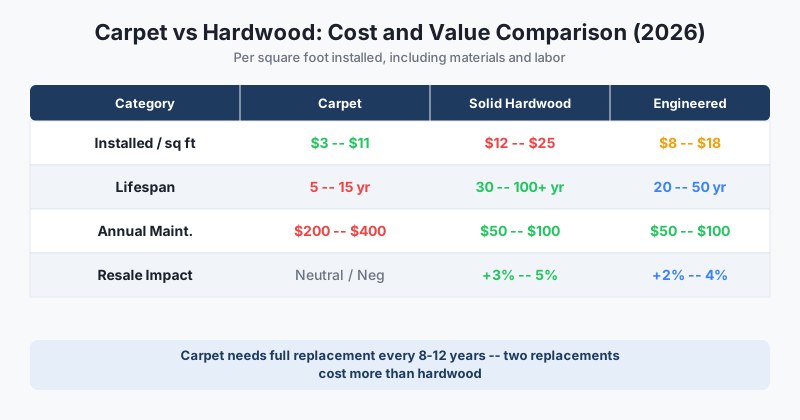
Carpet flooring costs $3-$11 per square foot installed in 2026, while hardwood runs $12-$25 per square foot installed. For a 500 square foot living room, that is $1,500-$5,500 for carpet versus $6,000-$12,500 for hardwood. But the upfront price gap is misleading. Over 20 years, carpet requires two full replacements and annual professional cleaning, pushing its total cost to $6,000-$18,000 for that same room. Hardwood, with one refinish and minimal upkeep, lands at $7,500-$16,500. The "cheap" option is not always cheaper.
Consider a 1,800 square foot ranch with wall-to-wall beige carpet nine years old -- the kind builders install because it costs $4 per square foot and nobody complains during a showing. That carpet looked fifteen years old. Pet stains had soaked through the pad into the subfloor in two rooms, and no amount of professional cleaning was going to fix that. The replacement quote was $9,400 for new mid-grade carpet, installed. Spending $21,000 on red oak hardwood for the main level instead, with carpet kept only in the three bedrooms upstairs, is the kind of trade-off homeowners weigh constantly -- and in one such case, the house appraised $18,000 higher than the neighborhood comp. That math is exactly why this comparison matters.
Use our Flooring Calculator to estimate material quantities and total installed cost for your specific square footage before committing to either option.
Side-by-Side Comparison
Every number that matters, in one table. All prices reflect 2026 national averages from Angi, HomeGuide, and the National Wood Flooring Association.
| Factor | Carpet | Solid Hardwood | Engineered Hardwood |
|---|---|---|---|
| Material cost (per sq ft) | $1 - $5 | $3 - $12 | $3 - $10 |
| Pad/underlayment (per sq ft) | $0.50 - $1 | Included in labor | Included in labor |
| Installation labor (per sq ft) | $1 - $3 | $4 - $8 | $3 - $6 |
| Finishing (per sq ft) | N/A | $2 - $5 | Pre-finished |
| Total installed (per sq ft) | $3 - $11 | $12 - $25 | $8 - $18 |
| 500 sq ft room | $1,500 - $5,500 | $6,000 - $12,500 | $4,000 - $9,000 |
| Lifespan | 5 - 15 years | 30 - 100+ years | 20 - 50 years |
| Refinishing | Not possible | 3 - 7 times | 1 - 3 times |
| Annual maintenance | $200 - $400 (cleaning) | $50 - $100 | $50 - $100 |
| Resale value impact | Neutral to negative | +3% to 5% home value | +2% to 4% home value |
| Allergen friendliness | Poor (traps dust, dander) | Excellent | Excellent |
| Sound insulation | Excellent | Poor (needs rugs) | Moderate |
| Comfort underfoot | Excellent | Hard, cold | Hard, cold |
| DIY difficulty | Moderate | Hard | Moderate |
The gap between carpet and hardwood is not just price. It is a fundamentally different product philosophy. Carpet is disposable comfort. Hardwood is a permanent improvement. Engineered hardwood splits the difference, covered separately below.
Carpet: Full Cost Breakdown
Carpet pricing has three components that installers often bundle into a single number, which makes comparison shopping difficult. Here is what you are actually paying for.
Material Cost by Tier
| Carpet Tier | Material (per sq ft) | Typical Fiber | Expected Lifespan |
|---|---|---|---|
| Builder grade | $1 - $2 | Polyester or olefin | 5 - 8 years |
| Mid-grade | $2 - $3.50 | Nylon (solution-dyed) | 8 - 12 years |
| Premium | $3.50 - $5 | Wool or SmartStrand | 12 - 15 years |
| Luxury/custom | $5 - $8+ | Wool blend or specialty | 10 - 20 years |
Builder-grade polyester is what you find in rental properties and new construction spec homes. It mats down within three years in high-traffic areas. Mid-grade nylon is the sweet spot for most homeowners -- solution-dyed nylon resists stains and fading far better than anything cheaper. Premium wool carpet is genuinely beautiful but costs nearly as much as engineered hardwood, which defeats the main reason people choose carpet.
Pad Cost
The carpet pad is not optional, and cheap pad ruins good carpet. A $0.50 per square foot rebond pad is the minimum. Upgrading to a $0.75-$1.00 per square foot memory foam or fiber pad extends carpet life by 20-30% and dramatically improves comfort. For a 500 square foot room, pad costs $250-$500. Homeowners who spend $4 per square foot on carpet and $0.30 on pad often wonder why it feels thin after two years.
Labor and Extras
Basic carpet installation runs $1-$3 per square foot, but watch for surcharges:
- Stairs: $15-$25 per step. A 13-step staircase adds $195-$325 to the total.
- Furniture moving: $50-$150 per room if the installer handles it.
- Old carpet removal and disposal: $0.50-$1.50 per square foot, or $250-$750 for 500 square feet.
- Subfloor repair: $2-$5 per square foot if the subfloor is damaged (common under old carpet with pet stains).
- Seaming: Large rooms requiring multiple rolls add $50-$100 per seam.
A realistic all-in cost for a 500 square foot living room with mid-grade carpet, quality pad, old carpet removal, and furniture moving is $2,500-$4,500. That is higher than the $1,500 minimum you see in ads, because ads assume builder-grade carpet, no removal, and you move your own furniture.
Hardwood: Full Cost Breakdown
Hardwood pricing varies wildly by species. The wood you pick determines not just aesthetics but durability, and the Janka hardness rating tells you how well it resists dents and scratches.
Species Comparison
| Species | Material (per sq ft) | Janka Hardness | Total Installed (per sq ft) | Notes |
|---|---|---|---|---|
| Red oak | $3 - $6 | 1,290 | $12 - $18 | Most common, strong grain pattern |
| White oak | $5 - $8 | 1,360 | $14 - $20 | Current trend leader, water-resistant |
| Maple | $5 - $8 | 1,450 | $14 - $20 | Very hard, subtle grain |
| Hickory | $5 - $9 | 1,820 | $14 - $22 | Hardest domestic species, rustic look |
| Cherry | $6 - $10 | 950 | $15 - $22 | Beautiful but soft, darkens with age |
| Walnut | $7 - $12 | 1,010 | $16 - $25 | Dark, rich, premium price |
| Brazilian cherry | $8 - $14 | 2,350 | $18 - $28 | Extremely hard, exotic premium |
Red oak at $12-$18 per square foot installed is the workhorse. It is available everywhere, every installer knows how to work with it, and it refinishes beautifully. White oak has overtaken it in popularity thanks to European-style matte finishes, but it costs $2-$3 more per square foot. If you want the hardwood look without paying walnut prices, red oak is where the value is.
Labor Components
Hardwood installation is not one task -- it is several:
- Subfloor prep: $1-$2 per square foot. The subfloor must be flat within 3/16 inch over 10 feet, or the hardwood will creak and gap.
- Installation (nail-down): $3-$6 per square foot over plywood subfloor.
- Installation (glue-down): $4-$7 per square foot over concrete.
- Sanding and finishing (site-finished): $2-$5 per square foot for three coats of polyurethane.
- Pre-finished boards: Skip the sanding step but pay $1-$3 more per square foot for factory-finished material.
Total labor for a 500 square foot room with site-finished red oak runs $3,000-$5,500. Pre-finished boards cut the timeline from 5-7 days to 2-3 days and eliminate dust, but you lose the ability to get a custom stain color.
Engineered Hardwood: The Middle Ground
Engineered hardwood is real wood on top -- a 2-6mm veneer of oak, maple, or walnut glued to a plywood or HDF core. At $8-$18 per square foot installed, it sits between carpet and solid hardwood on price while delivering most of hardwood's benefits.
The case for engineered hardwood is strongest in three situations:
Below-grade installation. Solid hardwood and basements do not mix. Wood expands with moisture, and basements are inherently humid. Engineered hardwood's plywood core is dimensionally stable, meaning it handles humidity swings that would buckle solid planks. If you want wood in a finished basement, engineered is the only real option.
Over concrete slabs. Same logic as basements. Slab-on-grade construction (common in the South and Southwest) requires either glue-down or floating installation. Engineered hardwood handles both. Solid hardwood on concrete is a warranty nightmare.
Budget-conscious hardwood. A 500 square foot room in engineered white oak runs $4,000-$9,000 installed, compared to $7,000-$12,500 for solid white oak. You get the same surface appearance. The tradeoff is fewer refinishes -- a 4mm veneer can be sanded 1-2 times, while a 6mm veneer handles 2-3 refinishes.
The main limitation is longevity. Solid hardwood lasts 50-100 years with multiple refinishes. Engineered hardwood lasts 20-50 years. For a home you plan to stay in for 15-20 years, that difference is academic. For a forever home, solid hardwood pays for itself.
When to Choose Carpet
Carpet is not the wrong choice everywhere. It is the wrong choice in most common areas, but it wins in specific rooms and situations.
Bedrooms
Bedrooms get low traffic, no food spills, and no muddy shoes. A mid-grade nylon carpet at $5-$7 per square foot installed lasts 10-15 years in a bedroom and provides warmth and sound insulation that hardwood cannot match. Bare feet on carpet at 6 AM in January is a real quality-of-life advantage.
Children's Rooms and Playrooms
Falls happen. A toddler tripping on hardwood hits a surface with zero give. Carpet with a quality pad absorbs impact significantly better. The Consumer Product Safety Commission has noted that carpeted surfaces reduce fall injury severity in residential settings. For kids under 5, this matters more than resale value.
Basements on a Budget
If engineered hardwood at $8-$18 per square foot is out of reach, carpet at $3-$6 per square foot with a moisture-barrier pad is a practical basement floor. Use indoor-outdoor or olefin carpet that handles moisture better than nylon. Accept that you may replace it in 5-8 years if the basement gets damp.
Elderly Residents or Accessibility Needs
Carpet provides better traction than hardwood for walkers and canes, and a fall on carpet is less likely to result in a fracture. For aging-in-place renovations, bedroom and hallway carpet is a legitimate safety choice, not just a budget compromise.
Rental Properties
Tenants are hard on floors. Builder-grade carpet at $3-$4 per square foot installed is a replaceable surface that you budget to swap between tenants. Hardwood in a rental gets scratched, dented, and damaged by furniture drags. The math favors disposable carpet in high-turnover rentals.
When to Choose Hardwood
Hardwood wins in most permanent living scenarios, and the reasons go beyond aesthetics.
Main Living Areas
Living rooms, dining rooms, kitchens, and entryways see the most traffic and the most visibility. These rooms define first impressions for guests and buyers. Hardwood in the main living areas and carpet in bedrooms is the most common combination installed, and it is the right call for 80% of homeowners.
Resale-Focused Renovations
The National Association of Realtors consistently reports that hardwood floors rank among the top features home buyers seek. Hardwood adds 3-5% to home value, according to multiple real estate surveys. On a $400,000 home, that is $12,000-$20,000 in additional value from a flooring upgrade that might cost $15,000-$25,000 for 1,000 square feet. Carpet adds nothing -- and visibly worn carpet actively deducts from perceived value.
Allergy and Asthma Households
Carpet traps dust mites, pet dander, pollen, and mold spores at levels that regular vacuuming cannot fully address. The American Lung Association recommends hard-surface flooring for allergy and asthma sufferers. Hardwood with area rugs (which can be washed) is dramatically better for indoor air quality than wall-to-wall carpet.
Long-Term Homeownership
If you plan to stay in your home for 15+ years, hardwood's math crushes carpet. You pay more upfront but avoid two or three carpet replacement cycles. And when you eventually sell, hardwood still has value. Fifteen-year-old carpet has none.
Total Cost of Ownership: 5, 10, and 20 Years
This is the table that changes people's minds. All figures are for a 500 square foot room, mid-grade materials, including maintenance and replacements.
| Cost Component | Carpet (Mid-Grade) | Solid Hardwood (Red Oak) | Engineered Hardwood |
|---|---|---|---|
| Initial install | $3,500 | $8,000 | $6,000 |
| Annual maintenance | $300/year | $75/year | $75/year |
| 5-Year total | $5,000 | $8,375 | $6,375 |
| 10-Year total (1 carpet replacement) | $9,500 | $8,750 | $6,750 |
| 10-Year refinish | N/A | $2,500 (1 refinish) | $2,000 (1 refinish) |
| 10-Year adjusted total | $9,500 | $11,250 | $8,750 |
| 20-Year total (2 carpet replacements) | $16,500 | $12,750 | $10,250 |
| 20-Year refinish | N/A | $5,000 (2 refinishes) | $2,000 (1 refinish) |
| 20-Year adjusted total | $16,500 | $14,250 | $11,250 |
| Residual value at 20 years | $0 (needs replacement) | $4,000-$6,000 (still has life) | $2,000-$3,000 |
At year five, carpet is still cheaper. That is the only window where carpet wins on cost. By year 10, carpet's total cost has overtaken hardwood because you are paying for a second installation. By year 20, carpet has cost $2,000-$5,000 more than hardwood and has zero residual value.
Engineered hardwood is the cost leader at every time horizon beyond five years. Its lower initial price and single-refinish requirement make it the best total value for homeowners who plan to stay 10-20 years.
Room-by-Room Recommendations
Every room has a best flooring choice. A sensible plan for a typical 2,000 square foot home on a balanced budget:
| Room | Recommended Flooring | Reason | Estimated Cost |
|---|---|---|---|
| Living room (300 sq ft) | Solid or engineered hardwood | High visibility, resale impact | $3,600 - $6,000 |
| Kitchen (200 sq ft) | Engineered hardwood or LVP | Moisture exposure, heavy traffic | $1,600 - $3,600 |
| Dining room (150 sq ft) | Hardwood (match living room) | Visual continuity, resale | $1,800 - $3,750 |
| Master bedroom (250 sq ft) | Mid-grade carpet | Comfort, low traffic | $1,250 - $2,750 |
| Secondary bedrooms (400 sq ft total) | Mid-grade carpet | Cost efficiency, comfort | $2,000 - $4,400 |
| Hallways/stairs (200 sq ft) | Hardwood | Heavy traffic, durability | $2,400 - $5,000 |
| Basement (500 sq ft) | Engineered hardwood or carpet | Depends on budget and moisture | $2,500 - $9,000 |
Total for this layout: $15,150-$34,500 with a mix of carpet and hardwood, compared to $22,000-$50,000 for all hardwood or $6,000-$22,000 for all carpet. The mixed approach gives you hardwood where it matters for value and carpet where it matters for comfort.
The flooring industry's own data backs this up. According to the IICRC (Institute of Inspection, Cleaning and Restoration Certification), carpet in bedrooms lasts 30-50% longer than carpet in living areas because foot traffic is lower and shoes are rarely worn. A bedroom carpet that would last 8 years in a living room lasts 12-15 years in a bedroom. That changes the replacement math significantly.
Frequently Asked Questions
Is carpet or hardwood cheaper in the long run?
Hardwood is cheaper in the long run for any time horizon beyond 8-10 years. Carpet costs $3-$11 per square foot installed but needs full replacement every 8-10 years in high-traffic areas, plus $200-$400 per year in professional cleaning. Over 20 years, a 500 square foot room in mid-grade carpet costs approximately $16,500 including two replacements and annual cleaning. The same room in red oak hardwood costs about $14,250 over 20 years, including the initial install, two refinishes at $3-$8 per square foot, and minimal annual maintenance. Hardwood also retains residual value -- a 20-year-old hardwood floor can be refinished and used for another 20 years, while 20-year-old carpet is in a landfill. The break-even point where hardwood becomes cheaper than carpet is typically year 9-12, depending on material grade.
Does hardwood flooring increase home value more than carpet?
Yes, and the difference is significant. Hardwood flooring adds 3-5% to home value according to data from the National Association of Realtors and multiple real estate appraisal studies. On a $400,000 home, that translates to $12,000-$20,000 in added value. Carpet is considered a neutral or slightly negative flooring choice by appraisers -- it does not subtract value when it is new, but worn or dated carpet actively reduces a home's perceived worth. Real estate agents consistently report that homes with hardwood floors sell faster and closer to asking price. The ROI on hardwood installation is 70-80% of cost recovered at sale, while carpet recovers essentially 0% because buyers expect it to be replaced. If you are renovating with resale in mind, hardwood in the main living areas is one of the highest-return improvements you can make.
How long does carpet last compared to hardwood?
Carpet lasts 5-15 years depending on quality and traffic, with 8-10 years being the realistic average for mid-grade nylon in a living room. High-traffic areas like hallways and stairs wear out faster, sometimes in 5-7 years. Hardwood lasts 30-100+ years and can be refinished 3-7 times over its lifespan. Each refinishing costs $3-$8 per square foot and adds another 7-10 years of like-new appearance. A red oak floor installed in 2026 can reasonably be expected to still be in service in 2076 with two to three refinishes. Engineered hardwood falls between the two, lasting 20-50 years depending on the thickness of the veneer layer. The lifespan difference is the single biggest factor in total cost of ownership calculations. Carpet is a consumable -- you use it and replace it. Hardwood is an asset that maintains or increases in value over decades.
Is carpet better for allergies or is hardwood?
Hardwood is significantly better for allergy sufferers. Carpet traps and accumulates dust mites, pet dander, pollen, mold spores, and other allergens deep in its fibers and pad. Regular vacuuming removes surface allergens but cannot reach particles embedded in the carpet backing and pad. The American Lung Association specifically recommends hard-surface flooring for people with allergies or asthma. A study published in the Journal of Allergy and Clinical Immunology found that carpeted bedrooms had dust mite allergen levels 10-100 times higher than hard-surface floors. Hardwood with washable area rugs gives you the comfort of soft surfaces underfoot while allowing regular, thorough cleaning. If anyone in your household has allergies, asthma, or respiratory sensitivities, replacing carpet with hardwood -- especially in bedrooms where you spend 8 hours breathing near the floor -- is one of the most impactful changes you can make.
Can I install hardwood flooring myself to save money?
You can, but it depends on the type. Engineered hardwood with click-lock installation is genuinely DIY-friendly -- it floats over the subfloor without nails or glue, and a competent homeowner can install 100-200 square feet per day. This saves $3-$6 per square foot in labor, or $1,500-$3,000 on a 500 square foot room. Solid hardwood nail-down installation is a different story. It requires a pneumatic floor nailer (rental: $50-$75/day), proper acclimation of the wood (3-5 days sitting in the room before installation), and experience with staggering joints, undercutting door jambs, and managing expansion gaps. A poor nail-down job results in squeaky floors, visible gaps, and potential warranty issues. Site-finishing (sanding and applying polyurethane) adds another skill layer entirely -- uneven sanding shows through the finish and cannot be hidden. The general recommendation: DIY engineered hardwood if you are handy, and hire a professional for solid hardwood nail-down and any site-finishing work.
What is the best flooring for a basement -- carpet or hardwood?
Neither solid hardwood nor standard carpet is ideal for basements. The best basement flooring is engineered hardwood at $8-$18 per square foot installed or LVP (luxury vinyl plank) at $4-$10 per square foot. Solid hardwood buckles in basement moisture conditions because below-grade spaces have higher relative humidity (often 50-70%) and the ever-present risk of water intrusion. Standard carpet in a basement is a mold risk -- moisture wicks up through the concrete slab, gets trapped in the carpet pad, and creates an environment where mold thrives invisibly for months. If budget requires carpet in the basement, use synthetic carpet with a moisture-barrier pad and a dehumidifier set to keep relative humidity below 50%. Expect to replace it every 5-8 years. Engineered hardwood with a plywood core handles basement moisture far better than solid wood, and its click-lock variants can float over concrete with a vapor barrier. For the best combination of durability, moisture resistance, and appearance, engineered hardwood is the right call for finished basements.
Cost data sourced from Angi, HomeGuide, the National Wood Flooring Association (NWFA), and the IICRC. Prices reflect 2026 national averages and may vary by region, material availability, and labor market conditions. Always get 3 quotes from local contractors before committing to a flooring project.
This article is provided for informational and educational purposes only. Content should not be considered professional financial, medical, legal, or other advice. Always consult a qualified professional before making important decisions. UseCalcPro is not responsible for any actions taken based on the information in this article.
Try These Calculators
Estimate materials for hardwood, laminate, vinyl, or carpet floors. Get box counts, waste allowance, and full cost breakdowns for your flooring project.
Compare carpet vs hardwood flooring cost over decades: install price, refinish vs replacement cycles, the break-even year, and the resale value hardwood adds.
Estimate 2026 hardwood floor refinishing cost by square feet, method, and region. Traditional $3-$8/sqft; dustless $5-$8/sqft; 400 sqft room $1,000-$3,200.
Estimate 2026 vinyl flooring installation cost by format — sheet, tile, LVP, or LVT. Installed quotes run $2 to $22 per sqft depending on format and region.
Estimate 2026 laminate floor installation cost by room size and quality. Budget to waterproof laminate quotes typically range from $1,500 to $6,000 total.