Asphalt vs Concrete Driveway Cost in 2026 (Full Comparison)
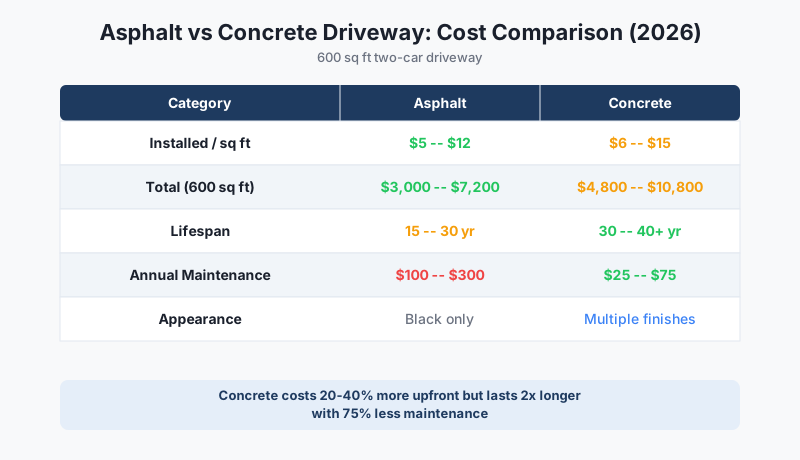
Asphalt driveways cost $5-$12 per square foot installed in 2026, while concrete runs $6-$15 per square foot -- making asphalt the cheaper option upfront by 20-40%. For a standard 600 sq ft two-car driveway, that translates to $3,000-$7,200 for asphalt versus $4,800-$10,800 for concrete. But concrete lasts 30-40+ years with almost no maintenance, while asphalt needs sealing every 2-5 years and typically tops out at 15-30 years. Over a 30-year window, concrete's total cost of ownership is lower in most scenarios despite the higher day-one price.
The asphalt-vs-concrete question is one of the most common conversations homeowners have with a paving contractor. Take a typical 640 sq ft driveway quote in central Pennsylvania: $4,500 for asphalt versus $7,800 for concrete. Choosing asphalt to save $3,300 looks like the obvious call on paper. But here is what often does not come up in that conversation: that asphalt driveway will need its first sealcoat in year 2-3 at around $130, then another every 3-5 years after that, plus crack filling at $200-$400 per round. By year 15, the homeowner will have spent close to $2,000 just keeping the surface together -- and the driveway will still look like a 15-year-old asphalt driveway. A concrete driveway poured the same month, in the same neighborhood, will look almost exactly the same as the day it was finished.
Use our Concrete Calculator to estimate material costs for your specific driveway dimensions, thickness, and finish type.
Side-by-Side Comparison
This table covers every metric that matters when choosing between asphalt and concrete for a residential driveway. All figures reflect 2026 national averages.
| Factor | Asphalt | Concrete |
|---|---|---|
| Material cost/sq ft | $2 - $5 | $3 - $7 |
| Installed cost/sq ft | $5 - $12 | $6 - $15 |
| 600 sq ft driveway (installed) | $3,000 - $7,200 | $4,800 - $10,800 |
| Expected lifespan | 15 - 30 years | 30 - 40+ years |
| Maintenance frequency | Sealcoat every 2 - 5 years | Seal joints every 5 - 10 years |
| Annual maintenance cost | $100 - $300 | $25 - $75 |
| Resale ROI | 70 - 75% | 75 - 80% |
| DIY difficulty | Not recommended | Not recommended |
| Installation time | 1 - 2 days | 3 - 7 days |
| Cure / usable time | 2 - 3 days | 7 - 28 days |
| Appearance options | Black only (standard) | Broom, stamped, exposed aggregate, colored |
| Best climate fit | Cold / freeze-thaw | Hot / stable |
Tip
The installed price gap is smaller than the material price gap. Subgrade prep, grading, drainage, and equipment mobilization cost roughly the same for both materials. Those fixed costs make up 30-50% of the total, which is why a $3/sq ft material difference only translates to a $1-$3/sq ft installed difference.
Asphalt Driveways: Full Cost Breakdown
Asphalt (technically "hot-mix asphalt" or HMA) is a petroleum-based material laid hot and compacted with a roller. The cost structure breaks down into four components that homeowners rarely see itemized.
Material: $2-$5/sq ft. Hot-mix asphalt runs $100-$150 per ton in 2026, and one ton covers roughly 40-80 sq ft at standard 2-3 inch thickness. Prices fluctuate with crude oil -- when oil spikes, asphalt follows within 30-60 days. This is the single biggest variable in asphalt pricing from year to year.
Labor: $2-$4/sq ft. A typical crew of 3-4 workers can pave a 600 sq ft driveway in 4-6 hours. Labor costs are lower than concrete because the skill threshold is lower and the work moves faster.
Base preparation: $1-$3/sq ft. This is the part most homeowners underestimate. A proper asphalt driveway needs 6-8 inches of compacted gravel base, graded for drainage. Skipping or skimping on the base is the number one reason asphalt driveways fail early. If a contractor quotes you significantly below market rate, ask what base depth they are specifying. If the answer is less than 6 inches, find another contractor.
Sealcoating schedule:
- First sealcoat: 6-12 months after installation. Cost: $0.15-$0.25/sq ft ($90-$150 for 600 sq ft).
- Ongoing sealcoats: Every 2-5 years. Same cost per application.
- Crack filling: $1-$3 per linear foot, typically $100-$400 per session starting around year 5-8.
- Patching: $2-$5/sq ft for localized failures.
- Resurfacing: $3-$7/sq ft for a full overlay when the surface is deteriorated but the base is sound. For a 600 sq ft driveway, that is $1,800-$4,200 -- often needed around year 15-20.
Warning
Here is what the paving contractor will not tell you: asphalt sealcoating is not optional. It is structural maintenance. Without it, water penetrates the surface, freezes, expands, and breaks the asphalt from the inside out. An unsealed asphalt driveway in a northern climate can develop alligator cracking within 5-7 years. At that point, you are looking at resurfacing or replacement, not just a coat of sealer.
Concrete Driveways: Full Cost Breakdown
Concrete is a mix of Portland cement, aggregate, sand, and water, poured into forms and finished by hand. It is a more complex installation but a simpler ownership experience.
Material: $3-$7/sq ft. Concrete pricing depends heavily on mix design and finish. A standard 4,000 PSI broom-finish driveway uses basic ready-mix at $140-$160 per cubic yard. One cubic yard covers about 80 sq ft at 4 inches thick. Decorative options push material costs higher.
Labor: $3-$6/sq ft. Concrete work requires more skill than asphalt. Forming, pouring, screeding, floating, finishing, and cutting control joints all demand experienced hands. A 600 sq ft pour typically takes a crew of 4-5 workers a full day, with finishing work extending into day two.
Base preparation: $1-$3/sq ft. Similar to asphalt -- 4-6 inches of compacted gravel, graded for drainage. Concrete also requires formwork ($1-$2/sq ft) and reinforcement (wire mesh or rebar at $0.50-$1.50/sq ft), costs that asphalt does not have.
Finishing options and their cost impact:
- Broom finish (standard): No added cost. Textured surface provides good traction. This is what 70% of residential driveways get.
- Stamped concrete: Adds $3-$8/sq ft. Mimics brick, stone, or slate patterns. Looks impressive but requires periodic resealing ($0.50-$1.00/sq ft every 2-3 years) to maintain color and protect the stamp pattern.
- Exposed aggregate: Adds $2-$5/sq ft. The surface is washed to reveal decorative stone. Durable and attractive, with better traction than smooth finishes.
- Colored concrete: Adds $1-$3/sq ft for integral color mixed into the batch. More consistent than surface-applied stains and does not peel or fade as quickly.
Maintenance costs are minimal for standard broom-finish concrete:
- Joint sealing: Every 5-10 years at $0.50-$1.00 per linear foot of joint. Typical cost: $50-$150 per application.
- Pressure washing: Once per year for appearance, $50-$100 if hired out.
- Crack repair: Concrete cracks are harder and more expensive to fix than asphalt. Expect $5-$15/sq ft for professional repair, and color-matching is nearly impossible on older concrete. The good news: properly poured and jointed concrete cracks far less often than asphalt.
When to Choose Asphalt
Asphalt is the right call in these specific situations. Do not let the longevity argument push you into concrete if your circumstances favor asphalt.
You live in a cold climate with heavy freeze-thaw cycles. Asphalt flexes. Concrete does not. In regions with 50+ freeze-thaw cycles per year -- think Minnesota, Wisconsin, upstate New York, and New England -- asphalt's flexibility is a genuine structural advantage. Concrete in these climates develops surface scaling and spalling from road salt and deicing chemicals, which penetrate the pores and accelerate freeze damage. Asphalt absorbs those same stresses without cracking because the binder has some give. This is why nearly every state DOT in the northern tier uses asphalt for road surfaces.
Your budget is under $5,000 for a 600 sq ft driveway. At the budget end, asphalt can deliver a functional driveway for $3,000-$4,000. Concrete cannot get close to that number. If cash flow is the constraint, a well-installed asphalt driveway with diligent sealcoating will serve you for 15-20 years. That is not a compromise -- it is a practical decision.
You need the driveway usable quickly. Asphalt is ready for light traffic in 2-3 days. Concrete needs 7 days minimum before you drive on it, and 28 days to reach full strength. If you are on a timeline -- maybe a home sale closing, a rental property turnover, or simply cannot park on the street for a month -- asphalt's fast turnaround is a real advantage.
You plan to sell the house within 5-8 years. If you are not staying long enough for concrete's maintenance savings to accumulate, the lower upfront cost of asphalt makes more financial sense. Both materials add similar curb appeal when fresh. A newly sealed asphalt driveway photographs just as well as concrete in listing photos.
When to Choose Concrete
Concrete earns its premium when the long-term math works in your favor and the conditions suit the material.
You plan to stay in the house 15+ years. The total cost crossover between asphalt and concrete happens around year 12-15, depending on maintenance habits and local pricing. After that, concrete's near-zero maintenance costs compound into real savings every year. If this is your forever home, concrete is almost always the better investment.
You live in a hot climate. Asphalt softens in extreme heat. In the Sun Belt -- Arizona, Texas, Florida, southern California -- surface temperatures on asphalt can exceed 150 degrees F, causing the binder to become tacky. You will see tire marks, indentations from parked vehicles, and accelerated surface deterioration. Concrete stays rigid and dimensionally stable in heat. There is a reason most driveways in Phoenix are concrete.
Appearance matters to you. Asphalt is black. That is your option. Concrete comes in broom finish, stamped patterns that mimic brick or flagstone, exposed aggregate with decorative stone, and a range of integral colors. If your driveway is a prominent visual element of the property -- a long approach, a circular drive, or a front-facing garage -- concrete gives you design options that asphalt simply cannot match.
You want to minimize lifetime hassle. A standard broom-finish concrete driveway needs almost nothing. Wash it once a year. Reseal the control joints every 5-10 years. That is the entire maintenance program. Compare that to asphalt's sealcoating, crack filling, and eventual resurfacing, and the convenience gap is significant. If you already skip oil changes and forget to clean the gutters, asphalt's maintenance demands will catch up with you.
Total Cost of Ownership (600 sq ft Driveway)
This is where the real comparison happens. Upfront cost tells one story; total cost tells another. The table below uses midpoint pricing and assumes consistent maintenance for both materials.
| Time Horizon | Asphalt | Concrete |
|---|---|---|
| Installed cost | $5,100 | $7,800 |
| 5-year TCO | $5,700 | $7,950 |
| 10-year TCO | $6,900 | $8,200 |
| 20-year TCO | $9,500 | $8,600 |
| 30-year TCO | $15,200 | $9,200 |
Assumptions: Asphalt maintenance at $200/year average (sealcoat every 3 years at $130, crack filling every 4 years at $250, resurfacing at year 17 for $3,600). Concrete maintenance at $50/year average (joint resealing every 7 years at $100, annual cleaning at $75). Asphalt includes resurfacing once at midlife. Concrete assumes no major repair within 30 years for a properly installed slab.
Warning
The 30-year asphalt number includes a resurfacing. Most asphalt driveways need a full overlay between year 15 and 20, costing $1,800-$4,200 for 600 sq ft. Some will need a second resurfacing or full replacement around year 25-30. If your asphalt base fails (due to poor initial prep or drainage issues), you are looking at full removal and repaving -- essentially the same cost as the original installation.
The crossover point is clear: concrete becomes cheaper than asphalt somewhere between year 12 and year 15. Before that, asphalt's lower upfront cost gives it the edge. After that, concrete's minimal maintenance and superior longevity pull away every year. By year 30, you have spent roughly $6,000 more on asphalt than you would have on concrete -- and the asphalt driveway is near end of life while the concrete still has 10-15 years left.
Regional Pricing Differences
Driveway costs vary significantly by region due to material availability, labor markets, and climate-driven specifications. Here is what to expect across four broad regions in 2026.
| Region | Asphalt (installed/sq ft) | Concrete (installed/sq ft) | Notes |
|---|---|---|---|
| Northeast | $7 - $13 | $8 - $16 | Asphalt dominant. Freeze-thaw climate favors asphalt. Strong paving contractor supply. |
| South | $5 - $10 | $6 - $14 | Concrete dominant. Hot climate softens asphalt. Lower labor costs overall. |
| Midwest | $5 - $11 | $7 - $15 | Mixed market. Cold winters favor asphalt; many homeowners still choose concrete for longevity. |
| West | $6 - $12 | $8 - $18 | Concrete dominant, especially in CA and AZ. Higher labor costs push both materials up. Asphalt less available in desert regions. |
A few regional specifics worth knowing:
- New England and upstate New York are asphalt country. Nearly 80% of residential driveways are asphalt, which means paving contractors are plentiful and competitive. You will get better prices and better work here than in regions where asphalt is uncommon.
- Texas and Florida are concrete territory. The heat makes asphalt impractical for most homeowners, and concrete contractors are everywhere. Stamped and colored concrete is especially popular in these markets.
- Pacific Northwest is a toss-up. The mild but wet climate does not stress either material as much as extreme heat or cold. Price and preference drive the decision more than performance concerns.
- Mountain states (Colorado, Utah, Montana) present the toughest conditions for both materials -- extreme UV, wide temperature swings, and heavy snow loads. Concrete with air-entrained mix and proper control joints performs best here, but costs run 10-15% above national averages.
Frequently Asked Questions
Is an asphalt driveway cheaper than concrete in 2026?
Yes, asphalt is cheaper than concrete upfront in every U.S. market in 2026. A standard 600 sq ft two-car driveway costs $3,000-$7,200 for asphalt versus $4,800-$10,800 for concrete, a difference of roughly $1,800-$3,600 at midpoint pricing. However, "cheaper" depends on your time horizon. Asphalt's ongoing maintenance costs -- sealcoating at $90-$150 every 2-5 years, crack filling at $100-$400, and eventual resurfacing at $1,800-$4,200 -- add up to $4,000-$8,000 over the driveway's lifetime. Concrete maintenance over the same period totals $1,000-$2,000. When you run the 20-year numbers, asphalt costs roughly $9,500 total while concrete comes in at $8,600. The tipping point is around year 12-15 for most projects. If you are staying less than 10 years, asphalt saves money. If you are staying longer, concrete saves money.
How long does an asphalt driveway last compared to concrete?
Asphalt driveways last 15-30 years with proper maintenance, while concrete driveways last 30-40 years or more. The range for asphalt is wide because lifespan depends heavily on three factors: base quality, sealcoating consistency, and climate. An asphalt driveway with a proper 6-8 inch gravel base, sealcoated every 3 years, in a moderate climate can push 25-30 years. The same driveway with a thin base, irregular sealing, and harsh freeze-thaw cycles might need resurfacing by year 12. Concrete's longevity is more predictable because it does not depend on periodic maintenance to maintain structural integrity. A 4-inch, 4,000 PSI concrete slab with proper control joints and drainage will outlast most other elements of the house. The main threats to concrete longevity are tree root heaving, poor subgrade compaction, and heavy deicing salt exposure -- all manageable with proper installation and reasonable care.
Can I pour concrete over an existing asphalt driveway?
Technically yes, but most contractors advise against it and many building codes prohibit it. The issue is that asphalt and concrete expand and contract at different rates. When the asphalt layer beneath flexes with temperature changes, it creates stress on the rigid concrete layer above, leading to reflective cracking -- cracks that telegraph up through the concrete following the asphalt crack pattern below. If you do overlay concrete on asphalt, the asphalt must be in good condition (no alligator cracking, no soft spots, no drainage issues), and the concrete needs to be at least 4 inches thick with proper reinforcement. Most contractors will recommend removing the asphalt entirely, which adds $1-$3/sq ft for demolition and disposal. That puts total conversion cost at $8-$20/sq ft, making it one of the most expensive driveway options. If your asphalt is failing, removal and a fresh concrete pour is almost always the better approach.
Does a concrete driveway add more home value than asphalt?
Both materials add value, but concrete has a slight edge. Industry data from Angi and HomeAdvisor suggest asphalt driveways return 70-75% of their cost at resale, while concrete returns 75-80%. The difference comes down to buyer perception: concrete signals permanence and low maintenance, while asphalt -- especially asphalt showing any wear -- signals future expense. Stamped or decorative concrete can push ROI even higher by contributing to curb appeal that lifts the entire property presentation. In practical terms, a $7,800 concrete driveway adds roughly $5,850-$6,240 to home value, while a $5,100 asphalt driveway adds roughly $3,570-$3,825. The net cost after resale value is similar: about $1,275-$1,950 for asphalt versus $1,560-$1,950 for concrete. Where concrete wins decisively is when the driveway is 10+ years old at time of sale -- aged concrete still looks presentable, while aged asphalt often looks like a liability.
What thickness should a residential driveway be?
For asphalt, the standard residential specification is 2-3 inches of hot-mix asphalt over 6-8 inches of compacted gravel base, for a total pavement section of 8-11 inches. The asphalt layer itself consists of a base course (1.5-2 inches of larger aggregate mix) and a surface course (1-1.5 inches of finer mix). Going thinner than 2 inches total asphalt is asking for premature failure. For concrete, the standard is 4 inches of 4,000 PSI concrete over 4-6 inches of compacted gravel, for a total section of 8-10 inches. If the driveway will handle heavy vehicles -- RVs, delivery trucks, construction equipment -- increase concrete to 5-6 inches and asphalt to 3-4 inches. Your municipality's building code may have specific requirements; check before committing to a design. The base layer is equally important for both materials. A 3-inch asphalt surface on 4 inches of poorly compacted fill will fail faster than a 2-inch surface on 8 inches of properly compacted gravel. Driveways can fail in under 5 years when a contractor skimps on base prep to hit a low bid price.
How do I maintain an asphalt driveway to maximize its lifespan?
Asphalt maintenance follows a predictable schedule if you want to get the full 20-30 year lifespan. First, wait 6-12 months after installation before the first sealcoat -- the asphalt needs to cure and off-gas volatile compounds. After that, sealcoat every 2-5 years depending on climate and traffic (every 2-3 years in harsh northern climates, every 4-5 in moderate ones). A quality coal-tar or asphalt-emulsion sealer costs $0.15-$0.25/sq ft applied, or $90-$150 for a 600 sq ft driveway. Fill cracks as soon as they appear -- hot-pour crack filler at $1-$3 per linear foot stops water infiltration before it causes base damage. Keep the edges maintained; asphalt edges are the most vulnerable to crumbling because they lack lateral support. Avoid parking heavy vehicles in the same spot during extreme heat, which causes depressions. And never use sharp-edged snow removal tools -- a metal-edged snow plow blade will gouge the surface and accelerate deterioration. Rubber-edged plows and plastic shovels only. If you follow this program consistently, you can realistically expect 25+ years from a quality asphalt installation. Skip the sealcoating for even 2-3 cycles and you are looking at resurfacing by year 12-15.
Pricing data sourced from Angi, HomeGuide, HomeAdvisor, and Fixr. All figures reflect 2026 national averages; regional pricing varies. Use our Concrete Calculator for a personalized driveway estimate.
This article is provided for informational and educational purposes only. Content should not be considered professional financial, medical, legal, or other advice. Always consult a qualified professional before making important decisions. UseCalcPro is not responsible for any actions taken based on the information in this article.
Try These Calculators
Compare asphalt vs concrete driveway lifetime cost: lower asphalt upfront vs sealcoating and resurfacing over 30 years. See the break-even year and which wins.
Enter your slab dimensions to get concrete volume in cubic yards, bags needed, and estimated cost. Works for patios, footings, driveways, and columns.
Estimate 2026 asphalt driveway install cost by size, thickness, and region. New paving runs $7-$13/sqft; replacement $8-$15/sqft; overlay $3-$7/sqft all-in.
Estimate 2026 concrete driveway install cost by size, finish, and region. Plain runs $6-$10/sqft; decorative stamped $10-$21/sqft installed nationwide.