DIY vs Contractor: Home Renovation Costs in 2026 (Real Comparison)
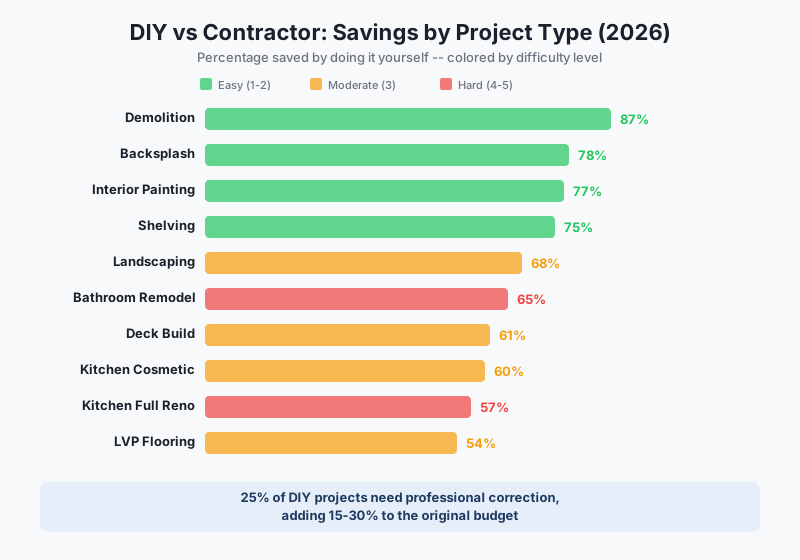
DIY renovation saves 40-60% on projects where labor is the dominant cost, but one in four DIY projects requires professional correction that adds 15-30% to the original budget. Labor accounts for 50-60% of total renovation cost nationally, which means a $48,000 kitchen remodel includes $24,000-$29,000 in labor alone. Cut that labor out and you keep a serious chunk of money. But cut it out on the wrong project and you pay twice -- once for your attempt, once for the contractor who fixes it.
A familiar scenario in residential construction: a homeowner rips out bathroom tile, hits a supply line, and ends up calling in a professional in a panic with water running through the subfloor. That call often runs $4,200 -- the plumber, the water damage remediation, the new subfloor, and the labor to finish what was started. The original contractor quote for the full bathroom remodel was $11,000. The homeowner thought they were saving $6,000. They ended up spending $15,200. That is the reality this article addresses: which projects actually save you money DIY, and which ones will cost you more than if you had just written the check.
Use our Home Renovation Estimator Calculator to get a personalized cost breakdown for your specific project, including labor, materials, and permit fees.
DIY vs Contractor: 10 Common Projects Compared
This table is the honest comparison. Not internet fluff, not contractor marketing -- just the numbers drawn from real invoices and material receipts across dozens of projects a year. DIY costs assume you already own basic hand tools (drill, saw, level) but need to buy or rent specialty equipment.
| Project | Pro Cost | DIY Cost | Savings | DIY Difficulty (1-5) | Permit Required? |
|---|---|---|---|---|---|
| Interior painting (whole house) | $4,000 - $10,000 | $800 - $2,000 | 75 - 80% | 1 | No |
| Laminate/LVP flooring (1,000 sq ft) | $6,000 - $12,000 | $3,000 - $5,000 | 50 - 58% | 2 | No |
| Deck build (320 sq ft, PT wood) | $8,000 - $20,000 | $3,000 - $8,000 | 60 - 63% | 3 | Yes |
| Landscaping (full yard) | $5,000 - $15,000 | $1,500 - $5,000 | 67 - 70% | 2 | Rarely |
| Bathroom remodel (full) | $10,000 - $30,000 | $3,000 - $12,000 | 60 - 70% | 4 | Yes (plumbing/electrical) |
| Kitchen remodel (cosmetic) | $10,000 - $25,000 | $4,000 - $10,000 | 60% | 3 | No |
| Kitchen remodel (full gut) | $25,000 - $75,000 | $10,000 - $30,000 | 55 - 60% | 5 | Yes |
| Tile backsplash | $1,500 - $3,500 | $300 - $800 | 77 - 80% | 2 | No |
| Shelving/built-ins | $2,000 - $6,000 | $500 - $1,500 | 75% | 2 | No |
| Demolition (interior, non-structural) | $1,500 - $5,000 | $200 - $600 | 87 - 88% | 1 | Sometimes |
Tip
The savings percentage drops fast when you factor in mistakes. That 60% savings on a bathroom remodel assumes you get the tile, plumbing connections, and waterproofing right on the first attempt. If you have never set tile on a shower wall or soldered a copper joint, budget an extra 20% for materials you will waste learning.
What DIY Actually Saves You
The real savings in DIY are straightforward: you are eliminating the labor markup. Here is how the money breaks down on a typical renovation.
Labor is the biggest line item. Contractor hourly rates run $50-$150 depending on the trade and region. A general contractor charges $50-$80/hr. Electricians and plumbers bill $75-$150/hr. On a $48,000 renovation (the 2025 national average according to Houzz), $24,000-$29,000 is pure labor. That is the pool of money DIY draws from.
Material costs are identical. You pay the same price for a sheet of drywall whether you are a licensed contractor or a weekend warrior. In fact, contractors sometimes pay less because they buy in volume. The idea that DIY saves on materials is a myth -- it saves on labor, period.
Where the math works in your favor:
- High-labor, low-skill projects -- painting is the textbook example. Professional painters charge $3-$7/sq ft. Paint and supplies cost $1-$3/sq ft. You are paying $2-$4/sq ft purely for someone to roll paint on a wall. If you can operate a roller and cut a straight line with painter's tape, there is no reason to pay that premium.
- Repetitive tasks with a learning curve under one hour -- click-lock LVP flooring, fence staining, basic landscaping. You figure out the technique on the first section and then it is just repetition.
- Demolition -- swinging a sledgehammer does not require a license. Demo is often 5-10% of a remodel budget and can be done in a weekend with a dumpster rental ($300-$500).
The time trade-off nobody talks about:
DIY takes 3-10x longer than professional work. A crew of three painters will finish a 2,000 sq ft house interior in 2-3 days. You will spend 3-4 weekends. A flooring crew lays 1,000 sq ft of LVP in a day. You are looking at 3-5 days working alone. If your time has a dollar value -- and it does -- factor that into the savings calculation. At $40/hr of personal time, a 60-hour DIY flooring job "costs" $2,400 in time. That does not show up on a receipt, but it is real.
What DIY Actually Costs You
Here is what the YouTube tutorials leave out.
Tool investment. Basic hand tools are not enough for most renovations. A major remodel requires $500-$3,000 in tools you may never use again:
- Tile wet saw rental: $50-$75/day
- Miter saw (decent quality): $250-$400
- Floor nailer rental: $40-$60/day
- Drywall lift rental: $40-$50/day
- Paint sprayer: $150-$400
- Concrete mixer rental: $75-$100/day
If you only use a $350 miter saw once and it sits in the garage for a decade, that is not a savings -- it is a storage fee.
Mistakes and rework. According to the National Association of the Remodeling Industry (NARI), approximately 25% of DIY renovation projects require some degree of professional correction. That correction adds 15-30% to the original project cost. Common expensive mistakes:
- Cutting tile wrong -- a $4/sq ft porcelain tile cracked on the last cut means buying another box. Four bad cuts and you have burned $100-$200 in wasted material.
- Improper waterproofing -- the most expensive DIY mistake in bathrooms. If your shower pan fails, you are looking at mold remediation ($1,500-$5,000), subfloor replacement ($500-$1,500), and retiling. $3,000 DIY showers commonly turn into $12,000 repair projects.
- Unlevel flooring -- LVP is forgiving, but not that forgiving. Subfloor prep is boring and nobody wants to do it. Skip it, and your floor develops gaps at the seams within a year.
- Electrical errors -- a crossed wire or improper junction box is not just a code violation. It is a fire hazard. This is where DIY stops being about money and starts being about safety.
Permit and insurance problems. Many jurisdictions require a licensed contractor to pull permits for electrical, plumbing, and structural work. If you do unpermitted work and your insurance company finds out -- say, during a claim for water damage -- they can deny the claim. That is not a hypothetical. It happens.
No warranty. Professional work typically comes with a 1-5 year workmanship warranty. If the contractor's tile cracks or the plumbing leaks within that window, they fix it at their expense. Your DIY work has no warranty. If the shower leaks in month six, that is your Saturday and your wallet.
Projects You Should Always DIY
These are the projects where DIY is almost always the right call. Low risk, high savings, minimal skill required.
Interior painting. This is the single best DIY project in terms of return on time invested. Materials run $800-$2,000 for a whole-house interior. Professionals charge $4,000-$10,000 for the same job. The savings are enormous and the risk of catastrophic failure is essentially zero. You might get some drips on the trim. Nobody is calling a remediation company for drips on the trim.
Demolition. Tearing out old cabinets, ripping up carpet, removing non-load-bearing drywall -- this is where you save your contractor a full day of labor at $500-$1,000 per day. Rent a dumpster, buy safety glasses and a respirator, and go to town. Just confirm with your contractor which walls are structural before you start swinging. Hitting a load-bearing wall without knowing it is how ceilings sag.
Landscaping and yard work. Grading, planting, mulching, building raised beds, laying pavers for a simple patio -- all of it is physically demanding but requires no special license or expertise. Professional landscapers charge $50-$100/hr. You can achieve the same result with a weekend, a rented Bobcat ($250-$400/day for major grading), and a trip to the nursery.
Click-lock flooring (LVP and laminate). Modern click-lock systems are explicitly designed for DIY installation. No glue, no nails, no specialty tools beyond a pull bar and a rubber mallet. The key is subfloor prep -- if you spend the time leveling the subfloor with self-leveling compound, the installation itself is almost foolproof.
Shelving and closet systems. A custom closet company charges $2,000-$6,000 for what is essentially $300-$800 in materials from a home center. You need a level, a stud finder, a drill, and an afternoon. The Elfa, ClosetMaid, and IKEA PAX systems are all designed for homeowner installation.
Projects You Should Never DIY
These are non-negotiable. The risks -- physical, financial, and legal -- outweigh any possible savings.
Electrical panel upgrades and new circuits. Working inside a breaker panel exposes you to 200+ amps of current. A mistake does not trip a breaker and give you a do-over. It arcs, it burns, or it kills. Virtually every jurisdiction requires a licensed electrician for panel work, and for good reason. The permit inspection exists to verify that the work will not burn your house down. Cost to hire: $1,500-$4,000 for a panel upgrade. Cost of getting it wrong: everything you own.
Plumbing rough-in. Running new supply and drain lines through walls and floors is a code-intensive job. Drain lines need specific slopes (1/4 inch per foot for most residential drains). Vent stacks need to terminate above the roofline. Supply lines need proper support and insulation in exterior walls. A failed plumbing inspection means ripping open the walls you just closed up. A plumbing leak inside a wall that you do not catch means mold, rot, and five-figure remediation bills.
Structural work. Removing or modifying load-bearing walls, adding headers, sistering joists, foundation repair -- all of this requires an engineer's calculation and a licensed contractor's execution. DIY load-bearing wall removals sometimes happen because a homeowner "thought it was just a partition wall." The ceiling sagged an inch within a month. The repair cost $18,000. The original removal and proper header installation would have been $3,500.
Roofing. Beyond the code and warranty issues (most shingle manufacturers void the warranty if a non-licensed installer does the work), roofing is physically dangerous. According to the Bureau of Labor Statistics, falls from roofs account for one-third of all construction fatalities. A professional roofing crew works with harnesses, scaffolding, and fall arrest systems that cost thousands of dollars. You should not be on a roof without them.
HVAC installation and gas lines. Gas lines and refrigerant handling require specific licensing in every state. An improperly connected gas line is an explosion risk. An improperly charged HVAC system runs inefficiently, fails prematurely, and voids the equipment warranty. This is one area where the "savings" from DIY can literally cost lives.
Warning
Building codes exist for a reason. Every project on this "never DIY" list involves a system that, when installed incorrectly, can cause injury, death, or catastrophic property damage. The $2,000-$5,000 you save by doing your own electrical is not worth the risk of a house fire. Period.
The Hybrid Approach: DIY + Pro
Here is what the contractor will not tell you: the smartest homeowners do not go full DIY or full contractor. They split the project and handle the parts that save the most money with the least risk.
The hybrid strategy works like this:
-
Demo yourself. Rip out the old stuff -- cabinets, flooring, drywall, fixtures. This saves the contractor 1-3 days of labor ($500-$2,000). Just coordinate with them first so you do not remove something they need to see (like the condition of the subfloor or the existing wiring routing).
-
Hire licensed trades for rough-in. Electrical, plumbing, HVAC, and structural work get done by licensed professionals. They pull the permits, they pass the inspections, and their work is warrantied. This is non-negotiable.
-
Do your own finishing work. After the rough-in passes inspection, you handle painting, flooring installation, trim, backsplash tile, shelving, and light fixture installation (on circuits already wired by the electrician). These are the high-labor, low-risk tasks where your time directly replaces contractor billing hours.
-
Handle your own cleanup. Dumpster rental and final cleanup are another 1-2 days of contractor labor you can easily handle.
The hybrid approach typically saves 25-35% compared to full contractor pricing while keeping all the high-risk work in professional hands. On a $48,000 full renovation, that is $12,000-$17,000 back in your pocket. Not as much as full DIY would save on paper, but you actually keep the savings because you are not paying for rework.
Total Cost Comparison: Full Kitchen Remodel
A kitchen remodel is the most common renovation in America and the best illustration of how DIY, contractor, and hybrid approaches compare in practice. These numbers assume a 150 sq ft kitchen with mid-range finishes.
| Line Item | Full Contractor | Full DIY | Hybrid Approach |
|---|---|---|---|
| Demolition | $1,500 | $200 | $200 (DIY) |
| Cabinets (materials) | $6,000 | $6,000 | $6,000 |
| Cabinet installation | $2,500 | $0 (DIY) | $0 (DIY) |
| Countertops (materials + fabrication) | $4,000 | $4,000 | $4,000 |
| Countertop install | $800 | $0 (DIY) | $800 (Pro -- templating is precise) |
| Plumbing rough-in | $2,500 | $2,500 (must hire) | $2,500 (Pro) |
| Electrical rough-in | $2,000 | $2,000 (must hire) | $2,000 (Pro) |
| Flooring (LVP, 150 sq ft) | $1,800 | $600 | $600 (DIY) |
| Backsplash tile | $1,500 | $400 | $400 (DIY) |
| Painting | $1,200 | $300 | $300 (DIY) |
| Fixtures + hardware | $1,500 | $1,500 | $1,500 |
| Appliances | $5,000 | $5,000 | $5,000 |
| Permit fees | $500 | $500 | $500 |
| Dumpster + cleanup | $800 | $400 | $400 (DIY) |
| Tool rental/purchase | $0 | $1,200 | $600 |
| Contingency (mistakes) | $0 | $2,500 | $500 |
| Total | $31,600 | $26,600 | $25,300 |
| Savings vs. full contractor | -- | $5,000 (16%) | $6,300 (20%) |
The numbers tell the story. Full DIY on a kitchen remodel does not save as much as people expect because you still have to hire licensed trades for electrical and plumbing. And the contingency line -- the $2,500 for mistakes -- is not pessimism. It reflects what commonly turns up when a professional gets called in to fix things halfway through a kitchen project: bad tile cuts, cabinets that are not level, flooring that buckles at the transitions.
The hybrid approach actually saves more than full DIY in this example because it avoids the $2,500 mistake contingency while still capturing savings on demo, painting, flooring, and backsplash. That is the counterintuitive result: doing less yourself can save you more money.
Use our Home Renovation Estimator Calculator to run your own numbers for any room, any scope, and any approach.
Frequently Asked Questions
Is it cheaper to renovate a house yourself or hire a contractor?
DIY renovation is cheaper on paper for most projects, with typical savings of 40-60% on labor-dominated work like painting, flooring, and landscaping. However, the actual savings depend entirely on your skill level and the project complexity. The national average renovation spend is $48,000 according to Houzz's 2025 study, with labor accounting for 50-60% of that total. On a straightforward project like interior painting, DIY savings are real and substantial -- you keep $3,000-$8,000 that would have gone to labor. But on complex projects like bathroom remodels, roughly 25% of DIY attempts require professional correction that adds 15-30% to the original cost, according to NARI data. The safest approach is a hybrid model: hire licensed trades for plumbing, electrical, and structural work, then handle demo, painting, flooring, and finish work yourself.
- Best DIY savings: painting (75-80%), demolition (87-88%), shelving (75%)
- Moderate DIY savings: flooring (50-58%), decks (60-63%)
- Risky DIY savings: full kitchen (16% after mistakes), bathroom (variable)
- Rule of thumb: if the project needs a permit, hire a pro for that portion
How much does a contractor charge per hour in 2026?
Contractor hourly rates in 2026 range from $50 to $150 per hour depending on the trade, region, and project complexity. General contractors and handymen charge $50-$80/hr for tasks like trim carpentry, drywall repair, and general finish work. Specialized trades command higher rates: electricians bill $75-$130/hr, plumbers charge $80-$150/hr, and HVAC technicians run $75-$125/hr. These rates vary significantly by region -- a plumber in rural Tennessee charges $60-$80/hr while the same work in San Francisco runs $120-$150/hr. Most contractors also build in overhead (insurance, vehicle, tools, licensing) that adds 15-25% beyond the hourly rate. When comparing DIY savings, multiply the hourly rate by realistic project hours, not the optimistic estimate the contractor gives you.
- General contractor: $50 - $80/hr
- Electrician: $75 - $130/hr
- Plumber: $80 - $150/hr
- HVAC technician: $75 - $125/hr
- Roofer: $50 - $80/hr (but projects are bid per square, not hourly)
What home renovations should you never do yourself?
Five categories of renovation should never be DIY regardless of your skill level: electrical panel work, plumbing rough-in, structural modifications, roofing, and gas line work. Every one of these involves either life-safety risk, code compliance requirements, or both. Electrical panel work exposes you to 200+ amps -- a mistake does not trip a breaker, it causes an arc flash or fire. Plumbing rough-in requires specific drain slopes (1/4 inch per foot) and proper venting to code, and a failed inspection means ripping open finished walls. Structural work -- removing load-bearing walls, adding headers, modifying joists -- requires an engineer's calculation and can cause catastrophic collapse if done incorrectly. Roofing is the deadliest construction trade according to BLS data, and most shingle warranties require licensed installation. Gas lines require specific licensing in every state because an improper connection creates explosion risk.
- Electrical panel: 200+ amp exposure, arc flash risk, permit required everywhere
- Plumbing rough-in: code-specific slopes, venting rules, hidden leak risk
- Structural: engineer calcs required, collapse risk, $10,000+ correction cost
- Roofing: fall risk (1/3 of construction fatalities), warranty voided without license
- Gas lines: explosion risk, state licensing required, no margin for error
Does DIY renovation affect home insurance?
Yes, DIY renovation can affect your homeowner's insurance coverage in several important ways. If you perform work that requires a permit -- electrical, plumbing, structural, or HVAC -- without pulling that permit and passing inspection, your insurance company can deny claims related to that work. For example, if you rewire a bathroom yourself without a permit and an electrical fire starts in that bathroom, the insurer can investigate, find the unpermitted work, and deny the claim entirely. This is not theoretical -- it happens regularly during claims investigations. Additionally, some policies have exclusions for damage caused by workmanship defects. If your DIY plumbing fails and causes water damage, the insurer may cover the water damage but not the plumbing repair itself. The safest approach is to always pull permits when required, hire licensed professionals for code-regulated work, and notify your insurance company of any major renovation that changes the home's value or systems.
- Unpermitted work: insurer can deny related claims
- Workmanship exclusion: damage from DIY defects may not be covered
- Liability: injuries to helpers on your property are your responsibility
- Notification: major renovations should be reported to your insurer
- Protection: keep all permits, inspection records, and contractor licenses on file
How long does a DIY renovation take compared to hiring a contractor?
DIY renovation takes 3-10 times longer than professional work, depending on the project scope and your experience level. A professional painting crew of three finishes a 2,000 sq ft house interior in 2-3 days. A solo DIYer spends 3-4 full weekends -- roughly 10-15 working days spread over a month. A flooring crew installs 1,000 sq ft of LVP in a single day. Working alone, expect 3-5 full days. A full kitchen remodel that takes a contractor crew 3-4 weeks will take a DIYer working evenings and weekends anywhere from 3-6 months. The extended timeline is not just inconvenient -- it means living in a construction zone for months, eating takeout because your kitchen is torn apart, and losing motivation halfway through when the project drags on longer than expected. This is the hidden cost of DIY that does not appear in any cost comparison: the impact on your daily quality of life during the project.
- Painting (whole house): 2-3 days (pro) vs 3-4 weekends (DIY)
- Flooring (1,000 sq ft): 1 day (pro) vs 3-5 days (DIY)
- Kitchen remodel: 3-4 weeks (pro) vs 3-6 months (DIY)
- Bathroom remodel: 2-3 weeks (pro) vs 2-4 months (DIY)
- Deck build: 3-5 days (pro) vs 3-6 weekends (DIY)
What tools do I need for a major DIY renovation?
A major DIY renovation requires $500-$3,000 in tools beyond what most homeowners already own, and this cost is frequently overlooked in DIY savings calculations. Your existing drill, hammer, and tape measure are not enough. A kitchen or bathroom remodel requires at minimum: a miter saw ($250-$400 for a quality 10-inch model), a tile wet saw ($50-$75/day rental), a floor nailer or pull bar ($40-$60/day rental), a drywall lift for ceiling work ($40-$50/day rental), painter's tape and drop cloths ($50-$100), and various specialty bits, blades, and adhesives ($100-$200). If you are doing multiple rooms, buying a miter saw and a quality circular saw makes sense. For one-time projects, rent everything you can. Home Depot and Lowe's tool rental departments offer daily and weekly rates that are a fraction of purchase price. The honest calculation is: add up every tool you need, subtract what you already own, price the rest as purchases or rentals, and include that number in your DIY budget before deciding whether the savings are worth it.
- Buy (multi-use): miter saw ($250-$400), circular saw ($100-$200), impact driver ($100-$150)
- Rent (one-time): tile wet saw ($50-$75/day), floor nailer ($40-$60/day), dumpster ($300-$500)
- Consumables: blades, bits, adhesives, sandpaper, caulk ($100-$200 per project)
- Safety gear: respirator ($30-$50), safety glasses ($15), ear protection ($15-$30)
- Rule of thumb: if you will use a tool on 3+ future projects, buy it; otherwise, rent
Cost data sourced from Angi, HomeAdvisor, Houzz 2025 Renovation Barometer, and NARI. Contractor rates reflect national averages; actual prices vary by region, season, and market conditions. All figures current as of March 2026.
This article is provided for informational and educational purposes only. Content should not be considered professional financial, medical, legal, or other advice. Always consult a qualified professional before making important decisions. UseCalcPro is not responsible for any actions taken based on the information in this article.
Try These Calculators
Estimate 2026 bathroom remodel cost by size, scope, and tier. Mid-range full baths run $16,000-$28,000; luxury master baths $50,000+ with stone and custom.
Estimate 2026 professional irrigation install cost by yard size, zones, and drip vs spray. Most quarter-acre systems run $3,500 to $8,000 with 4 to 6 zones.
Estimate 2026 bartending service costs by guest count, hours, and add-ons. A bartender for a party runs $40 to $75 per hour or $250 to $700 flat per event.
Estimate 2026 event security costs by guest count, hours, and guard type. Unarmed officers run $25-$40/hr and armed $40-$75/hr, with a 4-hour minimum.