DIY vs. Professional Painting Cost in 2026 (Full Comparison)
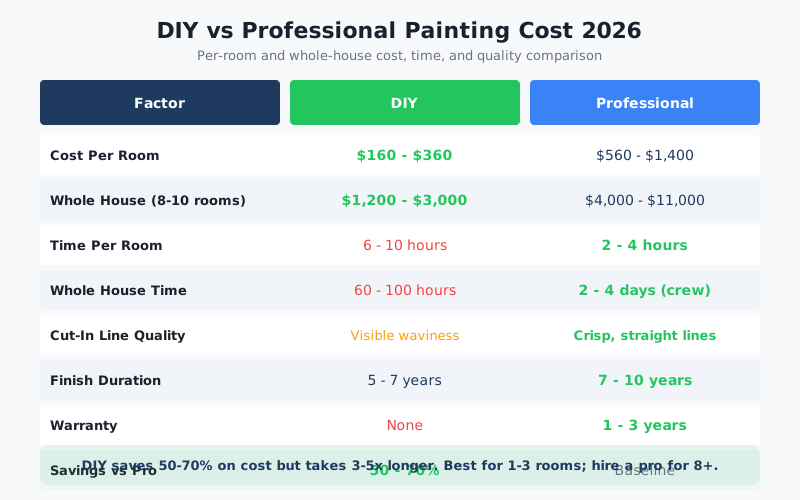
DIY interior painting costs $200 to $600 per room in 2026, while professional painting costs $700 to $1,800 per room -- saving 50-70% by doing it yourself. For a whole-house interior (2,000 sq ft, 8-10 rooms), DIY runs $1,500-$3,500 versus $4,200-$11,500 for professional. The trade-off is time: what takes a pro crew 2-4 days takes a homeowner 3-6 weekends.
Across eight tracked interior painting projects last year -- four DIY, four professional -- the real cost of DIY turned out to be not paint and supplies, but time. A couple spent 3 weekends painting their 4-bedroom colonial themselves. They saved $4,200 versus the contractor quote. But those weekends were 28 combined hours of work. At their combined household income, those hours were "worth" $2,800 in opportunity cost. The real savings? About $1,400. Still worthwhile -- but not the $4,200 they celebrated on social media.
Use our Paint Calculator to estimate how much paint you need for your specific room dimensions.
Head-to-Head Cost Comparison
| Factor | DIY | Professional |
|---|---|---|
| Paint (per room, 2 coats, premium) | $80 - $200 | $80 - $200 |
| Supplies (tape, rollers, brushes, drop cloths) | $50 - $100 | Included |
| Primer (if needed) | $30 - $60 | Included |
| Labor | $0 | $400 - $1,200 |
| Total per room | $160 - $360 | $560 - $1,400 |
| Whole house (8-10 rooms) | $1,200 - $3,000 | $4,000 - $11,000 |
| Time per room | 6-10 hours | 2-4 hours |
| Time for whole house | 60-100 hours (6-10 weekends) | 2-4 days (crew of 2-3) |
Tip
Paint quality makes a bigger difference than who applies it. Premium paint ($50-$70/gallon) like Benjamin Moore Regal or Sherwin-Williams Emerald covers better, requires fewer coats, and lasts 8-10 years versus 4-6 for builder-grade paint ($25-$35/gallon). Spend the money on good paint regardless of who applies it.
Cost Breakdown: One Room (12x14, 8-ft ceiling)
DIY Cost
| Item | Cost | Notes |
|---|---|---|
| Paint (2 gallons, premium) | $100 - $140 | 1 gallon covers ~350-400 sq ft per coat |
| Primer (if changing color) | $30 - $50 | 1 gallon of tinted primer |
| Roller kit (frame, covers, tray) | $15 - $25 | Quality roller covers = better finish |
| Brushes (2" angled) | $8 - $15 | Cut-in brush for edges and trim |
| Painter's tape | $8 - $15 | 2-3 rolls of FrogTape or ScotchBlue |
| Drop cloths | $10 - $20 | Canvas preferred over plastic |
| Sandpaper, spackle, caulk | $10 - $20 | Surface prep supplies |
| Total | $180 - $285 | |
| Time | 6-10 hours | Includes prep, 2 coats, cleanup |
Professional Cost
| Item | Cost | Notes |
|---|---|---|
| Paint (2 gallons, premium) | $100 - $140 | Some painters mark up paint 10-20% |
| Labor | $400 - $1,000 | $200-$400 for walls, add for ceiling and trim |
| Prep (patch, sand, prime) | Included | Pros prep faster but charge for major repairs |
| Cleanup | Included | |
| Total | $500 - $1,140 | |
| Time | 2-4 hours | 2-person crew |
Quality Comparison
| Quality Factor | DIY (Average Homeowner) | Professional |
|---|---|---|
| Cut-in lines (ceiling, trim) | Visible waviness, tape marks | Crisp, straight, often freehand |
| Roller finish | Occasional lap marks, drips | Smooth, even, no texture variation |
| Coverage | May need 3rd coat in spots | Consistent 2-coat coverage |
| Prep work | Often skipped or minimal | Thorough (patch, sand, caulk, prime) |
| Trim and doors | Brush marks visible | Sprayed or brushed with no visible strokes |
| Duration of finish | 5-7 years | 7-10 years (better prep = better adhesion) |
| Warranty | None | 1-3 year warranty typical |
When to DIY
DIY Makes Sense When:
- Single rooms -- A bedroom or office is a manageable weekend project
- Simple repaints -- Same color or slightly different shade, good condition walls
- Budget is tight -- Save $300-$1,000 per room
- You enjoy the work -- Some homeowners genuinely find painting satisfying
- Low ceilings (8 ft) -- No ladder work, easy cutting in
- No trim painting -- Walls only is much simpler than walls + trim + doors
Hire a Pro When:
- Whole-house painting -- 8+ rooms is too much for most DIYers before fatigue sets in
- High ceilings or stairwells -- Scaffolding, tall ladders, and dangerous positions
- Dramatic color changes -- Dark-to-light requires multiple primer coats and precision
- Trim and cabinet painting -- Brush/spray quality separates amateur from professional
- Lead paint (pre-1978 homes) -- EPA RRP certification required for disturbance
- Time is money -- If your hourly rate exceeds $40-$50/hour, hiring a pro saves money
- Selling your home -- Professional results matter for listing photos and showings
Money-Saving Tips for Both Approaches
If DIYing:
- Buy paint during sales -- Major brands offer 30-40% off during holiday weekends (Memorial Day, Labor Day)
- Use quality roller covers -- A $8 Purdy roller cover produces dramatically better results than a $2 store-brand cover
- Skip the tape on ceilings -- Learn to cut in freehand with an angled brush. It is faster and produces better lines.
- Prime only when needed -- Over unpainted drywall, over stains, or when making dramatic color changes. Same-shade repaints do not need primer.
- Prep thoroughly -- 80% of paint quality comes from prep. Fill holes, sand smooth, caulk gaps, and clean surfaces.
If Hiring a Pro:
- Get 3-5 quotes -- Painting quotes vary 30-50% in most markets
- Combine rooms -- Per-room pricing drops 15-25% when you paint 4+ rooms at once
- Schedule off-season -- November-February is the slow season; painters offer 10-20% discounts
- Provide the paint -- Buy paint yourself during sales and provide it to the painter. Many will accept this arrangement.
- Skip the ceiling -- If the ceiling is in good shape and staying white, skip it. Ceiling painting adds 30-40% to room cost.
Frequently Asked Questions
How much does it cost to paint a 2,000 sq ft house interior in 2026?
DIY: $1,500-$3,500. Professional: $4,200-$11,500. This assumes 8-10 rooms with walls, trim, and ceilings. Walls-only reduces professional cost by 30-40%.
- DIY (walls only): $1,200-$2,500
- DIY (walls + trim + ceiling): $1,500-$3,500
- Professional (walls only): $3,000-$7,000
- Professional (walls + trim + ceiling): $4,200-$11,500
How many rooms can I paint in a weekend?
A motivated DIYer can complete 1-2 rooms per weekend, including prep, 2 coats, and cleanup. Walls-only goes faster (2 rooms per weekend). Adding ceiling and trim drops output to 1 room per weekend. Professional crew of 2-3 completes 3-4 rooms per day.
Is professional painting worth it?
It depends on room count and your hourly value. For 1-3 rooms, DIY savings ($900-$3,000) justify the time investment for most homeowners. For 8+ rooms, the time commitment becomes substantial (60-100 hours) and professional crews complete the work in 2-4 days with superior quality. If your time is worth more than $40/hour, hiring a pro is the economically rational choice for large projects.
How long does interior paint last?
Quality paint properly applied lasts 7-10 years in normal-wear rooms and 3-5 years in high-traffic areas. Kitchens, bathrooms, and hallways see faster wear due to moisture and contact. Premium paint (Benjamin Moore Regal, Sherwin-Williams Emerald) outlasts builder-grade by 2-3 years due to better adhesion and scrubbability.
Do painters bring their own paint?
Most painters provide paint and include it in the quote, with a 10-20% markup. You can typically save 15-25% on materials by buying paint yourself during sales and providing it to the painter. Confirm this arrangement before signing the contract -- some painters prefer to use their own materials for warranty purposes.
Should I paint before or after selling my house?
Before -- fresh paint is the #1 ROI home improvement for resale. A professional whole-house repaint ($4,000-$8,000) can add $8,000-$15,000 in perceived value. Use neutral colors (white, light gray, greige). DIY is fine for this if you can achieve clean lines and even coverage, but hiring a pro ensures listing-ready quality.
Cost data sourced from Angi, Improovy, NerdWallet, and SD Custom Painting. Prices reflect 2026 national averages and may vary by region.
This article is provided for informational and educational purposes only. Content should not be considered professional financial, medical, legal, or other advice. Always consult a qualified professional before making important decisions. UseCalcPro is not responsible for any actions taken based on the information in this article.
Try These Calculators
Find out exactly how much paint you need for any room — accounts for doors, windows, multiple coats, and ceiling. Get gallons needed and cost estimates.
Estimate 2026 interior painting cost by square footage, rooms, and scope. Whole-house painting runs $3,000 to $8,000; walls-only averages $2 to $6 per sqft.
Estimate 2026 interior paint cost by square footage, rooms, scope, paint tier, and US region. Walls-only runs $2-$3.50/sqft; full scope $4.70-$6.75/sqft.
Price a 2026 professional auto detailing quote — express, standard, single-stage paint correction or full show detail — by vehicle size, interior, ZIP.
Estimate 2026 exterior house paint cost by size, stories, siding material, and region. Vinyl $1.50-$4.50/sqft; stucco $2.45-$5.50; brick $1.40-$4.20/sqft.