Composite vs. Wood Deck Cost in 2026: Which Saves More Long-Term?
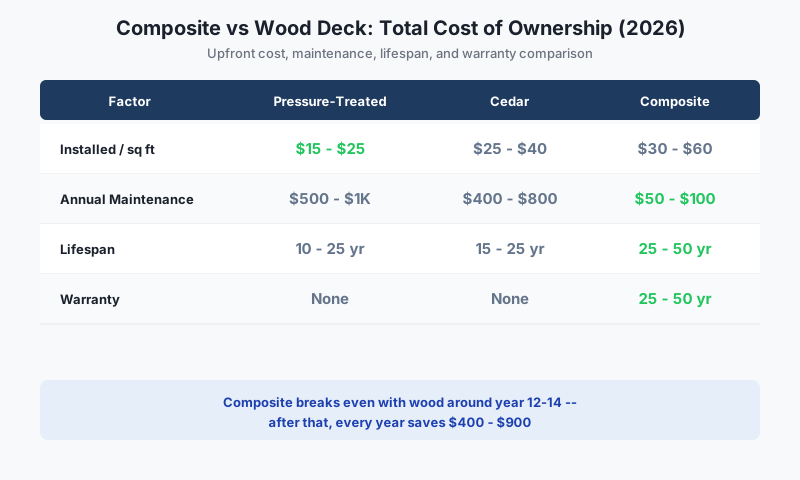
Composite decking costs $30-$60 per square foot installed in 2026, roughly double the $15-$25/sq ft price of pressure-treated wood -- but composite's near-zero maintenance means it costs less over 20 years. For a standard 320 sq ft deck, pressure-treated wood totals about $16,000 over 20 years (including stain, seal, and board replacements), while composite holds at roughly $14,400. The crossover point where composite becomes cheaper is somewhere around year 12-14 for most projects.
The composite-vs-wood conversation comes up on nearly every decking project. Consider two nearly identical 16x20 decks built three miles apart in northern Virginia -- one in Trex Transcend, one in pressure-treated southern pine. The PT deck cost $6,400 installed. The composite came to $13,800. On paper, the wood deck looks like a slam dunk. But eight months later, the PT deck's homeowner was already on his knees with a pressure washer and a $180 bucket of semi-transparent stain, while the composite homeowner was reading a book on his deck. That is the gap this article tries to put a number on.
Use our Deck Calculator to get a personalized estimate based on your exact dimensions, material choice, and maintenance schedule.
Side-by-Side Cost Comparison
The table below compares the three most common residential decking materials on every metric that matters: upfront cost, maintenance burden, lifespan, and warranty coverage.
| Factor | Pressure-Treated Wood | Cedar | Composite |
|---|---|---|---|
| Material cost/sq ft | $2 - $5 | $5 - $9 | $6 - $12 |
| Installed cost/sq ft | $15 - $25 | $25 - $40 | $30 - $60 |
| 320 sq ft installed | $4,800 - $8,000 | $8,000 - $12,800 | $9,600 - $19,200 |
| Expected lifespan | 10 - 25 years | 15 - 25 years | 25 - 50 years |
| Annual maintenance | $500 - $1,000 | $400 - $800 | $50 - $100 |
| Maintenance type | Stain/seal every 2-3 years | Seal every 1-2 years | Soap and water |
| Warranty | None (typical) | None (typical) | 25 - 50 years |
| DIY difficulty | Easier (standard tools) | Moderate | Moderate (hidden fasteners) |
| Resale ROI | 65 - 75% | 65 - 75% | 65 - 75% |
Tip
Material cost is only 30-40% of the installed price. The rest is labor, fasteners, framing, and footings -- costs that are nearly identical regardless of what boards you put on top. That is why the installed price gap between wood and composite is smaller than the raw material gap suggests.
Pressure-Treated Wood: Pros and Cons
Pressure-treated lumber remains the most popular decking material in the United States, and for good reason. A 5/4x6 PT board at 16 feet costs $18-$28 at major retailers in 2026, making it the most accessible entry point for homeowners on a budget.
Where PT wood wins:
- Lowest upfront cost. At $15-$25/sq ft installed, a 320 sq ft PT deck can come in under $6,500 at the budget end. No other material gets close to that number.
- DIY-friendly. You can cut, drill, and fasten PT lumber with the same tools you already own. No specialty clips, no hidden fastener systems, no proprietary screws.
- Structural versatility. PT lumber is the standard for joists, beams, and posts regardless of what decking goes on top. Contractors know it, code inspectors know it, and lumberyards stock it in every dimension.
- Easy to repair. A damaged board costs $4-$7 to replace. You can swap it in twenty minutes with a pry bar and a drill.
Where PT wood falls short:
- Relentless maintenance. Staining and sealing every 2-3 years at $1-$2/sq ft adds up to $500-$1,000 per cycle for a 320 sq ft deck. Skip a cycle and you get cupping, splitting, and gray discoloration that is much harder to reverse.
- Shorter lifespan. Even with diligent maintenance, most PT decks need significant board replacement by year 15-20. The ground-contact rated lumber used for posts and joists holds up better than the decking boards, which take the brunt of foot traffic and UV exposure.
- Splinters and warping. PT lumber is wet when it arrives from the yard. As it dries, it twists, cups, and checks. Those checks become splinters, a routine complaint from parents of barefoot kids on PT decks.
- Chemical treatment concerns. Modern PT lumber uses micronized copper azole (MCA) or alkaline copper quaternary (ACQ), which are far safer than the old CCA arsenic treatment. But the copper content still corrodes standard steel fasteners, which is why you need stainless steel or coated screws -- an often-overlooked added cost.
Composite Decking: Pros and Cons
Composite decking -- a blend of recycled wood fibers and plastic polymers -- has taken over roughly 40% of the residential decking market according to the North American Deck and Railing Association. Brands like Trex, TimberTech, and Fiberon offer products at multiple price points, from entry-level ($6/sq ft) to premium capped polymer ($12+/sq ft).
Where composite wins:
- Minimal maintenance. An annual wash with soap and water is all that is required. No staining, no sealing, no sanding. Over 20 years, that saves $8,000-$16,000 compared to PT wood for a 320 sq ft deck.
- Consistent appearance. Modern capped composites resist fading, staining, and mold growth. The color you install is essentially the color you have in year 15.
- Long warranties. Most major brands offer 25-year structural warranties and 25-50 year fade/stain warranties. Trex Transcend, for example, carries a 50-year limited warranty. PT lumber typically comes with no warranty beyond what the retailer offers.
- No splinters, no warping. Composite boards are dimensionally stable. They do not check, split, or send your kids inside crying.
- Increasingly preferred by buyers. According to HomeGuide and multiple real estate surveys, composite decks are increasingly favored by homebuyers who do not want to inherit a maintenance burden.
Where composite falls short:
- Higher upfront cost. At $30-$60/sq ft installed, composite costs roughly twice what PT wood does on day one. For budget-constrained projects, that premium is a real barrier.
- Heat retention. Dark composite boards absorb and hold heat. On a sunny July afternoon in the Southeast, surface temperatures can exceed 150 degrees F. Light-colored boards and shaded locations help, but this is a genuine comfort issue.
- Requires hidden fastener systems. Most composite manufacturers require or strongly recommend proprietary hidden fastener clips, which add $0.50-$1.50/sq ft to material costs and slow down installation for DIYers unfamiliar with the system.
- Cannot be refinished. If a composite board gets deeply scratched or stained by something aggressive (like a rust stain from a metal planter), your option is replacement, not sanding and restaining.
- Heavier than wood. A 16-foot composite board weighs 40-50 lbs compared to 25-35 lbs for PT lumber. That matters if you are hauling material up to a second-story deck.
When to Choose Wood
Wood decking is the right call in several specific situations. Do not let the internet's composite enthusiasm talk you out of a material that has worked for decades.
You are building on a tight budget. If your total budget is under $8,000 for a 320 sq ft deck, pressure-treated wood is your only realistic option. A well-maintained PT deck delivers 15-20 solid years of service. That is not a consolation prize -- it is a perfectly good deck.
You plan to sell within 5-7 years. If the house is going on the market before the maintenance costs stack up, you capture the full resale ROI (65-75%) without paying the composite premium. Buyers see a deck; most do not flip boards over to check the material.
You enjoy hands-on maintenance. Some homeowners genuinely like the ritual of sanding and staining their deck every couple of years. It is a weekend project with visible, satisfying results. If that sounds like you rather than a chore, wood is the natural choice.
You want maximum design flexibility for DIY. Complex multi-level builds, curved edges, and custom benches are all easier to execute in wood with standard carpentry tools. Composite requires more planning around manufacturer specs and expansion gaps.
When to Choose Composite
Composite decking earns its premium in scenarios where the long-term math favors low maintenance and durability.
You plan to stay in the house 10+ years. The TCO crossover happens around year 12-14. If you are building your "forever deck," composite pays for itself and then keeps saving you money every year after that.
You do not want maintenance obligations. Be honest with yourself. If you already skip oil changes and let the gutters go three seasons, a PT deck is going to look rough by year 5. Composite is the "set it and forget it" material, and there is no shame in choosing it for exactly that reason.
You are building in a harsh climate. Coastal salt spray, heavy freeze-thaw cycles, and persistent moisture all accelerate PT lumber deterioration. Composite's moisture resistance and dimensional stability give it a meaningful performance edge in those environments.
You value warranty protection. A 25-50 year manufacturer warranty on composite decking is real insurance. It covers structural failure, excessive fading, and staining defects. PT lumber offers no comparable coverage -- if a board rots in year 6, that is your problem.
Total Cost of Ownership (320 sq ft Deck)
This is where the composite-vs-wood conversation gets real. The table below models total cost of ownership across four time horizons for a standard 320 sq ft deck, using midpoint pricing.
| Time Horizon | Pressure-Treated | Cedar | Composite |
|---|---|---|---|
| Installed cost | $6,400 | $10,400 | $14,400 |
| 5-year TCO | $8,400 | $12,400 | $14,650 |
| 10-year TCO | $11,200 | $15,200 | $14,900 |
| 20-year TCO | $16,000 | $20,800 | $15,400 |
| 30-year TCO | $24,000+ | $26,000+ | $15,900 |
Assumptions: PT maintenance at $800/year average (stain/seal every 2-3 years). Cedar maintenance at $600/year. Composite at $75/year (cleaning). PT includes partial board replacement at year 15 ($2,000) and likely full rebuild at year 25 ($6,400). Cedar includes partial replacement at year 18 ($2,500). Composite assumes no board replacement within warranty period.
Warning
The 30-year PT number includes a full rebuild. Most pressure-treated decks need a complete tear-off and rebuild between year 20 and 30, depending on climate and maintenance history. That rebuild costs as much as the original deck. Composite decks within their warranty period do not face this expense.
The crossover point is clear: composite becomes cheaper than pressure-treated wood somewhere between year 12 and year 14. After that, the gap widens every year because you are paying $75/year versus $800/year in maintenance, and you are not replacing boards.
The Maintenance Reality
Numbers on a spreadsheet are one thing. The lived experience of maintaining a wood deck is another, and it is worth being specific about what "maintenance" actually means.
Pressure-treated wood maintenance cycle (every 2-3 years):
- Power wash the entire deck surface (2-3 hours for 320 sq ft, plus drying time of 24-48 hours).
- Sand any raised grain, splinters, or rough patches (1-2 hours).
- Apply wood brightener if the boards have grayed (optional but recommended, $30-$50 in product).
- Apply semi-transparent stain or solid-color stain with a roller and brush (3-5 hours for two coats, plus 24-hour dry time between coats).
- Total time investment: a full weekend, weather permitting.
- Total material cost per cycle: $320-$640 for a 320 sq ft deck ($1-$2/sq ft for quality stain).
Over 20 years, that is roughly 7-10 stain cycles, each consuming a weekend and $400-$600 in materials. You are also burning through power washer fuel or rental fees, sandpaper, brushes, and brightener. The cumulative cost in both dollars and time is substantial.
Composite maintenance (annual):
- Hose down the deck or use a low-pressure washer (30-60 minutes).
- Scrub any stubborn spots with a composite deck cleaner and a soft-bristle brush (15-30 minutes).
- Total time investment: a Saturday morning.
- Total cost: $20-$50 in cleaning solution per year.
That is the maintenance gap in practical terms. Over 20 years, you are looking at roughly 140-200 hours of labor on a PT deck versus maybe 20-30 hours on composite. If your time has any value at all, composite's real-world advantage is even larger than the dollar figures suggest.
Cedar falls in between. Cedar needs sealing every 1-2 years to maintain its color, but it does not require the aggressive sanding that PT lumber demands. The annual time commitment is roughly half that of PT wood. However, cedar's higher material cost and similar lifespan to well-maintained PT make it the hardest value proposition to justify in 2026 pricing.
Frequently Asked Questions
Is composite decking really cheaper than wood over time?
Yes, composite decking is cheaper than pressure-treated wood over any time horizon beyond about 12-14 years. The math is straightforward: a 320 sq ft PT deck costs roughly $6,400 installed but requires $500-$1,000 per maintenance cycle every 2-3 years, plus partial board replacement around year 15 at $1,500-$2,500. A composite deck at $14,400 installed needs only $50-$100/year in basic cleaning. By year 14, the cumulative maintenance on PT wood has erased the upfront savings. By year 20, the PT deck has cost approximately $16,000 total while composite sits at roughly $15,400. The gap continues to widen after that because composite maintenance costs stay flat while wood maintenance costs escalate as boards age, warp, and need replacement. The only scenario where wood wins on total cost is if you plan to use the deck for less than 10-12 years.
How long does composite decking actually last?
Modern capped composite decking from major manufacturers like Trex, TimberTech, and Fiberon is rated for 25-50 years depending on the product line. Entry-level composites (Trex Enhance, TimberTech PRIME) carry 25-year warranties, while premium lines (Trex Transcend, TimberTech PRO) offer 50-year limited warranties covering structural integrity, fading, and staining. In practice, composite decking installed since the mid-2010s has not yet reached its theoretical end of life, so 50-year claims are projections based on accelerated weathering tests rather than field data. What we do know is that early-generation composites from the 2000s -- which had inferior capping technology -- have shown surface deterioration in the 15-20 year range. Current-generation products are meaningfully better, with multi-sided capping that protects against moisture intrusion, mold, and UV damage. A reasonable expectation for a quality composite deck installed in 2026 is 30-40 years of service.
Does a composite deck increase home value more than wood?
Both composite and wood decks add roughly 65-75% of their cost to home resale value according to Remodeling Magazine's Cost vs. Value Report. The return percentages are similar, but composite has an edge in buyer perception. Real estate agents consistently report that buyers in 2026 prefer low-maintenance outdoor spaces. A well-maintained wood deck and a composite deck photograph about the same in listing photos, but during inspections and walkthroughs, composite signals "move-in ready" while a visibly aged wood deck signals "another thing to fix." The practical difference is that composite decks are less likely to become a negotiation point during the sale. Wood decks that show deferred maintenance -- peeling stain, gray boards, visible splinters -- give buyers leverage to negotiate the price down by the cost of re-staining or replacement.
Can I install composite decking myself to save money?
You can, but the savings are smaller than you might expect, and the learning curve is steeper than wood. Labor accounts for roughly 50-60% of an installed composite deck's cost, so DIY can theoretically save you $5,000-$9,000 on a 320 sq ft deck. However, composite manufacturers require specific installation practices -- hidden fastener systems, precise gapping for thermal expansion (typically 1/8 to 3/16 inch between boards and 1/4 inch at fixed objects), and approved joist spacing (usually 16 inches on center, 12 inches for diagonal patterns). Improper installation can void the warranty entirely. If you have built a wood deck before and are comfortable reading manufacturer specs carefully, composite DIY is achievable in a long weekend with a helper. If this is your first deck, start with PT wood -- the forgiveness factor on cuts, fastening, and spacing is much higher, and mistakes cost $4 per board instead of $12.
What is the best composite decking brand in 2026?
The three dominant composite brands in 2026 are Trex, TimberTech, and Fiberon, and all three offer solid products at multiple price points. Trex holds the largest market share and the widest retail availability -- you can find Trex Enhance at most Home Depot locations for $6-$8/sq ft. TimberTech (owned by AZEK) positions itself as the premium option with its Advanced PVC line, which contains no wood fibers and offers superior moisture resistance at $10-$14/sq ft. Fiberon offers competitive mid-range products (Good Life, Concordia) at $7-$10/sq ft with strong warranties. For most homeowners, the mid-tier products from any of these three brands -- Trex Select, TimberTech PRO, or Fiberon Concordia -- offer the best balance of durability, appearance, and cost. The premium tiers add incremental improvements in color depth and scratch resistance, but the mid-tier products carry the same structural warranties and perform well in every climate. Avoid no-name composite brands sold exclusively online; warranty claims require a manufacturer that will still be in business in 25 years.
Is cedar decking worth the extra cost over pressure-treated?
Cedar occupies an awkward middle ground in 2026 decking economics. At $25-$40/sq ft installed, it costs 50-60% more than pressure-treated wood but still requires regular sealing every 1-2 years to maintain its appearance. The maintenance burden is lighter than PT -- cedar does not splinter as aggressively and does not require sanding between seal coats -- but it is not maintenance-free. Cedar's natural resistance to rot and insects is real, giving it a 15-25 year lifespan that edges out PT lumber's 10-25 years. However, cedar prices have climbed 8-12% since 2024 due to reduced harvesting in British Columbia, pushing it closer to entry-level composite pricing in many markets. At that price point, composite's zero-maintenance advantage and longer warranty make it the stronger value proposition. The case for cedar is aesthetic: if you want the warm, natural look and smell of real wood and are willing to maintain it, cedar delivers a beauty that composite manufacturers still cannot perfectly replicate. But if your decision is purely economic, cedar is the hardest option to justify.
Pricing data sourced from HomeGuide, Bob Vila, DecksDirect, ThinkWood, and North Penn Now. All figures reflect 2026 national averages; regional pricing varies. Use our Deck Calculator for a personalized estimate.
This article is provided for informational and educational purposes only. Content should not be considered professional financial, medical, legal, or other advice. Always consult a qualified professional before making important decisions. UseCalcPro is not responsible for any actions taken based on the information in this article.
Try These Calculators
Plan your deck build with exact board, joist, post, and hardware counts. Enter deck dimensions to get a detailed material list and total budget estimate.
Compare composite vs pressure-treated wood deck costs in 2026: upfront price, yearly stain/seal upkeep, lifespan, and the break-even year. See which deck wins.
Estimate 2026 composite deck cost for Trex, TimberTech, and Azek builds. Installed $25-$60/sqft; a 300 sqft deck averages $9,000, premium past $25,000.
Compare firewood BTU output by wood species and moisture content. Calculate heating equivalents for oil, gas, propane, and electricity with cost comparisons.
Estimate 2026 deck building cost by size, material, region, and pitch. Pressure-treated $16-$28/sqft, composite $25-$55/sqft; 300 sqft from $5,000 and up.