Gas vs Electric Water Heater Cost in 2026 (Full Comparison)
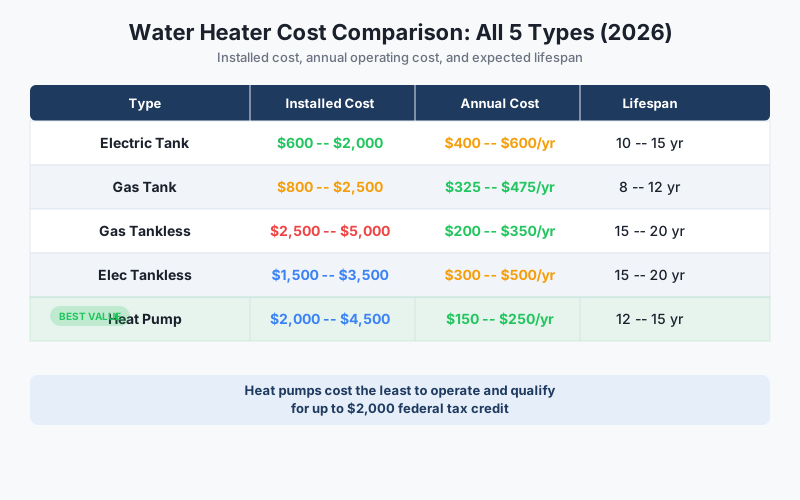
A gas tank water heater costs $800-$2,500 installed in 2026, while an electric tank water heater runs $600-$2,000. Annual operating costs flip the script: gas tanks cost $325-$475 per year to run versus $400-$600 for electric. But neither is the cheapest option anymore. Heat pump water heaters cost $150-$250 per year to operate and qualify for a federal tax credit of up to $2,000, making them the clear efficiency winner for homeowners who have the space and climate to support one.
Consider a 1970s ranch house outside Milwaukee with a 13-year-old 50-gallon gas tank limping along on a failing anode rod and a thermocouple already replaced twice. The homeowner wanted to go electric tankless to save space. Running the numbers on infrastructure costs -- a new 240V circuit and panel upgrade -- pointed to a heat pump unit instead. Total installed cost came to $3,200 after the federal credit, and the first full winter gas bill dropped by $38 per month. That kind of outcome is exactly why a heat pump deserves a look before defaulting to a straight swap.
Before you read further, use the Water Heater Size Calculator to figure out what capacity you actually need based on your household size and usage patterns. Oversizing or undersizing costs you money either way.
Side-by-Side Comparison
The water heater market in 2026 has five main categories. Here is what each one costs to buy, install, and operate:
| Type | Purchase Cost | Installed Cost | Annual Operating Cost | Lifespan | Recovery Rate |
|---|---|---|---|---|---|
| Gas Tank | $400-$1,200 | $800-$2,500 | $325-$475/year | 8-12 years | 40-50 gal/hr |
| Electric Tank | $300-$1,000 | $600-$2,000 | $400-$600/year | 10-15 years | 20-25 gal/hr |
| Gas Tankless | $1,000-$2,500 | $2,500-$5,000 | $200-$350/year | 15-20 years | Continuous (2-5 GPM) |
| Electric Tankless | $500-$1,500 | $1,500-$3,500 | $300-$500/year | 15-20 years | Continuous (2-4 GPM) |
| Heat Pump | $1,200-$2,500 | $2,000-$4,500 | $150-$250/year | 12-15 years | 20-30 gal/hr |
A few things to note. The gap between purchase cost and installed cost is not just labor. Gas units need venting, which adds $500-$1,500 if you do not have existing vent infrastructure. Electric units need a dedicated 240V circuit, which costs $300-$800 if your panel does not already have one. These infrastructure costs are where budget estimates blow up, and they are the costs most online calculators quietly ignore.
Recovery rate is how fast the unit can heat incoming cold water. Gas tanks recover at 40-50 gallons per hour. Electric tanks recover at only 20-25 gallons per hour. That difference matters in a household of four or more people taking back-to-back showers. If you are comparing units, look at the first-hour rating on the EnergyGuide label. It tells you more than tank size alone.
Gas Water Heaters: Full Cost Breakdown
Gas water heaters heat water using a burner at the bottom of the tank and a flue running through the center. They recover faster than electric tanks and cost less to operate in most markets because natural gas is cheaper per BTU than electricity.
Upfront costs:
- Unit cost: $400-$1,200 for a standard 40-50 gallon tank
- Installation labor: $300-$800
- Venting (if needed): $500-$1,500 for direct vent or power vent installation
- Gas line extension (if needed): $200-$600
- Permit and inspection: $50-$150 depending on municipality
Total installed range: $800-$2,500 for a standard tank. If you are replacing an existing gas unit in the same location with existing venting, expect the lower half of that range. If you are converting from electric to gas or moving the unit, budget for the upper half.
Operating costs: Natural gas prices average $1.10-$1.50 per therm nationally in 2026. A typical 50-gallon gas water heater uses 200-300 therms per year, putting annual operating cost at $325-$475. That number varies significantly by region. Homes in the Northeast and West Coast pay more for natural gas. Homes in the Midwest and Gulf states pay less.
Maintenance: Drain and flush the tank once per year. Replace the anode rod every 4-6 years at $20-$50 for the part plus $100-$200 for labor if you do not do it yourself. Annual maintenance runs roughly $50-$100 on average.
Lifespan: 8-12 years. Hard water areas trend toward the lower end because mineral buildup accelerates tank corrosion. Gas tanks can fail at 6 years in homes with untreated well water.
Gas tankless units eliminate the tank entirely and heat water on demand. Installed cost jumps to $2,500-$5,000 because the gas line often needs upsizing and the venting requirements are more complex. But operating costs drop to $200-$350 per year, and lifespan extends to 15-20 years. For homes with existing gas infrastructure and high hot water demand, gas tankless is a strong option.
Electric Water Heaters: Full Cost Breakdown
Electric tank water heaters use one or two heating elements immersed in the tank. They are simpler than gas units, have no combustion products, and need no venting. That simplicity makes them cheaper to install.
Upfront costs:
- Unit cost: $300-$1,000 for a standard 40-50 gallon tank
- Installation labor: $200-$600
- 240V circuit (if needed): $300-$800 for new circuit and breaker
- Permit and inspection: $50-$150
Total installed range: $600-$2,000. A straight replacement of an existing electric tank in the same location is the cheapest water heater installation you can do. Expect $600-$1,200 in that scenario.
Operating costs: This is where electric tanks lose ground. Electricity costs more per BTU than natural gas in most of the country. A typical 50-gallon electric tank uses 3,500-4,500 kWh per year. At the national average of $0.12-$0.15 per kWh, annual operating cost lands at $400-$600. That is $75-$125 per year more than a comparable gas tank.
Maintenance: Electric tanks require the same annual drain and flush as gas units. Heating elements occasionally burn out and cost $10-$30 for the part. Overall maintenance is slightly lower than gas because there is no burner assembly, pilot light, or venting system to inspect. Budget $30-$75 per year.
Lifespan: 10-15 years. Electric tanks tend to outlast gas tanks by 2-3 years because there is no combustion-related corrosion. The glass-lined tank still corrodes over time, but the process is slower without exhaust gases passing through the center of the unit.
Recovery rate disadvantage: Electric tanks recover at only 20-25 gallons per hour compared to 40-50 for gas. In a four-person household, running the dishwasher and doing laundry while someone showers can exhaust a 50-gallon electric tank. A larger tank (65-80 gallons) compensates but increases both purchase and operating costs.
Electric tankless units cost $1,500-$3,500 installed and operate at $300-$500 per year. They require significant electrical capacity, often 150-200 amps for whole-house models, which may require a panel upgrade at $1,000-$2,500. Factor that cost in before committing.
Heat Pump Water Heaters: The Efficiency Winner
Heat pump water heaters do not generate heat directly. They move heat from the surrounding air into the water, working like a refrigerator in reverse. This process uses 2-3 times less energy than conventional electric resistance heating.
Upfront costs:
- Unit cost: $1,200-$2,500
- Installation labor: $400-$1,000
- 240V circuit (if needed): $300-$800
- Permit and inspection: $50-$150
Total installed range: $2,000-$4,500. After the federal tax credit of up to $2,000 (Section 25C, 30% of installed cost), the effective cost drops to $1,400-$3,150 for most installations. That puts it in the same range as gas tankless.
Operating costs: This is the headline number. Heat pump water heaters use 1,500-2,000 kWh per year, roughly half what a standard electric tank consumes. Annual operating cost: $150-$250. That is the lowest of any water heater type. Over 10 years, a heat pump saves $1,500-$3,500 compared to a standard electric tank and $750-$2,250 compared to a gas tank in operating costs alone.
Space and climate requirements: Heat pump water heaters are not a universal fit. They need at least 700 cubic feet of air space around the unit to function efficiently, roughly a 10x10 foot room with an 8-foot ceiling. They also work best in ambient temperatures between 40-90 degrees Fahrenheit. An unheated garage in Minnesota during January is not going to cut it. Basements, utility rooms, and attached garages in moderate climates are ideal locations.
Noise: Heat pump units produce a low hum similar to a dehumidifier, around 45-55 decibels. In a basement or garage, this is not a problem. In a closet adjacent to a bedroom, it could be noticeable.
Cooling bonus: Because heat pump water heaters extract heat from the surrounding air, they dehumidify and cool the space where they are installed. In a hot, humid climate, this is a genuine side benefit. In a cold climate where you are paying to heat that space, it works against you marginally.
Lifespan: 12-15 years. The compressor is the most expensive component to fail, typically at the 10-12 year mark. Some manufacturers offer 10-year compressor warranties.
When to Choose Gas
Gas water heaters make the most sense in these scenarios:
Your home already has gas infrastructure. If you have an existing gas line and vent running to the water heater location, replacing a gas tank with another gas tank is the cheapest possible job. Installed cost stays in the $800-$1,500 range. Switching to electric or heat pump means new wiring, possible panel upgrades, and paying for infrastructure you already have in gas.
Your household has high simultaneous demand. A family of five or six with overlapping shower schedules benefits from the faster recovery rate of gas. A gas tank recovers 40-50 gallons per hour versus 20-25 for electric. Gas tankless provides continuous hot water with no recovery wait at all.
Natural gas is cheap in your area. In states where natural gas runs under $1.00 per therm, like Texas, Louisiana, and parts of the Midwest, gas water heaters have a larger operating cost advantage over electric. The gap narrows in high-gas-cost states like California and the Northeast.
You need a quick, low-cost replacement. When your water heater dies on a Tuesday morning and you need hot water by Tuesday night, a gas tank swap at the same location is the fastest path. No electrical work, no panel upgrades, no space requirements. The plumber arrives with the unit, swaps it, and leaves.
When to Choose Electric
Electric water heaters are the better choice in these situations:
Your home has no gas line. Running a new gas line to a water heater location costs $500-$2,000 or more depending on distance and local codes. If your home is all-electric, stay electric. The infrastructure cost of adding gas eliminates any operating savings for years.
You want lower upfront cost and your budget is tight. An electric tank replacement costs $600-$1,200 when the circuit already exists. Nothing else comes close on day-one price.
You live in a mild climate with low electricity rates. In the Pacific Northwest, where hydropower keeps electricity rates at $0.08-$0.10 per kWh, electric tanks operate for roughly $280-$400 per year. That narrows or eliminates the gas operating cost advantage.
You are in a new construction home going all-electric. The trend toward all-electric new construction is real, driven by code changes and builder preference. If there is no gas meter on the property, electric is your only option aside from propane. In this scenario, pair a heat pump water heater with solar panels for the lowest possible operating cost.
You want simpler maintenance. No pilot light, no burner, no venting, no gas leak risk. Electric tanks have fewer components that can fail and fewer safety concerns.
When to Choose Heat Pump
Heat pump water heaters are the right pick when these conditions align:
You have the space. The 700 cubic foot minimum is non-negotiable. If your water heater sits in a small closet, a heat pump will not perform correctly. You need a basement, garage, or large utility room.
Your ambient temperature stays above 40 degrees Fahrenheit. Heat pump efficiency drops sharply in cold air. If your installation space regularly drops below 40 degrees, the unit falls back to standard electric resistance heating, which eliminates the efficiency advantage. Basements in most of the country stay above 50 degrees year-round and work well.
You plan to stay for 5+ years. The payback period on a heat pump versus a standard electric tank is 3-5 years when you factor in the tax credit. Versus gas, it is 5-8 years. If you are selling next year, you will not recoup the premium.
You want the lowest possible operating cost. At $150-$250 per year, nothing else comes close. Over a 12-year lifespan, a heat pump saves $1,800-$4,200 in operating costs versus an electric tank and $900-$2,700 versus a gas tank.
You are eligible for the federal tax credit. The 30% credit under Section 25C, up to $2,000, applies to qualified heat pump water heaters installed through at least 2032. This single incentive closes most of the upfront cost gap between a heat pump and a basic gas or electric tank.
Total Cost of Ownership
Here is where the real comparison happens. Upfront cost means nothing without understanding what each system costs you over its full life. The table below uses midrange pricing, average operating costs, and includes one replacement when the unit reaches end of life.
| Time Horizon | Gas Tank | Electric Tank | Gas Tankless | Electric Tankless | Heat Pump |
|---|---|---|---|---|---|
| Installed Cost | $1,650 | $1,300 | $3,750 | $2,500 | $3,250 ($2,275 after credit) |
| 5-Year Total | $3,650 | $3,800 | $5,125 | $4,500 | $3,275 |
| 10-Year Total | $5,650 + replacement = $7,300 | $6,300 | $6,500 | $6,500 | $4,275 |
| 15-Year Total | $7,300 + $2,000 operating = $9,300 | $6,300 + replacement = $7,600 | $7,875 | $8,500 | $4,275 + replacement = $6,550 |
A few things jump out. The gas tank is the most expensive option at 15 years because its short 8-12 year lifespan forces a full replacement. The heat pump water heater, even with a higher purchase price, has the lowest 15-year total cost because its operating costs are so low that they more than offset the upfront premium.
Gas tankless looks expensive at installation but its 15-20 year lifespan and low operating costs make it competitive at the 15-year mark. Electric tankless is the worst value in the table because it combines moderate installation cost with moderate operating cost and no particular advantage in either dimension.
Run your own scenario with the Water Heater Size Calculator to see how your household size and local energy rates change these numbers.
Tax Credits and Rebates in 2026
The federal government and many state programs offer incentives that change the math on water heater purchases.
Federal tax credit (Section 25C): Heat pump water heaters meeting ENERGY STAR requirements qualify for a 30% tax credit on the total installed cost, capped at $2,000 per year. This credit is available through at least 2032. A $3,500 heat pump installation yields a $1,050 credit. A $4,500 installation yields the full $1,350 credit. This is a tax credit, not a deduction, meaning it reduces your tax bill dollar for dollar.
High-Efficiency Electric Home Rebate Act (HEEHRA): This program, part of the Inflation Reduction Act, offers point-of-sale rebates of up to $1,750 for heat pump water heaters for low and moderate income households (under 150% of area median income). Unlike the tax credit, this is an instant rebate applied at purchase, not claimed on your tax return.
State and utility rebates: Many states and local utilities stack additional rebates on top of federal incentives. Examples include:
- California: TECH Clean California offers $2,500-$3,500 for heat pump water heaters depending on fuel type being replaced
- Massachusetts: Mass Save offers $750 rebates for heat pump water heaters
- Oregon: Energy Trust of Oregon provides $500-$1,000 depending on the model
What does not qualify: Standard gas and electric tank water heaters receive no federal tax credits. Gas tankless units with an energy factor of 0.82 or higher may qualify for a smaller credit under the same Section 25C provision, but the cap is $150 for gas equipment, not $2,000.
The bottom line on incentives: a heat pump water heater with combined federal and state rebates can effectively cost the same as a basic gas tank, sometimes less, while operating at half the annual cost. Check the DSIRE database (dsireusa.org) for your state-specific programs.
Frequently Asked Questions
Is a gas or electric water heater cheaper to run in 2026?
A gas tank water heater costs $325-$475 per year to operate, while an electric tank costs $400-$600 per year. Gas wins on operating cost in most markets because natural gas delivers more BTUs per dollar than electricity at current rates. However, neither gas nor electric tanks are the cheapest to operate overall. A heat pump water heater runs at $150-$250 per year, roughly half the cost of gas and less than half the cost of electric resistance. The operating cost comparison also depends heavily on your local energy prices. In states with cheap hydroelectric power like Washington and Oregon, electricity rates drop to $0.08-$0.10 per kWh, which narrows or eliminates the gas advantage. In states with expensive natural gas, the gap widens further. Check your utility bills for exact rates per kWh and per therm before assuming gas is always cheaper.
How long does each type of water heater last?
Gas tank water heaters last 8-12 years on average. The combustion process creates byproducts that accelerate corrosion inside the tank and around the burner assembly. Hard water makes this worse. Electric tank water heaters last 10-15 years because they avoid combustion-related corrosion entirely. The heating elements may need replacement at the 8-10 year mark, but the tank itself often holds up longer than a gas equivalent. Tankless water heaters, both gas and electric, last 15-20 years because there is no standing water corroding a tank 24 hours a day. Heat pump water heaters last 12-15 years, with the compressor being the lifespan-limiting component. In every case, water quality is the wild card. Homes with hard water, high mineral content, or acidic well water will see shorter lifespans across all types. Annual flushing and timely anode rod replacement are the two cheapest things you can do to extend any water heater's life.
Should I switch from gas to electric or heat pump?
Switching from gas to electric or heat pump involves infrastructure changes that add cost. You will need a dedicated 240V circuit, which costs $300-$800 if one does not exist. Your electrical panel may also need an upgrade if it is already near capacity, adding $1,000-$2,500. A heat pump unit also needs at least 700 cubic feet of surrounding air space and ambient temperatures above 40 degrees Fahrenheit. If those conditions are met, switching from gas to a heat pump water heater makes financial sense for most homeowners. The federal tax credit of up to $2,000 offsets much of the infrastructure cost. Operating savings of $100-$225 per year compared to gas mean payback in 5-8 years even after accounting for the electrical work. Switching from gas to a standard electric tank rarely makes sense because you pay for the electrical work and then operate at a higher annual cost than gas. That combination is hard to justify unless you are eliminating gas service from your home entirely.
What is the first-hour rating and why does it matter more than tank size?
The first-hour rating measures how many gallons of hot water a water heater can deliver in the first hour starting with a full tank of hot water. It combines tank capacity with recovery rate to give you the real-world output number. A 50-gallon gas tank with a high recovery rate might deliver 70-80 gallons in the first hour. A 50-gallon electric tank with a slower recovery rate might deliver only 55-65 gallons in the same period. This means a smaller gas tank can outperform a larger electric tank during peak usage. Energy.gov recommends sizing your water heater based on first-hour rating, not tank size. To determine your needs, count the number of hot water activities that overlap during your busiest hour, such as showers, dishwasher, and laundry. Add up the gallons for each activity and match that total to a unit's first-hour rating. The Water Heater Size Calculator automates this calculation for you.
Do tankless water heaters really save money?
Tankless water heaters save $75-$175 per year in operating costs compared to their tank-based equivalents. A gas tankless unit runs $200-$350 per year versus $325-$475 for a gas tank. An electric tankless runs $300-$500 versus $400-$600 for an electric tank. The savings are real, but the payback period is long. A gas tankless unit costs $2,500-$5,000 installed, which is $1,700-$2,500 more than a gas tank. At $125 per year in operating savings, the payback period is 14-20 years. An electric tankless at $1,500-$3,500 installed versus $600-$2,000 for an electric tank has a similar payback window. Tankless units make the most financial sense when you factor in their 15-20 year lifespan, which avoids one full tank replacement cycle. They also make sense in homes with high but intermittent demand, vacation homes where a tank would waste energy maintaining temperature while nobody is home, and tight spaces where a wall-mounted tankless unit frees up floor area.
What size water heater do I need for my household?
For tank water heaters, the general guideline is 30-40 gallons for 1-2 people, 40-50 gallons for 2-3 people, 50-65 gallons for 3-4 people, and 65-80 gallons for 5 or more people. But these are rough estimates that do not account for your actual usage patterns. A household of three that runs the dishwasher and laundry during evening showers needs more capacity than a household of four with staggered schedules. For tankless water heaters, sizing is measured in gallons per minute flow rate. A single shower uses 2-2.5 GPM. A dishwasher uses 1-2 GPM. Running both simultaneously requires a unit rated for 3.5-4.5 GPM. Gas tankless units handle higher flow rates than electric. The most accurate way to size your water heater is to calculate your peak-hour demand and match it to the first-hour rating for tank models or the GPM rating for tankless. Use the Water Heater Size Calculator to get a recommendation based on your actual household data rather than rules of thumb.
Pricing data sourced from Angi, HomeGuide, Energy.gov, and Consumer Reports. Federal tax credit information from IRS Section 25C guidance. All figures reflect 2026 national averages for professional installation. Actual costs vary by location, energy rates, and contractor.
This article is provided for informational and educational purposes only. Content should not be considered professional financial, medical, legal, or other advice. Always consult a qualified professional before making important decisions. UseCalcPro is not responsible for any actions taken based on the information in this article.
Try These Calculators
Compare gas vs electric water heater costs in 2026: upfront price, yearly running cost, and break-even year. Gas typically saves $3,850 over 12 years.
Estimate 2026 water heater installation cost by fuel type, tank size, efficiency tier, and scope. A 40-gal gas tank replacement runs $1,200-$2,200 installed.
Estimate 2026 local heat pump water heater install cost by tank size, panel capacity, location, and ZIP. Typical $2,500-$5,500; Bay Area $5,500-$8,000.
Estimate 2026 dedicated 240V circuit cost for EV chargers, hot tubs, heat pumps, ranges, and welders. Typical $300-$1,500, absolute bounds $150-$3,500.