How Much Does a Retaining Wall Cost in 2026? (By Material & Height)
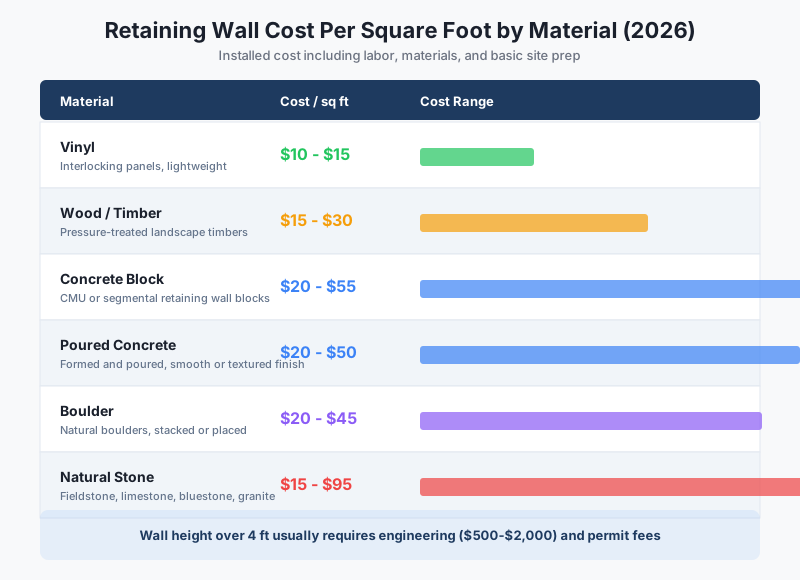
A retaining wall costs $35 to $65 per square foot of wall face installed in 2026, with total project costs ranging from $2,600 for a small garden wall to $32,500 or more for a large structural wall. Concrete block runs $20-$55/sq ft, natural stone $15-$95/sq ft, poured concrete $20-$50/sq ft, and wood timber $15-$30/sq ft. Materials account for $5-$20 per square foot, with labor adding $10-$30 per square foot depending on wall height and site conditions.
Retaining walls built or supervised on 19 residential properties across Pennsylvania and New Jersey over three years show the single biggest cost surprise is always drainage. A 50-foot-long, 4-foot-tall block wall in Montgomery County came to $11,200 installed -- and $1,800 of that was drainage gravel, perforated pipe, filter fabric, and the labor to install it properly behind the wall. The homeowner's original budget assumed $8,000. Every retaining wall is a drainage structure first and a wall second, and the moment that gets forgotten, the result is something that will lean, crack, and eventually fail.
Use our Retaining Wall Calculator to get a personalized estimate based on your wall dimensions, material choice, and site conditions.
Retaining Wall Cost at a Glance
The table below shows what you can expect to pay per square foot of wall face for materials and installation across all common retaining wall types in 2026.
| Material | Installed Cost/sq ft | Best For | Typical Lifespan |
|---|---|---|---|
| Concrete block (CMU/segmental) | $20 - $55 | Structural walls, engineered walls over 4 ft | 50-100 years |
| Natural stone | $15 - $95 | High-end landscaping, visible focal walls | 50-100+ years |
| Poured concrete | $20 - $50 | Tall structural walls, basements, commercial | 50-75 years |
| Wood / Timber | $15 - $30 | Garden terraces, short walls under 3 ft | 15-20 years |
| Brick | $20 - $40 | Decorative garden walls, matching existing brick | 25-75 years |
| Boulder | $20 - $45 | Natural-looking slopes, erosion control | 75-100+ years |
| Gabion (wire basket + rock) | $10 - $55 | Erosion control, modern aesthetic, drainage-heavy sites | 50-100 years |
| Vinyl | $10 - $15 | Short decorative borders, garden beds | 10-20 years |
Tip
Square foot of wall face = linear feet x height. A 50-foot-long wall that is 4 feet tall has 200 square feet of wall face. Most contractor quotes are priced per square foot of face area, not per linear foot. When comparing quotes, make sure everyone is measuring the same way.
Cost by Material
Concrete Block ($20-$55/sq ft installed)
Segmental retaining wall block -- brands like Allan Block, Versa-Lok, and Belgard -- is the most popular choice for structural retaining walls. Standard split-face block costs $20-$35 per square foot installed, while premium textured systems run $35-$55. The blocks themselves cost $5-$15 per square foot; the rest is labor, base preparation, drainage, and backfill.
Block walls use a built-in setback of about 1 inch per course for passive structural stability without mortar. Walls under 4 feet rarely need geogrid reinforcement. Walls over 4 feet almost always require geogrid layers every 2-3 courses, adding $3-$8 per square foot.
Natural Stone ($15-$95/sq ft installed)
Natural stone has the widest price range because it covers everything from locally quarried fieldstone at $15-$30 per square foot to hand-cut Pennsylvania bluestone at $60-$95. Dry-stacked fieldstone walls are labor-intensive but use inexpensive material. Cut-and-fitted ashlar stone requires skilled masons and precise fitting.
Natural stone is the right choice when the wall is a visual centerpiece -- a front-yard terrace, an entrance wall, or a patio surround. For a wall behind the garage holding back a slope nobody sees, concrete block delivers the same structural performance at half the price.
Poured Concrete ($20-$50/sq ft installed)
Poured-in-place concrete is the strongest option and the standard for walls over 6 feet tall, basement foundations, and commercial applications. The concrete alone costs $3-$6 per square foot; formwork and rebar add $8-$15; labor adds $10-$25. Poured walls can be built to virtually any height with proper engineering and faced with stone veneer or stamped for appearance.
Wood / Timber ($15-$30/sq ft installed)
Pressure-treated landscape timbers (6x6 or 8x8) are the most affordable material at $15-$30 per square foot installed. Timber walls work well for garden terraces up to about 3 feet tall. The trade-off is lifespan -- even pressure-treated timber rots in constant soil contact. Expect 15-20 years, roughly one-third the life of block or stone. Anything over 3 feet in timber requires deadman anchors, extensive drainage, and engineering that closes the cost gap with block.
Brick ($20-$40/sq ft installed)
Brick retaining walls are chosen for aesthetic consistency -- matching an existing brick home or garden structure. They require a poured concrete footing, mortar joints, and weep holes for drainage. Brick is not inherently as strong as segmental block for earth retention, so engineering requirements kick in at lower heights.
Boulder ($20-$45/sq ft installed)
Boulder walls use large rocks (200-2,000 pounds each) stacked to create a natural-looking structure. Much of the expense goes to equipment -- you need an excavator to place boulders. They drain naturally through gaps between stones, making them excellent for wet climates. The limitation is precision: expect a rougher look and wider wall profiles (3-5 feet deep) compared to 12-18 inches for block.
Gabion ($10-$55/sq ft installed)
Gabion walls -- wire mesh baskets filled with rock -- are inherently permeable, making them excellent for sites with high water tables. Basic gabion with local fill stone costs $10-$25/sq ft; architectural gabion with selected stone and powder-coated cages reaches $55. They require no mortar, minimal foundation preparation, and flex with ground movement without cracking.
Vinyl ($10-$15/sq ft installed)
Vinyl retaining walls are limited to decorative walls under 2 feet -- adequate for flower bed edging and small landscape terraces, but not suitable for real earth retention.
Cost by Wall Size
Most homeowners fall into one of three project categories. Here is what each typically costs in 2026:
| Project Size | Dimensions | Wall Face (sq ft) | Installed Cost Range | Typical Material |
|---|---|---|---|---|
| Small | 25 linear ft x 3 ft tall | 75 | $2,600 - $5,000 | Block, timber, or stone |
| Medium | 50 linear ft x 4 ft tall | 200 | $7,000 - $13,000 | Block or stone |
| Large | 100 linear ft x 5 ft tall | 500 | $17,500 - $32,500 | Block, poured concrete, or engineered stone |
Warning
Walls over 4 feet tall require engineering in most jurisdictions. A structural engineer's design typically costs $500-$2,000 and is legally required before you can pull a building permit. Do not skip this step. An unengineered wall over 4 feet is a liability -- if it fails and damages a neighbor's property, your homeowner's insurance may deny the claim because you built without a permit.
Labor Cost Breakdown
Labor accounts for roughly 50-65% of total retaining wall cost. Here is where the labor budget goes on a typical segmental block wall:
| Labor Component | Cost Range | Notes |
|---|---|---|
| Excavation and grading | $3 - $8/sq ft of face | Machine excavation for base trench + soil behind wall |
| Base preparation (crushed stone) | $2 - $5/sq ft of face | 6-12 inches compacted gravel base, critical for wall stability |
| Drainage installation | $5 - $15/linear ft | Perforated pipe, drainage gravel, filter fabric |
| Block/stone installation | $8 - $20/sq ft of face | Stacking, cutting, leveling, backfilling per course |
| Geogrid (walls over 4 ft) | $3 - $8/sq ft of face | Reinforcement layers every 2-3 courses |
| Cap installation | $5 - $10/linear ft | Adhesive-set cap block or natural stone coping |
| Backfill and compaction | $2 - $5/sq ft of face | Granular fill behind wall, compacted in lifts |
| Permits | $100 - $500+ | Required for most walls; higher for engineered walls |
The drainage line item deserves special attention. Every retaining wall holds back soil, and soil holds water. Hydrostatic pressure from waterlogged soil is the number-one cause of retaining wall failure. Proper drainage -- a perforated pipe at the base, 12+ inches of drainage gravel behind the wall, and filter fabric to prevent soil migration -- costs $5-$15 per linear foot but is non-negotiable. Walls that failed because the original builder skipped or under-built the drainage system are a recurring repair job -- three such rebuilds in the last two years alone.
Regional Cost Variation
Retaining wall costs vary significantly by region due to differences in labor rates, material availability, soil conditions, and code requirements.
| Region | Installed Cost/sq ft | vs. National Avg | Key Factors |
|---|---|---|---|
| Northeast | $40 - $75 | +15% to +25% | High labor costs, frost footings required, rocky soil common |
| South | $25 - $55 | -10% to -15% | Lower labor rates, year-round construction, clay soils |
| Midwest | $30 - $60 | -5% to +5% | Moderate labor, deep frost lines, competitive market |
| West Coast | $45 - $80 | +20% to +30% | Highest labor costs, seismic engineering requirements |
| Mountain West | $35 - $65 | +0% to +10% | Moderate labor, challenging terrain, variable soil |
These ranges reflect 2026 pricing from contractor surveys by Angi, HomeGuide, LawnStarter, and HomeAdvisor. Your actual cost depends on local market conditions, contractor availability, and time of year.
Engineering and Permits
When Is Engineering Required?
Most jurisdictions require a structural engineer's design for retaining walls over 4 feet tall, measured from the bottom of the footing to the top of the wall. Some municipalities set the threshold at 3 feet. Walls that retain a slope above (surcharge loading), support a driveway or structure, or sit within a certain distance of a property line often require engineering regardless of height.
What Does Engineering Cost?
A structural engineer's retaining wall design typically runs $500-$2,000, depending on wall complexity, soil testing requirements, and local engineering rates. This includes:
- Site assessment and soil evaluation: $200-$800
- Structural design with stamped drawings: $300-$1,200
- Geotechnical report (if required): $500-$2,500 (separate from the structural engineer)
Permit Costs
Retaining wall permits range from $100-$500+ in most municipalities. The permit fee itself is often modest ($100-$200), but the required engineering drawings and inspections drive the total cost higher. Some jurisdictions require footing inspections, drainage inspections, and final inspections -- each potentially requiring the engineer to visit the site.
Do Not Skip Permits
Unpermitted retaining walls regularly become serious problems during home sales. A buyer's inspector flags an unpermitted wall over 4 feet, the buyer demands either a permit or a price reduction, and the seller ends up paying for retroactive engineering, a permit, and sometimes a partial rebuild to meet code. The $500-$2,000 "saved" upfront becomes $5,000-$15,000 in retroactive compliance costs.
Factors That Affect Cost
1. Wall Height
Height is the single biggest cost driver beyond material choice. Every additional foot of height increases material volume, requires deeper excavation, and may trigger engineering requirements. A 3-foot wall is a straightforward gravity structure. A 5-foot wall needs geogrid reinforcement and extends 4-7 feet behind the face with reinforcement layers. A 6-foot wall requires full engineering, deeper footings, and significantly more excavation and backfill.
2. Soil Conditions
Sandy, well-draining soil is the cheapest to work with. Heavy clay retains water and exerts more lateral pressure on the wall, requiring better drainage and potentially a stronger wall design. Rocky soil increases excavation costs by 20-40% because machine-breaking rock is slow work. Expansive soils (common in parts of Texas, Colorado, and the Carolinas) may require specialized engineering.
3. Drainage Requirements
Every retaining wall needs drainage, but the scope varies dramatically. A 2-foot garden wall on sandy soil might need only a gravel backfill zone. A 5-foot wall on clay soil in a wet climate needs a full drainage system: perforated pipe at the footing, 12-18 inches of drainage aggregate behind the wall, filter fabric, and possibly a secondary drain line at mid-height. Drainage adds $5-$15 per linear foot to wall cost, and it is the one line item you should never cut.
4. Site Access
A wall in an open backyard with equipment access from a driveway is straightforward. A wall in a side yard with 36 inches of clearance, or behind a house with no machine access, requires hand-carrying materials and possibly hand-excavation. Limited access can add 20-50% to labor costs. A 40-foot wall in a narrow side yard in Doylestown was quoted at $14,500 -- the same wall with open access would have been $9,800.
5. Curves and Corners
Straight walls are the most cost-efficient to build. Curves require cutting blocks to fit the radius, which adds material waste and labor time. Inside corners (concave curves) are particularly expensive because they concentrate soil pressure. Expect 10-20% added cost for moderately curved walls and 25-40% for tight-radius curves or complex multi-tier designs.
6. Surcharge Loading
If anything sits on top of or near the wall -- a driveway, patio, structure, or significant slope -- the soil pressure on the wall increases substantially. This surcharge loading typically requires engineering and a stronger wall design, adding 15-30% to project cost. A retaining wall next to a flat lawn and a retaining wall holding up a driveway are two completely different engineering problems, even at the same height.
DIY vs. Professional
What You Can DIY
Short retaining walls under 3 feet using segmental block or timber are within reach of a competent DIYer. A 25-foot-long, 2-foot-tall block garden wall is a weekend project with rented tools and costs $800-$1,500 in materials versus $2,000-$3,500 installed professionally. The skills required are digging a level trench, compacting a gravel base, stacking blocks with a consistent setback, and installing basic drainage behind the wall.
What Needs a Professional
Any wall over 3-4 feet tall should be built by a professional, full stop. The engineering is not intuitive -- the forces involved scale non-linearly with height, and a 5-foot wall experiences roughly 2.8 times the soil pressure of a 3-foot wall, not 1.67 times as you might expect. Walls that retain slopes, support structures, or sit on challenging soil need professional design and construction.
Safety warning: A failing retaining wall is not a cosmetic problem. A 4-foot block wall holding back saturated clay soil can weigh 800-1,200 pounds per linear foot. When these walls fail, they fail suddenly -- the base kicks out, the wall leans, and thousands of pounds of soil and block slide downhill. Wall failures have pushed soil into basements, destroyed landscaping, and blocked drainage paths that caused flooding to adjacent properties. The cost of professional installation is a fraction of the cost of a catastrophic failure.
DIY vs. Pro Cost Comparison
| Factor | DIY (25 ft x 3 ft) | Professional (25 ft x 3 ft) |
|---|---|---|
| Materials (block + base + gravel) | $800 - $1,200 | $800 - $1,200 |
| Labor | $0 (your time) | $1,200 - $2,400 |
| Tool rental (compactor, level, saw) | $150 - $300 | Included |
| Drainage materials | $150 - $350 | Included in quote |
| Time | 2-3 weekends | 1-2 days |
| Total | $1,100 - $1,850 | $2,600 - $5,000 |
| Savings | 40-55% | -- |
Frequently Asked Questions
How much does a retaining wall cost per linear foot?
A retaining wall costs $40-$200+ per linear foot installed in 2026, depending heavily on wall height and material. Per-linear-foot pricing is less precise than per-square-foot because it does not account for height. A 3-foot-tall wall at $35/sq ft costs $105 per linear foot; a 5-foot wall at $50/sq ft costs $250 per linear foot.
- Short wall (2-3 ft), block: $40 - $120 per linear foot
- Medium wall (3-4 ft), block or stone: $100 - $200 per linear foot
- Tall wall (5-6 ft), engineered block or poured concrete: $175 - $350+ per linear foot
- Timber wall (2-3 ft): $30 - $90 per linear foot
When comparing contractor quotes, always confirm whether the price is per linear foot or per square foot of wall face. A quote of "$45 per foot" is ambiguous -- $45 per linear foot for a 4-foot wall is only $11.25/sq ft (suspiciously cheap), while $45 per square foot for the same wall is $180 per linear foot (reasonable for natural stone).
What is the cheapest retaining wall material?
Wood timber is the cheapest structural retaining wall material at $15-$30 per square foot installed, while vinyl is the cheapest overall at $10-$15 per square foot for decorative walls under 2 feet. However, cheapest upfront and cheapest long-term are two different calculations.
- Vinyl (decorative only): $10 - $15/sq ft, 10-20 year lifespan
- Wood timber: $15 - $30/sq ft, 15-20 year lifespan
- Gabion: $10 - $55/sq ft, 50-100 year lifespan
- Concrete block: $20 - $55/sq ft, 50-100 year lifespan
Timber costs roughly half of what block costs upfront, but block lasts 3-5 times longer. Over a 50-year period, a timber wall rebuilt twice ($15-$30/sq ft x 3 builds = $45-$90) costs more than a single block wall ($20-$55). For walls under 3 feet in a garden setting where replacement is easy, timber makes sense. For any structural or permanent wall, the long-term economics favor block or stone.
How long does it take to build a retaining wall?
A professional crew typically builds 20-40 linear feet of retaining wall per day for standard block walls, making most residential projects a 3-7 day job. Timeline varies significantly with wall height, material, and site conditions.
- Small wall (25 ft x 3 ft, block): 1-2 days
- Medium wall (50 ft x 4 ft, block): 3-5 days
- Large wall (100 ft x 5 ft, engineered block): 7-14 days
- Natural stone (any size): Add 30-50% more time vs. block
- Poured concrete: 2-3 days for forming, 1 day pour, 7+ days cure before backfill
Permit approval adds 2-6 weeks to the timeline in most jurisdictions, and engineering design adds 1-3 weeks before that. Start the permitting process at least 6-8 weeks before your desired construction date.
Do I need a permit for a retaining wall?
Most municipalities require a building permit for retaining walls over 4 feet tall (measured from the bottom of the footing to the top of the wall), and many require permits starting at 3 feet. The permit typically requires stamped structural engineering drawings.
- Under 3 feet: Usually no permit required (check local code)
- 3-4 feet: Permit required in many jurisdictions
- Over 4 feet: Permit required in nearly all jurisdictions
- Near property lines: Often requires setback variances or neighbor notification
- Near structures or driveways: Engineering required regardless of height
Permit costs range from $100-$500+, but the engineering drawings required for the permit application ($500-$2,000) are the real expense. Some municipalities also require a geotechnical report ($500-$2,500) for walls on certain soil types or in flood zones. Call your local building department before getting quotes -- the permit requirements directly affect your project cost and timeline.
Can I build a retaining wall myself?
You can DIY a retaining wall up to about 3 feet tall using segmental block or timber, saving 40-55% on labor costs. Above that height, the structural engineering, equipment requirements, and safety risks make professional installation the right choice.
- Good DIY candidates: Garden terraces under 3 ft, planting bed walls, small landscape walls on flat ground
- Required skills: Digging a level trench, compacting gravel, using a string line, cutting block with a masonry saw
- Required tools (rentable): Plate compactor ($60-$100/day), masonry saw ($50-$80/day), hand tamper, 4-foot level
- Material cost (DIY, 25 ft x 3 ft block wall): $800 - $1,200
- Common DIY mistakes: Inadequate base preparation, no drainage behind the wall, inconsistent setback between courses, poor compaction of backfill
The base preparation is the most important part and the step most DIYers rush. Excavate 6-12 inches below grade, lay 6 inches of compacted crushed stone, and verify level across the entire trench before setting the first course. If the first course is not level, every course above it amplifies the error.
How long do retaining walls last?
Retaining wall lifespan ranges from 15 years for timber to 100+ years for natural stone and concrete, assuming proper construction and drainage. The wall material matters, but drainage is the real determinant of longevity.
- Wood / Timber: 15-20 years (rot is inevitable, even with pressure treatment)
- Vinyl: 10-20 years (UV degradation, brittleness over time)
- Brick: 25-75 years (mortar joints are the weak point)
- Poured concrete: 50-75 years (dependent on rebar corrosion protection)
- Concrete block (segmental): 50-100 years (no mortar to fail, gravity-based)
- Boulder: 75-100+ years (no joints, no mortar, no moving parts)
- Natural stone (dry-stacked): 50-100+ years (fieldstone walls in New England have lasted 200+ years)
- Gabion: 50-100 years (wire cage eventually corrodes, but rock fill remains)
The most common cause of premature failure across all materials is inadequate drainage. Water saturates the soil behind the wall, hydrostatic pressure builds, and the wall either tips forward, slides at the base, or blows out at the bottom. A $10 drainage detail per linear foot can add decades to wall life. Retaining wall rebuilds trace back to the same root cause again and again: no drainage, or drainage that was installed but clogged because there was no filter fabric separating the drain gravel from the native soil.
Cost data sourced from Angi, HomeGuide, LawnStarter, HomeAdvisor, and HomeWyse. Prices reflect national averages for 2026 and vary by region, material availability, and local labor rates.
This article is provided for informational and educational purposes only. Content should not be considered professional financial, medical, legal, or other advice. Always consult a qualified professional before making important decisions. UseCalcPro is not responsible for any actions taken based on the information in this article.
Try These Calculators
Estimate 2026 retaining wall block material cost by block type and wall dimensions. CMU from $1.50/sqft, SRW blocks $4-$9, natural stone $8-$20 per sqft.
Estimate 2026 retaining wall install cost by height, length, and material. A 4 ft by 50 ft block wall runs $5,000 to $11,000 including drainage and permit.
Estimate new home construction costs by square footage, quality level, and region. Get detailed material and labor cost breakdowns for building your house.
Estimate 2026 deep house cleaning cost by home size, condition, and bathrooms. A first-time deep clean runs $200-$600, about $0.20-$0.40 per square foot.