How Much Does Concrete Work Cost in 2026? (Driveways, Patios & Slabs)
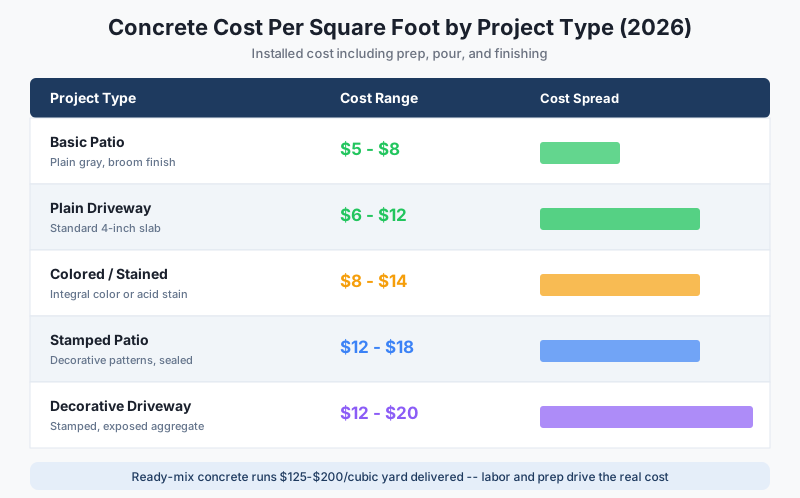
Concrete work costs $5 to $18 per square foot installed in 2026, with most residential projects landing between $2,000 and $15,000 total. Ready-mix concrete runs $125-$200 per cubic yard delivered, plain slabs and patios cost $5-$8/sq ft installed, stamped concrete runs $12-$18/sq ft, and driveways range from $6-$20/sq ft depending on finish. Concrete prices are up 4-9% from 2024-2025, driven by cement plant energy costs and steady residential demand.
I poured 22 residential concrete jobs last year across Pennsylvania and New Jersey, and the question I get more than any other is "why does a flat slab of concrete cost so much?" Here is the honest answer: on a $4,800 patio job I did in Bucks County last October, the concrete itself was $680. The other $4,120 went to excavation, gravel base, forms, rebar, labor, and finishing. The gray stuff is cheap. Getting it flat, level, and crack-free is where the money goes. Homeowners who understand that distinction make better decisions about where to spend and where to save.
Use our Concrete Calculator to estimate the exact yardage and cost for your project based on dimensions and thickness.
Concrete Cost at a Glance
The table below shows installed cost per square foot and typical total project cost for the most common residential concrete work in 2026.
| Project Type | Installed Cost/sq ft | Typical Size | Total Cost Range |
|---|---|---|---|
| Basic patio | $5 - $8 | 200-400 sq ft | $1,000 - $3,200 |
| Driveway (plain) | $6 - $12 | 400-600 sq ft | $2,400 - $7,200 |
| Driveway (decorative) | $12 - $20 | 400-600 sq ft | $4,800 - $12,000 |
| Sidewalk | $6 - $12 | 100-300 sq ft | $600 - $3,600 |
| Slab on grade (foundation) | $5 - $10 | 800-2,000 sq ft | $4,000 - $20,000 |
| Stamped patio | $12 - $18 | 200-400 sq ft | $2,400 - $7,200 |
Tip
These prices include labor, materials, base prep, and basic finishing. Upgrades like integral color, stamping, exposed aggregate, or radiant heat loops are additional. Always ask contractors for an itemized breakdown.
Cost by Finish Type
The finish you choose has a bigger impact on price than most people expect. A plain broom-finish slab and a stamped, colored patio use the same amount of concrete -- the difference is labor, materials, and skill.
Plain / Broom Finish ($5-$8/sq ft installed)
This is your standard gray concrete with a broom-swept texture for traction. It is the most affordable option and works well for utility slabs, garage floors, and basic patios. A 400 sq ft broom-finish patio runs $2,000-$3,200 installed. There is nothing wrong with plain concrete -- it lasts 25-30 years with minimal maintenance, and you can always stain or coat it later.
Stamped Concrete ($12-$18/sq ft installed)
Stamped concrete uses rubber mats pressed into wet concrete to create patterns that mimic stone, brick, slate, or wood plank. The process adds $6-$10/sq ft over plain concrete because it requires a color hardener ($0.50-$1.00/sq ft), release agent ($0.30-$0.50/sq ft), and significantly more labor time. A 400 sq ft stamped patio runs $4,800-$7,200 installed. The catch: stamped concrete needs resealing every 2-3 years at $0.50-$1.00/sq ft to maintain the color and protect the surface.
Colored / Stained ($8-$14/sq ft installed)
Integral color (mixed into the concrete) or acid staining (applied after curing) adds $3-$6/sq ft over plain concrete. Integral color is more consistent and durable. Acid staining creates a mottled, natural look but varies with every pour. A 400 sq ft colored patio runs $3,200-$5,600 installed. Colored concrete is a solid middle ground -- more visual interest than plain gray, less maintenance than stamped.
Polished Concrete ($3-$12/sq ft)
Polished concrete is typically done on existing interior slabs -- garage floors, basement floors, and commercial spaces. The process involves grinding the surface through progressively finer diamond pads to create a smooth, reflective finish. Basic single-pass polishing starts at $3/sq ft; a full multi-step polish with stain and densifier runs $8-$12/sq ft. This is one of the few concrete upgrades that does not require tearing out what you have.
Exposed Aggregate ($10-$16/sq ft installed)
Exposed aggregate concrete has the surface paste washed away to reveal the stones and gravel underneath. The look depends entirely on the aggregate mix -- river rock, crushed granite, or decorative glass all produce different effects. It costs $10-$16/sq ft installed and is popular for pool decks because the exposed stone provides excellent traction when wet. Expect to reseal every 2-4 years.
Ready-Mix Concrete Pricing
Ready-mix concrete is sold by the cubic yard. One cubic yard covers 80 sq ft at 4 inches thick.
| Item | Cost | Notes |
|---|---|---|
| Ready-mix (per yard) | $125 - $200 | Standard 3,000-4,000 PSI residential mix |
| Short-load fee | $40 - $60/yard extra | Charged on orders under 10 yards |
| Delivery | $0 - $50 | Often included within 20-mile radius |
| Saturday/overtime pour | +$100 - $300 | Avoid if possible |
| Pump truck | $150 - $300/hour | Needed when truck cannot back up to pour site |
| Fiber mesh additive | $5 - $8/yard | Reduces surface cracking |
| High-early mix | +$10 - $20/yard | Faster cure for cold weather pours |
The short-load fee is the one that surprises people. If your patio needs 3.5 yards and the truck minimum is 10, you are paying an extra $40-$60 per yard on those 3.5 yards. That is $140-$210 in surcharges on a small job. This is one reason contractors try to schedule multiple pours in the same area on the same day -- they can split a full truck across two or three jobs and avoid the surcharge entirely.
Labor Cost Breakdown
Labor accounts for roughly 50% of total concrete project cost. Here is where that labor money goes:
| Labor Component | Cost Range | Notes |
|---|---|---|
| Site prep and excavation | $1 - $3/sq ft | Grading, removing sod, compacting subgrade |
| Gravel base | $0.50 - $1.50/sq ft | 4-6 inches of compacted gravel |
| Formwork | $1 - $2/sq ft | Building and setting the wooden perimeter forms |
| Rebar / wire mesh | $0.50 - $1.50/sq ft | Rebar for driveways/foundations, mesh for patios |
| Pour and finish | $2 - $4/sq ft | Screeding, floating, edging, broom finish |
| Stamping / decorative | $3 - $8/sq ft | Additional to base finish labor |
| Cleanup and strip forms | $0.50 - $1/sq ft | Next day tear-down |
Total labor typically runs $2-$10 per square foot depending on project complexity and region. Simple flat slabs are at the low end. Stamped, colored, or sloped work is at the high end. The real variable is how much site prep is needed -- if your yard is flat, well-drained, and accessible, labor drops. If the truck cannot reach the pour site, or the ground needs extensive grading, labor climbs fast.
Regional Cost Variation
Concrete pricing varies significantly across the country. The biggest drivers are local labor rates, cement plant proximity, and seasonal build windows.
| Region | Ready-Mix/yard | Installed Cost/sq ft | Key Factors |
|---|---|---|---|
| Northeast | $140 - $220 | $8 - $20 | Highest labor rates, short pour season (Apr-Nov), frost depth 36-48" |
| South | $110 - $165 | $5 - $14 | Lower labor, year-round pouring, fast cure in heat |
| Midwest | $120 - $180 | $6 - $16 | Moderate labor, competitive market, frost depth 30-42" |
| West | $135 - $200 | $7 - $18 | High in urban metros (LA, SF, Seattle), moderate in rural |
| NYC Metro | $180 - $250 | $10 - $25 | Union labor, congestion surcharges, limited access |
A plain 400 sq ft patio costs roughly $2,000-$3,200 in Dallas but $3,200-$5,600 in Boston. The concrete itself accounts for less than half the difference -- most of the gap is labor and logistics. Texas contractors pour year-round with non-union crews; Northeast contractors face a compressed season with higher overhead.
DIY vs. Contractor
Concrete is one of the harder DIY projects because the material is unforgiving. Once the truck arrives, you have 60-90 minutes before the concrete sets, and there is no undo button. That said, small slabs are absolutely DIY-friendly if you prepare properly.
| Factor | DIY | Professional |
|---|---|---|
| Material cost (400 sq ft patio, 4" thick) | $625 - $1,000 (5 yards) | $625 - $1,000 |
| Labor | $0 (your time + helpers) | $2,000 - $4,000 |
| Tool rental (screed, float, edger) | $100 - $250 | Included |
| Base prep (gravel, compaction) | $200 - $400 | Included |
| Total | $925 - $1,650 | $2,600 - $5,000 |
| Savings | 50-65% | -- |
| Risk | Cracks, uneven surface, drainage issues | Warranted work |
Good for DIY: Small slabs under 200 sq ft, shed pads, fence post footings, stepping stones, and filling sono tubes. These jobs are small enough that you can use bagged concrete or a half-yard trailer mix and work at your own pace.
Hire a pro: Driveways, large patios, anything with slopes or drainage requirements, stamped or decorative finishes, and any load-bearing foundation work. A bad DIY driveway pour is a $3,000-$8,000 mistake that requires jackhammering and starting over.
Factors That Affect Your Concrete Cost
1. Thickness and Reinforcement
Standard patios and sidewalks use 4-inch thick concrete. Driveways need 5-6 inches to handle vehicle weight. Garage slabs for heavy equipment may need 6-8 inches. Every extra inch of thickness adds roughly 25% more concrete per square foot. Rebar reinforcement (required for driveways and foundations) adds $0.50-$1.50/sq ft over basic wire mesh.
2. Site Access
If the concrete truck can back right up to your pour site, great. If the truck has to park on the street and pump concrete through a hose 100 feet to your backyard, that pump truck costs $150-$300/hour and adds $500-$1,500 to a typical residential job. Tight access through gates, up hills, or around obstacles drives cost up fast.
3. Demolition and Removal
Tearing out an existing concrete slab costs $2-$6 per square foot. A 400 sq ft driveway tearout runs $800-$2,400. The old concrete needs to be hauled to a recycling facility -- disposal fees run $25-$50 per ton, and a 400 sq ft, 4-inch slab weighs about 4.5 tons. If you are replacing existing concrete, add 20-40% to your budget for demo and disposal.
4. Slope and Drainage
Concrete must slope away from structures at a minimum 1/8 inch per foot. Complex grading, French drains, or channel drains add $500-$2,000 to a project. Poor drainage is the number one cause of premature concrete failure -- water pools, freezes, and cracks the slab from underneath. This is not the place to cut corners.
5. Frost Depth and Footings
In cold climates, concrete footings for structures must extend below the frost line -- 36 inches in most of the Midwest and Northeast, 48+ inches in northern Minnesota. Deeper footings mean more excavation, more concrete, and more labor. A patio on grade in Houston needs no footings; the same patio in Chicago needs frost-protected edges or risk heaving.
6. Time of Year
Spring and fall are ideal pour windows -- moderate temperatures mean predictable cure times. Summer heat can cause rapid surface drying and cracking without careful curing. Winter pours require hot water, blankets, and accelerators, adding $1-$3/sq ft in cold-weather precautions. Scheduling a pour in October instead of July can save money and produce a better result.
How to Get the Best Price
- Get 3-5 itemized quotes. Concrete contractor pricing varies 25-40% in most markets. An itemized quote separates material, labor, base prep, and finishing so you can compare apples to apples.
- Combine projects. If you need a patio and a sidewalk, pour them the same day. You share one concrete delivery, one pump truck rental, and one mobilization fee. Combining two small jobs into one saves $500-$1,500.
- Minimize the pump truck. If you can clear a path for the concrete truck to back within 10-15 feet of the pour site, you avoid the $150-$300/hour pump truck charge entirely. Move the fence panel, trim the tree, do whatever it takes.
- Order the right amount. Over-ordering by half a yard is smart insurance (about $75-$100). Under-ordering means a short-load delivery at premium rates or a cold joint where wet meets set concrete. Cold joints are structural weak points.
- Skip the short-load. If your project needs less than 5 yards, ask the contractor to pair your pour with another job, or price out bagged concrete from a home center. At very small volumes, 80-lb bags at $6 each can beat ready-mix when you factor in the short-load fee.
- Choose plain now, upgrade later. A broom-finish slab can be acid-stained, epoxy-coated, or polished years later. Stamping has to happen during the pour. If budget is tight, pour plain and stain it next year for $3-$6/sq ft.
Frequently Asked Questions
How much does a concrete driveway cost in 2026?
A plain concrete driveway costs $6-$12 per square foot installed in 2026, with decorative options running $12-$20 per square foot. The average two-car driveway is 400-600 square feet, putting the total at $2,400-$7,200 for plain and $4,800-$12,000 for stamped or colored.
- Plain broom-finish (500 sq ft): $3,000-$6,000 installed
- Stamped to look like stone (500 sq ft): $6,000-$10,000 installed
- Colored/stained (500 sq ft): $4,000-$7,000 installed
- Exposed aggregate (500 sq ft): $5,000-$8,000 installed
- Concrete thickness: 5-6 inches minimum for vehicles (vs. 4 inches for patios)
- Rebar is standard for driveways due to vehicle weight -- adds $0.75-$1.50/sq ft
Driveway concrete must be a minimum 4,000 PSI mix to handle vehicle loads. Always include proper expansion joints every 10-12 feet to control cracking.
How much does a concrete patio cost in 2026?
A basic concrete patio costs $5-$8 per square foot installed, while stamped concrete patios run $12-$18 per square foot. For a typical 300 sq ft patio, expect to pay $1,500-$2,400 for plain concrete or $3,600-$5,400 for stamped.
- Plain 12x16 (192 sq ft): $960-$1,536 installed
- Plain 16x20 (320 sq ft): $1,600-$2,560 installed
- Stamped 16x20 (320 sq ft): $3,840-$5,760 installed
- Colored 16x20 (320 sq ft): $2,560-$4,480 installed
- Add for seating wall: $20-$35 per linear foot
- Add for fire pit pad: $500-$1,500 depending on size
Patios are one of the highest-ROI outdoor improvements. According to the National Association of Realtors, a patio addition recoups 50-75% of its cost at resale, and concrete patios specifically outperform pavers on maintenance costs over a 20-year horizon.
Is stamped concrete worth the extra cost?
Stamped concrete costs 2-3x more than plain concrete upfront, but it is significantly cheaper than natural stone or pavers for achieving a similar look. A 400 sq ft stamped patio runs $4,800-$7,200 installed, while natural flagstone for the same area costs $8,000-$16,000 and brick pavers run $4,800-$10,000.
- Stamped concrete vs. flagstone: Stamped saves 40-55% over real stone
- Stamped concrete vs. pavers: Similar upfront cost, but concrete has no weed growth or settling issues
- Maintenance cost: Resealing every 2-3 years at $0.50-$1.00/sq ft ($200-$400 per application for 400 sq ft)
- Lifespan: 25-30 years with proper maintenance
- Downside: Cracks are harder to repair than individual paver replacement, and color fades without regular resealing
Stamped concrete makes the most sense for large, flat areas where natural stone labor would be prohibitive. For small accent areas or zones prone to ground movement, pavers may be the better long-term choice because individual units can be pulled and reset.
How thick should a concrete slab be?
Standard residential concrete slabs are 4 inches thick for patios and sidewalks, 5-6 inches for driveways, and 6-8 inches for garage floors and foundations. Going thinner than 4 inches is not recommended for any application -- the concrete will crack under its own thermal stress.
- Patio / walkway: 4 inches on 4-inch gravel base (standard)
- Driveway (passenger vehicles): 5 inches minimum, 6 inches recommended
- Driveway (heavy vehicles / RV): 6-8 inches with rebar on 12-inch centers
- Garage floor: 6 inches with wire mesh or fiber reinforcement
- Foundation slab on grade: 6-8 inches with rebar, per local code
- Shed pad: 4 inches is sufficient for most prefab sheds
Each additional inch of thickness adds about 25% more concrete per square foot. Going from 4 inches to 6 inches on a 400 sq ft slab adds roughly 2.5 cubic yards ($310-$500 in concrete cost). The labor to pour and finish does not change much, so the added cost for extra thickness is modest relative to the strength gain.
Can I pour concrete myself to save money?
Yes, for small projects. DIY concrete can save 50-65% over hiring a contractor, but concrete is one of the least forgiving DIY materials. Once the truck arrives, you are on a clock -- the mix begins setting in 60-90 minutes, and a bad pour cannot be fixed.
- Good DIY projects: Shed pads under 100 sq ft, fence post footings, stepping stones, small sidewalk sections, sono tube piers
- Marginal DIY projects: Patios 100-200 sq ft (doable with helpers and preparation)
- Hire a pro: Anything over 200 sq ft, driveways, foundations, stamped/decorative work, sloped sites
- DIY material cost: Bagged concrete at $6-$7 per 80-lb bag ($135-$155 per cubic yard) or ready-mix at $125-$200/yard plus short-load fees
- Tools needed: Screed board, bull float, hand float, edger, groover, broom, wheelbarrow -- rental runs $100-$250/day
The biggest DIY mistake is underestimating how fast concrete sets and how much physical work is involved. A 200 sq ft patio needs about 2.5 cubic yards -- that is roughly 7,500 pounds of concrete that needs to be placed, screeded, floated, edged, and finished before it hardens. Have at least two strong helpers.
How long does concrete last?
Properly poured and maintained concrete lasts 25-50 years for residential applications. The actual lifespan depends on climate, traffic, thickness, reinforcement, and maintenance habits.
- Driveway (5-6 inches, rebar): 30-50 years with sealing every 3-5 years
- Patio (4 inches, mesh): 25-35 years with occasional sealing
- Sidewalk (4 inches): 25-40 years, municipal standard
- Foundation slab: 50+ years (protected from weather)
- Stamped concrete: 25-30 years if resealed on schedule; color fades in 5-8 years without resealing
- Common failure causes: Poor drainage (water pooling and freeze-thaw), inadequate base (settling and cracking), too-thin pour, insufficient control joints
The single best thing you can do for concrete longevity is apply a penetrating sealer every 3-5 years. A good sealer costs $0.15-$0.25/sq ft to apply yourself, or $1-$2/sq ft if you hire it out. That $60-$100 investment on a 400 sq ft patio every few years can double the effective lifespan of the surface.
Cost data sourced from Angi, HomeGuide, Concrete Network, HomeWyse, and CostFlowAI. Prices reflect 2026 national averages and may vary by region.
This article is provided for informational and educational purposes only. Content should not be considered professional financial, medical, legal, or other advice. Always consult a qualified professional before making important decisions. UseCalcPro is not responsible for any actions taken based on the information in this article.
Try These Calculators
Enter your slab dimensions to get concrete volume in cubic yards, bags needed, and estimated cost. Works for patios, footings, driveways, and columns.
Estimate 2026 pressure washing service costs by surface, square footage, and method. Driveways run $100 to $350, siding $250 to $600, roof soft-wash $500+.
Estimate 2026 concrete driveway install cost by size, finish, and region. Plain runs $6-$10/sqft; decorative stamped $10-$21/sqft installed nationwide.
Estimate 2026 stamped concrete patio install cost by size, pattern complexity, and region. Basic stamp runs $10-$14/sqft; multi-color custom $18-$25/sqft.
Estimate new home construction costs by square footage, quality level, and region. Get detailed material and labor cost breakdowns for building your house.