Vinyl vs. Wood Fence Cost in 2026: Which Is the Better Investment?
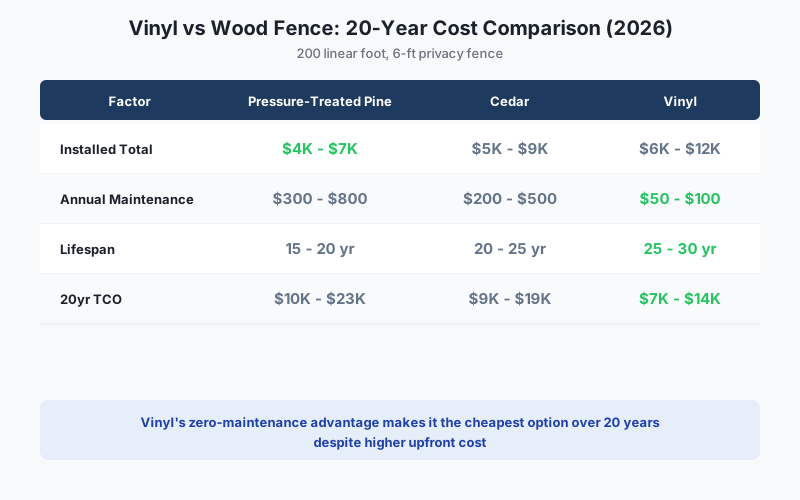
A 200-linear-foot wood fence (pressure-treated pine) costs $4,000-$7,000 installed in 2026, while the same length in vinyl runs $6,000-$12,000. But over 20 years, vinyl's near-zero maintenance flips the equation: wood's total cost of ownership reaches $10,000-$23,000, while vinyl lands at $7,000-$14,000. The cheaper fence on day one is often the more expensive fence over its lifetime.
A 180-foot rotting pressure-treated pine fence replacement at a remodel project in Beaverton, Oregon shows how this plays out. The original fence was nine years old. The posts had gone soft at the base, two panels were warped beyond repair, and staining had been skipped for five consecutive years. The replacement cost $5,400 in materials and labor -- nearly what the original fence cost to install. Upfront cost is one number. The number that matters is what gets spent over the full life of the fence.
Use our Fence Calculator to estimate materials, posts, and total installed cost for wood, vinyl, or any other fencing material.
Side-by-Side Cost Comparison
The table below covers 2026 pricing for a standard 6-foot privacy fence. Material costs are what you pay at a lumberyard or home center. Installed costs include labor, post-hole digging, concrete, and hardware.
| Cost Factor | Pressure-Treated Pine | Cedar | Vinyl (PVC) |
|---|---|---|---|
| Materials per linear ft | $12-$20 | $15-$30 | $15-$40 |
| Installed per linear ft | $20-$35 | $25-$45 | $30-$60 |
| 200 ft total (installed) | $4,000-$7,000 | $5,000-$9,000 | $6,000-$12,000 |
| Lifespan | 15-20 years | 20-25 years | 25-30 years |
| Maintenance frequency | Every 2-3 years | Every 3-5 years | Annual wash only |
| Annual maintenance cost (200 ft) | $300-$800 avg | $200-$500 avg | $50-$100 |
| 20-year total cost of ownership | $10,000-$23,000 | $9,000-$19,000 | $7,000-$14,000 |
Sources: HomeGuide, Angi, Bob Vila (2025-2026 pricing data).
Tip
Regional pricing varies significantly. A vinyl privacy fence in the Pacific Northwest runs about 10-15% less than the same fence in the Northeast, where demand for privacy fencing is higher. Get at least three local quotes before committing.
The installed price gap between wood and vinyl narrows in areas with high labor costs. Vinyl panels are faster to install -- a two-person crew can set 80-100 linear feet of vinyl per day versus 50-70 feet of wood. That labor savings partially offsets vinyl's higher material cost.
Wood Fencing: Pros and Cons
Wood remains the most popular residential fencing material in the United States. About 65% of new residential fences are wood, according to the American Fence Association. There are good reasons for that dominance, and some real drawbacks.
Advantages of wood fencing:
- Lower upfront cost. Pressure-treated pine is the cheapest privacy fence material at $20-$35 per linear foot installed. For homeowners on a tight budget, that $2,000-$5,000 savings on a 200-foot run is significant.
- Easy to repair. A single damaged board costs $2-$5 and takes 10 minutes to replace. You do not need special tools or proprietary parts.
- Customizable. Wood accepts paint, stain, and custom cuts. You can build curved sections, decorative tops, or non-standard heights without special ordering.
- Natural appearance. Cedar and redwood develop a silver-gray patina that many homeowners prefer. Stained wood offers warmth that vinyl cannot replicate.
Disadvantages of wood fencing:
- Ongoing maintenance is mandatory. Staining or sealing every 2-3 years costs $3-$8 per linear foot professionally, or $600-$1,600 for a 200-foot fence. Skip it, and the wood deteriorates rapidly.
- Vulnerable to rot and insects. Even pressure-treated lumber can rot at ground level within 8-12 years if drainage is poor. Termites and carpenter ants target untreated sections.
- Warping and leaning. Wood posts shift as soil expands and contracts. Panels warp from moisture cycling. After 7-10 years, most wood fences need straightening work.
- Shorter lifespan. Pressure-treated pine lasts 15-20 years with good maintenance. Without maintenance, expect 8-12 years before major sections need replacement.
Vinyl Fencing: Pros and Cons
Vinyl fencing has grown from about 10% of the residential market in 2010 to roughly 25% in 2026. The material has improved significantly over the past decade, with better UV stabilizers and impact resistance.
Advantages of vinyl fencing:
- Virtually maintenance-free. A garden hose and occasional scrub with mild soap is all vinyl needs. No staining, sealing, or painting -- ever. Annual maintenance runs $50-$100 at most.
- Longer lifespan. Quality vinyl fencing lasts 25-30 years with no structural degradation. Most manufacturers offer 20-year or lifetime limited warranties.
- No rot or insect damage. PVC does not absorb moisture and is immune to termites, carpenter ants, and fungal decay.
- Consistent appearance. Vinyl does not warp, split, or develop rough surfaces. It looks the same in year 15 as it did in year one.
Disadvantages of vinyl fencing:
- Higher upfront cost. At $30-$60 per linear foot installed, vinyl costs 50-70% more than pressure-treated wood on day one.
- Cracking in extreme cold. PVC becomes brittle below -20 degrees Fahrenheit. A hard impact from a falling branch or a lawnmower in sub-zero temperatures can crack a panel. Replacement panels cost $50-$150 each.
- Limited color and style options. White and tan are the dominant colors. Wood-grain vinyl exists but costs 20-30% more than standard, and the appearance rarely matches real wood up close.
- Yellowing over time. Lower-quality vinyl can yellow after 10-15 years of UV exposure. Stick with brands that use titanium dioxide UV stabilizers.
- Wind vulnerability. Solid vinyl panels catch more wind than board-on-board wood fencing. In high-wind areas, vinyl posts need deeper concrete footings -- typically 36 inches versus 24 inches for wood.
When to Choose Wood
Wood makes financial and practical sense in several specific situations. Do not default to vinyl simply because the long-term math favors it on paper. Context matters.
You are on a strict budget. If you need a fence now and the $2,000-$5,000 upfront difference matters, wood gets the job done. A well-maintained pressure-treated fence will serve you for 15-20 years. Not every homeowner plans to stay in a house long enough for vinyl's maintenance savings to compound.
You want a specific aesthetic. Horizontal slat fences, custom lattice tops, and stained cedar board-on-board designs cannot be replicated in vinyl. If the fence is a design element of your landscaping, wood gives you options that vinyl simply does not offer.
You live in a mild, dry climate. In areas with low humidity and minimal freeze-thaw cycling -- think parts of the Southwest or inland California -- wood lasts longer and needs less maintenance. The rot and warping concerns that make vinyl attractive in the Pacific Northwest or Southeast are less relevant in Tucson.
You are selling the house within five years. If you plan to sell soon, the upfront savings of wood will not be offset by maintenance costs. Both materials add roughly equivalent value at resale, so the cheaper installation gives you a better return.
When to Choose Vinyl
Vinyl is the stronger investment in situations where long-term ownership and low effort are priorities.
You plan to stay for 10 or more years. The break-even point where vinyl's maintenance savings surpass its higher upfront cost is typically 7-10 years for pressure-treated pine and 10-14 years for cedar. After that, every year is money saved.
You do not want to maintain a fence -- period. Some homeowners simply will not stain a fence every two to three years. That is not a character flaw; it is a realistic self-assessment. If the fence will go unmaintained, vinyl is the only material that holds up without intervention.
You live in a humid or wet climate. The Southeast, Gulf Coast, and Pacific Northwest accelerate wood decay. In these regions, pressure-treated pine fences often fail at the 12-15 year mark even with maintenance. Vinyl is unaffected by moisture, mold, or mildew.
Your property backs to a wetland, drainage ditch, or low area. Any fence section that sits in standing water after rain will rot from the base up. Pressure-treated posts can go soft in as little as four years when installed in poorly drained soil. Vinyl is the only practical choice for chronically wet ground.
Total Cost of Ownership
The real comparison between wood and vinyl is not what you pay on installation day. It is what you spend over 5, 10, and 20 years. The table below assumes a 200-linear-foot privacy fence with professional maintenance for wood.
Pressure-Treated Pine vs. Vinyl (200 linear ft)
| Time Period | PT Pine (Low) | PT Pine (High) | Vinyl (Low) | Vinyl (High) |
|---|---|---|---|---|
| Installation | $4,000 | $7,000 | $6,000 | $12,000 |
| Year 5 maintenance total | $1,500 | $4,000 | $250 | $500 |
| 5-year total | $5,500 | $11,000 | $6,250 | $12,500 |
| Year 10 maintenance total | $3,000 | $8,000 | $500 | $1,000 |
| 10-year total | $7,000 | $15,000 | $6,500 | $13,000 |
| Year 20 maintenance total | $6,000 | $16,000 | $1,000 | $2,000 |
| 20-year total | $10,000 | $23,000 | $7,000 | $14,000 |
At the five-year mark, wood is still cheaper in the low-cost scenario by about $750. By year 10, vinyl pulls ahead in nearly every scenario. By year 20, the gap is substantial: vinyl saves $3,000-$9,000 compared to pressure-treated pine.
Cedar vs. Vinyl (200 linear ft)
| Time Period | Cedar (Low) | Cedar (High) | Vinyl (Low) | Vinyl (High) |
|---|---|---|---|---|
| Installation | $5,000 | $9,000 | $6,000 | $12,000 |
| 5-year total | $6,000 | $11,500 | $6,250 | $12,500 |
| 10-year total | $7,000 | $14,000 | $6,500 | $13,000 |
| 20-year total | $9,000 | $19,000 | $7,000 | $14,000 |
Cedar narrows the gap because it requires less frequent maintenance (every 3-5 years versus 2-3 for pressure-treated) and lasts longer. But vinyl still wins at the 20-year mark by $2,000-$5,000 in most scenarios.
The Maintenance Reality
Here is what most cost comparisons leave out: maintenance does not happen on schedule. In theory, you stain your wood fence every two to three years. In practice, life happens. The stain goes four years. Five years. Then you need to sand and prep before you can stain, which doubles the cost.
Professional staining costs for a 200-foot fence:
- On-schedule (every 2-3 years): $600-$1,600 per application. Two coats of semi-transparent stain, light power washing, no sanding required.
- Deferred (4-5 years): $1,000-$2,400 per application. Surface prep is heavier -- power washing at higher PSI, light sanding of gray or rough areas, two to three coats of stain.
- Neglected (6+ years): $1,500-$3,200 per application. Full sanding or chemical stripping, wood brightener, primer on damaged areas, two coats of solid stain. At this point, some boards need replacement.
The maintenance math in the comparison tables assumes on-schedule professional staining. If you are honest about your maintenance habits and know you will defer, add 30-50% to the wood maintenance estimates.
Vinyl maintenance is genuinely simple. A pressure washer on a low setting (under 1,500 PSI) once or twice a year removes green algae and dirt. A Mr. Clean Magic Eraser handles scuff marks. Total annual cost: $50-$100 including water and cleaning supplies.
One caveat: vinyl is not zero-maintenance forever. After 15-20 years, UV degradation can make panels more brittle. A section hit by a heavy branch during a storm may crack rather than flex. Budget $100-$200 per panel for spot replacements in the back half of the fence's life. Most homeowners replace two to four panels over a 25-year span, adding $200-$800 to the total cost.
Frequently Asked Questions
Is vinyl fencing cheaper than wood in the long run?
Yes, vinyl fencing is cheaper than wood over 10 or more years for most homeowners. While vinyl costs $6,000-$12,000 to install on a 200-linear-foot property versus $4,000-$7,000 for pressure-treated wood, the maintenance gap erases that difference by year 7-10. Wood fences require professional staining every 2-3 years at $600-$1,600 per application, plus repairs for warped or rotting boards averaging $200-$500 per year after the first decade. Vinyl needs only a yearly wash costing $50-$100. Over 20 years, a pressure-treated wood fence costs $10,000-$23,000 total, while vinyl comes in at $7,000-$14,000. The savings are most dramatic for homeowners who would otherwise hire contractors for maintenance rather than doing it themselves.
How long does a vinyl fence last compared to wood?
A quality vinyl fence lasts 25-30 years, significantly outlasting both pressure-treated pine (15-20 years) and cedar (20-25 years). The key difference is degradation mode. Wood deteriorates continuously through moisture absorption, UV damage, insect activity, and fungal decay. Even with regular maintenance, wood fences show visible aging by year 8-10 and structural compromise by year 15-18. Vinyl does not rot, absorb water, or attract insects. Its primary degradation is UV-induced brittleness, which modern titanium dioxide stabilizers have largely solved. Most vinyl fence manufacturers back their products with 20-year or lifetime limited warranties, while wood fence warranties rarely exceed 5 years for materials and 1-2 years for labor.
Can I install a vinyl fence myself to save money?
DIY vinyl fence installation is possible and can save $3,000-$5,000 on a 200-foot fence. Vinyl panel systems are designed for homeowner installation with interlocking rails and pre-routed posts. The process involves setting posts in concrete at 6-8 foot intervals, allowing concrete to cure for 24-48 hours, then sliding panels into place. Most homeowners with basic tool experience can complete 30-50 linear feet per day. The main challenges are digging post holes to the correct depth (typically 30-36 inches), keeping posts plumb and level across uneven terrain, and dealing with grade changes on sloped lots. Renting a two-person auger ($60-$100 per day) makes post-hole digging manageable. Where DIY gets difficult is corners, gate openings, and transitions on hills. If your yard is flat with minimal corners, DIY is straightforward. If you have significant grade changes, consider hiring a contractor for post setting and doing the panel installation yourself.
Does a vinyl fence increase home value more than wood?
Both vinyl and wood fences add roughly equivalent value at resale, typically recovering 50-70% of installation cost according to Angi and HomeGuide data. The material matters less than the condition. A well-maintained cedar fence adds more value than a yellowing vinyl fence, and a clean white vinyl fence adds more value than a weathered, unstained pine fence. In suburban markets, vinyl has a slight edge because buyers perceive it as lower maintenance and more modern. In rural or historic neighborhoods, wood fencing -- especially stained cedar or painted picket styles -- is often preferred for its traditional appearance. The strongest value-add comes from fencing that creates a fully enclosed backyard, regardless of material. Homes with fenced yards sell 1-7 days faster than comparable homes without fencing, according to multiple real estate studies.
What are the biggest hidden costs of a wood fence?
The biggest hidden cost of a wood fence is deferred maintenance compounding into premature replacement. A pressure-treated fence that gets stained on schedule every 2-3 years costs roughly $6,000-$16,000 in maintenance over 20 years. But homeowners who skip two or three staining cycles face accelerated rot, warping, and insect damage that shortens the fence's life by 5-8 years. Replacing a 200-foot fence at year 12 instead of year 20 means paying $4,000-$7,000 in installation costs a second time. Other hidden costs include post replacement ($75-$150 per post when concrete footings crack or posts rot below grade), gate realignment ($100-$200 per gate as posts shift), and pressure washing before each stain application ($200-$400 for a 200-foot fence). Property line disputes are another hidden cost -- wood fences are more frequently built on incorrect boundaries because homeowners install them without surveys, leading to legal fees and fence relocation averaging $1,500-$3,000.
Is vinyl fencing strong enough for high winds?
Standard vinyl privacy fencing is rated for sustained winds of 70-90 mph when properly installed with posts set in concrete at 30-36 inches deep. That covers most residential locations outside hurricane and tornado zones. The critical factor is post depth and concrete volume, not the panels themselves. Vinyl panels that pop out of their post channels during high winds are usually a sign of shallow post footings, not a material failure. In hurricane-prone areas (coastal Florida, Gulf Coast, Carolinas), look for vinyl fencing systems rated to 110+ mph winds, which use aluminum-reinforced posts and deeper footings at 42-48 inches. These systems cost 15-25% more than standard vinyl but eliminate the wind concern entirely. Wood fencing in the same high-wind areas faces its own problems: board-on-board wood fences catch less wind than solid vinyl panels, but the individual boards can tear loose from rails, creating dangerous projectiles. Neither material is immune to extreme weather. For areas with frequent 80+ mph gusts, semi-privacy designs with spacing between boards or panels reduce wind load by 30-40% regardless of material.
Cost data sourced from HomeGuide, Angi, Bob Vila, Cool Cat Fence, Barrier Boss, and Cedar Rustic. Prices reflect 2025-2026 national averages and may vary by region, contractor, and project specifics. Use our Fence Calculator for estimates tailored to your project dimensions.
This article is provided for informational and educational purposes only. Content should not be considered professional financial, medical, legal, or other advice. Always consult a qualified professional before making important decisions. UseCalcPro is not responsible for any actions taken based on the information in this article.
Try These Calculators
Estimate fence posts, rails, panels, gates, and total project cost for wood or vinyl fences. Enter fence length and spacing to get a full material list.
Compare firewood BTU output by wood species and moisture content. Calculate heating equivalents for oil, gas, propane, and electricity with cost comparisons.
Estimate 2026 brick wall build cost by height, length, and type. A 6 ft by 30 ft freestanding wall runs $5,400 to $13,500 installed including footing.
Price 2026 bathroom tile installation cost by labor, underlayment, waterproofing, niches, and demo scope. Pure install runs $1,500 to $6,500 for 40-80 sqft.
Compare wood vs vinyl fence cost over 25 years: upfront install, staining upkeep, and rebuilds. See why vinyl costs more now but wins on lifetime cost.