Average Insulation Cost by State in 2026 (All 50 States Compared)
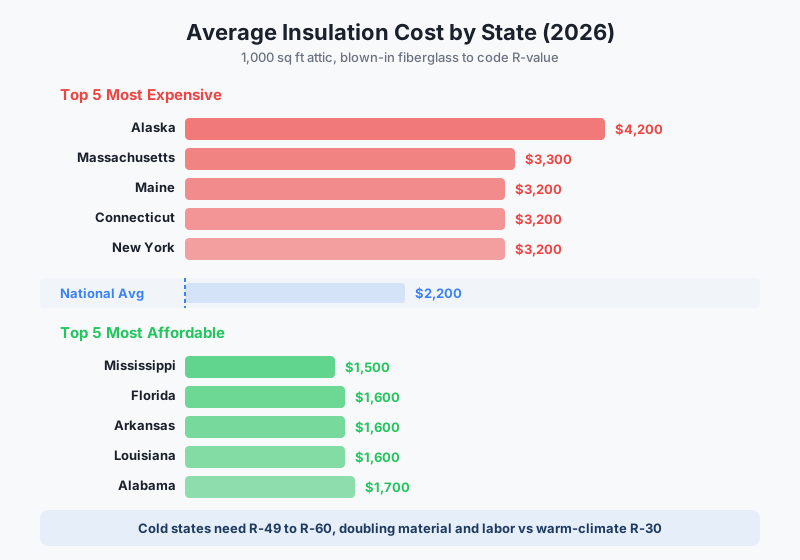
The average attic insulation project costs $2,500 nationally for 1,000 square feet of blown-in fiberglass to R-49 in 2026, but prices range from $1,500 in Mississippi to over $4,200 in Alaska. The variation comes from three factors that compound: labor rates, required R-values (northern states need more insulation), and energy costs that determine your payback period.
I insulated a 1,200-square-foot attic in suburban Philadelphia last year with blown-in cellulose to R-60. Total cost: $3,100 including air sealing the attic floor penetrations. The homeowner's heating bill dropped from $2,800/year to $1,720/year -- a $1,080 annual savings that pays back the project in under three years. That same job in Anchorage would have cost $4,400 but saved even more on heating because Alaska energy costs are brutal.
Use our Insulation Calculator to estimate your insulation needs based on your climate zone and current R-value.
All 50 States: Insulation Cost Comparison
The table below shows estimated costs for attic insulation (1,000 sq ft of blown-in fiberglass) to meet current DOE-recommended R-values. Northern states cost more because they require higher R-values (more material) and have higher labor rates.
| State | Avg. Cost | R-Value Req. | Climate Zone | vs. National |
|---|---|---|---|---|
| Alabama | $1,700 | R-38 | 3 | -32% |
| Alaska | $4,200 | R-60 | 7-8 | +68% |
| Arizona | $1,800 | R-38 | 2-3 | -28% |
| Arkansas | $1,600 | R-38 | 3 | -36% |
| California | $2,800 | R-38 to R-49 | 3-4 | +12% |
| Colorado | $2,700 | R-49 | 5-6 | +8% |
| Connecticut | $3,200 | R-49 | 5 | +28% |
| Delaware | $2,600 | R-49 | 4 | +4% |
| Florida | $1,600 | R-30 to R-38 | 1-2 | -36% |
| Georgia | $1,800 | R-38 | 3 | -28% |
| Hawaii | $2,200 | R-30 | 1 | -12% |
| Idaho | $2,400 | R-49 | 5-6 | -4% |
| Illinois | $2,700 | R-49 | 5 | +8% |
| Indiana | $2,400 | R-49 | 5 | -4% |
| Iowa | $2,400 | R-49 | 5 | -4% |
| Kansas | $2,200 | R-49 | 4 | -12% |
| Kentucky | $2,000 | R-38 to R-49 | 4 | -20% |
| Louisiana | $1,600 | R-30 to R-38 | 2-3 | -36% |
| Maine | $3,200 | R-60 | 6 | +28% |
| Maryland | $2,700 | R-49 | 4 | +8% |
| Massachusetts | $3,300 | R-49 to R-60 | 5 | +32% |
| Michigan | $2,700 | R-49 | 5-6 | +8% |
| Minnesota | $2,900 | R-49 to R-60 | 6-7 | +16% |
| Mississippi | $1,500 | R-30 to R-38 | 2-3 | -40% |
| Missouri | $2,200 | R-38 to R-49 | 4 | -12% |
| Montana | $2,700 | R-49 to R-60 | 6 | +8% |
| Nebraska | $2,300 | R-49 | 5 | -8% |
| Nevada | $2,100 | R-38 | 3 | -16% |
| New Hampshire | $3,100 | R-49 to R-60 | 5-6 | +24% |
| New Jersey | $3,100 | R-49 | 4-5 | +24% |
| New Mexico | $1,900 | R-38 | 3-4 | -24% |
| New York | $3,200 | R-49 | 4-5 | +28% |
| North Carolina | $2,000 | R-38 | 3-4 | -20% |
| North Dakota | $2,800 | R-60 | 6-7 | +12% |
| Ohio | $2,500 | R-49 | 5 | +0% |
| Oklahoma | $1,800 | R-38 | 3 | -28% |
| Oregon | $2,600 | R-49 | 4-5 | +4% |
| Pennsylvania | $2,700 | R-49 | 5 | +8% |
| Rhode Island | $3,000 | R-49 | 5 | +20% |
| South Carolina | $1,700 | R-38 | 3 | -32% |
| South Dakota | $2,400 | R-49 | 5-6 | -4% |
| Tennessee | $2,000 | R-38 | 4 | -20% |
| Texas | $1,700 | R-30 to R-38 | 2-3 | -32% |
| Utah | $2,400 | R-49 | 5 | -4% |
| Vermont | $3,200 | R-60 | 6 | +28% |
| Virginia | $2,300 | R-38 to R-49 | 4 | -8% |
| Washington | $2,800 | R-49 | 4-5 | +12% |
| West Virginia | $2,000 | R-38 to R-49 | 4-5 | -20% |
| Wisconsin | $2,700 | R-49 to R-60 | 6 | +8% |
| Wyoming | $2,500 | R-49 | 6 | +0% |
Info
Climate zone determines how much insulation you need. Zone 1 (South Florida, Hawaii) needs only R-30; Zone 7 (northern Minnesota, Alaska) needs R-60. More material = higher cost, even when labor rates are similar.
Top 5 Most Expensive States
1. Alaska ($4,200)
Alaska is the most expensive state for insulation by a wide margin. R-60 requirements mean roughly 20 inches of blown-in material, labor rates are the highest in the country, and shipping materials to remote locations adds significant cost. However, the payback is also the fastest -- heating costs in Alaska average $3,000-$5,000/year, so proper insulation can save $1,500-$2,500 annually.
2. Massachusetts ($3,300)
High labor costs in the Boston metro area, R-49 to R-60 requirements, and older housing stock (many pre-1970 homes with minimal insulation) drive costs up. The state's Mass Save rebate program offsets 75-100% of insulation costs for many homeowners, making effective out-of-pocket costs much lower.
3. Maine ($3,200)
Maine has cold climate requirements (R-60 for Zone 6), high heating costs, and limited contractor supply in rural areas. The state's Efficiency Maine program offers significant rebates. Many Maine homes are over 50 years old with original insulation well below current code.
4. Connecticut ($3,200)
High labor rates, R-49 requirements, and dense suburban development with difficult attic access in older homes push costs up. Connecticut's Energize CT program offers rebates of $0.50-$1.00 per square foot for qualifying insulation work.
5. New York ($3,200)
Like Massachusetts, New York's average is driven by the NYC metro area. Upstate New York has higher R-value requirements (Zone 5-6) but lower labor costs, while the city has lower requirements (Zone 4) but drastically higher labor. The statewide average reflects both.
Top 5 Cheapest States
1. Mississippi ($1,500)
Mississippi needs only R-30 to R-38 (less material), has the lowest construction labor rates in the country, and mild winters mean less urgency driving demand up. The downside: lower energy costs mean the payback period is longer -- 5-8 years versus 2-3 years in northern states.
2. Florida ($1,600)
Florida's warm climate means R-30 is sufficient for most areas (Zone 1-2). Insulation here is primarily about cooling efficiency rather than heating. The focus is on attic radiant barriers ($0.50-$1.00/sq ft) combined with moderate blown-in insulation.
3. Arkansas ($1,600) and Louisiana ($1,600)
Both states benefit from low labor costs, low R-value requirements (R-30 to R-38), and a competitive contractor market. Blown-in fiberglass in these states runs $0.80-$1.20 per square foot installed -- about half the Northeast rate.
5. Alabama ($1,700)
Low labor, Zone 3 R-value requirements, and a long building season make Alabama one of the cheapest states for insulation work. Most attic insulation projects in Alabama come in under $2,000.
Regional Analysis
Northeast
The Northeast is the most expensive region for insulation, averaging $2,700-$3,300 per project. High R-value requirements (R-49 to R-60), expensive labor markets, older housing stock with difficult access, and ice dam prevention needs all add cost. However, the energy savings payback is among the fastest due to high heating costs ($1,500-$3,000/year). Many northeastern states offer generous utility rebates.
South
The South is the cheapest region at $1,500-$2,000. Lower R-value needs, cheap labor, and mild winters keep costs down. Southern insulation priorities differ -- here it is about keeping cooling costs down, and attic radiant barriers combined with R-30 to R-38 insulation are the standard approach.
Midwest
The Midwest averages $2,200-$2,900. The region requires R-49 to R-60 in northern states (Minnesota, Wisconsin, Michigan) but only R-38 to R-49 in southern states (Missouri, Kansas). Labor is moderate. The extreme temperature swings (hot summers, cold winters) mean insulation pays for itself faster here than in mild climates.
West
The West shows wide variation. California ($2,800) and Washington ($2,800) have high labor but moderate R-value needs. Mountain states (Montana, Wyoming, Colorado) need R-49 to R-60 but have moderate labor. Desert states (Arizona, Nevada) need minimal insulation but face extreme cooling loads. Hawaii ($2,200) needs only R-30 but has high material shipping costs.
What Drives State-to-State Cost Variation?
R-Value Requirements
This is the single biggest cost driver. R-60 requires roughly twice the material thickness of R-30. In blown-in fiberglass, R-30 is about 10 inches deep; R-60 is about 20 inches. That doubles the material cost per square foot from $0.60 to $1.20.
Labor Rates
Insulation labor ranges from $0.40/sq ft in Mississippi to $1.50/sq ft in Massachusetts. Spray foam labor is even more variable: $1.00/sq ft in the South to $3.00+/sq ft in the Northeast. Labor is typically 40-60% of total project cost.
Energy Costs
States with high energy costs (Alaska, Hawaii, Connecticut, Massachusetts) have faster payback periods, which drives demand and supports higher contractor pricing. Where insulation pays for itself in 2-3 years, homeowners are willing to invest more.
Rebates and Incentives
Many states offer insulation rebates that dramatically reduce out-of-pocket costs. The federal 25C tax credit covers 30% of insulation costs up to $1,200. State utility programs (Mass Save, Energize CT, Efficiency Maine, NYSERDA) can cover an additional 50-100% of remaining costs.
Housing Stock Age
States with older housing stock (Northeast, Midwest) tend to have more insulation demand because pre-1980 homes often have R-11 to R-19 in their attics -- far below current code. Retrofitting these homes costs more due to access issues and the need to air-seal before insulating.
Frequently Asked Questions
How much insulation do I need for my climate zone?
The DOE recommends R-30 to R-60 depending on your climate zone. Most of the United States falls in Zones 3-5, which need R-38 to R-49 in the attic. Here is the breakdown:
- Zone 1 (South FL, HI): R-30 minimum
- Zone 2 (Gulf Coast, South TX): R-30 to R-38
- Zone 3 (Southeast, Southwest): R-38
- Zone 4 (Mid-Atlantic, lower Midwest): R-38 to R-49
- Zone 5 (Upper Midwest, Northeast): R-49
- Zone 6-7 (Northern border, AK): R-49 to R-60
Existing homes with less than R-11 in the attic should prioritize insulation upgrades. The energy savings are most dramatic going from R-11 to R-38 -- diminishing returns set in above R-49 in moderate climates.
Is spray foam worth the extra cost?
Spray foam costs 2-4x more than blown-in fiberglass but provides both insulation and air sealing in one step. The cost comparison for 1,000 sq ft:
- Blown-in fiberglass (R-49): $1,500-$3,300 depending on state
- Open-cell spray foam (R-49): $3,000-$6,500 depending on state
- Closed-cell spray foam (R-49): $5,000-$12,000 depending on state
Spray foam makes the most financial sense in homes with significant air leakage (older homes, balloon-frame construction) or in areas where moisture control is critical (coastal, humid climates). For most attics, blown-in fiberglass with separate air sealing is the better value.
What is the payback period for insulation in my state?
Payback ranges from 2-3 years in cold/expensive energy states to 7-10 years in mild/cheap energy states. The calculation is simple: project cost divided by annual energy savings.
- Alaska: $4,200 project / $2,000 annual savings = 2.1 years
- Massachusetts: $3,300 / $1,200 savings = 2.8 years
- Ohio: $2,500 / $800 savings = 3.1 years
- Texas: $1,700 / $400 savings = 4.3 years
- Florida: $1,600 / $250 savings = 6.4 years
After payback, the savings continue for the 20-30 year lifespan of the insulation. Federal and state rebates shorten payback periods significantly.
Can I install insulation myself to save money?
DIY blown-in insulation saves 40-60% on labor costs and is feasible for accessible attics. Many home improvement stores rent blowing machines for free with insulation purchase. DIY costs for 1,000 sq ft:
- Materials only (R-49 fiberglass): $600-$1,000
- Machine rental: Free with purchase at most retailers
- Protective gear: $50-$100
- Total DIY: $650-$1,100 vs. $2,500 professional
DIY is NOT recommended for spray foam (requires specialized equipment and training), cathedral ceilings, wall cavity insulation, or attics with knob-and-tube wiring (fire hazard requires professional assessment).
Do insulation rebates differ by state?
Yes, dramatically. Some states cover 75-100% of insulation costs through utility programs; others offer nothing beyond the federal tax credit. The best state programs:
- Massachusetts (Mass Save): Up to 75-100% of insulation cost for qualifying homes
- Connecticut (Energize CT): Rebates covering 50-75% of costs
- Maine (Efficiency Maine): $1,000-$4,000 rebates for insulation
- New York (NYSERDA): $500-$2,000 rebates plus utility incentives
- Oregon (Energy Trust): $0.50-$1.50/sq ft rebates
The federal 25C tax credit (30% up to $1,200) is available nationwide and stacks with state programs. Always check the Database of State Incentives before starting your project.
Should I insulate walls or attic first?
Attic first -- always. Heat rises, and an uninsulated or under-insulated attic is the single largest source of energy loss in most homes. The ROI comparison:
- Attic insulation: $1,500-$4,200 cost, 15-30% energy savings, 2-5 year payback
- Wall insulation (retrofit): $3,000-$10,000 cost, 10-20% energy savings, 5-10 year payback
- Crawl space/basement: $1,000-$4,000 cost, 5-15% energy savings, 3-8 year payback
After the attic is properly insulated and air-sealed, walls are the next priority -- but only if your existing wall insulation is R-11 or less. Retrofit wall insulation (drilling holes and blowing in dense-pack cellulose or fiberglass) is significantly more expensive per R-value gained than attic work.
Cost data sourced from Angi, HomeGuide, Sprayman, and DOE Energy Saver. Prices reflect 2026 estimates based on regional labor rates, material costs, and DOE-recommended R-values. Actual costs vary by specific location, contractor, and home conditions.
This article is provided for informational and educational purposes only. Content should not be considered professional financial, medical, legal, or other advice. Always consult a qualified professional before making important decisions. UseCalcPro is not responsible for any actions taken based on the information in this article.
Try These Calculators
Estimate 2026 spray foam insulation cost by sqft and foam type. Open-cell runs $1.50-$3.50/sqft; closed-cell $3-$5/sqft; 1,500 sqft attic $4,500-$9,000.
Price 2026 bathroom tile installation cost by labor, underlayment, waterproofing, niches, and demo scope. Pure install runs $1,500 to $6,500 for 40-80 sqft.
Estimate 2026 pressure washing service costs by surface, square footage, and method. Driveways run $100 to $350, siding $250 to $600, roof soft-wash $500+.
Estimate 2026 sod installation cost by lawn size, sod type, and region. Installed prices run $1.00-$2.50 per sqft; most 5,000 sqft lawns cost $5,000-$12,500.