Compare BOP Insurance Quotes by Industry: 2026 Cost Averages
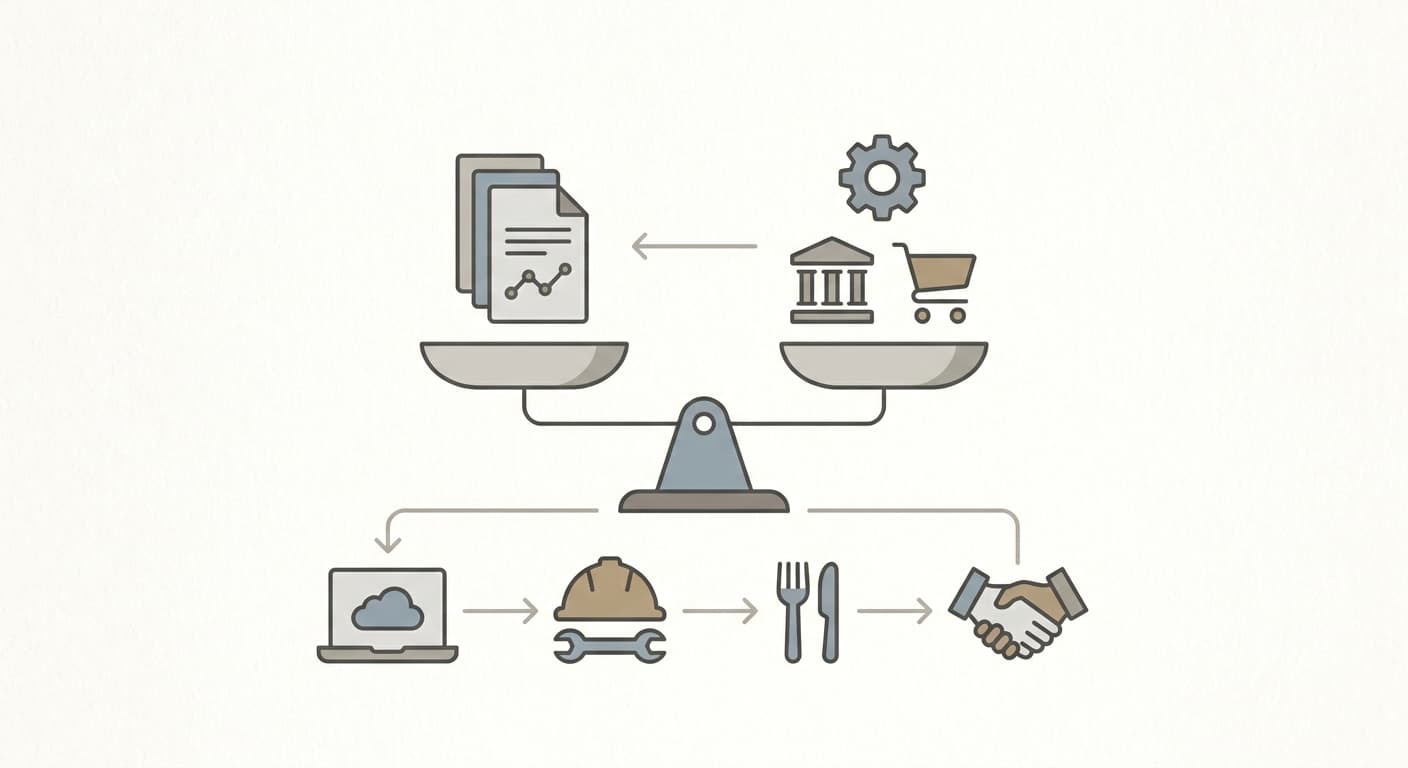
A Business Owner's Policy (BOP) bundles general liability and commercial property coverage into one policy, and in 2026 it runs a median of about $83 per month (roughly $1,000/year) for a typical small business per Insureon — though MoneyGeek's broader sample puts the mean closer to $1,767/year — and the price swings from about $25/month for a drone photographer to $1,346/month for a pressure-washing contractor. Industry classification, not size or revenue, is the single biggest reason two businesses get wildly different quotes. To compare BOP insurance quotes by industry against real 2026 averages, run your details through the Small Business Insurance Quote Calculator before you call a single broker.
The most expensive mistake in comparing commercial coverage for small businesses is accepting the first quote. On one retail boutique account, the spread between the cheapest and most expensive carrier on identical $1M/$2M coverage was $1,650 versus $2,300 — a $650/year gap for the exact same policy. One roofing contractor had been overpaying $4,100/year because his broker bundled him at a generic "construction" class code instead of his actual specialty. Industry class is where the money hides, and that is exactly what this guide breaks down.
What a BOP Covers (and What It Does Not)
A Business Owner's Policy is not a single product — it is two coverage lines packaged together at a discount. Understanding the bundle is the first step to comparing quotes accurately, because a "BOP" from one carrier may include endorsements another excludes.
The two core lines in every BOP are:
- General Liability (GL): Covers third-party bodily injury, third-party property damage, and advertising injury. The classic claim is a customer slipping on a wet floor in your shop, or your delivery crew cracking a homeowner's hardwood.
- Commercial Property: Covers your building (if owned), leasehold improvements, inventory, equipment, computers, furniture, and business-interruption income if the property is damaged.
Bundling these two lines into a BOP typically costs 10-20% less than buying GL and property separately, which is why a BOP is the mass-market default for any business with a physical location or inventory.
Important
A BOP does NOT cover employee injuries (that is Workers Compensation), professional mistakes or bad advice (that is Professional Liability / E&O), or vehicles used for business (that is Commercial Auto). When a carrier quotes a "full-stack" price, they are adding these separate lines on top of the BOP — always confirm which lines a quote actually includes before comparing it to another.
According to Insureon's BOP cost data, small businesses pay a median of about $83/month for a BOP, and 42% of small businesses pay under $50/month while 30% pay $50-$100/month. That spread is almost entirely explained by industry. The Small Business Insurance Quote Calculator lets you toggle coverage from GL-only to a full BOP to a full stack so you can see exactly which lines drive your number.
Average BOP Cost by Industry in 2026
Here is the heart of the comparison. The table below shows typical annual BOP premiums (GL + property bundled) by industry, alongside the GL-only price for reference. These ranges are built from 2026 rate data published by MoneyGeek, Insureon, The Hartford, and Hiscox.
Average BOP Premium by Industry (2026)
| Industry | GL Only | BOP (GL + Property) | Full Stack (+ WC + E&O) |
|---|---|---|---|
| Retail / boutique / e-commerce | $500-$1,200/yr | $800-$2,200/yr | $2,500-$5,500/yr |
| Professional services (accountant, lawyer) | $500-$1,200/yr | $700-$1,800/yr | $2,000-$4,500/yr |
| Tech / IT consultant / SaaS | $400-$1,000/yr | $600-$1,500/yr | $1,800-$4,500/yr |
| Restaurant / bar / cafe | $1,200-$3,500/yr | $1,800-$5,000/yr | $5,000-$12,000/yr |
| General contractor / HVAC | $1,500-$5,000/yr | $2,200-$7,500/yr | $6,500-$15,000/yr |
Two patterns jump out. First, retail, professional services, and tech cluster at the bottom — their BOP rarely tops $2,200/year because premises risk and physical-injury exposure are low. Second, restaurants and contractors sit 2-4x higher on the same coverage.
Tip
When you collect quotes, normalize them to the same coverage and limits ($1M per occurrence / $2M aggregate is the most common enterprise minimum) before comparing. A "$900 BOP" with a $50K property limit is not cheaper than a "$1,400 BOP" with a $200K limit — it is a different product. Always compare like-for-like.
According to MoneyGeek's 2026 BOP cost report, drone-related businesses pay the lowest average BOP at about $25/month ($300/year), while pressure washing tops the list at $1,346/month ($16,152/year). That roughly 54x spread within a single product is why "average BOP cost" is almost meaningless until you filter by industry.
Why Restaurants and Contractors Pay 3-4x More
The premium gap between a tech consultant and a roofing contractor is not arbitrary. Three forces stack on top of each other.
Claim frequency. Restaurants have slip-and-fall exposure from spills, wet floors, and liquor service. Contractors face property-damage and on-site injury exposure every single day. A retail shop sees far fewer liability incidents.
Claim severity. A contractor dropping a tool through a window or a restaurant kitchen fire is a $50,000-$500,000 event. A retail shoplifting loss is $200. Insurers price for the worst plausible day, not the average day.
Property values and equipment. A restaurant's commercial kitchen, walk-in coolers, and tenant improvements push the property side of the BOP far higher than a consultant's laptop and desk.
Industry Risk and Pricing Drivers
| Industry | Relative BOP Cost | Primary Risk Driver | GL Baseline /yr |
|---|---|---|---|
| Clerical office | Lowest (1.0x) | Minimal physical risk | $400-$800 |
| Retail store | Low (1.2-1.5x) | Foot traffic + inventory | $500-$1,200 |
| Restaurant | High (2-2.5x) | Slip-fall + liquor + kitchen fire | $1,200-$3,500 |
| Landscaper | High (2-2.5x) | Equipment + outdoor work | $900-$2,200 |
| General contractor | Very high (3-4x) | On-site injury + client property | $1,500-$5,000 |
| Roofing contractor | Highest (4x+) | Fall risk + heights + fire | $3,000-$8,000 |
The relative multipliers above are computed against the clerical-office baseline. A restaurant's $1,200-$3,500 GL baseline is roughly 2-2.5x the $500-$1,200 retail baseline, and a roofing contractor's $3,000-$8,000 baseline is 4x or more. The same logic carries into the property side of the BOP, which is why the bundled premiums in the first table separate so cleanly by industry.
Warning
If you run a roofing, HVAC, or general contracting business with employees, your Workers Compensation line can exceed your entire BOP premium. Roofing Workers Comp runs $15-$25 per $100 of payroll versus $0.20-$0.50 for an office. On $500K of payroll, that is $75,000-$125,000 in Workers Comp alone — quote it FIRST, because it determines whether you even fit inside a digital carrier's appetite.
How a BOP Quote Is Calculated
Carriers do not pull BOP prices out of thin air. The number is a stack of factors, each with a known driver. The core formula looks like this:
Important
BOP premium = (GL industry base × revenue factor) + commercial property rider + state/ZIP multiplier Add Workers Comp (payroll ÷ 100 × class rate) and E&O separately to reach a full-stack quote.
Walk it in five steps using a real example — a 3-employee retail boutique in Dallas with $300K revenue:
- Start with the GL industry base. Retail GL runs $500-$1,200/year. Take the midpoint near $850.
- Apply the revenue factor. At $100K-$500K revenue, the multiplier is roughly 1.0x, so the GL line stays near $850.
- Add the commercial property rider. Property adds $300-$2,000/year; a small boutique with modest inventory lands around $350-$1,350 on top.
- Apply the state/ZIP multiplier. Dallas, TX sits at the 1.0x national baseline (no California or New York surcharge), so nothing is added.
- Result. GL (
$850) + property ($350-$1,350) lands the BOP at roughly $1,200-$2,200/year — a band that straddles the Insureon median (~$1,000/year) and MoneyGeek's higher ~$1,767/year mean.
The Seven Factors That Move Your Quote
| Factor | Typical Impact on Premium |
|---|---|
| Industry class | Largest driver — retail/tech baseline; restaurant 2-2.5x; contractor 3-4x |
| Annual revenue | $500K → $5M roughly 3-4x the GL line |
| Coverage limits | $1M/$2M is standard; higher limits raise premium |
| Deductible | $500 → $2,500 trims BOP premium 10-20% |
| State / ZIP | CA / NY / NJ / IL +20-40%; rural Midwest / South -10-20% |
| Claims history | 3 claim-free years earns 10-25% credit; one open claim adds 25-50% |
| Bundling | BOP + Workers Comp + E&O with one carrier cuts 8-15% across lines |
The Small Business Insurance Quote Calculator bakes all seven of these into a single estimate, so you can change one variable at a time and watch the number move. Because insurance premiums are a deductible business expense, pair the result with the Self-Employment Tax Calculator and the 1099 Tax Calculator to see how much of the premium you effectively recover at tax time — usually 25-35% for a profitable solo operation.
BOP vs General Liability vs Commercial Package: Which to Compare
Comparing quotes across industries only works if you are comparing the same type of policy. Three products get confused constantly.
General Liability (GL) alone is the cheapest entry point — $400-$2,000/year for most businesses under 10 employees, averaging about $1,474/year for a 1-4 employee operation per Insureon's general liability cost data. It covers third-party injury and property damage but nothing of your own.
A BOP adds commercial property to GL at a 10-20% bundle discount. It is the right default for any business with inventory, equipment, or a leased space.
A Commercial Package Policy (CPP) is the next tier up — it un-bundles the BOP's pre-set limits and lets a larger or higher-risk business custom-build property, liability, crime, and equipment-breakdown coverage. Restaurants and contractors that outgrow BOP eligibility (typically above $5M revenue or higher property values) move to a CPP.
BOP vs GL vs Commercial Package
| Feature | General Liability | BOP | Commercial Package |
|---|---|---|---|
| Third-party liability | Yes | Yes | Yes |
| Commercial property | No | Yes (pre-set limits) | Yes (customizable) |
| Bundle discount | N/A | 10-20% | Varies |
| Best for | Home-based, no property | Most retail/restaurant/contractor | $5M+ revenue, complex risk |
| Typical cost | $400-$2,000/yr | $700-$7,500/yr | $5,000+/yr |
Tip
If you are a solo, home-based e-commerce seller or a remote SaaS consultant with almost no physical property, a GL-only policy can be cheaper than a BOP. But carriers often cross-subsidize property on low-risk buyers, so a modest BOP sometimes costs only slightly more than GL alone — always quote both and compare the real numbers.
Carrier Comparison: Who's Cheapest for Your Industry
The same business can get materially different quotes across carriers, because each carrier optimizes for a different buyer. Matching your industry to the right carrier is half the savings.
Next Insurance and biBERK are the digital-first low-touch options, often noticeably cheaper than traditional carriers on solo-through-10-employee BOP and GL, with instant online binding. Their weak spot is contractors with $500K+ payroll.
Hiscox is the professional-services and tech specialist. Per Hiscox's published median pricing, its BOP runs about $83/month and general liability about $45/month for small businesses — consultants, accountants, lawyers, and IT firms usually find its E&O the most comprehensive.
The Hartford is the mainstream pick with the broadest appetite and stronger-than-average restaurant and contractor underwriting. Per The Hartford's general liability cost page, its customers pay about $810/year ($68/month) for general liability.
Progressive Commercial, Travelers, and Chubb dominate mid-market accounts ($10K+ annual premium, 25+ employees) where deeper underwriting and umbrella support matter.
Warning
Always request three quotes on IDENTICAL limits, deductibles, and policy dates. A meaningful spread across carriers on a matched BOP is common, and it tends to widen on high-risk classes like restaurant and contractor. The "cheapest" quote that excludes your highest-risk activity via endorsement is not actually cheaper — read the specimen policy, not the marketing summary.
How to Compare BOP Quotes the Right Way
Here is the six-step process for comparing quotes correctly:
- Decide which lines you need. A solo home-based seller needs GL, maybe E&O. A 10-employee restaurant needs the full stack (BOP + Workers Comp + E&O + liquor liability).
- Document the limits your contracts require. $1M/$2M GL is the most common landlord and enterprise minimum. Carriers cannot upsell you past documented limits.
- Get three quotes on identical terms. One digital (Next/biBERK), one specialist (Hiscox or The Hartford), one independent broker who shops multiple markets.
- Read the specimen policy PDF. Confirm your actual work is covered IN, not excluded OUT via endorsement — critical for restaurant, contractor, and childcare classes.
- Negotiate deductible and bundle. Moving $500 → $2,500 deductible trims 10-20%; bundling 3+ lines earns 8-15%.
- Bind before you need the certificate. Digital carriers bind same-day; traditional underwriting takes 3-5 business days.
Because your billable rate has to absorb the premium, run the annual number through the Freelance Rate Calculator to fold insurance into your hourly rate, and the Income Tax Calculator to confirm the after-tax cost of each line. Insurance is one expense; the full picture only makes sense alongside your tax bill.
Frequently Asked Questions
How do I compare BOP insurance quotes by industry?
Normalize every quote to the same coverage lines, limits, and deductible, then compare the bundled BOP price against the 2026 industry average: retail and tech land at $800-$2,200/year, professional services at $700-$1,800, restaurants at $1,800-$5,000, and contractors at $2,200-$7,500. Get three quotes — one digital carrier, one specialist, one broker — because a meaningful spread on identical coverage is common. Use the Small Business Insurance Quote Calculator to benchmark your number before you call.
What is the average BOP cost by industry in 2026?
The national BOP median is about $83/month (roughly $1,000/year) per Insureon, while MoneyGeek's broader sample puts the mean closer to $1,767/year; either way it ranges from about $25/month for a drone photographer to $1,346/month for a pressure-washing contractor. Retail and tech businesses typically pay $800-$2,200/year, restaurants $1,800-$5,000, and general contractors $2,200-$7,500 for GL plus property bundled. Industry classification is the single largest driver of the difference.
What does a BOP cover?
A BOP bundles two coverage lines: General Liability (third-party bodily injury, property damage, and advertising injury) and Commercial Property (your building, inventory, equipment, and business-interruption income), usually at a 10-20% discount versus buying them separately. It does NOT cover employee injuries (Workers Comp), professional mistakes (E&O), or business vehicles (Commercial Auto) — those are priced as separate lines on top of the BOP.
How is a BOP quote calculated?
A BOP quote stacks the GL industry base rate, multiplies it by a revenue factor (roughly 1.0x at $100K-$500K revenue up to 4x at $5M+), adds a commercial property rider of $300-$2,000, then applies a state/ZIP multiplier of 0.8-1.4x. For a 3-employee retail boutique in Dallas with $300K revenue, that produces a BOP of about $1,200-$2,200/year. Deductible choice, claims history, and bundling adjust the final number by another 10-25% each.
What is the difference between a BOP, general liability, and a commercial package policy?
General Liability alone covers third-party claims and runs $400-$2,000/year. A BOP adds commercial property to GL at a 10-20% bundle discount and is the default for most businesses with inventory or a location. A Commercial Package Policy un-bundles BOP limits and lets larger or higher-risk businesses (typically $5M+ revenue) custom-build property, liability, crime, and equipment-breakdown coverage. Most small businesses fit a BOP; restaurants and contractors that outgrow it move to a package.
Which carrier is cheapest for a BOP?
Next Insurance and biBERK are often cheapest on solo-to-10-employee BOP. Hiscox is best for professional services and tech, with a published median BOP around $83/month. The Hartford has the broadest appetite and stronger restaurant and contractor underwriting. There is no universal cheapest carrier — request three quotes on identical coverage, because the cheapest carrier for a tech consultant is rarely the cheapest for a roofing contractor.
Can a home-based business skip a BOP and just buy general liability?
Yes, if you have almost no physical property. A solo, home-based e-commerce seller or remote SaaS consultant can buy GL-only and save the property portion. But carriers often cross-subsidize property on low-risk buyers, so a modest BOP sometimes costs only marginally more than GL alone — and most commercial leases and enterprise contracts require $1M GL regardless, so quote both and compare the real numbers.
Related Articles
- How Much Does RV Insurance Cost in 2026? — The same coverage-and-class logic applied to recreational-vehicle premiums.
- Good Sam RV Insurance Quote Guide 2026 — How specialty insurers price niche risk, a useful parallel to industry-class BOP pricing.
Related Calculators
- Small Business Insurance Quote Calculator — Estimate your BOP, GL, Workers Comp, and E&O premium by industry, revenue, and payroll.
- 1099 Tax Calculator — Price self-employment tax and deductions, including your deductible insurance premium.
- Self-Employment Tax Calculator — Compute the 15.3% SE tax on net business income to see your true after-insurance cost.
- Freelance Rate Calculator — Build premium, taxes, and overhead into the hourly rate you need to charge.
- Income Tax Calculator — Confirm the after-tax cost of each coverage line you buy.
This article provides general information for educational purposes. Insurance rates, class codes, and carrier appetites change frequently; verify current pricing and coverage with a licensed agent before binding a policy.
This article is provided for informational and educational purposes only. Content should not be considered professional financial, medical, legal, or other advice. Always consult a qualified professional before making important decisions. UseCalcPro is not responsible for any actions taken based on the information in this article.
Try These Calculators
Estimate 2026 small business insurance cost by industry, revenue, payroll, and coverage. BOP averages $1,767/yr, GL $1,474/yr, E&O $1,051/yr nationwide.
Estimate 2026 nutritionist and dietitian costs by session type, format, and credential. Single visits run $75 to $250; insurance often cuts it to a copay.
Estimate 2026 exterior paint cost per gallon and total material spend. Behr $28-$55, Benjamin Moore $45-$95, Sherwin-Williams $60-$120 per gallon (2 coats).