Hardwood vs. Laminate Flooring Cost in 2026: Full Comparison
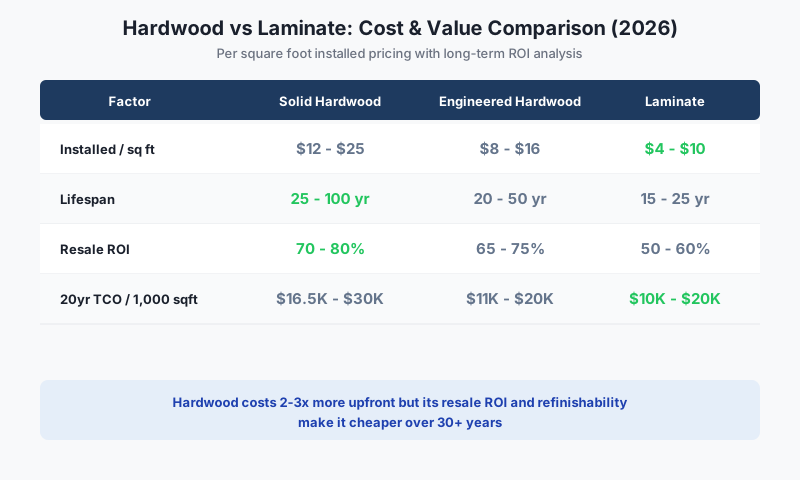
Hardwood flooring costs $12-$25 per square foot installed in 2026, while laminate runs $4-$10 per square foot installed. Over 20 years, hardwood's total cost of ownership for 1,000 square feet ranges from $16,500 to $30,000 including refinishing, while laminate lands at $10,000-$20,000 with a likely full replacement. Hardwood wins on resale value (70-80% ROI) and lifespan (25-100 years), but laminate wins on upfront cost and is the better choice when budget matters more than longevity.
Consider 1,200 square feet of flooring replaced in a 1960s colonial -- 800 square feet of red oak hardwood downstairs and 400 square feet of 12mm laminate upstairs in the bedrooms. The hardwood material bill was $7,200 and installation ran $4,800, so $12,000 total for the main level. The laminate upstairs cost $1,400 for materials and $2,000 for labor -- $3,400 total. Same house, same week, but a $8,600 difference between floors. That gap is exactly why the right answer depends on the room, not the brochure.
Use our Flooring Calculator to estimate material quantities and total installed cost for your specific square footage before you commit to either option.
Side-by-Side Cost Comparison
Here is every number that matters, in one table. All prices reflect 2026 national averages from Fixr, Angi, and HomeGuide.
| Factor | Solid Hardwood | Engineered Hardwood | Laminate |
|---|---|---|---|
| Material cost (per sq ft) | $6 - $15 | $4 - $10 | $2 - $5 |
| Installation labor (per sq ft) | $6 - $10 | $4 - $6 | $2 - $5 |
| Total installed (per sq ft) | $12 - $25 | $8 - $16 | $4 - $10 |
| 1,000 sq ft installed | $12,000 - $25,000 | $8,000 - $16,000 | $4,000 - $10,000 |
| Lifespan | 25 - 100 years | 20 - 50 years | 15 - 25 years |
| Refinishing | 3 - 7 times over lifespan | 1 - 3 times (depends on veneer) | Not possible |
| Refinishing cost (per sq ft) | $3 - $5 every 7-10 years | $3 - $5 every 7-10 years | N/A |
| Annual maintenance cost | ~$0.10 - $0.20/sq ft | ~$0.10 - $0.15/sq ft | ~$0.05/sq ft |
| Resale value ROI | 70% - 80% | 65% - 75% | 50% - 60% |
| DIY difficulty | Hard (nail-down requires tools) | Moderate (click-lock available) | Easy (floating click-lock) |
| Moisture resistance | Low | Moderate | Moderate to high |
The gap narrows when you factor in engineered hardwood. At $8-$16 per square foot installed, engineered sits right between solid hardwood and laminate. It gives you a real wood surface with better dimensional stability, especially in basements or over concrete slabs where solid hardwood buckles.
Hardwood Flooring: Pros and Cons
Hardwood is not complicated. It is real wood, it looks like real wood, and it ages like real wood. That last part is both the selling point and the catch.
Advantages
- Longevity that nothing else matches. A well-maintained oak or maple floor lasts 50-100 years. Original hardwood floors in homes built in the 1920s, once sanded and given three coats of polyurethane, can look better than new laminate. You cannot do that with any synthetic product.
- Refinishing extends the life indefinitely. Solid hardwood can be sanded and refinished 3-7 times depending on the thickness of the wear layer. At $3-$5 per square foot every 7-10 years, refinishing is far cheaper than full replacement.
- Resale value is real, not theoretical. According to the National Association of Realtors, hardwood floors recover 70-80% of their cost at resale. Real estate agents consistently rank hardwood as the number one flooring upgrade that buyers notice. A $20,000 hardwood investment in a 1,500 square foot home adds roughly $14,000-$16,000 to the sale price.
- Variety of species, stains, and widths. Oak, maple, walnut, hickory, cherry -- each species has a different hardness rating (Janka scale), grain pattern, and price point. White oak at $8-$12 per square foot is the current trend leader. Brazilian cherry at $12-$15 per square foot is the premium pick.
Disadvantages
- Upfront cost is steep. At $12-$25 per square foot installed, a 1,000 square foot hardwood project runs $12,000-$25,000. That is a significant commitment for most homeowners.
- Scratches, dents, and water damage. Hardwood is softer than it looks. Dog nails, high heels, and dropped cast iron pans all leave marks. Water is the real enemy -- a slow dishwasher leak can warp hardwood in 48 hours.
- Installation is not a weekend project. Nail-down installation over a plywood subfloor requires a pneumatic floor nailer, an understanding of acclimation (boards need 3-5 days to adjust to indoor humidity), and patience with staggering joints. Most homeowners hire a professional at $4-$8 per square foot for labor.
- Climate sensitivity. Hardwood expands in humidity and contracts in dry air. Homes without consistent climate control (55-75 degrees, 35-55% relative humidity) will see gaps in winter and cupping in summer.
Laminate Flooring: Pros and Cons
Laminate is a photograph of wood printed on a fiberboard core, covered with a wear-resistant melamine layer. That sounds dismissive, but modern laminate has gotten remarkably good at mimicking real wood -- visually, at least.
Advantages
- Price is the obvious winner. At $4-$10 per square foot installed, laminate costs one-third to one-half of solid hardwood. A 1,000 square foot laminate job runs $4,000-$10,000 -- leaving $8,000-$15,000 in your pocket compared to hardwood.
- Installation is genuinely DIY-friendly. Click-lock floating planks go down over any flat surface -- plywood, concrete, existing vinyl. No nails, no glue, no specialty tools. A handy homeowner can install 200-300 square feet in a weekend. That saves $2,000-$4,000 in labor on a typical project.
- Scratch and stain resistance. The melamine wear layer on quality laminate (AC3 or higher) resists scratches better than most hardwood species. Families with dogs and young kids often find laminate holds up better in daily use.
- Moisture-resistant options exist. Waterproof laminate with rigid polymer cores (sometimes marketed as "waterproof LVP") handles bathroom and kitchen moisture that would destroy solid hardwood. Prices for waterproof laminate run $3-$6 per square foot for materials.
- Near-zero maintenance. Sweep, vacuum, occasional damp mop. No refinishing, no resealing, no special cleaners. Annual maintenance cost is effectively $0 beyond basic cleaning supplies.
Disadvantages
- Cannot be refinished. When laminate wears through -- and it will, typically in 15-25 years -- the only option is full replacement. A deep scratch or chip on laminate is permanent. On hardwood, you sand it out.
- Resale value is lower. Laminate recovers 50-60% of its cost at resale, compared to 70-80% for hardwood. Buyers and appraisers can tell the difference, and some actively dislike laminate in main living areas.
- It sounds hollow. Walk across laminate in hard-soled shoes and you hear a distinct hollow tap. Underlayment helps (cork or foam at $0.25-$0.75 per square foot), but it never matches the solid feel of nailed-down hardwood.
- Fading and delamination over time. Direct sunlight degrades the photographic layer. In south-facing rooms, laminate can visibly fade within 5-7 years. Cheap laminate (AC1-AC2) may delaminate at the edges in humid conditions.
When to Choose Hardwood
Hardwood is not always the right call, but these four scenarios make it the clear winner.
Scenario 1: Main Living Areas in a Home You Plan to Keep 10+ Years
If you are staying put, hardwood's longevity pays for itself. A $20,000 solid oak installation in a 1,200 square foot living room/dining room lasts 50+ years with two refinishings ($3,600-$6,000 each). Over 20 years, your total is roughly $23,600-$26,000. Laminate in the same space costs $6,000-$12,000 upfront but may need full replacement at year 20, doubling the total to $12,000-$24,000. At that point, the costs converge and hardwood gives you a better floor.
Scenario 2: Pre-Sale Renovation on a Dated Home
Realtors call hardwood the "instant upgrade." If a home has carpet or worn vinyl in the main rooms, replacing it with hardwood before listing typically returns 70-80% of the cost. On a $15,000 installation, that is $10,500-$12,000 added to the sale price. Laminate returns 50-60%, or $3,000-$6,000 on a $6,000-$10,000 installation. The net recovery is often similar, but hardwood makes a stronger impression on buyers and can accelerate the sale.
Scenario 3: Historic or High-End Homes
In homes where buyers expect real materials -- Victorians, craftsman bungalows, homes listed above $500,000 -- laminate reads as a cost-cutting measure. Hardwood matches the architecture and maintains the home's character. Engineered hardwood at $8-$16 per square foot installed is the smart compromise here: real wood surface, more stable over radiant heat or older subfloors.
Scenario 4: Open Floor Plans with Consistent Sightlines
In a modern open-concept layout where the kitchen, dining, and living areas share one continuous floor, hardwood's natural variation and depth look noticeably better than laminate. The difference is most visible in large, uninterrupted spans over 500 square feet where laminate's repeating patterns become obvious.
When to Choose Laminate
Laminate is not a consolation prize. In these scenarios, it is the smarter investment.
Scenario 1: Rental Properties and Investment Homes
A landlord installing 1,000 square feet of flooring in a rental cares about one number: cost per year of service. Laminate at $5,000 lasting 15 years costs $333 per year. Hardwood at $18,000 lasting 30 years costs $600 per year -- even with the longer lifespan. Tenants are harder on floors than homeowners. Laminate is cheaper to replace when the inevitable damage happens.
Scenario 2: Basements and Below-Grade Rooms
Solid hardwood and basements do not mix. Concrete slabs below grade wick moisture upward, and even with a vapor barrier, solid hardwood risks cupping and buckling. Laminate with a waterproof core or engineered hardwood are the only reasonable options here. At $4-$10 per square foot installed, laminate makes financial sense for a space that sees less foot traffic and lower buyer scrutiny.
Scenario 3: Tight Budget, Full-House Renovation
When you need to floor an entire 2,000 square foot home and your budget is $15,000, the math is simple. Laminate covers the full house at $7.50 per square foot average. Hardwood covers 600-750 square feet at that budget, leaving the rest in mismatched flooring. A consistent laminate floor throughout the home looks and appraises better than hardwood in the living room and bare subfloor in the bedrooms.
Scenario 4: Kids and Pets Dominate the Household
Families with three kids under 10 and a Labrador are going to destroy any floor. The question is not whether the floor gets damaged but how cheaply you can fix it. Replacing a 200 square foot section of damaged laminate costs $800-$2,000. Refinishing 200 square feet of scratched hardwood costs $600-$1,000 -- similar, but laminate's higher scratch resistance means you reach that point later. For high-traffic family homes, laminate buys time.
Total Cost of Ownership
This is where the real comparison happens. Upfront price means nothing without context. Here is what 1,000 square feet actually costs over time, using mid-range pricing.
| Time Horizon | Solid Hardwood | Engineered Hardwood | Laminate |
|---|---|---|---|
| Upfront installed | $15,000 - $20,000 | $10,000 - $14,000 | $5,000 - $8,000 |
| 5-Year TCO | $15,000 - $20,000 | $10,000 - $14,000 | $5,000 - $8,000 |
| 10-Year TCO (includes 1 refinish for hardwood) | $18,000 - $25,000 | $13,000 - $19,000 | $5,000 - $8,000 |
| 20-Year TCO (includes 2 refinishes for hardwood; laminate may need replacement) | $21,000 - $30,000 | $16,000 - $24,000 | $10,000 - $16,000 |
| Cost per year (20-yr) | $1,050 - $1,500 | $800 - $1,200 | $500 - $800 |
| Remaining lifespan at year 20 | 30 - 80 years | 10 - 30 years | 0 - 5 years |
The 20-year row is where the story shifts. Hardwood at $21,000-$30,000 still has decades of life left. Laminate at $10,000-$16,000 is at or near end of life and facing a $5,000-$8,000 replacement. By year 30, hardwood has been refinished a third time ($3,000-$5,000) for a cumulative $24,000-$35,000. Laminate has been replaced once and is halfway through its second life at a cumulative $15,000-$24,000. Hardwood is still more expensive, but the gap narrows with every decade.
For the majority of homeowners who sell and move every 7-13 years, laminate's lower upfront cost and acceptable resale recovery make it the better financial decision. Hardwood's advantages compound only when you stay long enough to use its full lifespan.
The Resale Value Question
This is the question everyone asks, so here is a direct look at what the numbers actually show.
Hardwood adds 70-80% of its cost back to the home's sale price, according to data from the National Association of Realtors and multiple regional appraisal studies. On a $20,000 hardwood installation, expect $14,000-$16,000 reflected in the sale price. Your net cost after resale is $4,000-$6,000 for years of living on a premium floor.
Laminate adds 50-60% of its cost. On a $7,000 laminate installation, expect $3,500-$4,200 at resale. Net cost: $2,800-$3,500.
Here is what most comparison articles miss: the percentage return is higher for hardwood, but the absolute dollars lost are similar. You "lose" $4,000-$6,000 on hardwood and $2,800-$3,500 on laminate. The difference -- $1,200-$2,500 -- is the real premium you pay for living with hardwood. For most homeowners, that is the price of a nice weekend away, spread over years of daily enjoyment.
One more factor: appraisers and buyers react differently depending on the price point of the home. In homes under $300,000, laminate is expected and does not hurt you. In homes over $500,000, laminate in the main living areas can raise questions and slow the sale. Know your market.
Frequently Asked Questions
Is hardwood flooring worth the extra cost over laminate in 2026?
Hardwood is worth it if you plan to live in the home for 10 or more years and the home is valued above $300,000. The 70-80% resale recovery means your net cost after selling is only $4,000-$6,000 more than laminate on a typical 1,000 square foot installation. You also get a floor that can be refinished 3-7 times, potentially lasting 50-100 years. For shorter ownership periods or budget-constrained projects, laminate at $4-$10 per square foot installed delivers 85% of the look at 40% of the price. The decision comes down to time horizon and home value -- not which floor is "better" in some abstract sense.
How long does laminate flooring last compared to hardwood?
Laminate flooring lasts 15-25 years under normal residential use, depending on the quality rating (AC3-AC5) and traffic levels. Solid hardwood lasts 25-100 years and can be refinished 3-7 times, each refinishing adding another 7-10 years of fresh appearance. Engineered hardwood splits the difference at 20-50 years with 1-3 possible refinishings. The critical distinction is that laminate reaches a hard endpoint -- once the wear layer is gone, the floor is done. Hardwood degrades gradually and can always be restored. In a 1,000 square foot home, replacing laminate at year 20 costs $5,000-$8,000. Refinishing hardwood at year 20 costs $3,000-$5,000 and buys another decade.
Can I install hardwood or laminate flooring myself to save money?
Laminate is genuinely DIY-friendly. Click-lock floating planks require no specialty tools -- a saw, tape measure, spacers, and a tapping block. A competent homeowner can install 200-300 square feet per day and save $2,000-$5,000 in labor on a 1,000 square foot project. Hardwood is a different story. Nail-down installation over plywood requires a pneumatic floor nailer (rental: $50-$75/day), proper acclimation of the boards (3-5 days in the room), and experience with staggering joints and fitting transitions. Mistakes are expensive -- a misaligned row means pulling up and re-nailing. Most homeowners should hire a professional for hardwood at $4-$8 per square foot for labor. Engineered hardwood with click-lock profiles offers a middle ground: real wood surface with DIY-friendly installation.
Does hardwood or laminate flooring add more value to a home?
Hardwood adds 70-80% of its installed cost to the home's resale value, while laminate adds 50-60%. On a $20,000 hardwood project, you recover $14,000-$16,000 at sale. On a $7,000 laminate project, you recover $3,500-$4,200. The percentage favors hardwood, but the absolute net loss is closer than most people expect: $4,000-$6,000 for hardwood versus $2,800-$3,500 for laminate. In homes priced above $500,000, buyers and appraisers expect hardwood in main living areas, and laminate can actually slow a sale. In homes under $300,000, quality laminate is perfectly acceptable and the lower investment means less financial risk if the market softens.
What is the best flooring option for homes with pets and children?
For active households with pets and children, laminate with an AC4 or AC5 rating offers the best combination of durability and affordability. The melamine wear layer resists scratches better than most hardwood species -- a dog's nails that would gouge red oak barely mark quality laminate. Hardwood is not out of the question: harder species like hickory (Janka rating 1,820) or Brazilian cherry (Janka 2,350) resist pet damage significantly better than softer options like pine (Janka 690) or American cherry (Janka 950). If you choose hardwood in a pet-heavy home, budget for refinishing every 5-7 years instead of the standard 7-10, which adds $3,000-$5,000 per refinishing for 1,000 square feet. Engineered hardwood with a thick wear layer (4mm+) and a satin or matte finish hides scratches better than high-gloss options.
Should I use engineered hardwood instead of solid hardwood or laminate?
Engineered hardwood at $8-$16 per square foot installed is the compromise that makes sense in three specific situations: basements or below-grade rooms where solid hardwood risks moisture damage, homes with radiant floor heating where dimensional stability matters, and budgets that cannot stretch to solid hardwood but want real wood. The top layer is genuine hardwood veneer (2-6mm thick), so it looks and feels like solid wood. It can be refinished 1-3 times depending on veneer thickness, giving it a lifespan of 20-50 years. The downside is that thin veneers (2mm) can only be lightly screened, not fully sanded, which limits restoration options. For main-level living areas in a home you plan to keep long-term, solid hardwood is still the better investment. For everywhere else, engineered hardwood outperforms laminate on appearance and resale while staying $4-$9 per square foot below solid hardwood.
Pricing data sourced from Fixr, Angi, HomeGuide, Floor Boys, and AA Flooring. All prices reflect 2026 national averages and may vary by region, species, and contractor.
This article is provided for informational and educational purposes only. Content should not be considered professional financial, medical, legal, or other advice. Always consult a qualified professional before making important decisions. UseCalcPro is not responsible for any actions taken based on the information in this article.
Try These Calculators
Estimate materials for hardwood, laminate, vinyl, or carpet floors. Get box counts, waste allowance, and full cost breakdowns for your flooring project.
Compare hardwood vs laminate flooring lifetime cost: upfront price, refinishing, replacement lifespan, and resale. See which floor is cheaper over the years.
Estimate 2026 laminate floor installation cost by room size and quality. Budget to waterproof laminate quotes typically range from $1,500 to $6,000 total.
Estimate 2026 hardwood floor refinishing cost by square feet, method, and region. Traditional $3-$8/sqft; dustless $5-$8/sqft; 400 sqft room $1,000-$3,200.
Estimate 2026 vinyl flooring installation cost by format — sheet, tile, LVP, or LVT. Installed quotes run $2 to $22 per sqft depending on format and region.