How Much Do Brake Pads Cost in 2026? (Parts Price by Material & Vehicle)
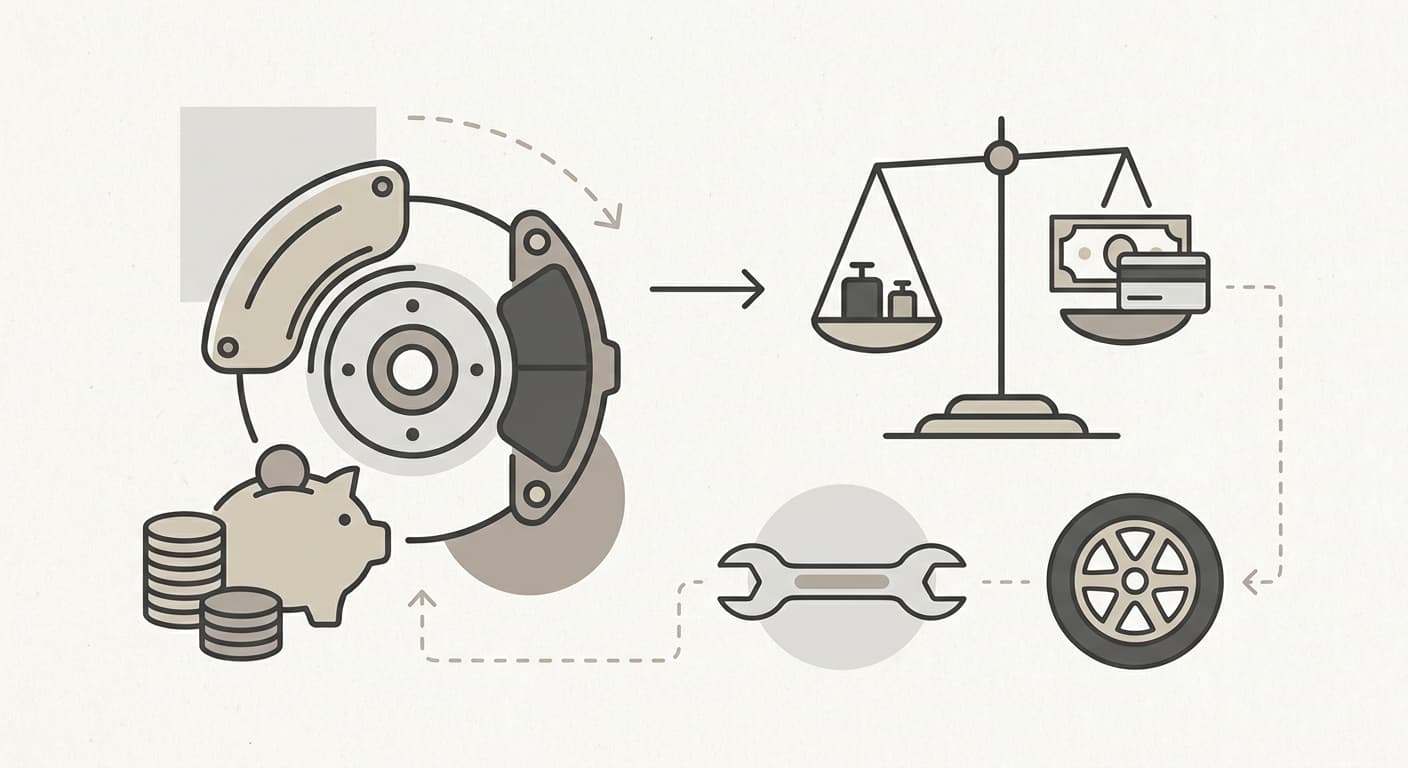
Brake pads cost $25 to $120 per axle for parts alone in 2026, or $150 to $300 per axle installed at an independent shop. Organic pads are the cheapest at $25–$50 per axle, semi-metallic run $40–$70, and ceramic land $60–$120. A pad-only replacement done at a dealer runs $250–$500 per axle. Price your exact car with the Brake Pad Replacement Cost Calculator, confirm the pads are actually worn with the Brake Pad Life Calculator, and compare full-job pricing with the Brake Repair Service Cost Calculator.
Pricing pad-only jobs across more than a dozen cars, both DIY and at local shops, turns up a spread that always surprises people. A set of ceramic pads for a 2019 Honda Civic runs $58 at the parts counter, and installing the front axle takes about 40 minutes. A shop two miles away quoted $289 for the identical job. The pads were the same price either way — the entire $231 gap was labor, shop hardware kits, and disposal fees. That is the single most useful thing to understand about brake pad cost: the part itself is cheap, and almost everything else on the invoice is the cost of having someone else turn the wrench.
This article is about the pads specifically — the friction parts, what they cost by material and by vehicle, and what a pad-only replacement runs. If you also need rotors, calipers, or a fluid flush, that is a full brake job, and the numbers shift; we cover that in our companion guide, How Much Does Brake Repair Cost in 2026.
How Much Are New Brake Pads? Parts Cost by Material
A set of brake pads covers one axle — two wheels, left and right. You never buy a single pad; pads are sold and installed in axle sets. The price of that set depends almost entirely on the friction compound. There are three mainstream choices, and the parts cost runs from about $25 to $120 per axle.
| Pad Material | Parts Cost / Axle | Lifespan | Best For |
|---|---|---|---|
| Organic (NAO) | $25 – $50 | 20,000 – 40,000 mi | Light commuter cars, budget jobs |
| Semi-metallic | $40 – $70 | 30,000 – 50,000 mi | Trucks, towing, hard braking |
| Ceramic | $60 – $120 | 50,000 – 70,000 mi | Daily drivers wanting quiet + long life |
Parts-only price per axle (one set). Sources: AutoZone, Direct Brakes, Jerry.
Organic (NAO) pads — $25 to $50 per axle
Organic pads, also called NAO (non-asbestos organic), are made from cellulose, rubber, glass, and resin. They are the cheapest pads you can buy, the quietest when new, and the gentlest on rotors. The tradeoff is lifespan: organic pads wear out in 20,000 to 40,000 miles and fade under hard or repeated heavy braking. For a light commuter that mostly sees city and highway driving, organic is a perfectly adequate $25–$50 choice.
Semi-metallic pads — $40 to $70 per axle
Semi-metallic pads blend 30–65% steel fiber with other materials. That metal content gives them stronger bite and far better heat dissipation, which is why they are the default on trucks, towing rigs, and any vehicle that brakes hard or carries weight. At $40–$70 per axle they sit in the middle on price. The downsides are more brake dust on your wheels and a bit more noise — a faint groan under light braking is normal for this compound. Expect 30,000 to 50,000 miles.
Ceramic pads — $60 to $120 per axle
Ceramic pads use ceramic fibers with a small amount of copper. They are the premium tier at $60–$120 per axle and earn it: they last the longest (50,000–70,000 miles), run the quietest, throw off the least visible dust, and hold consistent performance across a wide temperature range. For a daily driver where you want the longest possible interval between brake jobs, ceramic is the value winner over the life of the car even though the upfront part costs more.
Tip
Match the pad compound to how you actually drive, not to the price tag. A half-ton truck that tows on ceramic pads can burn through them in 20,000 miles because ceramic is tuned for steady heat, not heavy momentary loads. Putting the wrong $60 compound on the wrong vehicle often costs $200 in premature wear later.
Cost of New Brake Pads: Parts Only vs Installed
The question "how much do brake pads cost" has two honest answers depending on whether you do the work yourself. The parts are cheap. The labor to install them — and the shop's hardware kits, brake grease, and disposal fees — is where most of the bill comes from.
| Pad Material | Parts Only (DIY) | Installed (Independent) | Installed (Dealer) |
|---|---|---|---|
| Organic | $25 – $50 | $150 – $250 | $250 – $400 |
| Semi-metallic | $40 – $70 | $170 – $280 | $270 – $450 |
| Ceramic | $60 – $120 | $200 – $300 | $300 – $500 |
Per axle, pad-only job (rotors reused). Labor runs 0.8–1.5 hr per axle at $100–$200/hr. Sources: Direct Brakes, ConsumerAffairs, RepairPal.
Here is the math behind a typical independent-shop ceramic front job. Parts: one axle set of ceramic pads at $60–$120. Labor: about 1 hour at a $110–$130/hr shop rate works out to $110–$130. Add a hardware kit and grease at $15–$40 and a disposal fee of about $5–$10. Total: $190–$300, or roughly $200–$300 per axle. That reconciles with the $200–$300 installed range in the table above. (At a higher $180/hr shop rate the labor alone climbs toward $180–$216 and the total can reach $380–$390 — which is why the dealer column runs to $500.) Strip out the labor and shop add-ons, and the same job is the $60–$120 part plus 40 minutes of your own time.
Tip
DIY pad replacement is one of the most beginner-friendly car jobs: it needs a jack, jack stands, a C-clamp or caliper tool, and basic hand tools. Doing one axle yourself instead of paying a shop typically saves $120–$240 in labor. Always do both wheels on an axle, never one side.
How Much to Change Brake Pads by Vehicle
Vehicle class is the second-biggest price lever after material. Bigger, heavier, or more specialized vehicles use larger brake components and sometimes dealer-only parts. The numbers below are real-world averages for a pad-only replacement, drawn from RepairPal estimator data and shop quotes.
| Vehicle | Class | Pad Job (parts + labor) | Why |
|---|---|---|---|
| Ford F-150 | Full-size truck | $233 – $290 | Larger pads, but common parts |
| Honda Civic | Economy car | $255 – $308 | Small components, cheap parts |
| Toyota Camry | Midsize sedan | $307 – $372 | Slightly larger rotors and pads |
| Honda Accord | Midsize sedan | $300 – $370 | Similar to Camry |
| BMW 3 Series | European luxury | $450 – $850 | OEM pads + wear sensors + dealer labor |
| Tesla Model 3 | EV | $400 – $600 | Long pad life, dealer-gated service |
Average cost for a brake pad replacement, per RepairPal estimator data. Averaging the six rows above gives an overall range of roughly $324–$465 per axle — pulled up by the luxury and EV outliers.
Economy and midsize cars — the cheapest pads to replace
A Honda Civic, Toyota Corolla, or Hyundai Elantra uses small brake components and standard pad compounds, so parts are cheap and widely stocked. RepairPal puts a Civic pad job at $255–$308. Midsize sedans like the Camry ($307–$372) and Accord ($300–$370) cost roughly $50–$65 more because the rotors and pads are slightly larger. These are the cars where DIY savings are biggest in percentage terms, because the part is so inexpensive relative to the labor.
Trucks and SUVs — bigger parts, sometimes premium pads
Trucks and full-size SUVs need larger, heavier-duty brake components. Surprisingly, a Ford F-150 pad job ($233–$290) can land below a Camry's because F-150 parts are produced in enormous volume and stocked everywhere. The cost climbs if you tow regularly and need premium semi-metallic or severe-duty pads — add $30–$80 to the pad cost for those.
Luxury and performance — where pad cost explodes
European luxury and performance cars run a 1.5–2.5x premium over mainstream pricing. Three factors drive it: OEM pads on BMW, Audi, Mercedes, and Porsche run $180–$280 per axle versus $60–$120 for mainstream ceramic; electronic wear sensors add $20–$40 per sensor and must be replaced at every pad change (two to four on the car); and dealer labor on these brands averages $150–$200/hr. A BMW 3 Series owner doing a pad-only job realistically lands $450–$850 per axle.
Warning
On most European luxury cars, fitting aftermarket brake-pad wear sensors throws a dashboard fault within a few hundred miles. Use OEM sensors even when you choose aftermarket pads. This is why the indie-shop discount on BMW and Audi is often only 10–20%, not the 30–50% you get on mainstream brands.
Tesla and EVs — pads last, service is gated
Tesla and most EVs are a special case. Regenerative braking does most of the slowing, so the friction pads can last well past 100,000 miles. The catch is that service is largely dealer- or service-center-gated, which pushes the installed price to $400–$600 even though you replace pads far less often than on a gas car.
Cost of Replacing Brake Pads: What's on the Invoice
A pad-only quote is built from a few line items. Knowing them lets you read any estimate and spot padding.
- Pads (parts): $25–$120 per axle depending on material — see the table above.
- Labor: 0.8–1.5 hours per axle. At $100–$200/hr that is $80–$300, typically 30–50% of the total bill.
- Hardware kit: $15–$40 — new clips, shims, and abutment hardware. Legitimate on most jobs.
- Brake grease and disposal: $5–$15 — small but standard.
- Rotor work (if needed): resurfacing $15–$30 per rotor, or replacement $150–$400 per axle. This is what turns a pad job into a full brake job.
Important
If a quote includes rotor replacement, ask for the rotor's measured thickness versus the minimum stamped on the hub. A shop that cannot give you a number is either guessing or padding the ticket. Unnecessary rotor replacement is the most common pad-job upsell — and once rotors are added, you are pricing a full job, not a pad job. See How Much Does Brake Repair Cost for those numbers.
Front vs rear: why front pads come up more often
Front brakes do 60–70% of the stopping work because weight shifts forward when you brake. Front pads therefore wear about 2–3x faster than rears — front pads typically last 25,000–50,000 miles, rears 50,000–100,000. The shop price for a single-axle job is nearly the same front or rear, so if both axles are worn, doing all four pads in one visit saves $50–$100 over two separate trips. If your rear pads still measure above 6mm, front-only is the right call.
A pad job alone is the most common brake service, but it pairs naturally with a few others. Many drivers schedule it alongside a tire replacement since the wheels are already off, or time it with an oil change. If you are weighing whether to keep paying for service on an older car, the Car Value Calculator helps decide when maintenance stops making sense. And the Tire Wear Calculator follows the same vehicle-class premium pattern — performance cars cost more across every line item.
How to Save on Brake Pads
The biggest savings lever is labor, not parts. A few practical moves:
- DIY the install. Pad replacement is beginner-friendly and saves $120–$240 per axle in labor.
- Choose an independent shop for mainstream cars. Indies beat dealers by 30–50% on Toyota, Honda, Ford, and Chevy with no quality tradeoff — aftermarket pads from Wagner, Akebono, Bosch, and Brembo meet or exceed OEM spec.
- Bundle both axles if both are worn — one visit, not two.
- Match the compound to your driving so you don't replace pads early.
- Get three quotes — one dealer, two independents — and ask for the pad brand by name, not "premium" or "standard."
Frequently Asked Questions
How much do brake pads cost?
Brake pads cost $25–$120 per axle for parts alone in 2026: organic $25–$50, semi-metallic $40–$70, and ceramic $60–$120. Installed at an independent shop, a pad-only job runs $150–$300 per axle; at a dealer, $250–$500 per axle.
What is the cost of new brake pads?
A new set of brake pads (one axle, two wheels) costs $25–$50 for organic, $40–$70 for semi-metallic, or $60–$120 for ceramic at the parts counter. Premium low-dust ceramic from Akebono or EBC can reach the top of that ceramic range.
How much are new brake pads installed?
New brake pads installed cost $150–$300 per axle at an independent shop and $250–$500 at a dealer. Labor is 0.8–1.5 hours per axle at $100–$200/hr, which makes up 30–50% of the total — the part itself is the cheap half of the bill.
How much to change brake pads yourself?
Changing brake pads yourself costs only the price of the pads — $25–$120 per axle — plus about 40–90 minutes per axle. DIY saves $120–$240 in labor versus a shop. You need a jack, jack stands, a C-clamp or caliper tool, and basic hand tools.
What is the cost of replacing brake pads on average?
Averaging the per-vehicle figures above gives an overall cost of replacing brake pads of roughly $324–$465 per axle, with luxury and EV models pulling the high end up. Economy cars like a Honda Civic run $255–$308, midsize sedans like a Camry $307–$372, and European luxury cars like a BMW 3 Series $450–$850.
How much do brake pads cost by material?
By material, parts cost $25–$50 per axle for organic, $40–$70 for semi-metallic, and $60–$120 for ceramic. On a labor-included shop quote, upgrading from organic to ceramic typically adds only $50–$100 per axle because the parts difference is spread across the same labor base.
How much do brake pads cost per axle vs all four?
Per axle, pads run $150–$300 installed at an independent shop. Doing all four pads in one visit costs $250–$550 on mainstream cars — about $50–$100 less than two separate single-axle jobs (which would total $300–$600) because shop minimums and diagnostic time are absorbed into one visit.
Related Articles
- How Much Does Brake Repair Cost in 2026 — Full brake job pricing including rotors, calipers, and fluid flush when the pads are not the only thing worn.
- How Much Does an Auto Paint Job Cost in 2026 — Another common vehicle expense, with the same independent-vs-dealer and vehicle-class price patterns.
Related Calculators
- Brake Pad Replacement Cost Calculator — Price a pad-only job by vehicle, axles, pad material, and rotor condition.
- Brake Pad Life Calculator — Estimate how many miles your current pads have left before replacement.
- Brake Repair Service Cost Calculator — Full brake job pricing when rotors or calipers also need work.
- Tire Replacement Service Cost Calculator — Often bundled with brake work since the wheels are already off.
This article provides general information for educational purposes. Brake pad prices vary by region, vehicle, and shop. Always get a written quote and confirm pad material and brand before authorizing work.
This article is provided for informational and educational purposes only. Content should not be considered professional financial, medical, legal, or other advice. Always consult a qualified professional before making important decisions. UseCalcPro is not responsible for any actions taken based on the information in this article.
Try These Calculators
Estimate 2026 brake pad replacement cost by vehicle, axles, and pad material. Pad-only jobs run $150–$650 at mainstream shops, up to $1,500 on performance cars.
Estimate 2026 brake repair cost by vehicle type, repair scope, and parts tier. A full brake job (pads, rotors, calipers, fluid) typically runs $400 to $2,500.
Calculate car detailing costs by vehicle size, service level, condition, and add-ons. Enter a real quote to check if it is fair, high, or low instantly.
Estimate 2026 tire replacement service cost by vehicle type, tire tier, and ZIP. New tires installed run $400–$1,800 for a set of four with alignment.
Estimate 2026 ceramic coating cost by vehicle size, durability tier, and ZIP. Pro installs run $700–$3,000 with paint correction, up to $6,000 flagship.