How Much Does Flooring Cost in 2026? (By Type: Hardwood, LVP, Tile & More)
Flooring costs $4 to $25 per square foot installed in 2026, with a national average of $8 to $12/sq ft for mid-range materials like LVP and engineered hardwood. For a typical 1,000 sq ft project, expect to pay $4,000 to $25,000 depending on material, labor market, and subfloor condition. Prices have risen 5-12% from 2025 due to tariffs on imported materials and continued labor shortages in the trades.
Across flooring replacement projects, the number one budget killer is often not the flooring itself -- it is what is underneath it. Consider a representative case: a 900 sq ft LVP job in Bucks County should have been $7,200. Instead it came to $10,800 because the plywood subfloor had moisture damage from a slow dishwasher leak nobody caught for two years. That $3,600 in subfloor repair was more than the material cost. The lesson: before you shop for flooring, inspect your subfloor. Everything else is a line item. A bad subfloor is a project derailment.
Use our Flooring Calculator to get a personalized estimate based on your room dimensions, material choice, and installation complexity.
Flooring Cost at a Glance
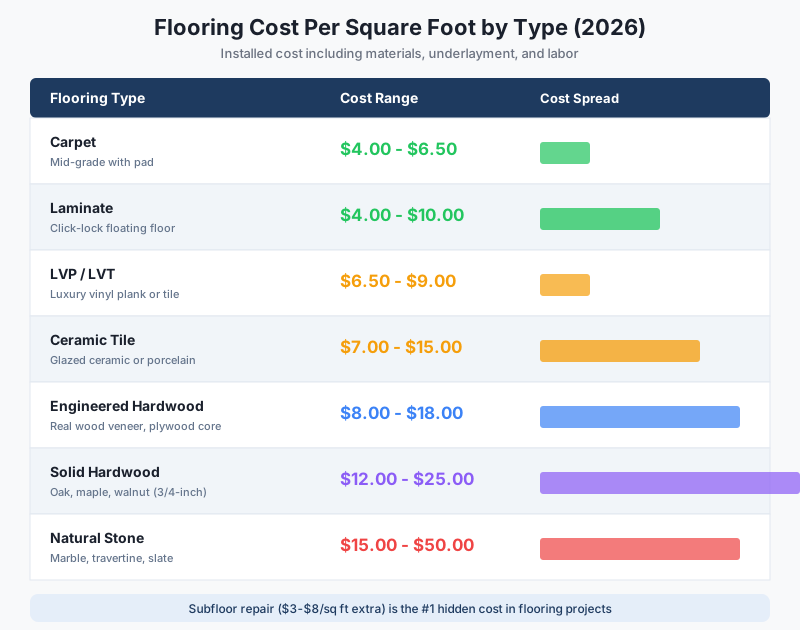
The table below covers every major flooring type at 2026 installed prices. "Installed cost" includes materials, standard labor, adhesive or underlayment, and basic trim work. It does not include old floor removal, subfloor repair, or furniture moving.
| Flooring Type | Material Cost/sq ft | Installed Cost/sq ft | 1,000 sq ft Total |
|---|---|---|---|
| Carpet | $1.50 - $4.00 | $4.00 - $6.50 | $4,000 - $6,500 |
| Laminate | $1.50 - $5.00 | $4.00 - $10.00 | $4,000 - $10,000 |
| LVP / LVT | $2.50 - $5.00 | $6.50 - $9.00 | $6,500 - $9,000 |
| Bamboo | $3.00 - $9.00 | $7.00 - $17.00 | $7,000 - $17,000 |
| Ceramic tile | $2.00 - $8.00 | $7.00 - $15.00 | $7,000 - $15,000 |
| Engineered hardwood | $4.00 - $10.00 | $8.00 - $18.00 | $8,000 - $18,000 |
| Porcelain tile | $3.00 - $12.00 | $10.00 - $20.00 | $10,000 - $20,000 |
| Solid hardwood | $5.00 - $14.00 | $12.00 - $25.00 | $12,000 - $25,000 |
| Natural stone tile | $5.00 - $30.00 | $15.00 - $50.00 | $15,000 - $50,000 |
Tip
These are national averages. Your actual cost depends on region, installer availability, and the specific product line within each material category. A builder-grade LVP at $6.50/sq ft installed and a premium rigid-core LVP at $9.00/sq ft are very different products.
Budget Flooring Options ($4-$10/sq ft)
If you need to cover a large area without breaking the bank, these three materials deliver the best square footage per dollar.
Carpet ($4-$6.50/sq ft installed)
Carpet remains the cheapest flooring to install in 2026. A basic polyester or nylon loop carpet with padding runs $4 to $5 per square foot installed. Upgraded plush or frieze styles push that to $5.50-$6.50/sq ft. Carpet makes sense for bedrooms and basements where comfort matters more than durability -- but steer clear of kitchens, bathrooms, and entryways. According to HomeGuide, the average carpet replacement runs $1,800 to $4,500 for a typical home.
The catch with carpet is lifespan. Budget carpet in a high-traffic hallway lasts 5-8 years before it looks flattened and worn. That means you are paying $4-$6.50/sq ft every 5-8 years, which makes it more expensive than LVP over a 20-year window. For low-traffic bedrooms, carpet is still a smart call.
Laminate ($4-$10/sq ft installed)
Laminate flooring has improved dramatically since the early 2000s. Modern laminate with an AC4 or AC5 wear rating, embossed-in-register textures, and attached underlayment runs $4-$7/sq ft installed for mid-grade products. Premium laminate from brands like Mohawk RevWood and Pergo Outlast pushes $8-$10/sq ft installed.
Laminate is a floating floor, which means faster installation and lower labor costs. Most installers charge $2-$3/sq ft for labor on laminate -- about half the cost of nailing down solid hardwood. The downside is moisture sensitivity. Standard laminate and standing water do not mix, so bathrooms and laundry rooms are out unless you specifically buy a waterproof laminate product rated for wet areas.
LVP / LVT ($6.50-$9/sq ft installed)
Luxury vinyl plank (LVP) and luxury vinyl tile (LVT) have taken over the residential flooring market. According to Modernize, LVP now accounts for roughly 35% of all residential flooring installations in the US. The appeal is obvious: it is waterproof, durable, easy to install, and mimics hardwood convincingly at a fraction of the cost.
A rigid-core LVP with a 20-mil wear layer runs $6.50-$9.00/sq ft installed. Thinner products with a 12-mil wear layer exist at $4-$5/sq ft installed, but these are best reserved for a rental unit rather than a primary residence. The wear layer is the difference between a floor that looks good for 15 years and one that shows scratches after 3. For the extra $2/sq ft, the 20-mil product is worth it.
Mid-Range Flooring Options ($8-$20/sq ft)
This is where most homeowners land -- materials that balance cost, durability, and aesthetics for long-term ownership.
Engineered Hardwood ($8-$18/sq ft installed)
Engineered hardwood gives you a real wood surface (typically 2-4mm veneer) bonded to a plywood or HDF core. The result looks and feels like solid hardwood but handles humidity swings much better, making it suitable for basements and over radiant heat. Installation runs $8-$12/sq ft for click-lock floating installation and $12-$18/sq ft for glue-down or nail-down methods on plywood subfloors.
Consider a representative case: engineered white oak installed across a 2,200 sq ft colonial in New Jersey. Materials ran $6.50/sq ft (3mm wear layer, 7-inch wide plank), labor was $5.50/sq ft for glue-down over concrete, and transitions plus trim added another $1,200. Total: $27,600 -- compared with a $52,000 quote for solid hardwood in the same species. Engineered saved 47% with a nearly identical finished appearance.
Ceramic and Porcelain Tile ($7-$20/sq ft installed)
Tile pricing depends heavily on the specific product. Basic ceramic tile for a bathroom floor runs $7-$10/sq ft installed. Large-format porcelain (24x24 or 12x48) for an open-concept main floor costs $12-$20/sq ft installed because of the precision and thinset work required.
Labor is the biggest variable in tile work. A simple 12x12 ceramic grid layout on a flat subfloor costs $4-$6/sq ft for labor. A herringbone or staggered pattern with large-format porcelain on an uneven subfloor can hit $8-$10/sq ft for labor alone, per Angi. Always get tile quotes that specify the pattern and tile size -- a "tile installation" bid without those details is meaningless.
Bamboo ($7-$17/sq ft installed)
Bamboo flooring occupies a niche between laminate and hardwood. Strand-woven bamboo is harder than most domestic hardwoods (rated 3,000+ on the Janka scale vs. 1,320 for red oak) and runs $7-$12/sq ft installed for standard products. Engineered bamboo with wider planks and premium finishes reaches $14-$17/sq ft installed.
The trade-off is moisture behavior. Bamboo expands and contracts more than engineered hardwood in high-humidity environments, and some cheaper products off-gas formaldehyde from the adhesives used in manufacturing. If you go bamboo, verify the product meets CARB Phase 2 emissions standards and acclimate the planks in your home for at least 72 hours before installation.
Premium Flooring Options ($15-$50/sq ft)
These materials are investments. They cost more upfront but add measurable resale value and last decades with proper maintenance.
Solid Hardwood ($12-$25/sq ft installed)
Solid hardwood remains the gold standard for home value. According to the National Association of Realtors, homes with hardwood floors sell for 2.5-3% more on average. Red and white oak dominate the market at $12-$18/sq ft installed. Exotic species like Brazilian cherry, walnut, and hickory run $18-$25/sq ft installed.
Solid hardwood requires nail-down installation over a plywood subfloor, which means it cannot go over concrete without a raised subfloor system (add $3-$5/sq ft for that). It is also sensitive to humidity -- do not install solid hardwood in basements or below-grade spaces. But for main floors and second stories, nothing else matches the feel underfoot or the 50+ year lifespan with periodic refinishing.
Natural Stone Tile ($15-$50/sq ft installed)
Natural stone is the most expensive flooring category, and the price range is enormous. Travertine and slate run $15-$25/sq ft installed. Marble starts at $20/sq ft and climbs to $40+/sq ft for premium Italian varieties. Quartzite and exotic granite can reach $50/sq ft installed for complex patterns.
Labor for natural stone runs $6-$10/sq ft because the material is heavy, requires precise cuts, and needs specialized thinset and sealing. Stone also requires periodic resealing -- typically every 1-3 years depending on the species and traffic level. Natural stone projects are best budgeted as "cost plus maintenance," because homeowners often forget the $0.50-$1.50/sq ft annual sealing cost over the floor's lifetime.
Labor Cost Breakdown
Labor is 30-50% of your total flooring cost depending on the material. Here is what installers charge in 2026:
| Material | Labor Cost/sq ft | Typical Install Method | Time (1,000 sq ft) |
|---|---|---|---|
| Carpet | $2.00 - $3.00 | Stretch-in over pad | 1-2 days |
| Laminate | $2.00 - $3.00 | Floating (click-lock) | 1-2 days |
| LVP / LVT | $2.00 - $4.00 | Floating or glue-down | 1-2 days |
| Engineered hardwood | $3.00 - $6.00 | Float, glue-down, or nail-down | 2-3 days |
| Solid hardwood | $4.00 - $8.00 | Nail-down only | 3-5 days |
| Ceramic tile | $4.00 - $7.00 | Thinset mortar | 3-5 days |
| Porcelain tile | $5.00 - $8.00 | Thinset mortar | 3-5 days |
| Natural stone | $6.00 - $10.00 | Thinset mortar + sealing | 4-7 days |
Warning
Beware of abnormally low labor quotes. If an installer bids $1.50/sq ft for hardwood installation, they are either cutting corners (no acclimation, no moisture testing, skipping underlayment) or planning to hit you with change orders. The $2-$3/sq ft difference between a cheap installer and a competent one costs far less than tearing out and replacing a botched installation.
Regional Cost Variation
Flooring prices vary by 15-30% depending on where you live. The same 1,000 sq ft LVP installation that costs $7,500 in Atlanta might run $10,500 in San Francisco.
| Region | Installed Cost Adjustment | Average LVP (1,000 sq ft) | Key Factors |
|---|---|---|---|
| Northeast | +15% to +25% | $8,100 - $10,800 | High labor rates, union prevalence, short install windows in winter |
| South | -10% to -15% | $5,500 - $7,200 | Lower labor costs, year-round availability, competitive market |
| Midwest | -5% to +5% | $6,200 - $8,500 | Moderate labor, good contractor supply, seasonal demand spikes |
| West Coast | +20% to +30% | $8,800 - $11,700 | Highest labor costs, strict building codes, long permitting times |
| Mountain West | +0% to +10% | $6,800 - $9,000 | Moderate labor, altitude considerations for acclimation, growing demand |
These ranges are based on 2026 data from HomeGuide, Angi, and HomeAdvisor. Actual quotes depend on your specific metro area, time of year, and how booked up local installers are.
Hidden Costs That Blow Up Your Budget
The flooring itself is only part of the project. These additional costs catch homeowners off guard every single time.
Old Floor Removal ($1-$3/sq ft)
Pulling up existing flooring costs $1-$1.50/sq ft for carpet, $1.50-$2.50/sq ft for laminate or LVP, and $2-$3/sq ft for tile or hardwood. Glued-down materials cost more because of the adhesive residue that must be scraped or ground smooth. A 1,000 sq ft tile removal can easily run $2,500-$3,000 with disposal fees included.
Subfloor Repair ($2-$5/sq ft)
If your subfloor has moisture damage, squeaks, unevenness, or rot, it must be repaired before new flooring goes down. Plywood patching runs $2-$3/sq ft. Full replacement of damaged sections costs $4-$5/sq ft. Self-leveling compound for uneven concrete slabs adds $2-$4/sq ft. Subfloor issues turn up on roughly 40% of projects in homes built before 1990.
Transitions and Trim ($200-$800)
Every doorway, room transition, and staircase nosing needs a transition strip or molding piece. T-moldings, reducers, and stair nosing cost $5-$15 per linear foot for hardwood or LVP transitions. A typical home with 8-12 transitions and 200 linear feet of baseboard replacement adds $400-$800 to the project total.
Baseboard and Quarter-Round ($1-$3/linear ft)
Most flooring installations require removing and reinstalling or replacing baseboards. Painters-grade MDF baseboard runs $1-$1.50/linear ft for material. Stain-grade oak or poplar baseboard costs $2-$3/linear ft. If your old baseboards are damaged during removal -- and they often are -- budget for full replacement.
Furniture Moving ($100-$400)
Some installers include basic furniture moving. Many do not. Moving large items like pianos, china cabinets, and heavy sectionals may require a separate moving crew at $100-$400 depending on the scope.
DIY vs Professional Installation
Floating floors (laminate and LVP) are genuinely DIY-friendly. Nail-down hardwood and tile are not. Here is the honest breakdown:
| Factor | DIY | Professional |
|---|---|---|
| Material cost (1,000 sq ft LVP) | $2,500 - $5,000 | $2,500 - $5,000 |
| Labor | $0 (your time) | $2,000 - $4,000 |
| Tools and supplies | $150 - $400 | Included |
| Time | 3-5 weekends | 1-2 days |
| Total | $2,650 - $5,400 | $4,500 - $9,000 |
| Savings | 35-50% | -- |
Good DIY candidates: Click-lock LVP in rectangular rooms with no transitions to adjacent rooms. Click-lock laminate in bedrooms. Carpet tiles in basements.
Hire a pro for: Solid hardwood (nail-down requires specialized tools and experience), tile (lippage and thinset consistency are hard to master), glue-down installations, any room with complex angles or transitions, and stairs. A crooked first row of tile or hardwood is visible for the life of the floor.
The hidden DIY cost: Your time. A professional crew installs 1,000 sq ft of LVP in 8-10 hours. Most DIYers take 30-40 hours for the same space because of measuring, cutting, fitting, and the inevitable mistakes. If your time is worth $25/hour, that is $750-$1,000 in labor you are donating to the project.
Frequently Asked Questions
What is the cheapest flooring to install in 2026?
Carpet is the cheapest flooring at $4 to $6.50 per square foot installed in 2026. Basic polyester loop carpet with standard padding runs $4/sq ft installed in most markets. Laminate flooring is the cheapest hard-surface option at $4 to $10/sq ft installed, with entry-level products starting at $4/sq ft in competitive markets. For a 500 sq ft room, carpet costs $2,000-$3,250 while basic laminate costs $2,000-$5,000. The cheapest option long-term is different: LVP at $6.50-$9/sq ft installed lasts 15-20 years versus carpet's 5-8 year lifespan, making LVP cheaper per year of use. Budget $4,000-$5,000 for a full 1,000 sq ft carpet installation including pad and basic labor.
How much does it cost to replace flooring in an entire house?
Replacing flooring throughout a 2,000 sq ft home costs $8,000 to $50,000 in 2026 depending on material choice. A full-house LVP installation runs $13,000-$18,000. Engineered hardwood across the same space costs $16,000-$36,000. Most homeowners use mixed materials -- LVP in kitchens and bathrooms, engineered hardwood in living areas, and carpet in bedrooms -- which averages $10-$14/sq ft installed across the whole project. Add $2,000-$6,000 for old floor removal, $1,000-$4,000 for subfloor repair (common in older homes), and $800-$1,500 for transitions and trim. A realistic all-in budget for a 2,000 sq ft home with mid-range materials is $24,000-$30,000.
Is LVP or hardwood flooring a better value?
LVP offers better value for most homeowners in 2026 based on cost-per-year-of-use. LVP costs $6.50-$9/sq ft installed and lasts 15-20 years, working out to roughly $0.40-$0.55 per sq ft per year. Engineered hardwood costs $8-$18/sq ft installed and lasts 25-40 years (with one refinish), working out to $0.30-$0.50 per sq ft per year. Solid hardwood at $12-$25/sq ft installed lasts 50+ years with multiple refinishes, bringing the per-year cost to $0.25-$0.50/sq ft. Hardwood also adds 2.5-3% to resale value according to the National Association of Realtors. If you plan to sell within 5-7 years, LVP is the smarter investment. If you plan to stay 15+ years, hardwood wins on long-term value.
How much does labor cost for flooring installation?
Flooring labor costs $2 to $10 per square foot in 2026 depending on the material and installation method. Carpet and laminate labor runs $2-$3/sq ft because both use fast installation methods (stretch-in and floating click-lock respectively). LVP labor is $2-$4/sq ft for floating installations. Hardwood labor runs $4-$8/sq ft for nail-down methods that require pneumatic nailers and careful board selection. Tile labor is $4-$10/sq ft because of the thinset work, grout, and precision cutting required. Natural stone labor reaches $6-$10/sq ft due to the weight and cutting difficulty. These rates do not include old floor removal ($1-$3/sq ft extra) or subfloor prep ($2-$5/sq ft if needed). Always get labor quoted separately from materials so you can compare bids accurately.
How much has flooring cost increased from 2025 to 2026?
Flooring prices have increased 5-12% from 2025 to 2026 across all major categories. LVP and laminate saw 5-8% increases driven by tariffs on imported vinyl and HDF core materials, primarily from China and Southeast Asia. Hardwood flooring increased 6-10% due to rising domestic lumber costs and continued supply chain tightness. Tile products jumped 8-12% with porcelain seeing the largest increases because of energy-intensive manufacturing and shipping costs from European and Asian producers. Labor costs rose 4-7% independently of material prices, driven by ongoing skilled trade shortages -- the Bureau of Labor Statistics reports that the construction sector has 350,000+ unfilled positions as of early 2026. The combined effect means a flooring project that cost $10,000 in early 2025 now runs $10,500-$11,200 for identical materials and scope.
Should I replace flooring before selling my house?
Replacing worn flooring before selling typically returns 70-80% of the investment at resale, making it one of the higher-ROI renovation projects. New hardwood floors return the most: the National Association of Realtors estimates a 100-118% return on hardwood refinishing and 70-80% return on new hardwood installation. New LVP throughout a home costs $13,000-$18,000 for 2,000 sq ft and can increase sale price by $8,000-$15,000 while reducing days on market by 10-20% according to HomeAdvisor. The worst investment is premium materials in a starter home -- installing $25/sq ft solid hardwood in a $250,000 home does not pencil out. Match the flooring quality to the home's price point: LVP for homes under $350,000, engineered hardwood for $350,000-$600,000, and solid hardwood for $600,000+.
Pricing data compiled from HomeGuide, Angi, HomeAdvisor, Modernize, and professional installer surveys. All prices reflect 2026 national averages and include standard installation. Your actual costs may vary based on region, project complexity, and contractor availability.
This article is provided for informational and educational purposes only. Content should not be considered professional financial, medical, legal, or other advice. Always consult a qualified professional before making important decisions. UseCalcPro is not responsible for any actions taken based on the information in this article.
Try These Calculators
Estimate materials for hardwood, laminate, vinyl, or carpet floors. Get box counts, waste allowance, and full cost breakdowns for your flooring project.
Estimate 2026 vinyl flooring installation cost by format — sheet, tile, LVP, or LVT. Installed quotes run $2 to $22 per sqft depending on format and region.
Estimate 2026 laminate floor installation cost by room size and quality. Budget to waterproof laminate quotes typically range from $1,500 to $6,000 total.
Estimate new home construction costs by square footage, quality level, and region. Get detailed material and labor cost breakdowns for building your house.
Estimate 2026 deep house cleaning cost by home size, condition, and bathrooms. A first-time deep clean runs $200-$600, about $0.20-$0.40 per square foot.