How Much Does Insulation Cost in 2026? (Spray Foam, Fiberglass & More)

Insulation costs $0.50 to $4.50 per square foot installed in 2026, depending on the material type and application method. Fiberglass batts are the most affordable at $0.50-$1.30/sq ft, while closed-cell spray foam tops the range at $1.75-$4.50/sq ft. A whole-house insulation project for a typical 2,000 square foot home runs $1,500 to $7,000 or more, with the final number driven almost entirely by which material you choose and where it goes.
Consider a 1,600 square foot attic in a 1985 colonial outside Milwaukee. The home had R-11 fiberglass batts -- original to the house, compressed and sagging after 40 years. Blowing in cellulose over the existing batts brought the total to R-49, and the project cost $2,340 in materials and labor for a two-person crew. The homeowner's gas bill dropped from $285/month to $195/month the following January -- $1,080 in annual savings on a $2,340 investment, a payback period under 26 months. Few other home upgrades come close to that return.
Use our Insulation Calculator to estimate your project cost based on square footage, material type, and climate zone requirements.
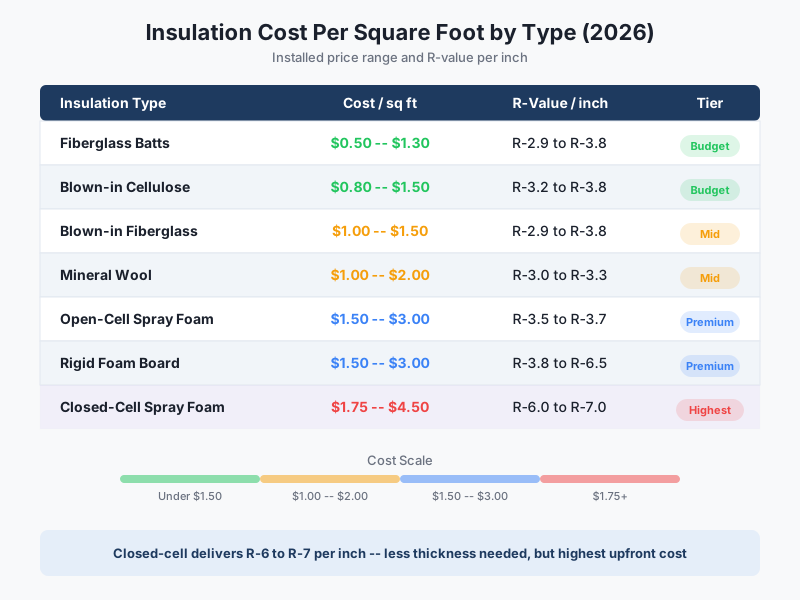
Insulation Cost at a Glance
The table below shows what you can expect to pay per square foot for each insulation type, installed, along with the R-value you get per inch of thickness. R-value per inch matters because it determines how thick the insulation needs to be to meet code requirements -- and thickness drives total material cost.
| Insulation Type | Installed Cost/sq ft | R-Value per Inch | Best Application |
|---|---|---|---|
| Fiberglass batts | $0.50 - $1.30 | 2.9 - 3.8 | Open walls, attics (new construction) |
| Blown-in fiberglass | $1.00 - $1.50 | 2.9 - 3.8 | Attics, enclosed cavities |
| Blown-in cellulose | $0.80 - $1.50 | 3.2 - 3.8 | Attics, retrofit walls |
| Open-cell spray foam | $1.50 - $3.00 | 3.5 - 3.7 | Interior walls, attic rafters |
| Closed-cell spray foam | $1.75 - $4.50 | 6.0 - 7.0 | Basements, crawl spaces, exterior |
| Rigid foam board | $1.50 - $3.00 | 3.8 - 6.5 | Foundation, continuous exterior |
| Mineral wool batts | $1.00 - $2.00 | 3.0 - 3.3 | Fire-rated assemblies, soundproofing |
Tip
Closed-cell spray foam costs the most per square foot but delivers the highest R-value per inch (R-6 to R-7). That means you need less thickness to meet code. In tight spaces like 2x4 wall cavities or low crawl spaces, closed-cell can be the only practical option to hit R-values that blown-in or batts physically cannot reach in the available depth.
Cost by Insulation Type
Fiberglass Batts ($0.50-$1.30/sq ft installed)
Fiberglass batts remain the most common insulation material in new residential construction. They come in pre-cut widths (15 and 23 inches) sized to fit standard stud and joist spacing. Material cost alone runs $0.25-$0.60 per square foot, with labor adding $0.25-$0.70 for professional installation.
The appeal is simple: fiberglass batts are cheap, widely available, and fast to install in open framing. A crew can insulate an entire 2,000 square foot home during the framing stage in a single day. The downside is performance. Batts are only effective when they fit the cavity perfectly, with no compression, gaps, or voids around wiring and plumbing. In practice, batt installations in existing homes average 50-70% of their rated R-value because of these installation deficiencies, according to the Department of Energy.
Blown-In Fiberglass ($1.00-$1.50/sq ft installed)
Blown-in fiberglass (also called loose-fill) is machine-applied, which eliminates the gaps and voids that plague batt installations. The fiberglass is chopped into small pieces and blown into attic floors or wall cavities under low pressure. Installed cost runs $1.00-$1.50 per square foot, with the machine rental included in most contractor quotes.
For attics, blown-in fiberglass settles approximately 10-15% over the first few years. A competent installer accounts for this by blowing to a depth about 15% greater than the target R-value requires. Always ask your installer about their settling allowance -- if they do not mention it, find a different installer.
Blown-In Cellulose ($0.80-$1.50/sq ft installed)
Cellulose insulation is made from recycled newsprint treated with borate fire retardant. It costs $0.80-$1.50 per square foot installed and delivers R-3.2 to R-3.8 per inch -- slightly better than fiberglass at comparable thickness. Cellulose is denser than blown-in fiberglass, which gives it better air-sealing properties and reduces convective heat loss in cold attics.
The trade-off is moisture sensitivity. Cellulose absorbs and holds water more readily than fiberglass, and wet cellulose loses its R-value and can promote mold growth. Proper vapor barriers and attic ventilation are non-negotiable with cellulose. Cellulose performs exceptionally well in dry attic applications but is a poor choice for crawl spaces or any location prone to moisture intrusion.
Open-Cell Spray Foam ($1.50-$3.00/sq ft installed)
Open-cell spray foam expands to roughly 100 times its liquid volume, filling every crack, gap, and void in the cavity. At R-3.5 to R-3.7 per inch, its thermal resistance per inch is moderate, but its air-sealing ability is what sets it apart. A properly applied open-cell installation eliminates air infiltration -- the single largest source of energy loss in most homes.
Open-cell foam is vapor-permeable, meaning moisture can pass through it. This is actually an advantage in many wall assemblies because it allows the wall to dry inward if it gets wet. However, open-cell foam should not be used in below-grade applications (basements, crawl spaces) where it will be in contact with soil moisture. According to Sprayman Insulation, open-cell is best suited for above-grade walls and attic roof decks in conditioned attic designs.
Closed-Cell Spray Foam ($1.75-$4.50/sq ft installed)
Closed-cell spray foam is the premium option -- and for certain applications, nothing else comes close. At R-6 to R-7 per inch, it delivers nearly twice the thermal resistance of any other common insulation material. It is also a vapor barrier, an air barrier, and adds structural rigidity to the wall assembly. A 2x4 wall with 3 inches of closed-cell foam hits R-18 to R-21 in a cavity that fiberglass can only insulate to R-13.
The cost is substantial. At $1.75-$4.50 per square foot, a 1,500 square foot attic roof deck in closed-cell foam runs $2,625-$6,750 installed. But in below-grade applications, flood-prone areas, and extreme climates, closed-cell is often the only material that provides both the thermal and moisture performance the building requires.
Rigid Foam Board ($1.50-$3.00/sq ft installed)
Rigid foam boards (XPS, EPS, and polyiso) are used primarily as continuous exterior insulation, foundation wall insulation, and under-slab applications. They range from R-3.8 per inch (EPS) to R-6.5 per inch (polyiso) and cost $1.50-$3.00 per square foot installed.
The critical advantage of rigid foam is that it eliminates thermal bridging through studs. Wood studs have an R-value of about R-1 per inch -- far less than any insulation material. In a standard 2x4 wall, studs account for roughly 25% of the wall area, creating thermal short circuits that reduce overall wall performance by 15-25%. Adding 1-2 inches of continuous rigid foam over the exterior sheathing breaks this bridge entirely.
Mineral Wool Batts ($1.00-$2.00/sq ft installed)
Mineral wool (also sold as rock wool or stone wool, with Rockwool being the dominant brand) costs $1.00-$2.00 per square foot installed. It delivers R-3.0 to R-3.3 per inch -- slightly less than fiberglass -- but offers significantly better fire resistance (rated to 2,150 degrees F) and sound attenuation.
Mineral wool batts are denser and stiffer than fiberglass, which makes them easier to cut precisely and less likely to sag or compress over time. For fire-rated wall and floor assemblies, mineral wool is often the specified material. It also excels in interior partition walls where soundproofing matters: a 2x4 wall with mineral wool batts achieves STC 45-50, compared to STC 35-39 for the same wall with fiberglass.
Cost by Location
Where the insulation goes affects cost as much as what type you choose. Retrofit work in enclosed walls costs significantly more than open-attic blowing because of access difficulty and the need to drill and patch.
| Location | Typical Cost/sq ft | Common Materials | Notes |
|---|---|---|---|
| Attic (open floor) | $1.00 - $3.00 | Blown-in cellulose/fiberglass | Easiest and most cost-effective upgrade |
| Attic (roof deck) | $2.00 - $4.50 | Spray foam | Creates conditioned attic; requires closed-cell in most zones |
| Walls (new construction) | $0.50 - $2.00 | Batts, open-cell foam | Open framing, fastest installation |
| Walls (retrofit) | $2.00 - $5.00 | Blown-in, injection foam | Drill-and-fill through siding or interior; patch costs add up |
| Crawl space | $1.00 - $3.00 | Closed-cell foam, rigid board | Moisture control is critical; vapor barrier required |
| Basement walls | $1.50 - $3.50 | Rigid foam, closed-cell foam | Must be moisture-resistant; fiberglass batts are a poor choice |
| Garage | $0.50 - $2.00 | Batts, blown-in | Only code-required on shared walls with conditioned space |
Warning
Never insulate a crawl space or basement with fiberglass batts. Moldy, sagging fiberglass is a common find when crawl spaces get inspected. Fiberglass absorbs moisture, loses its R-value when wet, and becomes a breeding ground for mold. Use closed-cell spray foam or rigid foam board in any below-grade or moisture-prone application.
Attic Insulation: The Best Bang for Your Dollar
If your home only has budget for one insulation upgrade, the attic is where to spend it. Heat rises, and an under-insulated attic is the largest single source of heat loss in most homes. Blowing cellulose or fiberglass into an open attic floor costs $1.00-$1.50 per square foot and can be completed in 2-4 hours for a typical 1,000-1,500 square foot attic.
The Department of Energy estimates that upgrading attic insulation from R-11 (common in pre-1980 homes) to R-49 can reduce heating and cooling costs by 20-30%. For a home spending $2,400/year on heating and cooling, that is $480-$720 in annual savings.
Wall Retrofit: The Expensive Necessity
Insulating existing walls without tearing off the drywall or siding requires a drill-and-fill approach. Installers drill 2-3 inch holes through the exterior siding (or interior drywall) at each stud bay, inject blown-in insulation or injection foam, then patch and paint the holes. The insulation itself costs $1-$2/sq ft, but the drilling, patching, and finishing push total costs to $2-$5/sq ft.
Wall retrofits make financial sense primarily in older homes with zero wall insulation. A 1960s ranch with empty 2x4 walls is losing heat at a tremendous rate. Adding blown-in cellulose to those cavities typically yields 20-25% reduction in heating costs -- a strong return despite the higher per-square-foot cost.
R-Value: What You Actually Need
The U.S. Department of Energy publishes minimum R-value recommendations by climate zone. These represent the bare minimum for energy code compliance. Going beyond code minimums is almost always cost-effective, particularly in attics where adding insulation is inexpensive.
| Climate Zone | Attic | Wood Frame Wall | Floor | Example Cities |
|---|---|---|---|---|
| 1 | R-30 | R-13 | R-13 | Miami, Honolulu, Key West |
| 2 | R-38 | R-13 | R-13 | Houston, Phoenix, New Orleans |
| 3 | R-38 | R-20 | R-25 | Atlanta, Dallas, Las Vegas |
| 4 | R-49 | R-20 | R-25 | Seattle, Baltimore, St. Louis |
| 5 | R-49 | R-20 | R-30 | Chicago, Denver, Boston |
| 6 | R-49 | R-20 | R-30 | Minneapolis, Burlington, Helena |
| 7 | R-60 | R-21 | R-38 | Duluth, Fairbanks, International Falls |
Tip
The DOE recommends R-38 to R-60 for attics in most zones. If your attic has less than 10 inches of insulation, you almost certainly have less than R-30 and will benefit from adding more. Measure existing depth and multiply by 3.2 (cellulose) or 3.0 (fiberglass) to estimate your current R-value.
How to Calculate the Insulation You Need
To figure out how much insulation a project requires, you need three numbers: the target R-value, the R-value per inch of your chosen material, and the area to cover.
Thickness needed = Target R-value / R-value per inch
Example: To reach R-49 in an attic with blown-in cellulose (R-3.5/inch):
- Thickness = R-49 / 3.5 = 14 inches of cellulose
- For a 1,200 sq ft attic at $1.00-$1.50/sq ft installed = $1,200-$1,800
The same R-49 with closed-cell spray foam (R-6.5/inch) requires only 7.5 inches but costs $2,100-$5,400 for the same area. Material choice is always a trade-off between thickness and cost.
Labor Cost Breakdown
Labor accounts for 40-70% of total installed cost depending on material type. Spray foam has the highest labor component because it requires specialized equipment, trained applicators, and safety gear.
| Component | Batts | Blown-In | Spray Foam |
|---|---|---|---|
| Material | $0.25 - $0.60/sq ft | $0.30 - $0.70/sq ft | $0.50 - $1.50/sq ft |
| Labor | $0.25 - $0.70/sq ft | $0.50 - $0.80/sq ft | $1.00 - $3.00/sq ft |
| Equipment | Minimal | Machine rental included | Specialized rig ($25K-$50K) |
| Total installed | $0.50 - $1.30/sq ft | $0.80 - $1.50/sq ft | $1.50 - $4.50/sq ft |
Most contractors price insulation jobs as a single installed cost per square foot rather than breaking out materials and labor separately. When comparing quotes, make sure each bid specifies the same R-value target, material type, and preparation work (air sealing, vapor barrier, old insulation removal if needed).
Regional Cost Variation
Insulation costs vary by region due to labor rates, climate-driven demand, and material availability. Cold-climate markets see higher demand and often higher prices, but the energy savings are also proportionally larger.
| Region | Cost Multiplier | Key Factors |
|---|---|---|
| Northeast | 1.10x - 1.25x | High labor costs, strong demand, deep energy retrofit programs |
| Southeast | 0.90x - 1.00x | Lower labor, focused on cooling (attic radiant barriers common) |
| Midwest | 0.95x - 1.10x | Moderate labor, high heating demand drives volume pricing |
| Southwest | 0.90x - 1.05x | Lower labor, less insulation needed (zones 2-3) |
| Pacific Northwest | 1.05x - 1.20x | High labor, aggressive energy codes, moisture management focus |
| Mountain West | 1.00x - 1.15x | Moderate labor, extreme temperature swings, R-49+ attic standard |
These multipliers apply to the national average costs listed in the tables above. A blown-in cellulose job that averages $1.20/sq ft nationally might cost $1.35-$1.50/sq ft in Boston and $1.05-$1.20/sq ft in Dallas. Get at least three local quotes before committing -- regional pricing varies widely even within the same metro area.
Energy Savings: The Payback Period
The DOE estimates that proper insulation saves homeowners 15-40% on heating and cooling bills. The wide range reflects the enormous variation in starting conditions: a 1960s home with no wall insulation and R-11 attic batts will see dramatic savings, while a 2010 code-built home going from R-38 to R-49 will see modest improvement.
Here is what payback looks like for common upgrade scenarios, assuming $2,400/year in baseline heating and cooling costs:
| Upgrade Scenario | Project Cost | Annual Savings | Payback Period |
|---|---|---|---|
| Attic: R-11 to R-49 (blown cellulose, 1,200 sq ft) | $1,200 - $1,800 | $480 - $720 (20-30%) | 2 - 3 years |
| Walls: empty to R-13 (blown-in, 1,500 sq ft) | $3,000 - $7,500 | $360 - $600 (15-25%) | 5 - 12 years |
| Crawl space: R-0 to R-19 (closed-cell, 800 sq ft) | $1,400 - $3,600 | $240 - $480 (10-20%) | 3 - 8 years |
| Whole house: comprehensive upgrade | $4,000 - $12,000 | $720 - $960 (30-40%) | 4 - 12 years |
Attic insulation almost always pays for itself within 2-4 years. Wall and crawl space insulation have longer payback periods but improve comfort dramatically -- eliminating cold drafts, reducing noise, and stabilizing indoor temperatures. Many homeowners report that the comfort improvement matters as much as the energy savings.
Rebates and Incentives
The Inflation Reduction Act (IRA) provides up to $1,600 in rebates for insulation and air-sealing improvements through state-administered Home Energy Rebate programs. Some states offer additional incentives. Check the DSIRE database for programs available in your area. Utility companies frequently offer their own rebate programs as well, particularly for attic insulation.
DIY vs Professional
Some insulation work is well-suited for DIY. Other types require professional equipment and training that make DIY impractical or unsafe.
| Factor | DIY | Professional |
|---|---|---|
| Best materials | Fiberglass batts, mineral wool batts | Blown-in, spray foam, injection foam |
| Typical cost savings | 40-60% on batt jobs | -- |
| Equipment needed | Utility knife, staple gun, safety gear | Blowing machine ($200-$400 rental) or spray rig ($25K+) |
| Skill level | Moderate (batts), high (blown-in) | Trained applicators |
| Safety concerns | Skin/lung irritation (fiberglass, mineral wool) | Chemical exposure (spray foam requires respirator, ventilation) |
| Time (1,200 sq ft attic) | 8-16 hours | 2-4 hours |
Good DIY candidates: Attic batt installation over open joists, basement wall rigid foam board with furring strips, weatherstripping and caulking for air sealing.
Hire a professional for: Spray foam (no exceptions -- the chemicals require training and PPE), blown-in wall retrofits (drill-and-fill requires experience to avoid voids), and any work in confined crawl spaces. Many home centers offer free blowing machine rental with the purchase of a certain number of bags of blown-in insulation, which makes DIY attic blowing feasible for handy homeowners.
Warning
Never attempt DIY spray foam with consumer-grade kits for large areas. The small two-component kits ($300-$600) are designed for rim joists and small gaps, not full walls or attics. The chemicals are temperature-sensitive, and improper mixing ratios produce foam that does not cure properly, off-gasses for months, and may need to be entirely removed -- at a cost exceeding the original professional installation.
Frequently Asked Questions
How much does it cost to insulate a 2,000 square foot house?
A full insulation upgrade for a 2,000 square foot house costs $1,500 to $7,000 or more in 2026, depending on the materials chosen and which areas are insulated. The low end represents adding blown-in cellulose to an open attic only, while the high end includes walls, attic, and crawl space with spray foam. Most homeowners spend $3,000-$5,000 for a comprehensive upgrade using a mix of materials -- blown-in cellulose in the attic ($1,200-$2,000), blown-in fiberglass in the walls ($1,500-$3,000), and rigid foam in the crawl space ($800-$1,600). Getting multiple quotes is essential because contractor pricing varies by 30-50% for the same scope of work, even within the same metro area.
Is spray foam insulation worth the extra cost?
Spray foam insulation is worth the premium in specific applications: below-grade spaces, cathedral ceilings, tight cavities, and homes in extreme climates. Closed-cell spray foam at R-6 to R-7 per inch delivers nearly double the thermal resistance of fiberglass or cellulose per inch of thickness, which matters when cavity depth is limited. It also acts as an air barrier, vapor barrier, and structural reinforcement simultaneously. However, spray foam is not cost-effective everywhere. In an open attic floor where you have unlimited depth, blown-in cellulose at $0.80-$1.50/sq ft achieves the same R-value as spray foam at $1.75-$4.50/sq ft -- you just need more inches of it. The payback calculation favors spray foam when cavity depth is limited, moisture control is critical, or air sealing is the primary goal.
How long does insulation last?
Most insulation materials last 50 to 100 years if kept dry and undisturbed. Fiberglass batts and mineral wool have no organic components that decompose, so they last essentially the lifetime of the structure. Cellulose can settle 15-20% over time, reducing its R-value, but it does not degrade chemically. Spray foam maintains its R-value indefinitely once cured. The real question is not how long the insulation lasts, but how long it performs at its rated R-value. Fiberglass batts that have been compressed, displaced by rodents, or exposed to moisture may still be physically present but offer a fraction of their original thermal resistance. If your home was built before 1990, an inspection of existing insulation is a better investment than blindly adding more on top of compromised material.
Should I remove old insulation before adding new?
In most cases, no -- new insulation can be added directly on top of existing insulation. R-values are additive, so adding R-30 of blown-in cellulose over existing R-11 fiberglass batts gives you approximately R-41. However, old insulation should be removed if it is wet, moldy, contaminated by rodents, or contains vermiculite (which may contain asbestos). Water-damaged insulation has lost its R-value and will compromise the new material. Rodent-contaminated insulation poses health risks and should be professionally removed. Vermiculite insulation installed before 1990 should be tested for asbestos before disturbance. Removal typically costs $1.00-$2.00 per square foot and adds significantly to the total project budget.
What is the most cost-effective insulation material?
Blown-in cellulose is the most cost-effective insulation for most residential applications, delivering R-3.2 to R-3.8 per inch at $0.80-$1.50/sq ft installed. It offers the best ratio of thermal performance to installed cost, fills cavities more completely than batts, and provides better air-sealing than loose-fill fiberglass. For a 1,200 square foot attic upgrade from R-11 to R-49, cellulose costs approximately $1,200-$1,800 installed and pays for itself in 2-3 years through energy savings. The only situations where cellulose is not the best value are moisture-prone locations (use closed-cell foam instead) and fire-rated assemblies (mineral wool is required by code in many jurisdictions).
How do I know if my home needs more insulation?
The simplest test: go into your attic and measure the depth of existing insulation. If you have less than 10 inches of fiberglass or cellulose (roughly R-30), your home is under-insulated by current standards. Other signs include: heating and cooling bills that seem high relative to neighbors with similar homes, rooms that are noticeably colder or warmer than others, ice dams forming on the roof in winter (indicating heat loss through the attic), and drafts near exterior walls, windows, and outlets. A professional energy audit ($200-$500) uses a blower door test and infrared camera to pinpoint exactly where your home is losing energy. Many utility companies offer subsidized or free audits. The audit typically pays for itself by identifying the highest-return improvements and avoiding money spent on upgrades that would not meaningfully reduce your bills.
Cost data sourced from HomeGuide, Angi, Sprayman Insulation, and Anthem Insulation. Prices reflect 2026 national averages and may vary by region.
This article is provided for informational and educational purposes only. Content should not be considered professional financial, medical, legal, or other advice. Always consult a qualified professional before making important decisions. UseCalcPro is not responsible for any actions taken based on the information in this article.
Try These Calculators
Estimate 2026 spray foam insulation cost by sqft and foam type. Open-cell runs $1.50-$3.50/sqft; closed-cell $3-$5/sqft; 1,500 sqft attic $4,500-$9,000.
Estimate new home construction costs by square footage, quality level, and region. Get detailed material and labor cost breakdowns for building your house.
Estimate 2026 deep house cleaning cost by home size, condition, and bathrooms. A first-time deep clean runs $200-$600, about $0.20-$0.40 per square foot.
Estimate 2026 pressure washing service costs by surface, square footage, and method. Driveways run $100 to $350, siding $250 to $600, roof soft-wash $500+.