50/30/20 Budget Rule Calculator: How to Budget Your Paycheck
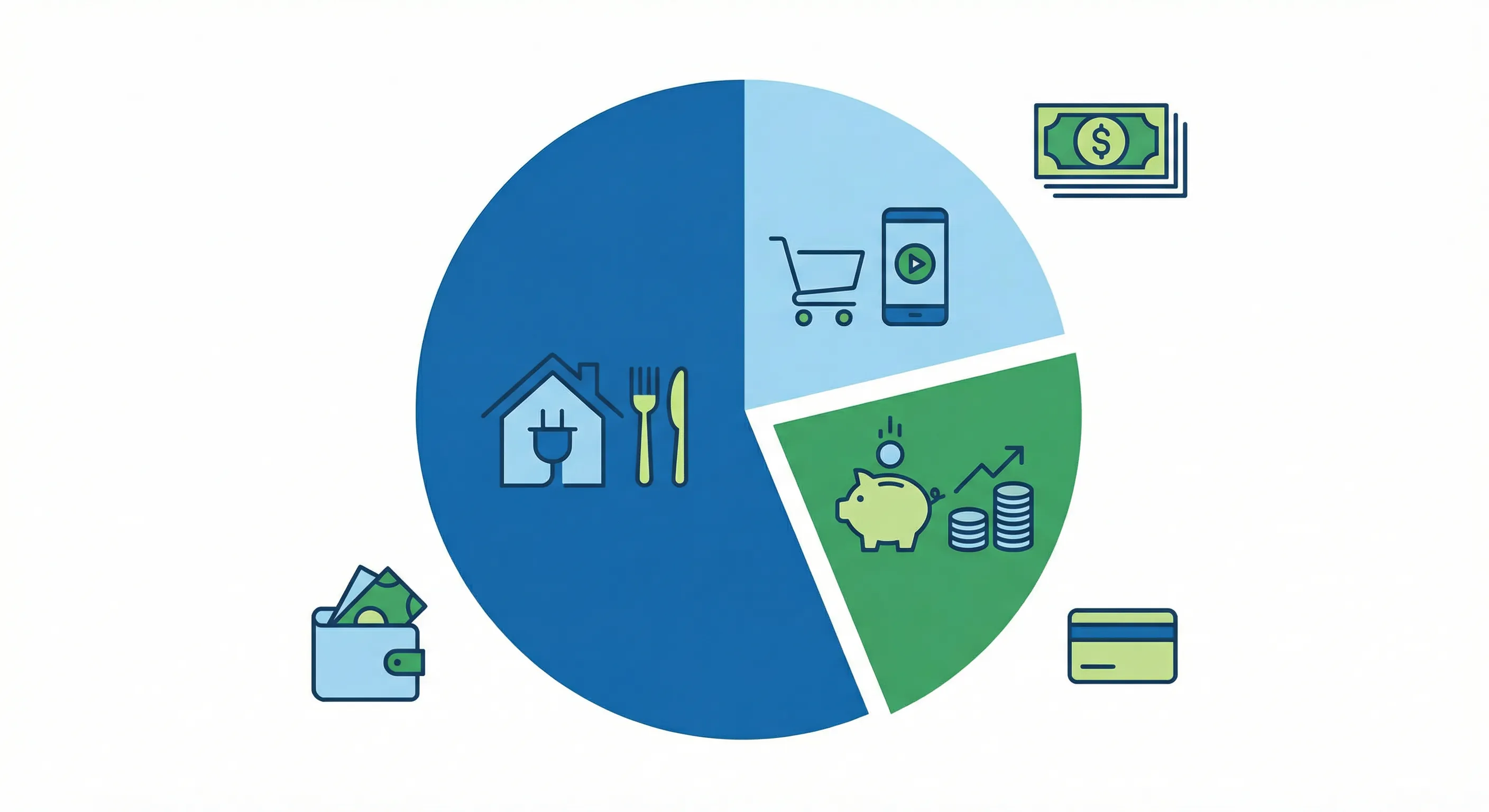
50/30/20 Budget Rule Calculator: How to Budget Your Paycheck The 50/30/20 budget rule divides your after-tax income into three categories: 50% for needs, 30% for wants, and 20% for savings and debt repayment. If your take-home pay is $4,000 per month, that means $2,000 for necessities, $1,200 for discretionary spending, and $800 for financial goals. Consider a typical case: tracking every dollar of a $4,200 monthly take-home paycheck for six months using this rule. Before adopting 50/30/20, monthly savings ran barely $150 with no real plan. Within the first year, sticking to the 20% savings target built a $5,400 emergency fund and paid off $3,800 in credit card debt. Use our Budget Calculator(/finance/budget-calculator) to instantly see your personalized 50/30/20 breakdown based on your income. !50/30/20 budget rule breakdown showing needs, wants, and savings allocation on $5,000 monthly income with category examples(/images/blog/50-30-20-budget-breakdown.svg) What Is the 50/30/20 Budget Rule? The 50/30/20 rule...
Savings Goal Calculator: How Much to Save Each Month
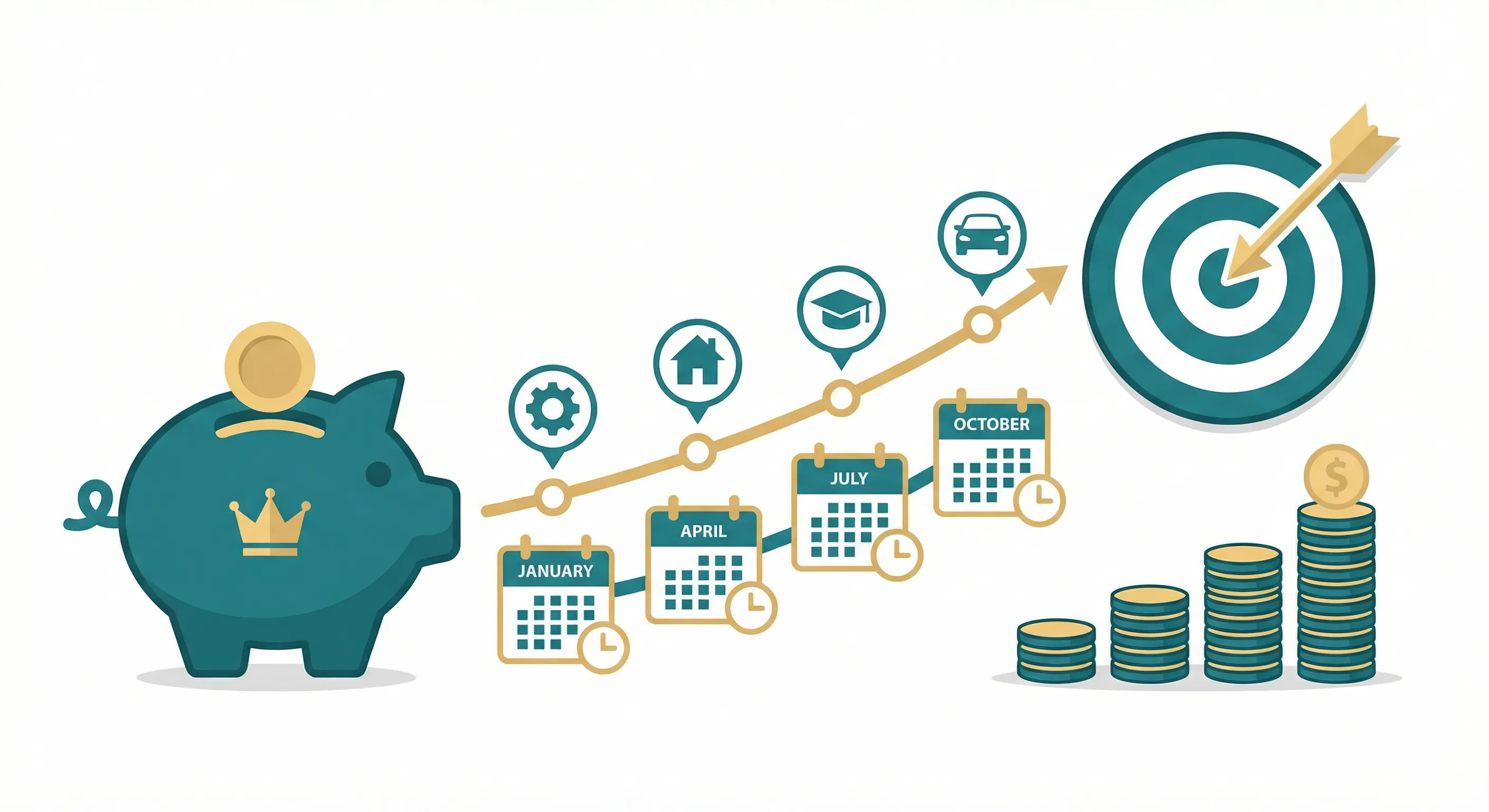
Savings Goal Calculator: How Much to Save Each Month To reach any savings goal, divide your target amount by the number of months until your deadline. If you need $10,000 for a down payment in 2 years, you need to save $417 per month. Factor in interest from a high-yield savings account, and you might reach your goal faster. Last year I set a goal to save $18,000 for a home down payment in 18 months. By parking my money in a 4.5% APY high-yield savings account and automating $950 monthly transfers on payday, I actually hit my target two months early -- the $627 in interest earnings made the difference. Breaking a big number into a concrete monthly amount turned an intimidating goal into something I could track and control. Use our Savings Goal Calculator(/finance/savings-goal-calculator) to create a personalized savings plan with interest calculations included. !Savings growth timeline showing...
Compound Interest Explained: How Your Money Grows Over Time
Compound Interest Explained: How Your Money Grows Over Time A classic early-start scenario shows why age 22 beats age 35. Someone who opens a Roth IRA at 22 and puts in $200/month might feel like they can barely afford it on top of rent, but it is worth doing anyway. Those $200 monthly contributions from ages 22-35 (just $31,200 total) can be worth over $180,000 at age 42. Money contributed after 35 barely catches up by comparison. That's compound interest: the earlier dollars do almost all the heavy lifting. Compound interest is interest earned on both your initial investment and the accumulated interest from previous periods—it's essentially "interest on interest." This creates exponential growth that can transform modest regular investments into substantial wealth over time. Use our Compound Interest Calculator(/finance/compound-interest-calculator) to see exactly how your money can grow. What Is Compound Interest? Compound interest differs from simple interest, which is...
Retirement Planning: Complete Guide to Building Your Financial Future
Retirement Planning: Complete Guide to Building Your Financial Future Retiring at 62 with enough money to travel, help with grandkids' college, and never stress about bills is possible. Still working at 70 because "retirement" was always "something to figure out later" is also common. The difference isn't income — people with similar salaries can land in either scenario. It's planning. Opening an IRA at 26 and maxing it out for 36 years puts someone in a fundamentally different position than starting "seriously saving" at 52. This guide is about building toward the first outcome, not the second. To plan for retirement, you need to determine how much money you'll need (typically 70-80% of pre-retirement income), calculate your current savings trajectory, and adjust contributions to close any gaps. Most financial experts recommend saving 10-15% of your income starting in your 20s, or more if you're starting later. Use our Retirement Calculator(/finance/retirement-calculator)...
How to Set and Achieve Savings Goals: Complete Guide
How to Set and Achieve Savings Goals: Complete Guide A transmission failure is a common wake-up call. Repair cost: $3,800. A typical emergency fund for someone who hasn't prioritized one: $400 or less. Without savings, that gap often ends up on a credit card, paying 19% interest for two years while financial stress climbs. That is exactly the scenario a fully funded emergency fund prevents. Separate accounts for emergencies, vacations, home repairs, and kids' activities — each funding automatically every month — remove the stress of surprise expenses entirely. To achieve any savings goal, calculate your target amount, divide it by your timeline to determine the monthly savings needed, then automate contributions to a dedicated account. This simple formula works whether you're saving $1,000 for an emergency fund or $1 million for retirement. Use our Savings Goal Calculator(/finance/savings-goal-calculator) to create your personalized savings plan. Why Savings Goals Matter Goals without...