Compound Interest Explained: How Your Money Grows Over Time
A classic early-start scenario shows why age 22 beats age 35. Someone who opens a Roth IRA at 22 and puts in $200/month might feel like they can barely afford it on top of rent, but it is worth doing anyway.
Those $200 monthly contributions from ages 22-35 (just $31,200 total) can be worth over $180,000 at age 42. Money contributed after 35 barely catches up by comparison. That's compound interest: the earlier dollars do almost all the heavy lifting.
Compound interest is interest earned on both your initial investment and the accumulated interest from previous periods—it's essentially "interest on interest." This creates exponential growth that can transform modest regular investments into substantial wealth over time. Use our Compound Interest Calculator to see exactly how your money can grow.
What Is Compound Interest?
Compound interest differs from simple interest, which is calculated only on the original principal.
Simple Interest vs. Compound Interest
| Year | Simple Interest (5% on $10,000) | Compound Interest (5% on $10,000) |
|---|---|---|
| 1 | $10,500 | $10,500 |
| 5 | $12,500 | $12,763 |
| 10 | $15,000 | $16,289 |
| 20 | $20,000 | $26,533 |
| 30 | $25,000 | $43,219 |
With simple interest, you earn $500 every year. With compound interest, your earnings accelerate because each year's interest is added to the principal.
Important
The difference grows dramatically over time. After 30 years, compound interest produces 73% more than simple interest on the same initial investment.
The Compound Interest Formula
The formula for compound interest is:
A = P(1 + r/n)^(nt)
Where:
- A = Final amount
- P = Principal (initial investment)
- r = Annual interest rate (decimal)
- n = Number of times interest compounds per year
- t = Time in years
Example Calculation
Initial investment: $10,000 Interest rate: 7% annually Compounding: Monthly (12 times per year) Time: 10 years
A = $10,000 × (1 + 0.07/12)^(12×10) A = $10,000 × (1.00583)^120 A = $10,000 × 2.0097 A = $20,097
Your $10,000 more than doubles in 10 years at 7% interest.
Tip
Don't want to do the math? Use our Compound Interest Calculator to instantly calculate your investment growth with any inputs.
The Rule of 72
A quick way to estimate how long it takes to double your money:
Years to Double = 72 ÷ Interest Rate
| Interest Rate | Years to Double |
|---|---|
| 4% | 18 years |
| 6% | 12 years |
| 7% | 10.3 years |
| 8% | 9 years |
| 10% | 7.2 years |
| 12% | 6 years |
Example: At the stock market's historical average return of about 7%, your money doubles approximately every 10 years.
The Three Factors That Maximize Compound Interest
1. Time (Most Important)
The longer your money compounds, the more dramatic the growth:
$10,000 invested at 7% annually:
| Time Period | Value | Growth |
|---|---|---|
| 10 years | $19,672 | +97% |
| 20 years | $38,697 | +287% |
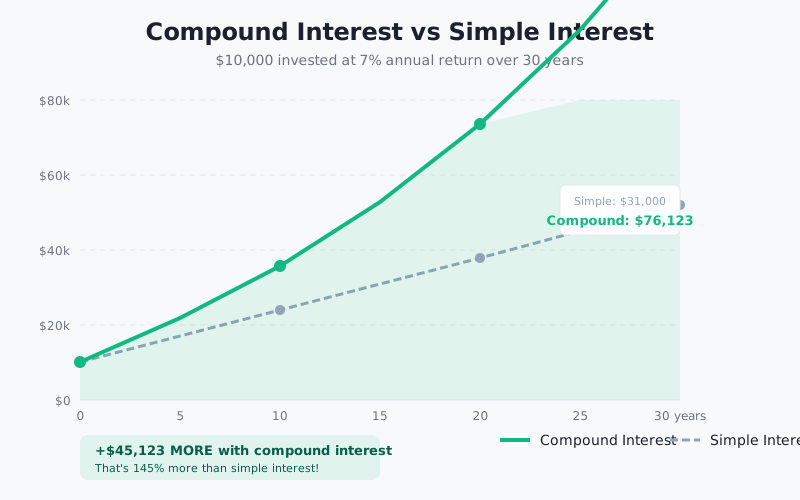
| 30 years | $76,123 | +661% |
| 40 years | $149,745 | +1,397% |
Tip
Starting early is the single most powerful thing you can do to build wealth. A 25-year-old investing $5,000/year will have more at 65 than a 35-year-old investing $10,000/year.
2. Rate of Return
Higher returns accelerate compounding significantly:
$10,000 invested for 30 years:
| Annual Return | Final Value |
|---|---|
| 4% | $32,434 |
| 6% | $57,435 |
| 7% | $76,123 |
| 8% | $100,627 |
| 10% | $174,494 |
Just 3 percentage points difference between 7% and 10% nearly doubles your final value over 30 years.
3. Regular Contributions
Adding money consistently supercharges compound growth:
$10,000 initial + $500/month for 30 years at 7%:
- Initial $10,000 grows to: $76,123
- Monthly contributions grow to: $566,764
- Total: $642,887
This is why maxing out your 401(k) and making regular contributions matters so much.
Compounding Frequency Matters
Interest can compound at different intervals:
| Frequency | Times/Year | $10,000 at 7% for 10 Years |
|---|---|---|
| Annually | 1 | $19,672 |
| Quarterly | 4 | $19,989 |
| Monthly | 12 | $20,097 |
| Daily | 365 | $20,137 |
| Continuous | ∞ | $20,138 |
While more frequent compounding helps, the difference is relatively small. Time and contribution rate matter far more than compounding frequency.
Real-World Applications of Compound Interest
Retirement Savings
The biggest application is retirement planning. Here's how compound interest works in a 401(k):
$6,000/year contribution from age 25 to 65 at 7%:
| Age | Total Contributed | Account Value |
|---|---|---|
| 25 | $6,000 | $6,420 |
| 35 | $66,000 | $92,411 |
| 45 | $126,000 | $263,191 |
| 55 | $186,000 | $582,664 |
| 65 | $246,000 | $1,197,811 |
You contributed $246,000 but ended up with nearly $1.2 million—almost 5x your contributions.
Savings Goals
Whether saving for a house, education, or other goals, compound interest helps you reach targets faster. Use our Savings Goal Calculator to plan your path.
Investment Returns
Stock market investments historically return about 7-10% annually when accounting for inflation. This compounds your wealth over time through:
- Price appreciation
- Reinvested dividends
- Compounded gains
Learn more in our investment basics guide.
The Dark Side: Compound Interest on Debt
Warning
Compound interest works against you when you're in debt. The same exponential growth that builds wealth can bury you in debt.
Credit Card Debt Example
$5,000 credit card balance at 20% APR, minimum payments:
- Monthly payment: ~$100
- Time to pay off: 9+ years
- Total interest paid: $6,923
- Total paid: $11,923 for a $5,000 purchase
This is why paying off high-interest debt should be a priority (after getting your 401(k) employer match).
Student Loans
Student loans compound daily, causing balances to grow during deferment or forbearance periods. A $30,000 loan at 6% grows to $40,317 after 5 years of no payments.
Maximizing Compound Interest in Your Life
Start Now, Not Later
The biggest compound interest mistake is waiting:
$500/month starting at different ages (7% return, retire at 65):
| Starting Age | Total Contributed | Value at 65 | Lost by Waiting |
|---|---|---|---|
| 25 | $240,000 | $1,199,052 | — |
| 30 | $210,000 | $829,421 | $369,631 |
| 35 | $180,000 | $566,764 | $632,288 |
| 40 | $150,000 | $381,505 | $817,547 |
Waiting just 5 years (25 to 30) costs you nearly $370,000.
Invest, Don't Save
Traditional savings accounts earn 0.01-5% interest. The stock market has historically returned 7-10% after inflation. Over 30 years:
$10,000 invested for 30 years:
- Savings account at 2%: $18,114
- Stock market at 7%: $76,123
That's a difference of $58,000 on a single $10,000 investment.
Reinvest Dividends
When your investments pay dividends, reinvest them to compound your returns:
$10,000 in a stock with 7% return + 2% dividend:
| Year | Without Reinvestment | With Dividend Reinvestment |
|---|---|---|
| 10 | $17,908 + $2,000 dividends | $23,674 |
| 20 | $32,071 + $4,000 dividends | $56,044 |
| 30 | $57,435 + $6,000 dividends | $132,677 |
Reinvesting dividends nearly doubles your long-term returns.
Automate Your Contributions
Set up automatic transfers to investment accounts:
- 401(k) contributions from paycheck
- Monthly IRA contributions
- Automatic investment into index funds
Automation ensures you never skip contributions, maximizing time in the market.
Compound Interest and Taxes
Tax-advantaged accounts supercharge compound growth:
Tax-Deferred Accounts (401k, Traditional IRA)
- Contributions reduce taxable income
- No taxes on annual growth
- Pay taxes on withdrawal
Tax-Free Accounts (Roth 401k, Roth IRA)
- Contribute after-tax money
- No taxes on growth
- No taxes on qualified withdrawals
$10,000/year for 30 years at 7%, 22% tax bracket:
| Account Type | Total Growth | After-Tax Value |
|---|---|---|
| Taxable Brokerage | $1,199,052 | ~$1,025,000 |
| Traditional 401(k) | $1,199,052 | ~$935,000 |
| Roth 401(k) | $1,199,052 | $1,199,052 |
The Roth advantage becomes enormous over long periods.
Frequently Asked Questions
How does compound interest make you money?
Compound interest earns you money by calculating interest not just on your initial investment, but also on all the interest you've previously earned. This creates a snowball effect where your balance grows exponentially rather than linearly. For example, $10,000 at 7% compound interest becomes $76,123 after 30 years, compared to just $31,000 with simple interest.
What's the difference between compound and simple interest?
Simple interest is calculated only on the original principal, so you earn the same dollar amount each year. Compound interest includes previously earned interest in each calculation, causing accelerating growth. For a $10,000 investment at 5%: simple interest earns $500/year forever, while compound interest earns $500 the first year, $525 the second year, $551 the third year, and so on.
How often should interest compound for best results?
More frequent compounding (monthly or daily vs. annually) produces slightly higher returns, but the difference is small. What matters much more is time, contribution rate, and rate of return. A 7% annual return compounded annually for 30 years produces $76,123 from $10,000, while the same rate compounded daily produces $81,165—a 6.6% difference.
How long does it take to double money with compound interest?
Use the Rule of 72: divide 72 by your interest rate to estimate doubling time. At 7% returns, money doubles in about 10 years. At 10%, it doubles in 7 years. This is why long-term investing is so powerful—your money can double multiple times over a career.
Is compound interest only for investing?
No, compound interest applies to both saving and borrowing. Savings accounts, CDs, bonds, and investments all compound in your favor. Loans, credit cards, and mortgages compound against you. Understanding this helps you make better financial decisions—maximize compound growth on savings while minimizing it on debt.
How can I start taking advantage of compound interest?
Start by:
- Opening a 401(k) if your employer offers one
- Contributing at least enough for the employer match
- Setting up automatic monthly investments
- Choosing low-cost index funds
- Reinvesting all dividends
- Never withdrawing early
Use our Compound Interest Calculator to see how your specific situation can grow.
Related Articles
- Retirement Planning Complete Guide — Build your long-term wealth strategy
- 401(k) Contribution Guide — Maximize tax-advantaged compound growth
- Investment Basics for Beginners — Start investing to harness compound interest
- Savings Goals Guide — Apply compound interest to specific goals
Related Calculators
- Compound Interest Calculator — Calculate how your investments grow
- Investment Calculator — Model different investment scenarios
- 401(k) Calculator — Project your 401(k) balance
- Savings Goal Calculator — Plan your savings with compound growth
- Retirement Calculator — See how compound interest builds retirement wealth
This article provides general financial information for educational purposes. Consider consulting with a qualified financial advisor for personalized investment advice.
This article is provided for informational and educational purposes only. Content should not be considered professional financial, medical, legal, or other advice. Always consult a qualified professional before making important decisions. UseCalcPro is not responsible for any actions taken based on the information in this article.
Try These Calculators
Calculate compound interest on investments and savings. See how your money grows over time with regular contributions and different compounding frequencies.
Project investment growth: turn $10,000 into $? over 10, 20, or 30 years. See monthly contributions, compound interest, and inflation-adjusted returns.
Set a savings goal, enter your monthly deposit and interest rate, and see exactly how long it takes to reach your target with a month-by-month breakdown.
Enter your home value and mortgage balance to see how much HELOC you qualify for. Shows draw period and repayment payments plus total interest over the life.
Enter your balance, APR, and monthly payment to see how long it takes to pay off your credit card and how much total interest you will pay over its life.