Retirement Planning: Complete Guide to Building Your Financial Future
Retiring at 62 with enough money to travel, help with grandkids' college, and never stress about bills is possible. Still working at 70 because "retirement" was always "something to figure out later" is also common.
The difference isn't income — people with similar salaries can land in either scenario. It's planning. Opening an IRA at 26 and maxing it out for 36 years puts someone in a fundamentally different position than starting "seriously saving" at 52.
This guide is about building toward the first outcome, not the second.
To plan for retirement, you need to determine how much money you'll need (typically 70-80% of pre-retirement income), calculate your current savings trajectory, and adjust contributions to close any gaps. Most financial experts recommend saving 10-15% of your income starting in your 20s, or more if you're starting later. Use our Retirement Calculator to see exactly where you stand.
Why Retirement Planning Matters
Retirement planning is no longer optional. According to the Social Security Administration, Social Security benefits are designed to replace only about 40% of the average worker's pre-retirement income. The remaining 60%+ must come from personal savings, employer-sponsored plans, and investments.
Warning
The average American has saved only $65,000 for retirement, according to the Federal Reserve. At a 4% withdrawal rate, that provides just $2,600 annually—far below what most people need to live comfortably.
The Power of Starting Early
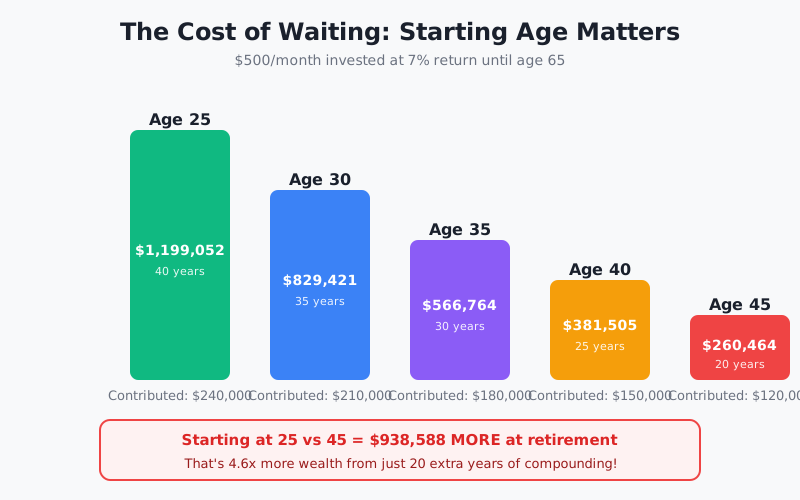
Consider this comparison of two savers:
| Saver | Starting Age | Monthly Contribution | Years Saving | Total Contributed | Value at 65 (7% return) |
|---|---|---|---|---|---|
| Alex | 25 | $500 | 40 | $240,000 | $1,199,052 |
| Jordan | 35 | $500 | 30 | $180,000 | $566,764 |
| Taylor | 45 | $500 | 20 | $120,000 | $260,464 |
Alex contributed only $60,000 more than Taylor but ends up with nearly $1 million more at retirement. That's the power of compound interest.
How Much Do You Need to Retire?
The amount you need depends on several factors:
The 25x Rule
A popular rule of thumb is to save 25 times your expected annual retirement expenses. This is based on the 4% withdrawal rule, which suggests you can safely withdraw 4% of your portfolio annually without running out of money over a 30-year retirement.
Example:
- Expected annual expenses in retirement: $60,000
- Target nest egg: $60,000 × 25 = $1,500,000
Factors That Affect Your Number
- Desired lifestyle - Traveling extensively costs more than staying local
- Healthcare costs - Average couple needs $315,000 for healthcare in retirement per Fidelity
- Location - Cost of living varies dramatically by region
- Inflation - Today's dollars won't buy as much in 30 years
- Social Security - Provides a baseline income stream
- Pension - If you have one, it reduces your savings target
Tip
Use our Retirement Calculator to get a personalized estimate based on your specific situation, income, and goals.
The Best Retirement Savings Accounts
Not all savings accounts are created equal. Tax-advantaged accounts can save you thousands over your lifetime.
401(k) Plans
Your employer's 401(k) is often the best place to start, especially if there's an employer match.
2025 Contribution Limits:
- Under 50: $23,500
- 50 and older: $31,000 (includes $7,500 catch-up)
Important
Always contribute enough to get your full employer match—it's literally free money. If your employer matches 50% up to 6% of your salary, that's an instant 50% return on your investment.
IRA (Individual Retirement Account)
IRAs offer tax advantages even if you don't have access to a 401(k).
| Account Type | 2025 Limit | Tax Benefit | Best For |
|---|---|---|---|
| Traditional IRA | $7,000 ($8,000 if 50+) | Tax-deductible contributions | Higher tax bracket now |
| Roth IRA | $7,000 ($8,000 if 50+) | Tax-free withdrawals | Lower tax bracket now |
Health Savings Account (HSA)
If you have a high-deductible health plan, an HSA offers triple tax advantages:
- Tax-deductible contributions
- Tax-free growth
- Tax-free withdrawals for medical expenses
After age 65, you can use HSA funds for anything (non-medical withdrawals are taxed as income).
Creating Your Retirement Plan
Step 1: Determine Your Retirement Goals
Ask yourself:
- At what age do you want to retire? See our retirement age guide
- What lifestyle do you envision?
- Where do you plan to live?
- What activities will fill your time?
Step 2: Calculate Your Target Number
Use this formula as a starting point:
Target Savings = (Annual Expenses × 25) - Expected Pension/Social Security Value
For a more accurate calculation, use our Retirement Calculator which accounts for:
- Current age and savings
- Expected returns
- Inflation
- Social Security estimates
- Other income sources
Step 3: Assess Your Current Situation
Calculate:
- Current retirement savings across all accounts
- Monthly contributions
- Expected employer matches
- Investment allocation
Step 4: Close the Gap
If you're behind, you have several options:
- Increase contributions - Even small increases compound over time
- Delay retirement - Working a few extra years dramatically improves outcomes
- Reduce expenses - Both now (to save more) and in retirement
- Optimize investments - Ensure age-appropriate asset allocation
Tip
Consider the "save more tomorrow" approach: commit to increasing contributions by 1-2% annually until you reach your target savings rate. You'll barely notice the gradual change.
Investment Strategy by Age
Your investment mix should evolve as you approach retirement.
In Your 20s-30s: Aggressive Growth
- Stocks: 80-90%
- Bonds: 10-20%
- Cash: 0-5%
You have decades to recover from market downturns, so prioritize growth.
In Your 40s: Moderate Growth
- Stocks: 70-80%
- Bonds: 20-30%
- Cash: 0-5%
Begin shifting slightly toward stability while maintaining growth potential.
In Your 50s: Balanced
- Stocks: 60-70%
- Bonds: 25-35%
- Cash: 5%
Protect accumulated wealth while still growing your portfolio.
In Your 60s and Beyond: Conservative
- Stocks: 40-50%
- Bonds: 40-50%
- Cash: 10%
Preserve capital and generate income. Still need some stocks to outpace inflation.
Learn more about building an investment strategy in our investment basics guide.
Common Retirement Planning Mistakes
1. Starting Too Late
Every year you wait costs you significantly. A 25-year-old who saves $5,000/year has $1.1 million at 65. A 35-year-old saving the same amount has only $540,000.
2. Not Taking Advantage of Free Money
According to CNBC, about 25% of employees don't contribute enough to get their full 401(k) match. This is leaving potentially thousands of dollars per year on the table.
3. Cashing Out When Changing Jobs
When you leave a job, roll your 401(k) into an IRA or your new employer's plan. Cashing out triggers taxes plus a 10% penalty if under 59½.
4. Ignoring Inflation
$1 million today will be worth about $550,000 in 20 years at 3% inflation. Your retirement plan must account for rising costs.
5. Underestimating Healthcare Costs
Medical expenses are one of the biggest retirement expenses. Plan for Medicare premiums, supplemental insurance, and potential long-term care needs.
Warning
Long-term care can cost $5,000-$10,000 per month. Only about 20% of people will need nursing home care, but those who do face potentially catastrophic costs.
Retirement Income Sources
A secure retirement typically draws from multiple income streams:
Social Security
- Provides a foundation but shouldn't be your only income source
- You can estimate your benefits at SSA.gov
- Delaying benefits until 70 increases monthly payments by about 8% per year past 62
Employer Retirement Plans
- 401(k), 403(b), pension plans
- Some pensions provide guaranteed lifetime income
- 401(k) balances require withdrawal decisions
Personal Savings and Investments
- IRAs, taxable brokerage accounts
- Rental income, business income
- Part-time work or consulting
The Bucket Strategy
Consider dividing your retirement savings into three "buckets":
- Short-term (1-2 years): Cash and short-term bonds for immediate expenses
- Medium-term (3-10 years): Balanced funds, bonds
- Long-term (10+ years): Stocks and growth investments
This ensures you have stable income while allowing long-term investments to grow.
Tax Planning for Retirement
Tax Diversification
Having a mix of account types gives you flexibility in retirement:
- Pre-tax accounts (Traditional 401k/IRA): Taxed on withdrawal
- After-tax accounts (Roth 401k/IRA): Tax-free withdrawals
- Taxable accounts: Only gains are taxed (at lower capital gains rates)
Required Minimum Distributions (RMDs)
Starting at age 73, you must take minimum withdrawals from traditional retirement accounts. Plan ahead to avoid being pushed into a higher tax bracket.
Tracking Your Progress
Review your retirement plan at least annually:
- Update your retirement calculator projections
- Rebalance investments if needed
- Increase contributions if possible
- Review and update beneficiaries
- Adjust target based on life changes
Use our Savings Goal Calculator to track your progress toward specific milestones.
Frequently Asked Questions
How much should I save for retirement each month?
Financial experts recommend saving 10-15% of your gross income for retirement, including any employer match. If you started saving later or want to retire early, aim for 20-25%. Use our Retirement Calculator to determine your specific monthly target based on your age, current savings, and retirement goals.
What is the 4% rule for retirement?
The 4% rule suggests you can withdraw 4% of your retirement portfolio in the first year of retirement, then adjust for inflation each subsequent year, and have a high probability of not running out of money over 30 years. For example, with a $1 million portfolio, you'd withdraw $40,000 in year one. Learn more about making your savings last in our savings goals guide.
Is $1 million enough to retire?
It depends on your expenses and lifestyle. Using the 4% rule, $1 million provides about $40,000 per year in retirement income. Combined with Social Security (average $22,000/year), that's $62,000 annually. Whether that's enough depends on your location, healthcare needs, and desired lifestyle. Use our Retirement Calculator to see how different amounts translate to monthly income.
At what age should I start planning for retirement?
Start as early as possible—ideally in your 20s when you begin working. Thanks to compound interest, money saved early has decades to grow. However, it's never too late to start. Even beginning in your 40s or 50s can significantly improve your retirement security through aggressive saving and smart planning.
Should I pay off debt or save for retirement?
It depends on the interest rates. Generally:
- Always get your full 401(k) match first (instant 50-100% return)
- Pay off high-interest debt (credit cards, personal loans above 10%)
- Then maximize retirement contributions
- Pay extra on low-interest debt (mortgages) only after maximizing tax-advantaged retirement savings
How do I catch up on retirement savings if I started late?
If you're behind, consider these strategies:
- Use catch-up contributions (extra $7,500 in 401k after age 50)
- Maximize IRA contributions
- Reduce expenses to increase savings rate
- Consider delaying retirement a few years
- Plan to work part-time in early retirement
- Downsize housing to free up equity
Read our complete guide to maximizing your 401(k) for more strategies.
Related Articles
- How to Maximize Your 401(k) Contributions — Strategies to get the most from your employer-sponsored retirement plan
- The Power of Compound Interest — Understanding how your money grows over time
- Investment Basics for Beginners — How to start investing for retirement
- Setting and Achieving Savings Goals — Create a roadmap for your financial future
- When Can You Retire? Finding Your Retirement Age — Calculate your optimal retirement age
Related Calculators
- Retirement Calculator — Calculate how much you need to save for retirement
- 401(k) Calculator — Project your 401(k) balance at retirement
- Compound Interest Calculator — See how your investments grow over time
- Investment Calculator — Model different investment scenarios
- Savings Goal Calculator — Track progress toward financial milestones
This article provides general financial information for educational purposes. Consider consulting with a certified financial planner for personalized retirement planning advice tailored to your specific situation.
This article is provided for informational and educational purposes only. Content should not be considered professional financial, medical, legal, or other advice. Always consult a qualified professional before making important decisions. UseCalcPro is not responsible for any actions taken based on the information in this article.
Try These Calculators
Enter your age, savings, and monthly contributions to see if you are on track for retirement. Includes 4% rule projections and Social Security estimates.
Enter your salary, contribution rate, and employer match to project your 401(k) balance at retirement. Shows growth breakdown by contributions vs returns.
Set a savings goal, enter your monthly deposit and interest rate, and see exactly how long it takes to reach your target with a month-by-month breakdown.
Calculate how long it will take to reach your savings goal or how much you need to save monthly. Plan for major purchases, emergencies, or retirement.
Enter your monthly expenses and savings rate to find your emergency fund target. Shows how many months you can cover now and how long to reach 3-6 months.