Impulse Spending: How to Stop Wasting $5,400 a Year on Things You Don't Need
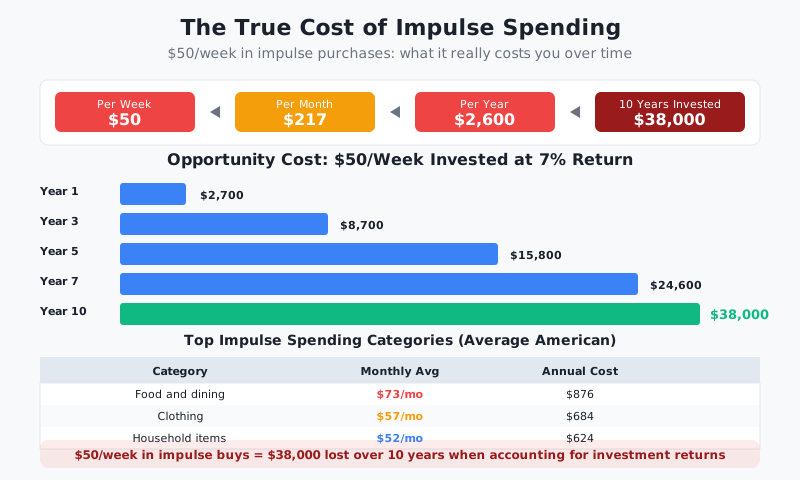
The average American spends $314 per month — or $5,400 per year — on impulse purchases they later regret. The top impulse categories are food and dining ($73/month), clothing ($57/month), and household items ($52/month). Research shows that more than half of U.S. shoppers have spent $100 or more on a single impulse buy, and 20% have crossed the $1,000 threshold at least once.
Tracking every unplanned purchase for 30 days is a reliable way to see the real number. A typical result is a gut punch: $487 in impulse spending that's hard to justify. Three Amazon orders totaling $134 forgotten about by the time they arrive. Eleven coffee shop visits at an average of $6.18 each — $68 on lattes bought purely out of habit. Four fast food lunches at $12-$16 a pop when there were groceries at home. A $487/month discovery is the kind of number that serves as a wake-up call. Annualized, that pace works out to $5,844 a year — money that could go toward an emergency fund or pay off a credit card balance in five months.
Use our No-Buy Challenge Calculator to see how much you could save by cutting impulse purchases for 30, 60, or 90 days.
How Much Do Americans Spend on Impulse Purchases?
Impulse spending is one of the biggest silent drains on household budgets. According to a survey commissioned by Slickdeals, the average American spends approximately $5,400 per year on unplanned purchases — adding up to roughly $324,000 over a lifetime.
The numbers fluctuate year to year. In 2022, Slickdeals reported the average hit $314 per month. By 2023, that number dropped to $151 per month as inflation-squeezed consumers pulled back. But the underlying behavior persists: more than a third of respondents in 2023 still admitted that most of their purchases were impulsive.
| Year | Average Monthly Impulse Spending | Average Annual Total | Key Driver |
|---|---|---|---|
| 2020 | $183 | $2,196 | Pandemic online shopping |
| 2021 | $276 | $3,312 | Stimulus-fueled spending |
| 2022 | $314 | $3,768 | Revenge spending / inflation |
| 2023 | $151 | $1,812 | Inflation pullback |
| 2024 | $282 | $3,384 | Normalized spending |
The trend is clear: even when consumers consciously try to reduce impulse spending, the average still hovers between $150 and $314 per month. That range represents the difference between building a substantial emergency fund or slowly bleeding your budget dry.
According to Capital One Shopping's research, 89% of shoppers admit to making impulse purchases, and the average consumer makes roughly 9-10 impulse buys per month at about $29 each.
Important
Even at the lower end ($151/month), impulse spending adds up to $1,812 per year. Invested at 8% annual returns over 20 years, that money could grow to over $89,000. The real cost of impulse buying is not just what you spend — it is what you never earn.
The Psychology of Impulse Buying: Why We Can't Stop
Understanding why you impulse buy is the first step toward stopping. The problem is not willpower — it is brain chemistry and cognitive biases working against you.
The Dopamine Loop
Your brain releases dopamine — the neurotransmitter associated with pleasure and reward — not when you receive a purchase, but when you anticipate it. Research published in Advances in Consumer Research shows that personalized ads and scarcity cues trigger dopamine responses that directly increase unplanned purchases. The "Add to Cart" click gives you the rush. The package arriving three days later? That is often a letdown — which is why so many impulse purchases end up forgotten or returned.
Anchoring Bias
When you see a $200 jacket marked down to $89, your brain anchors to the $200 price. You feel like you are saving $111, not spending $89. Retailers exploit this constantly with "original prices" that were never the real price. The $89 jacket is not a deal if you never planned to buy a jacket.
Social Proof and FOMO
"Only 3 left in stock." "47 people are looking at this right now." "Trending on TikTok." These are not informational — they are psychological triggers. According to a Bankrate survey, 48% of social media users have impulsively purchased a product they saw on social media. The fear of missing out overrides rational evaluation.
The Scarcity Effect
Limited-time offers create artificial urgency. Flash sales, countdown timers, and "today only" promotions short-circuit the deliberation process your brain needs to make a rational spending decision. When you believe something will disappear, your brain treats it as a survival-level threat — the same wiring that helped our ancestors hoard food now makes you buy discounted kitchen gadgets you will never use.
Emotional Spending
Stress, boredom, sadness, and even happiness can trigger impulse buying. The concept of "retail therapy" is real — shopping temporarily elevates mood through dopamine release. But the effect is short-lived, and it often creates a cycle: spend impulsively, feel guilty, feel stressed about guilt, spend again to relieve stress.
Warning
If you consistently use shopping to manage emotions — stress, loneliness, anxiety, or boredom — it may be a sign of compulsive buying disorder. The American Psychological Association estimates that 5-8% of Americans exhibit compulsive shopping behavior. If spending feels out of control, consider consulting a financial therapist or counselor.
Top 10 Impulse Spending Categories
Not all impulse spending is created equal. Knowing where your money leaks helps you plug the right holes. Based on aggregated survey data from Slickdeals and Capital One Shopping, here are the top categories:
| Rank | Category | Avg. Monthly Spend | Avg. Annual Spend | % of Impulse Buyers |
|---|---|---|---|---|
| 1 | Food & Dining | $73 | $876 | 71% |
| 2 | Clothing & Shoes | $57 | $684 | 64% |
| 3 | Household Items | $52 | $624 | 59% |
| 4 | Coffee & Beverages | $41 | $492 | 53% |
| 5 | Technology & Gadgets | $35 | $420 | 41% |
| 6 | Beauty & Personal Care | $29 | $348 | 38% |
| 7 | Entertainment & Streaming | $24 | $288 | 36% |
| 8 | Home Decor | $19 | $228 | 28% |
| 9 | Books & Media | $14 | $168 | 25% |
| 10 | Health & Supplements | $11 | $132 | 22% |
Food and dining dominate because they benefit from both emotional triggers (comfort eating) and convenience triggers (too tired to cook). Clothing ranks second because of the powerful combination of social proof, anchoring bias (sales), and instant visual gratification.
That $487 month breaks down almost exactly along these lines: $68 on coffee, $134 on household Amazon orders, $64 on fast food, and $221 on clothing and miscellaneous items seen in targeted Instagram ads.
Use our Budget Calculator to see how much of your income is going toward discretionary spending versus essentials. The 50/30/20 rule gives you a simple framework: if your "wants" category consistently exceeds 30%, impulse spending is likely the culprit.
The Real Cost of Impulse Spending: It's Not Just $5,400
The dollar amount you spend on impulse purchases is only the surface cost. The real damage is the opportunity cost — what that money could have become if invested.
The Opportunity Cost Table
If you redirected your impulse spending into a diversified index fund earning an average 8% annual return, here is what you could accumulate:
| Monthly Impulse Savings | 5 Years | 10 Years | 20 Years | 30 Years |
|---|---|---|---|---|
| $100/month | $7,348 | $18,295 | $58,902 | $149,036 |
| $200/month | $14,695 | $36,590 | $117,804 | $298,072 |
| $314/month | $23,073 | $57,447 | $185,064 | $468,173 |
| $450/month | $33,065 | $82,295 | $265,121 | $670,786 |
That $314/month in impulse spending? Over 30 years, it is not $113,040 in lost purchases. It is $468,173 in lost wealth. The difference — $355,133 — is pure compound interest that you forfeited for things you cannot even remember buying.
This is why impulse spending is best understood as a retirement problem, not just a budgeting problem. Every unnecessary $6 latte is not costing you $6. At 30 years of compounding, it is costing you roughly $60.
Use our Savings Goal Calculator to model what happens when you redirect even a portion of impulse spending toward a specific financial goal — an emergency fund, a home down payment, or early retirement.
The 24-Hour Rule and 7 Other Strategies to Stop Impulse Buying
Knowing the psychology is useful. Having concrete strategies is essential. Here are eight proven methods, ranked by effectiveness based on behavioral research and real-world application.
Strategy 1: The 24-Hour Rule
Before any unplanned purchase over $25, wait 24 hours. Write it down, screenshot it, add it to a wishlist — but do not buy it. After 24 hours, ask: "Do I still want this? Can I afford it without affecting my budget goals?"
Tip
The 24-hour rule eliminates 60-70% of impulse purchases. Most buying urges fade within hours. For purchases over $100, extend the waiting period to 72 hours. For purchases over $500, wait a full week. The bigger the purchase, the longer you should deliberate.
Strategy 2: The 10-10-10 Test
Ask yourself three questions before buying: How will I feel about this purchase 10 minutes from now? 10 days from now? 10 months from now? If the answer to any of these is "regretful" or "I will not care," skip it. This technique forces you to project beyond the dopamine rush of the moment.
Strategy 3: Unsubscribe and Unfollow
Marketing emails and social media ads are engineered to trigger impulse purchases. Unsubscribe from every retail email list. Unfollow brand accounts on Instagram, TikTok, and Facebook. Remove shopping apps from your phone. According to Bankrate's survey, nearly half of social media users have made impulse purchases directly from social media — removing the trigger removes the temptation.
Strategy 4: Use Cash or a Debit Card Only
Credit cards create psychological distance between spending and losing money. Studies consistently show that people spend 12-18% more when using credit cards versus cash. Switch to cash for discretionary spending categories (dining, clothing, entertainment). When the cash is gone, you are done for the month. For ongoing credit card balances fueled by impulse spending, our credit card payoff guide walks through the math of paying them down.
Strategy 5: Set a "Fun Money" Budget
Eliminating all discretionary spending is unsustainable — it leads to binge spending. Instead, allocate a fixed monthly "fun money" amount. When it is gone, it is gone. This gives you permission to spend without guilt while setting a hard ceiling. The 50/30/20 rule suggests 30% of after-tax income for wants — but if impulse spending is a problem, consider starting at 20% and working up.
Strategy 6: Delete Saved Payment Information
Important
Remove saved credit cards from Amazon, Target, Walmart, and every other online store. One-click purchasing exists because it eliminates friction — the same friction that gives your rational brain time to intervene. Making yourself re-enter a 16-digit card number, expiration date, and billing address adds a 2-3 minute delay that is often enough to break the impulse.
Strategy 7: Create a "Want List" with Prices and Dates
Instead of buying impulsively, add items to a running list with the date and price. Review the list every two weeks. Items that still feel important after two weeks might genuinely be worth purchasing. Items you have forgotten about were impulse urges that passed. This creates a visual record that teaches you to recognize the difference between wanting and needing.
Strategy 8: Implement a No-Buy Challenge
Commit to a period — 7 days, 30 days, or even 90 days — where you purchase only essentials (groceries, bills, transportation). No restaurants, no Amazon, no new clothes, no subscription sign-ups. A no-buy challenge resets your spending habits by breaking the automatic behavior loop.
Our No-Buy Challenge Calculator lets you set your challenge duration and see exactly how much you will save. Even a 30-day challenge at $314/month in reduced impulse spending saves $314 — enough to start an emergency fund or make an extra payment on debt. Read our complete guide to the 50/30/20 budget rule to build a sustainable spending framework around your challenge results.
Strategy Effectiveness Comparison
| Strategy | Effort Level | Effectiveness | Best For |
|---|---|---|---|
| 24-Hour Rule | Low | High (60-70% reduction) | All impulse buyers |
| 10-10-10 Test | Low | Medium (40-50% reduction) | Emotional spenders |
| Unsubscribe/Unfollow | One-time setup | High (reduces triggers by 50%+) | Online/social media shoppers |
| Cash Only | Medium | High (12-18% spending reduction) | In-store impulse buyers |
| Fun Money Budget | Medium | Medium-High | Budget-conscious spenders |
| Delete Saved Payments | One-time setup | Medium (reduces online impulse buys) | Online shoppers |
| Want List | Low-Medium | Medium (30-40% reduction) | Deliberate planners |
| No-Buy Challenge | High | Very High (full reset) | Heavy impulse spenders |
Online Shopping: The Biggest Impulse Spending Trap
Online shopping has fundamentally changed impulse buying behavior. According to research from Invesp, impulse rather than deliberate intent now drives up to 40% of all e-commerce purchases — a figure that has grown steadily with mobile shopping adoption.
Why Online Shopping Amplifies Impulse Spending
One-click purchasing removes the friction that in-store shopping naturally provides. In a physical store, you have to carry the item, wait in line, and hand over cash or a card. Online, you tap once and the transaction is complete before your rational brain catches up.
Personalized algorithms learn your browsing patterns and serve you products calculated to trigger purchases. That "recommended for you" section on Amazon is not helpful — it is a conversion engine optimized to exploit your purchase history and browsing behavior.
Social media shopping has blurred the line between content and commerce. According to the Bankrate social media survey, 48% of social media users have impulsively purchased products they saw on platforms like Instagram, TikTok, and Facebook. The combination of influencer endorsements and embedded "Shop Now" buttons creates a seamless path from desire to purchase.
Cart abandonment emails are designed to re-trigger buying impulses. If you add something to a cart and walk away (smart move), retailers will send you reminders, discount codes, and "low stock" warnings to pull you back in. The 24-hour rule only works if you can resist the follow-up pressure.
How to Protect Yourself Online
- Use browser extensions that hide ads, block tracking cookies, and remove "recommended products" sections.
- Disable push notifications from every shopping app on your phone.
- Set screen time limits for shopping apps — even 15 minutes of browsing can trigger multiple impulse urges.
- Never shop from email links. If you want something, go directly to the retailer's site after your waiting period.
- Log out of shopping sites. Having to log back in creates friction that helps break the autopilot.
How to Track Your Impulse Spending
You cannot fix what you do not measure. Here are four practical methods to track impulse spending, from simplest to most thorough.
Method 1: The Envelope System
Label envelopes for each spending category (groceries, dining out, clothing, entertainment). Put your monthly cash budget in each. When an envelope is empty, you are done in that category. Any overspending is, by definition, impulse spending.
Method 2: The Impulse Spending Journal
Carry a small notebook or use your phone's notes app. Every time you make an unplanned purchase, record: the date, the item, the amount, and the emotion you were feeling (bored, stressed, happy, tired). After 30 days, review the patterns. A common finding in 30-day impulse journals is that around 73% of impulse purchases happen after 8 PM, when tiredness and late-night phone scrolling combine.
Method 3: The Two-Account System
Open a separate checking account for discretionary spending. Each month, transfer your "fun money" budget into this account. Use a debit card linked to this account for all non-essential purchases. When the account hits zero, you stop. Your primary account stays protected from impulse drain.
Method 4: Calculator-Based Tracking
Use our Budget Calculator to set up your monthly spending framework and identify how much room you actually have for discretionary purchases. Pair it with the Savings Goal Calculator to redirect impulse savings toward a specific target — seeing the goal grow in real-time is a powerful motivator to stay disciplined.
If impulse spending has led to credit card debt, our Credit Card Calculator can show you the true cost of carrying those balances at 20%+ interest rates. A $500 impulse spending spree on a credit card with 24% APR costs you $620 if it takes a year to pay off. The debt payoff guide provides a step-by-step plan to eliminate those balances.
No-Buy Challenge: The Ultimate Impulse Spending Reset
A no-buy challenge is the most effective way to break deeply ingrained impulse spending habits. The concept is simple: for a set period, you commit to purchasing only essentials.
How to Structure Your No-Buy Challenge
Step 1: Define Your Rules
Decide what counts as essential. Most people include: rent/mortgage, utilities, groceries (not restaurants), transportation, insurance, and medications. Everything else is off-limits.
Step 2: Choose Your Duration
- 7 days: Good for beginners or as a test run
- 30 days: The standard challenge length — long enough to break habits
- 60-90 days: For serious reset of deeply ingrained spending patterns
Step 3: Calculate Your Potential Savings
Use the No-Buy Challenge Calculator to see exactly how much you could save. Input your typical monthly spending on dining out, coffee, clothing, entertainment, and subscriptions. The calculator shows your projected savings for your chosen challenge duration and the long-term investment potential of maintaining those savings.
Step 4: Plan for Temptation
Identify your top three impulse triggers (common ones include: scrolling Amazon before bed, walking past a coffee shop on the commute, and boredom on weekends). For each trigger, create a specific alternative: reading a book instead of scrolling, making coffee at home the night before, going for a hike instead of a mall.
Step 5: Track and Celebrate
Record every impulse urge you resist and the dollar amount you saved. At the end of the challenge, total your savings. Use that number as motivation to continue modified spending habits — you do not have to maintain a strict no-buy forever, but the habits you build during the challenge should permanently reduce your impulse spending baseline.
What Participants Typically Save
Based on our calculator data and user feedback, the average 30-day no-buy challenge participant saves $280-$420 by eliminating non-essential spending. Over a year of sustained reduced spending (not a permanent no-buy, but maintaining 50-70% of the savings), that translates to $1,680-$3,528 in annual savings.
For context, $3,528 invested annually at 8% returns grows to over $161,000 in 20 years. Your no-buy challenge is not just a month-long experiment — it is a potential retirement accelerator.
Our savings goal guide can help you decide where to direct those savings for maximum impact, whether that is an emergency fund, debt payoff, or long-term investment.
Frequently Asked Questions
How much does the average person spend on impulse purchases?
The average American spends between $151 and $314 per month on impulse purchases, depending on economic conditions and the survey methodology. The most frequently cited figure is $314/month ($5,400/year), based on Slickdeals' annual consumer surveys. Over a lifetime, this adds up to approximately $324,000 in unplanned spending.
What triggers impulse buying?
The most common triggers are emotional states (stress, boredom, sadness, excitement), marketing stimuli (sales, limited-time offers, social media ads), environmental cues (store layouts, product placement), and social influence (peer purchases, influencer recommendations). According to Bankrate, 48% of social media users have made impulse purchases directly from social media platforms.
Does the 24-hour rule actually work?
Yes. Behavioral research consistently shows that most buying urges are temporary — they peak within the first 15-30 minutes and dissipate within hours. By imposing a 24-hour waiting period on non-essential purchases over $25, most people eliminate 60-70% of their impulse spending. The key is writing down the item (so you feel like you have "captured" the desire) and then genuinely waiting before deciding.
Is impulse spending a sign of a bigger problem?
Occasional impulse purchases are normal — nearly 90% of consumers do it. However, if you regularly spend beyond your means, feel unable to stop even when you want to, hide purchases from family members, or use shopping to cope with negative emotions, it may indicate compulsive buying disorder. The American Psychological Association estimates that 5-8% of Americans exhibit compulsive shopping behavior. A licensed financial therapist or counselor can help distinguish between normal impulse buying and a clinical condition.
What are the most common impulse purchases?
The top impulse purchase categories are food and dining ($73/month average), clothing and shoes ($57/month), household items ($52/month), coffee and beverages ($41/month), and technology/gadgets ($35/month). Food consistently ranks first because it combines emotional triggers (comfort eating, stress snacking) with convenience triggers (too tired to cook) and low per-transaction amounts that feel insignificant individually but compound rapidly.
How do I track my impulse spending?
Start with a 30-day impulse journal: record every unplanned purchase with the date, amount, item, and your emotional state at the time. After 30 days, categorize and total your spending. Use our Budget Calculator to compare your actual discretionary spending against recommended guidelines like the 50/30/20 rule. The most revealing pattern is usually when you impulse spend (time of day, day of week) and why (the emotional trigger), not just how much.
Related Articles
- 50/30/20 Budget Rule Guide — The foundational budgeting framework for controlling discretionary spending, including impulse purchases
- Savings Goal Guide — How to redirect impulse savings toward a specific, motivating financial target
- Credit Card Payoff Guide — Step-by-step strategy to eliminate credit card debt that often accumulates from impulse spending
- Debt Payoff Complete Guide — Comprehensive approach to paying off all types of debt, including consumer debt from overspending
Related Calculators
- No-Buy Challenge Calculator — Calculate your potential savings from a 30, 60, or 90-day no-buy challenge
- Budget Calculator — Set up your monthly spending framework and identify where money is leaking
- Savings Goal Calculator — Model the long-term growth of redirected impulse spending
This article provides general financial information for educational purposes. If you believe you have compulsive spending issues, consult a licensed financial therapist or counselor.
This article is provided for informational and educational purposes only. Content should not be considered professional financial, medical, legal, or other advice. Always consult a qualified professional before making important decisions. UseCalcPro is not responsible for any actions taken based on the information in this article.
Try These Calculators
Calculate how much you'll save with a no-buy or low-buy challenge in 2026. Enter your actual discretionary spending to see your total savings potential.
Calculate how much the 2026 egg price surge really costs your family weekly and yearly. With eggs at $5.90/dozen, see your extra annual spending impact.
Track and calculate the true total cost of all your subscriptions. See monthly, yearly, and decade costs for Netflix, Spotify, streaming services, and more.
Estimate 2026 US auto insurance monthly premium by driver age, driving record, vehicle type, credit tier, and ZIP. Full coverage averages $177/mo nationally.
Enter your home price, down payment, and loan type to estimate closing costs. See lender fees, title fees, government fees, and prepaid items broken out.