Debt Payoff Calculator: Complete Guide to Becoming Debt-Free
A debt payoff calculator estimates how long it will take to eliminate your debt based on your balance, interest rate, and monthly payment amount. For example, $15,000 in credit card debt at 22% APR with $400 monthly payments takes 52 months and costs $5,719 in interest — but increasing to $600/month cuts that to 31 months and saves $2,673. Use our free Debt Payoff Calculator to build your personalized payoff plan.
Consider a representative case: $23,000 spread across four credit cards with rates between 19% and 26%. Running the numbers by hand takes hours with spreadsheets, but a calculator can show the exact payoff date instantly — and the $8,400 that switching from minimum payments to the avalanche method would save. A single afternoon of planning can change an entire financial trajectory.
How Debt Payoff Calculators Work
A debt payoff calculator uses the amortization formula to determine your payoff timeline. You enter three key inputs — total balance, annual interest rate (APR), and monthly payment — and the calculator shows your payoff date, total interest paid, and payment schedule.
The Math Behind Debt Repayment
The standard loan amortization formula calculates your payoff timeline:
Months to Payoff = -log(1 - (Balance × Monthly Rate / Payment)) / log(1 + Monthly Rate)
Where Monthly Rate = APR ÷ 12. This formula accounts for the fact that each payment covers both interest and principal, with the interest portion shrinking as your balance decreases.
Key Inputs and What They Mean
| Input | What It Is | Example |
|---|---|---|
| Total Debt Balance | Combined outstanding balances | $15,000 |
| Average APR | Weighted average interest rate | 20.5% |
| Monthly Payment | Amount you pay each month | $500 |
| Extra Payment | Additional amount above minimum | $200 |
Tip
Use your weighted average APR for mixed debts. If you have $5,000 at 24% and $10,000 at 18%, your weighted average is ($5,000 × 0.24 + $10,000 × 0.18) ÷ $15,000 = 20%. This gives a more accurate overall payoff estimate.
Debt Avalanche vs. Debt Snowball: Which Strategy Wins?
The two most popular repayment strategies are the avalanche method (highest interest first) and the snowball method (smallest balance first). Both work, but they serve different psychological profiles.
The Debt Avalanche Method
The avalanche method targets your highest-interest debt first while making minimum payments on everything else. Once the highest-rate debt is eliminated, you roll that payment into the next highest rate.
Example with $30,000 total debt:
| Debt | Balance | APR | Minimum | Avalanche Order |
|---|---|---|---|---|
| Credit Card A | $8,000 | 24.99% | $160 | 1st (highest rate) |
| Credit Card B | $5,000 | 19.99% | $100 | 2nd |
| Personal Loan | $12,000 | 11.50% | $275 | 3rd |
| Car Loan | $5,000 | 5.90% | $200 | 4th (lowest rate) |
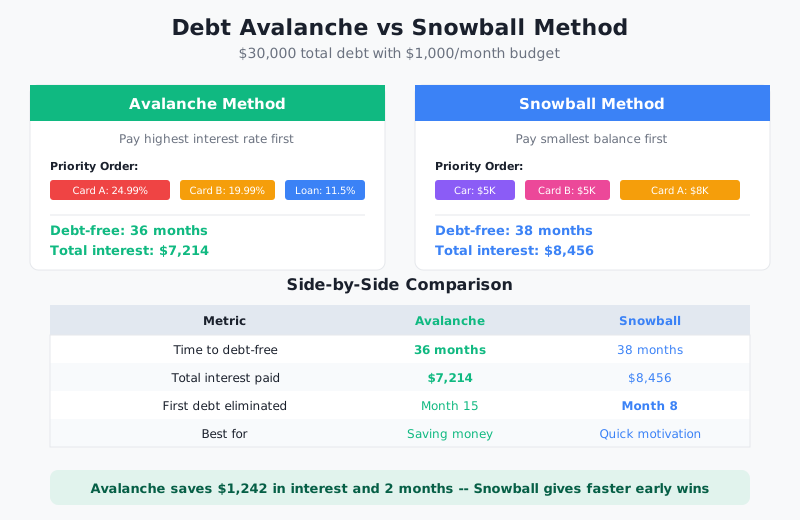
With $1,000/month total budget: Pay minimums on all ($735 total), then put the extra $265 toward Credit Card A. When Card A is paid off, the $160 minimum plus $265 extra ($425 total) rolls to Card B.
Avalanche result: Debt-free in 36 months, $7,214 total interest.
The Debt Snowball Method
The snowball method targets your smallest balance first, giving you quick wins and psychological momentum.
Same debts, snowball order:
| Debt | Balance | APR | Minimum | Snowball Order |
|---|---|---|---|---|
| Credit Card B | $5,000 | 19.99% | $100 | 1st (smallest) |
| Car Loan | $5,000 | 5.90% | $200 | 2nd |
| Credit Card A | $8,000 | 24.99% | $160 | 3rd |
| Personal Loan | $12,000 | 11.50% | $275 | 4th (largest) |
Snowball result: Debt-free in 37 months, $7,891 total interest.
Head-to-Head Comparison
| Factor | Avalanche | Snowball |
|---|---|---|
| Total interest paid | $7,214 | $7,891 |
| Interest saved | $677 more | — |
| Payoff time | 36 months | 37 months |
| First debt eliminated | ~18 months | ~8 months |
| Best for | Math-minded savers | Motivation seekers |
| Completion rate | Lower (research) | Higher (research) |
Important
Both methods beat minimum payments. Paying only minimums on $30,000 at mixed rates could take 15+ years and cost $25,000+ in interest. Either strategy gets you debt-free in about 3 years — pick the one you'll stick with.
According to the Consumer Financial Protection Bureau (CFPB), having a structured repayment plan is more important than which specific method you choose.
Step-by-Step: Building Your Debt Payoff Plan
Step 1: List All Your Debts
Gather every debt with its current balance, APR, and minimum payment. Include credit cards, personal loans, medical bills, student loans, and auto loans. Do not include your mortgage (different strategy).
Step 2: Calculate Your Debt-Free Date
Enter your total debt into our Debt Payoff Calculator. Try different monthly payment amounts to see how extra payments accelerate your timeline.
Payment impact on $20,000 at 20% APR:
| Monthly Payment | Payoff Time | Total Interest | Total Paid |
|---|---|---|---|
| $400 (minimum) | 92 months (7.7 years) | $16,607 | $36,607 |
| $500 | 58 months (4.8 years) | $8,997 | $28,997 |
| $700 | 36 months (3 years) | $5,132 | $25,132 |
| $1,000 | 23 months (1.9 years) | $3,099 | $23,099 |
Step 3: Choose Your Strategy
- Avalanche if you're disciplined and want to save the most money
- Snowball if you need quick wins to stay motivated
- Hybrid — start with snowball to eliminate 1-2 small debts, then switch to avalanche
Step 4: Find Extra Money
Every additional dollar toward debt reduces your payoff time:
| Extra Monthly Amount | Impact on $20,000 debt (at 20%) |
|---|---|
| +$50 | 7 months earlier, save $1,100 |
| +$100 | 12 months earlier, save $2,000 |
| +$200 | 20 months earlier, save $3,400 |
| +$500 | 34 months earlier, save $5,500 |
Tip
Automate your debt payments. Set up automatic payments for more than the minimum on your target debt. This removes willpower from the equation and ensures consistent progress.
Step 5: Track Progress Monthly
Review your balances monthly and celebrate milestones. When one debt is paid off, immediately redirect that payment to the next debt — don't let lifestyle inflation absorb it.
How Much Interest Are You Really Paying?
Understanding how credit card interest compounds helps motivate faster repayment. According to the Federal Reserve, the average American household carries $7,951 in credit card debt.
Daily Compounding Example
Credit cards charge interest daily:
Daily Rate = 22% APR ÷ 365 = 0.0603%
Daily Interest on $10,000 = $10,000 × 0.000603 = $6.03
Monthly Interest ≈ $183
Annual Interest ≈ $2,200
That's $6.03 per day just in interest charges on a $10,000 balance. Every day you carry the balance costs you money.
The Minimum Payment Trap
Credit card companies set minimums at roughly 1-2% of your balance (or $25, whichever is higher). This design maximizes the interest they earn:
| Balance | Minimum Payment | Payoff Time | Total Interest | Total Paid |
|---|---|---|---|---|
| $5,000 | $100 (2%) | 9.3 years | $6,238 | $11,238 |
| $10,000 | $200 (2%) | 9.7 years | $12,927 | $22,927 |
| $15,000 | $300 (2%) | 9.7 years | $18,802 | $33,802 |
| $25,000 | $500 (2%) | 9.9 years | $31,914 | $56,914 |
Warning
Minimum payments can double your total cost. On $25,000 of credit card debt at 22% APR, minimum-only payments mean you'll pay $56,914 total — more than double the original balance. You'll be paying for nearly a decade.
Debt Consolidation: Should You Combine Your Debts?
Debt consolidation rolls multiple debts into a single loan, ideally at a lower interest rate. Use our Debt Consolidation Calculator to see if consolidation saves you money.
When Consolidation Makes Sense
| Situation | Consolidate? | Why |
|---|---|---|
| Multiple high-rate cards (20%+) | Yes | Lower rate saves significant interest |
| Good credit (700+) | Yes | Qualify for best consolidation rates |
| Stable income | Yes | Can commit to fixed payments |
| Just one debt | No | Nothing to consolidate |
| Will keep using cards | No | Risk doubling total debt |
| Poor credit (<600) | Maybe | Rates may not be much lower |
Consolidation Options Compared
| Method | Typical Rate | Term | Best For |
|---|---|---|---|
| Balance transfer card | 0% intro (12-21 mo) | 12-21 months | Small balances, excellent credit |
| Personal loan | 7-20% | 2-7 years | Multiple debts, good credit |
| Home equity loan | 6-9% | 5-30 years | Large amounts, homeowners |
| 401(k) loan | Prime + 1% | 5 years | Last resort only |
For a detailed comparison of personal loan options, see our Personal Loan Comparison Guide.
Credit Card Debt: The Most Expensive Type
Credit card debt deserves special attention because of its high interest rates. The average credit card APR exceeds 22% in 2026, making it the most expensive consumer debt. Our Credit Card Calculator shows the true cost of carrying a balance.
Credit Card Payoff Strategies
- Stop adding to the balance — freeze or cut up cards during payoff
- Pay more than the minimum — even $50 extra makes a significant difference
- Target the highest-rate card first (avalanche) or smallest balance (snowball)
- Consider a balance transfer — 0% intro APR cards can save hundreds
- Call your issuer — request a rate reduction (works 50-70% of the time)
For a detailed credit card payoff strategy, read our Credit Card Payoff Guide.
Tip
The phone call that saves $1,000+. Call your credit card company and say: "I've been a loyal customer for X years. I'm considering transferring my balance to a lower-rate card. Can you reduce my APR?" Success rates are 56-69% according to surveys, and rate reductions of 5-6 percentage points are common.
Student Loan Repayment Strategies
Student loans have unique repayment options that other debts don't offer. Federal student loans provide income-driven repayment plans, deferment, and forgiveness programs.
Federal vs. Private Student Loans
| Feature | Federal Loans | Private Loans |
|---|---|---|
| Interest rates | Fixed, set by Congress | Fixed or variable, set by lender |
| Income-driven plans | Yes (SAVE, IBR, PAYE) | No |
| Deferment/forbearance | Yes | Limited |
| Forgiveness programs | PSLF, IDR forgiveness | No |
| Consolidation | Federal Direct Consolidation | Refinancing only |
According to the Federal Reserve, outstanding student loan debt exceeds $1.7 trillion in the United States, affecting over 43 million borrowers.
Use our Student Loan Calculator to model different repayment scenarios, and read the Student Loan Repayment Guide for a comprehensive look at forgiveness programs and repayment options.
How Your Credit Score Affects Debt Repayment
Your credit score directly impacts the interest rates you qualify for on consolidation loans and balance transfer cards. A higher score means lower rates, which means faster debt payoff.
Credit Score Impact on a $15,000 Consolidation Loan (5-year term)
| Credit Score | Typical APR | Monthly Payment | Total Interest |
|---|---|---|---|
| 750+ (Excellent) | 8% | $304 | $3,249 |
| 700-749 (Good) | 13% | $341 | $5,478 |
| 650-699 (Fair) | 19% | $389 | $8,315 |
| Below 650 (Poor) | 28% | $460 | $12,613 |
The difference between excellent and poor credit on a $15,000 loan is $9,364 in interest — nearly two-thirds of the original balance. Check your estimated score with our Credit Score Calculator and learn how to improve it in our Credit Score FAQ.
Important
Paying off debt improves your credit score. Reducing your credit utilization ratio (balances ÷ credit limits) is one of the fastest ways to boost your score. Going from 80% utilization to 30% can increase your score by 50-100 points within 1-2 billing cycles.
Worked Examples: Real Debt Payoff Scenarios
Scenario 1: Young Professional with Credit Card Debt
Situation: $12,000 across 3 credit cards, average 21% APR, $3,200/month take-home pay
Using the avalanche method with $500/month toward debt:
- Payoff time: 29 months
- Total interest: $3,344
- Monthly breakdown: $350 minimums + $150 extra toward highest rate
Using the snowball method:
- Payoff time: 30 months
- Total interest: $3,612
Use our Budget Calculator to find room in your budget for extra debt payments.
Scenario 2: Family with Mixed Debt
Situation: $45,000 total — $18,000 credit cards (22%), $15,000 personal loan (12%), $12,000 auto loan (6.5%)
Avalanche approach with $1,200/month total:
- Payoff time: 47 months
- Total interest: $12,836
- Attack credit cards first, then personal loan, then auto
If they consolidated credit cards + personal loan at 10%:
- New monthly payment: $700 (consolidated) + $250 (auto) = $950
- Savings: $3,200 less interest, 5 months faster
- Use the Debt Consolidation Calculator to model this
Scenario 3: Post-Graduation Debt
Situation: $35,000 student loans at 6.5% + $8,000 credit cards at 23%
Strategy: Attack credit cards first (highest rate), then accelerate student loan payments
- Credit cards paid off in 14 months at $650/month ($1,057 interest)
- Student loans on 10-year standard: $397/month ($12,624 interest)
- After cards paid off, add $650 to student loan: paid off in 3.5 more years, save $5,100
Calculate your student loan payments with our Student Loan Calculator.
How to Find Extra Money for Debt Payoff
Quick Wins (This Week)
- Cancel unused subscriptions ($50-200/month saved)
- Sell items you don't use (garage sale, Facebook Marketplace)
- Switch to a cheaper phone plan ($30-50/month saved)
- Pack lunches instead of buying ($100-200/month saved)
Medium-Term Strategies
- Negotiate bills (insurance, internet, phone)
- Refinance high-rate debts with our Personal Loan Calculator
- Pick up overtime or freelance work
- Use windfalls (tax refunds, bonuses) for lump-sum payments
The Power of Lump-Sum Payments
| $10,000 Debt at 20% APR, $300/month | Without Lump Sum | $1,000 Lump Sum | $2,500 Lump Sum |
|---|---|---|---|
| Payoff time | 41 months | 36 months | 28 months |
| Total interest | $2,309 | $1,911 | $1,329 |
| Interest saved | — | $398 | $980 |
Tip
Apply your tax refund to debt. The average tax refund is around $3,000. Applying that to credit card debt at 22% saves roughly $660 in interest per year. Use the IRS tax refund tracker to know exactly when it arrives.
Common Debt Payoff Mistakes to Avoid
Mistake 1: Only Paying Minimums
Minimum payments are designed to keep you in debt. Always pay more than the minimum on at least one debt.
Mistake 2: Consolidating Without Changing Habits
If you consolidate credit card debt into a personal loan but keep using the cards, you'll end up with double the debt. Cut up cards or freeze them during payoff.
Mistake 3: Ignoring High-Interest Debt
Some people focus on mortgage prepayment (3-7% rate) while carrying credit card debt at 22%. Always target the highest interest rate first.
Mistake 4: No Emergency Fund
Without a $1,000 emergency buffer, every unexpected expense goes back on credit cards. Build a small emergency fund before aggressive debt payoff.
Mistake 5: Going It Alone
If you're overwhelmed, contact a non-profit credit counseling agency. The CFPB maintains a directory of approved agencies.
Building a Debt-Free Future
Once you've paid off your debts, redirect those payments toward wealth building:
- Build a full emergency fund (3-6 months of expenses)
- Max out retirement contributions — use our Retirement Calculator to plan
- Invest the difference — your former $500/month debt payment becomes $500/month invested
- Stay debt-free — use credit cards for rewards, but pay in full monthly
The Federal Reserve's Survey of Consumer Finances shows that households with no consumer debt have a median net worth 3-4 times higher than those carrying debt.
Frequently Asked Questions
How long will it take to pay off my debt?
It depends on your balance, interest rate, and payment amount. Use our Debt Payoff Calculator for an exact timeline. As a rough guide: $10,000 at 20% APR takes 23 months at $500/month (paying $1,952 interest) or 41 months at $300/month (paying $2,309 interest). Every extra $100/month can save 5-8 months.
Is the avalanche or snowball method better?
The avalanche method (highest interest first) saves more money mathematically. The snowball method (smallest balance first) provides faster psychological wins. Research shows snowball users are slightly more likely to become debt-free because early wins keep them motivated. The best method is whichever one you'll stick with.
Should I use savings to pay off debt?
Keep a $1,000 emergency fund, then use additional savings to pay off high-interest debt (above 10-12% APR). If your debt rate is 22% and your savings earn 4%, you're effectively losing 18% by not using savings for debt. However, don't drain retirement accounts — early withdrawal penalties and lost compound growth make this a poor trade.
Will paying off debt hurt my credit score?
Paying off debt generally improves your credit score by reducing your credit utilization ratio. You may see a temporary dip if you close old accounts (which reduces average account age), so keep old cards open with zero balances instead of closing them.
How do I stay motivated during debt payoff?
Track your progress visually with a chart or app. Celebrate milestones (every $1,000 paid off). Join online communities like r/debtfree. Tell a friend or accountability partner about your goal. Remember: every payment gets you closer to financial freedom.
Can I negotiate my interest rates?
Yes. Call your credit card company and ask for a rate reduction. Studies show 56-69% of people who ask receive a lower rate. Mention competitive offers from other cards. Even a 2-3% reduction on $10,000 saves $200-300 per year.
What debts should I pay off first?
Generally, pay off debts in order of interest rate (highest first), except: always make minimum payments on everything, build a $1,000 emergency fund first, and don't prepay low-rate debt (under 5-6%) if you could invest that money instead.
Is debt consolidation worth it?
Consolidation saves money if the new rate is lower than your current weighted average rate AND you won't accumulate new debt. See our Debt Consolidation Guide for a full analysis.
Related Articles
- Credit Card Payoff Guide — Step-by-step strategies to eliminate credit card debt
- Debt Consolidation Guide — How to combine debts into one lower-rate payment
- Personal Loan Comparison — Compare personal loan options for debt consolidation
- Student Loan Repayment Guide — Federal repayment plans, forgiveness, and refinancing
- Credit Score FAQ — How your score affects rates and how to improve it
Related Calculators
- Debt Payoff Calculator — Calculate your debt-free date and total interest
- Credit Card Calculator — See the true cost of credit card debt
- Debt Consolidation Calculator — Compare consolidation savings
- Personal Loan Calculator — Calculate personal loan payments and costs
- Student Loan Calculator — Model student loan repayment scenarios
- Credit Score Calculator — Estimate your credit score and improvement timeline
This guide provides general financial information for educational purposes. Debt situations vary — consult a certified financial planner or non-profit credit counselor for personalized advice. Interest rates and terms referenced are approximate and may vary by lender and creditworthiness.
This article is provided for informational and educational purposes only. Content should not be considered professional financial, medical, legal, or other advice. Always consult a qualified professional before making important decisions. UseCalcPro is not responsible for any actions taken based on the information in this article.
Try These Calculators
Calculate how long it will take to pay off your debt. See total interest paid and payoff date based on your balance, interest rate, and monthly payment.
Enter your balance, APR, and monthly payment to see how long it takes to pay off your credit card and how much total interest you will pay over its life.
Calculate student loan payments, total interest, and payoff date. Plan your student loan repayment with grace period and different repayment terms. Compare.
See how much interest you save by switching to bi-weekly mortgage payments. Compare payoff timelines and total interest between monthly and bi-weekly plans.
Enter your home value and mortgage balance to see how much HELOC you qualify for. Shows draw period and repayment payments plus total interest over the life.