Credit Score FAQ: How Scores Work, What Affects Them, and How to Improve
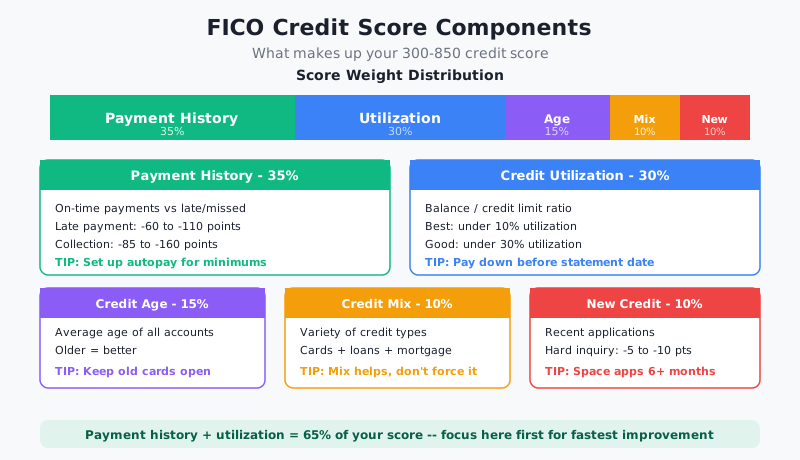
Your credit score is a three-digit number (300-850) that represents your creditworthiness, calculated from five factors: payment history (35%), credit utilization (30%), length of credit history (15%), credit mix (10%), and new credit inquiries (10%). A score of 740+ qualifies you for the best loan rates and credit card offers, potentially saving you tens of thousands in interest over your lifetime. Check your estimated score with our Credit Score Calculator.
Consider a representative case: a credit score dropping 87 points — from 761 to 674 — after a single missed mortgage payment during a job transition. That one 30-day late payment can cost $4,200 in higher interest on a subsequent auto loan refinance, and recovering those points can take 18 months of perfect payments. This is why understanding your credit score isn't optional — it's financial self-defense.
How Is Your Credit Score Calculated?
The FICO score model, used by 90% of lenders, weighs five factors:
The Five FICO Score Factors
| Factor | Weight | What It Measures | Impact |
|---|---|---|---|
| Payment History | 35% | On-time vs. late payments | Highest impact |
| Credit Utilization | 30% | Balances vs. credit limits | High impact |
| Length of History | 15% | Age of oldest account, average age | Medium impact |
| Credit Mix | 10% | Types of credit (cards, loans, mortgage) | Lower impact |
| New Credit | 10% | Recent applications and inquiries | Lower impact |
Important
Payment history and utilization together account for 65% of your score. These two factors are what you should focus on first if you're trying to improve your credit. Everything else is secondary.
Payment History (35%)
Payment history is the single most influential factor. Even one 30-day late payment can drop your score by 60-110 points. The impact depends on how late the payment was and how recent it is.
| Delinquency | Score Impact | How Long It Stays |
|---|---|---|
| 30 days late | -60 to -110 points | 7 years on report |
| 60 days late | -80 to -130 points | 7 years |
| 90+ days late | -100 to -150 points | 7 years |
| Collections | -100 to -150 points | 7 years from first delinquency |
| Bankruptcy | -130 to -240 points | 7-10 years |
Credit Utilization (30%)
Credit utilization is your total credit card balances divided by total credit limits. This is the factor you can improve the fastest.
| Utilization Range | Score Effect | Example ($10,000 limit) |
|---|---|---|
| 0-9% | Excellent | $0-$900 balance |
| 10-29% | Good | $1,000-$2,900 |
| 30-49% | Fair | $3,000-$4,900 |
| 50-74% | Poor | $5,000-$7,400 |
| 75-100%+ | Very poor | $7,500+ |
According to the Consumer Financial Protection Bureau (CFPB), keeping utilization below 30% is recommended, but below 10% is ideal for the highest scores.
Tip
Pay your balance before the statement closing date, not just the due date. Credit card companies report your balance to bureaus on the statement closing date. If you pay down the balance before that date, a lower utilization gets reported — even if you charge the same amount every month.
Credit Score Ranges Explained
| Score Range | Rating | What It Means |
|---|---|---|
| 800-850 | Exceptional | Best rates on everything; 20% of consumers |
| 740-799 | Very Good | Qualify for most premium products |
| 670-739 | Good | Most lenders approve; competitive rates |
| 580-669 | Fair | Subprime rates; limited options |
| 300-579 | Poor | Difficulty getting approved; very high rates |
How Your Score Affects Loan Rates
The financial impact of your credit score is substantial. According to the Federal Reserve, borrowers with excellent credit pay significantly less for the same loans.
Impact on a $250,000, 30-year mortgage:
| Credit Score | Mortgage Rate | Monthly Payment | Total Interest | Difference vs. 760+ |
|---|---|---|---|---|
| 760+ | 6.2% | $1,532 | $301,634 | — |
| 700-759 | 6.6% | $1,600 | $326,062 | +$24,428 |
| 660-699 | 7.1% | $1,680 | $354,948 | +$53,314 |
| 620-659 | 7.7% | $1,781 | $391,158 | +$89,524 |
| 580-619 | 8.4% | $1,903 | $435,069 | +$133,435 |
The difference between excellent and fair credit on a single mortgage is nearly $90,000 over 30 years.
Use our Debt Payoff Calculator to plan a debt repayment strategy that improves both your finances and your credit score.
Frequently Asked Questions
How often does my credit score update?
Credit scores update whenever new information is reported to the bureaus, typically every 30-45 days when your credit card statement closes or a loan payment is reported. Changes from paying down debt can appear within 1-2 statement cycles. Major improvements (like removing collections) may take 30-60 days to fully reflect.
Does checking my own credit score lower it?
No. Checking your own score is a "soft inquiry" and has zero impact. Hard inquiries (from lender applications) do affect your score, typically dropping it 5-10 points. Multiple hard inquiries for the same type of loan within a 14-45 day window count as a single inquiry for scoring purposes (rate shopping protection).
How can I improve my credit score quickly?
The two fastest methods are reducing credit utilization and becoming an authorized user on someone's old account with perfect payment history. Paying down a credit card from 80% utilization to 10% can improve your score by 50-100+ points within one billing cycle. Disputing errors on your report can also produce fast results — 79% of credit reports contain at least one error per a Federal Trade Commission study.
What's the difference between FICO and VantageScore?
| Factor | FICO | VantageScore |
|---|---|---|
| Used by | 90% of lenders | Growing adoption |
| Range | 300-850 | 300-850 |
| Versions | FICO 8 (most common), FICO 9 | 3.0, 4.0 |
| Payment history weight | 35% | 41% |
| Utilization weight | 30% | 20% |
| Minimum history | 6 months, 1 active account | 1 month, 1 account |
For most lending decisions, FICO is what matters. But knowing both scores helps you understand your credit profile.
Does closing a credit card hurt my score?
Usually yes, in two ways. First, it reduces your total available credit, increasing your utilization ratio. If you have $20,000 in limits and $4,000 in balances (20% utilization), closing a card with a $5,000 limit changes that to $4,000/$15,000 = 27%. Second, if it's your oldest card, closing it eventually reduces your average account age.
Better alternatives to closing:
- Downgrade to a no-fee version of the card
- Keep it open with a small recurring charge (subscription)
- Use it once every 6-12 months to keep it active
How does debt consolidation affect my credit score?
Debt consolidation typically causes a short-term dip (5-10 points from the hard inquiry) followed by improvement as utilization drops. If you consolidate $15,000 in credit card debt into a personal loan, your credit card utilization drops to 0% — a significant positive signal. Read our Debt Consolidation Guide for the full process.
Can I get a mortgage with a 620 credit score?
Yes, but with limitations. FHA loans accept 580+ (3.5% down) or even 500+ (10% down). Conventional loans typically require 620+. However, you'll pay higher interest rates and mortgage insurance. Improving from 620 to 700 before buying could save $50,000+ over the life of the mortgage.
How long do negative items stay on my credit report?
| Negative Item | Duration on Report |
|---|---|
| Late payments (30-90+ days) | 7 years from date of delinquency |
| Collections | 7 years from original delinquency |
| Chapter 7 bankruptcy | 10 years from filing date |
| Chapter 13 bankruptcy | 7 years from filing date |
| Foreclosure | 7 years |
| Hard inquiries | 2 years (impact fades after 12 months) |
| Tax liens (unpaid) | Indefinitely (until resolved) |
Warning
Don't pay old collections without a "pay for delete" agreement. Paying a collection account without a written agreement to remove it simply updates the status to "paid collection" — it still stays on your report for 7 years. Negotiate removal in writing before making payment.
What is credit mix and how much does it matter?
Credit mix (10% of score) reflects the variety of credit types you have. Lenders like to see you can handle different types of borrowing. An ideal mix includes revolving credit (credit cards) and installment loans (auto, student, personal, mortgage).
| Credit Mix | Typical Profile |
|---|---|
| Excellent | 2-3 credit cards + installment loan + mortgage |
| Good | 2 credit cards + 1 installment loan |
| Fair | 1-2 credit cards only |
| Poor | Single account type or very few accounts |
You should NOT open accounts just for mix. The benefit is minimal (10% of score) and new accounts temporarily lower your score.
Does paying off a loan early help my score?
Counterintuitively, paying off an installment loan can cause a small temporary dip because it reduces your credit mix and active accounts. However, the reduced debt improves your overall financial profile, and any dip is typically minor (5-15 points) and recovers within 1-2 months. Long-term, less debt is always better.
How do I dispute errors on my credit report?
- Get your free reports from AnnualCreditReport.com (all three bureaus)
- Review every account, balance, and payment record
- File disputes online with each bureau: Equifax, Experian, TransUnion
- Include supporting documentation
- Bureaus must investigate within 30 days
- If the creditor can't verify, the item must be removed
The CFPB provides sample dispute letters and step-by-step instructions.
Can I build credit with no credit history?
Yes. Start with a secured credit card (you deposit $200-500 as collateral, which becomes your limit). Use it for small purchases and pay in full monthly. After 6-12 months, you'll have a score and can qualify for unsecured cards. Credit-builder loans from credit unions are another option.
How Debt Affects Your Credit Score
Different types of debt impact your score differently:
| Debt Type | Primary Score Impact | How It Helps | How It Hurts |
|---|---|---|---|
| Credit cards | Utilization (30%) | Low utilization + on-time payments | High utilization, missed payments |
| Personal loans | Payment history (35%) | On-time payments, credit mix | Late payments, high DTI |
| Student loans | Payment history (35%) | Long history, on-time payments | Late payments, default |
| Auto loans | Payment history + mix | On-time payments, credit mix | Repossession |
| Mortgage | Payment history + mix | Strong positive if paid on time | Foreclosure is devastating |
For strategies to reduce debt while protecting your score, see our Debt Payoff Complete Guide and Credit Card Payoff Guide.
Credit Score Improvement Action Plan
Month 1: Quick Wins
- Pay down credit card balances to under 30% utilization
- Set up autopay on all accounts to prevent late payments
- Check all three credit reports for errors and dispute them
- Use our Credit Score Calculator to establish your baseline
Month 2-3: Build Foundation
- Continue paying down balances (target under 10% utilization)
- Make all payments on time
- Don't apply for new credit (avoid hard inquiries)
- Become an authorized user on a family member's old, well-managed card
Month 4-6: Optimize
- Open a credit-builder loan if credit mix is thin
- Keep old accounts active with small charges
- Monitor score monthly for progress
- Address any remaining negative items
Month 6-12: Maintain and Grow
- Score should be 50-150 points higher than starting point
- Consider applying for better credit products
- Continue low utilization and on-time payments
- Review and optimize annually
Tip
Free credit monitoring is widely available. Most banks and credit card companies offer free FICO score access. Credit Karma provides free VantageScore. Use these tools to track your progress without any hard inquiries.
Related Articles
- Debt Payoff Complete Guide — Strategies for eliminating debt and improving your credit
- Credit Card Payoff Guide — How paying off cards boosts your utilization ratio
- Debt Consolidation Guide — How consolidation affects your credit profile
Related Calculators
- Credit Score Calculator — Estimate your credit score based on key factors
- Debt Payoff Calculator — Plan a debt reduction strategy
- Credit Card Calculator — Calculate credit card payoff and utilization impact
- Debt Consolidation Calculator — See how consolidation affects your financial profile
- Personal Loan Calculator — Compare rates you qualify for based on credit
This FAQ provides general information about credit scores for educational purposes. Credit scoring models vary between lenders. Consult a financial advisor or credit counselor for personalized guidance on improving your credit.
This article is provided for informational and educational purposes only. Content should not be considered professional financial, medical, legal, or other advice. Always consult a qualified professional before making important decisions. UseCalcPro is not responsible for any actions taken based on the information in this article.
Try These Calculators
Estimate your credit score based on payment history, utilization, credit age, and inquiries. See which factors help or hurt your score and how to improve it.
Estimate 2026 mortgage monthly P&I payment by loan type (Conv/FHA/VA/Jumbo), term, and credit tier. Conv 30-yr averages 6.34%, FHA 6.07%, jumbo 6.62–6.87%.
Enter your home value and mortgage balance to see how much HELOC you qualify for. Shows draw period and repayment payments plus total interest over the life.
Enter your income, debts, and savings goal to find out how much rent you can afford. Uses the 30% rule with adjustments for your debt-to-income ratio.
Estimate 2026 personal loan monthly payments by credit tier, term, and amount. 740+ scores get 6.5-12% APR; subprime pays 28-36% APR. Quote $1K-$100K fast.