Debt Consolidation Calculator Guide: How to Combine Debts and Save
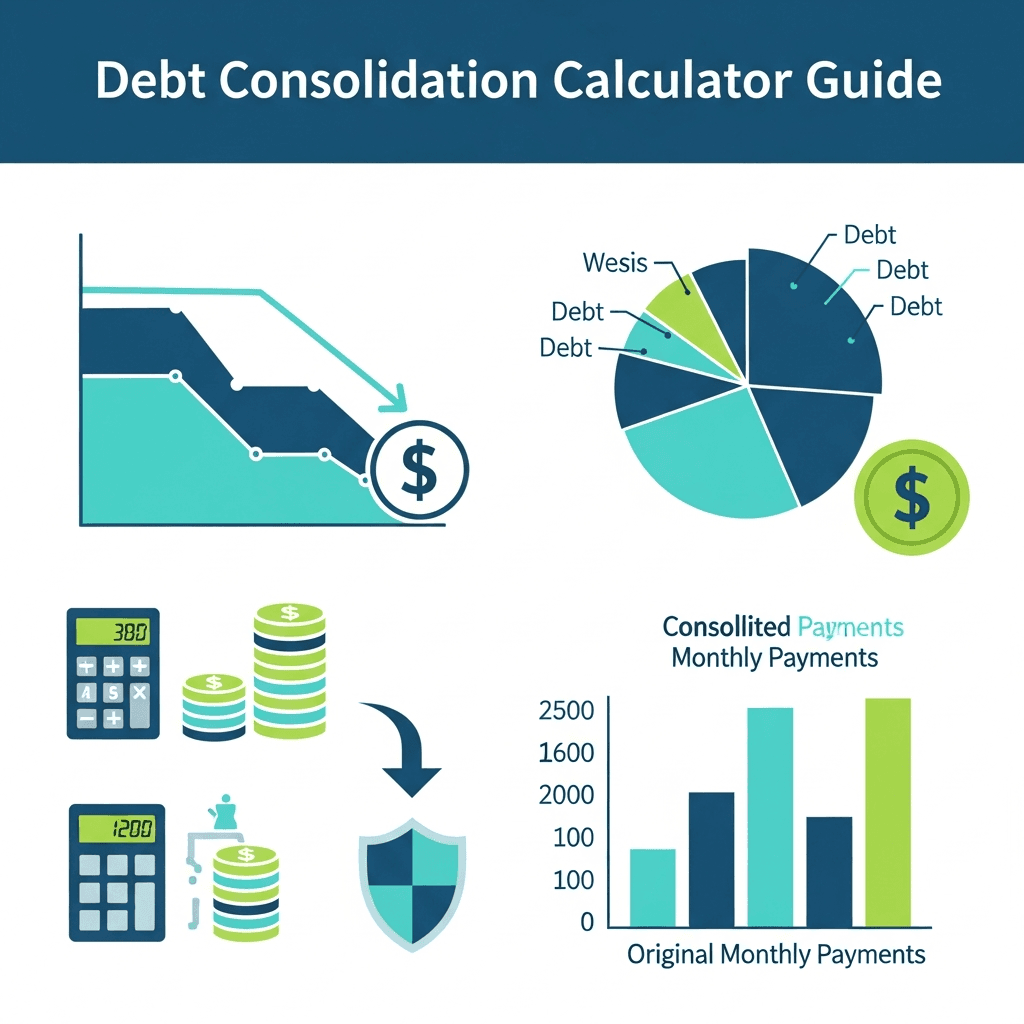
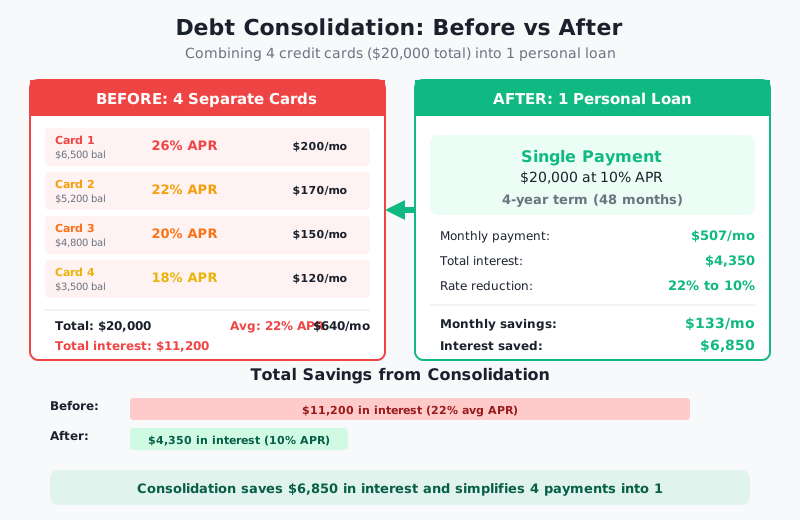
Debt consolidation combines multiple debts into a single loan with one monthly payment, ideally at a lower interest rate than your current debts. For example, consolidating $20,000 in credit card debt from 22% APR to a 10% personal loan saves $6,800 in interest over a 4-year term. Use our Debt Consolidation Calculator to see your specific savings.
A client I advised in 2021 was juggling five credit cards totaling $27,000 with rates from 18% to 26%. She was spending $640/month across all minimum payments and making almost no progress — $480 of that went to interest. After consolidating into a single 11% personal loan, her payment dropped to $590/month with a guaranteed 5-year payoff date, saving her $9,200 in total interest.
How Debt Consolidation Works
Debt consolidation replaces multiple debts with a single new loan. You use the new loan to pay off all existing debts, then make one monthly payment to the new lender.
The Basic Process
- Add up all current debts — balances, rates, and minimums
- Apply for a consolidation loan — personal loan, balance transfer, or home equity
- Pay off existing debts with the new loan proceeds
- Make one monthly payment to the new lender until paid off
When Consolidation Saves Money
Consolidation saves money when two conditions are met:
| Condition | Why It Matters |
|---|---|
| Lower interest rate | Less money lost to interest each month |
| Same or shorter term | Don't extend the payoff timeline |
Warning
Lower monthly payment ≠ lower total cost. A consolidation loan may reduce your monthly payment by extending the term. A $20,000 debt at 10% for 5 years costs $5,497 in interest. The same debt at 10% for 7 years costs $7,903 — you'd pay $2,406 MORE despite the lower monthly payment. Always compare total interest, not just the monthly number.
Comparing Consolidation Options
There are four main ways to consolidate debt. Each has different requirements, risks, and benefits.
Option 1: Personal Loan
A personal loan from a bank, credit union, or online lender is the most common consolidation method.
| Feature | Details |
|---|---|
| Typical rates | 7-20% (based on credit) |
| Terms | 2-7 years |
| Loan amounts | $1,000-$100,000 |
| Credit needed | 600+ (best rates at 700+) |
| Fees | Origination fee 1-8% |
Best for: Multiple high-rate debts, good credit, want a fixed payoff date.
Calculate your specific personal loan costs with our Personal Loan Calculator.
Option 2: Balance Transfer Credit Card
Move credit card balances to a new card with a 0% intro APR for 12-21 months.
| Feature | Details |
|---|---|
| Intro rate | 0% for 12-21 months |
| Regular rate | 20-26% after intro |
| Transfer fee | 3-5% of balance |
| Credit needed | 700+ (good to excellent) |
| Max transfer | Usually up to credit limit |
Best for: Small to medium balances you can pay off within the intro period.
Option 3: Home Equity Loan/HELOC
Borrow against the equity in your home at much lower rates.
| Feature | Details |
|---|---|
| Typical rates | 6-9% (fixed) or variable |
| Terms | 5-30 years |
| Loan amounts | Up to 85% of home equity |
| Credit needed | 620+ |
| Risk | Your home is collateral |
Best for: Large debts, homeowners with significant equity, disciplined borrowers.
Option 4: 401(k) Loan
Borrow from your retirement account. Generally a last resort.
| Feature | Details |
|---|---|
| Typical rates | Prime + 1% (~9.5%) |
| Terms | Up to 5 years |
| Max amount | 50% of balance or $50,000 |
| Credit needed | None (your own money) |
| Risk | Penalties if you leave job |
Best for: Emergency situations only when no other option exists.
Important
Never risk your home or retirement for credit card debt. Credit card debt is unsecured — worst case, you can negotiate it or file bankruptcy without losing your home. A home equity loan turns unsecured debt into secured debt. If you can't pay, you could lose your house.
Head-to-Head: $15,000 Consolidation Comparison
| Factor | Personal Loan | Balance Transfer | Home Equity | 401(k) Loan |
|---|---|---|---|---|
| Rate | 11% | 0% (15 months) | 7% | 9% |
| Monthly payment | $326 (5 yr) | $1,000 (15 mo) | $297 (5 yr) | $311 (5 yr) |
| Total interest | $4,590 | $0 | $2,832 | $3,588 |
| Upfront fees | $450 (3%) | $450 (3%) | $500 closing | $0 |
| Total cost | $5,040 | $450 | $3,332 | $3,588 |
| Risk level | Low | Medium | High | Medium |
Step-by-Step: How to Consolidate Your Debt
Step 1: Calculate Your Current Debt Cost
List every debt with its balance, APR, minimum payment, and remaining term. Then calculate your current total interest cost using our Debt Payoff Calculator.
Example: Current debts
| Debt | Balance | APR | Minimum | Monthly Interest |
|---|---|---|---|---|
| Visa | $6,000 | 24.99% | $120 | $125 |
| Mastercard | $4,500 | 21.99% | $90 | $82 |
| Store card | $2,000 | 26.99% | $40 | $45 |
| Medical bill | $3,000 | 18.00% | $100 | $45 |
| Total | $15,500 | 23.1% avg | $350 | $297 |
Current cost: At $350/month in minimums, payoff takes 8+ years with $14,200+ in total interest. Total paid: $29,700+.
Step 2: Check Your Credit Score
Your credit score determines which consolidation options are available and at what rate. Use our Credit Score Calculator for an estimate.
| Score Range | Best Consolidation Option |
|---|---|
| 750+ | Balance transfer (0%) or low-rate personal loan |
| 700-749 | Personal loan (10-14%) |
| 650-699 | Personal loan (14-20%) or credit union loan |
| Below 650 | Secured loan, credit union, or debt management plan |
Step 3: Shop for Consolidation Rates
Get quotes from at least 3-5 lenders. Most allow prequalification with a soft credit pull (no score impact).
Where to shop:
- Online lenders: SoFi, LightStream, Upgrade, Prosper
- Credit unions: Often lowest rates for members
- Banks: Check your existing bank first
- Balance transfer cards: NerdWallet, Bankrate compare offers
Step 4: Calculate Your Savings
Enter both scenarios into our Debt Consolidation Calculator.
Example: $15,500 consolidated into 11% personal loan for 4 years
| Metric | Current (multiple debts) | Consolidated |
|---|---|---|
| Monthly payment | $350 (minimums) | $401 |
| Payoff time | 8+ years | 4 years |
| Total interest | $14,200+ | $3,728 |
| Total paid | $29,700+ | $19,228 |
| Savings | — | $10,472 |
Tip
Factor in origination fees. Many personal loans charge 1-8% upfront. On a $15,500 loan with a 3% fee, that's $465 deducted from your loan proceeds or added to the balance. Include this in your total cost comparison.
Step 5: Execute the Consolidation
- Accept the loan offer
- Direct loan funds to pay off each existing debt
- Verify all old accounts show $0 balance
- Set up autopay on the new loan
- Do not close old credit card accounts (helps credit utilization)
- Do not use old cards — cut them up or freeze them
The Biggest Consolidation Mistake: Running Up Cards Again
According to the Consumer Financial Protection Bureau (CFPB), the number one reason consolidation fails is that borrowers continue using their credit cards after consolidating.
If you consolidate $15,500 in credit card debt into a personal loan, then charge another $8,000 on those now-empty cards, you end up with $23,500 in total debt instead of the original $15,500.
How to Prevent Re-accumulation
| Action | Difficulty | Effectiveness |
|---|---|---|
| Cut up credit cards | Easy | High |
| Remove from online accounts | Easy | High |
| Freeze cards in ice | Medium | High |
| Close cards (last resort) | Easy but hurts credit | Very high |
| Use cash envelope system | Medium | Very high |
| Give cards to trusted person | Medium | High |
Warning
If you can't commit to not using the cards, don't consolidate. You'll end up in a worse position than where you started. Consider a debt management plan through a non-profit credit counselor instead. Find one through the CFPB's directory.
Debt Consolidation vs. Other Options
Consolidation vs. Avalanche/Snowball
If your credit doesn't qualify for a significantly lower rate, the avalanche or snowball method may be just as effective without a new loan. See our Debt Payoff Complete Guide for a detailed comparison.
Consolidation vs. Debt Management Plan (DMP)
A DMP is arranged through a non-profit credit counseling agency. They negotiate lower rates with your creditors (often 6-10%) and you make one payment to the agency.
| Factor | Consolidation Loan | DMP |
|---|---|---|
| Rate reduction | Depends on your credit | Negotiated (often 6-10%) |
| Credit impact | Hard inquiry, new account | May note "in DMP" on report |
| Monthly fee | Loan payment | $20-50/month to agency |
| Discipline required | High (must not reuse cards) | Cards are closed for you |
| Term | 2-7 years | 3-5 years |
Consolidation vs. Bankruptcy
Bankruptcy is a legal last resort for unmanageable debt. Chapter 7 discharges most unsecured debt; Chapter 13 creates a 3-5 year repayment plan. Both severely impact your credit for 7-10 years. Always explore consolidation, DMPs, and negotiation before considering bankruptcy.
Worked Example: Full Consolidation Analysis
Sarah's situation:
- 3 credit cards: $8,000 (24%), $5,000 (21%), $3,000 (27%) = $16,000 total
- Current minimum payments: $320/month
- Credit score: 710
- Approved for 11.5% personal loan, 4-year term, 2% origination fee
Before consolidation:
- $320/month minimums → 9+ years to payoff
- Total interest: $15,870
- Total paid: $31,870
After consolidation:
- Loan amount: $16,000 + $320 fee = $16,320
- Monthly payment: $424
- Payoff: 48 months (guaranteed)
- Total interest: $4,032
- Total paid: $20,352
Net savings: $11,518 ($15,870 - $4,032 - $320 fee)
She used our Credit Card Calculator to verify the before numbers and the Personal Loan Calculator for the after scenario. Read more about choosing the right personal loan in our Personal Loan Comparison.
Frequently Asked Questions
Does debt consolidation hurt your credit score?
Initially, a consolidation loan may cause a small dip (5-10 points) from the hard credit inquiry and new account. However, within 2-3 months, your score typically improves as credit utilization drops and you establish a consistent payment history. Long-term, consolidation usually helps your score.
Can I consolidate debt with bad credit?
Yes, but options are limited. Credit unions often work with lower scores (580+). Secured loans are another option. Avoid predatory lenders offering "guaranteed approval" at 30%+ rates — that defeats the purpose of consolidation.
How much debt do you need to consolidate?
There's no minimum, but consolidation makes the most financial sense with at least $5,000 in high-rate debt. Below that, the origination fees and effort may not justify the savings. Use the avalanche method instead for smaller amounts.
Will consolidation stop collection calls?
If your debts are with original creditors (not in collections), consolidation pays them off and stops collections. If debts are already in collections, you may need to negotiate directly with collectors or work with a credit counselor.
Can I consolidate student loans with credit card debt?
Technically, a personal loan can pay off both. However, this converts federal student loans to private debt, losing access to income-driven repayment, deferment, and forgiveness programs. It's almost always better to keep student loans separate. See our Student Loan Repayment Guide.
How long does debt consolidation take?
Personal loan approval: 1-7 days. Funding: 1-5 business days after approval. Balance transfer: 5-14 days for transfer to process. Total from application to debts paid: typically 1-3 weeks.
Related Articles
- Debt Payoff Complete Guide — Avalanche, snowball, and other repayment strategies
- Credit Card Payoff Guide — Step-by-step strategies for credit card debt
- Personal Loan Comparison — Compare lenders and loan options for consolidation
Related Calculators
- Debt Consolidation Calculator — Calculate your consolidation savings
- Debt Payoff Calculator — Model your debt-free timeline
- Credit Card Calculator — See the true cost of card debt
- Personal Loan Calculator — Calculate consolidation loan payments
- Credit Score Calculator — Check how consolidation affects your score
This guide provides general financial education. Debt consolidation options, rates, and terms vary by lender and individual creditworthiness. Consult a non-profit credit counselor or financial advisor before making major debt management decisions.
This article is provided for informational and educational purposes only. Content should not be considered professional financial, medical, legal, or other advice. Always consult a qualified professional before making important decisions. UseCalcPro is not responsible for any actions taken based on the information in this article.
Try These Calculators
Calculate your savings from consolidating multiple debts into one loan. Compare current payments vs consolidated loan payments and total interest savings.
Estimate 2026 personal loan monthly payments by credit tier, term, and amount. 740+ scores get 6.5-12% APR; subprime pays 28-36% APR. Quote $1K-$100K fast.
Enter your balance, APR, and monthly payment to see how long it takes to pay off your credit card and how much total interest you will pay over its life.
Enter your home value and mortgage balance to see how much HELOC you qualify for. Shows draw period and repayment payments plus total interest over the life.
Estimate 2026 mortgage monthly P&I payment by loan type (Conv/FHA/VA/Jumbo), term, and credit tier. Conv 30-yr averages 6.34%, FHA 6.07%, jumbo 6.62–6.87%.