Student Loan Repayment Guide: Plans, Forgiveness, and Payoff Strategies
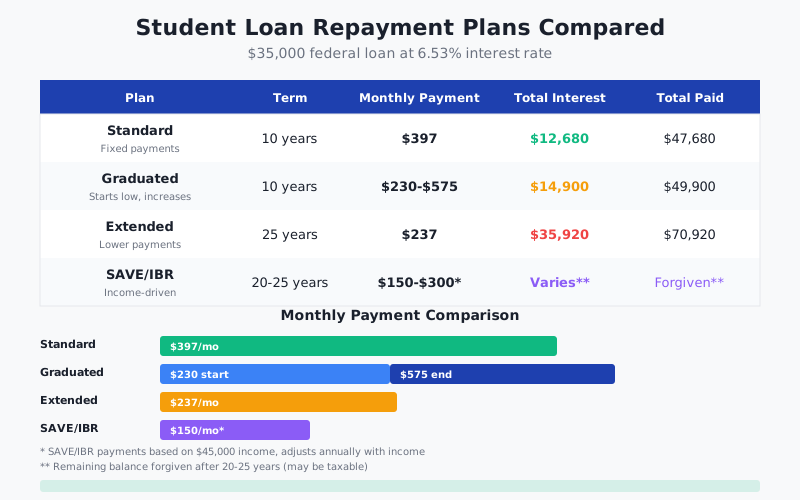
A student loan repayment calculator estimates your monthly payment, total interest, and payoff date based on your loan balance, interest rate, and repayment plan. On a standard 10-year plan, a $35,000 federal loan at 6.53% costs $397/month and $12,680 in total interest — but income-driven plans can reduce payments to as low as $150/month, with remaining balances forgiven after 20-25 years. Use our Student Loan Calculator to model different scenarios.
Consider a representative case: spending the first three years after college making minimum payments on $42,000 in student loans without exploring other options. Comparing repayment plans later reveals that an income-driven plan could have saved $340/month during the low-income years — roughly $12,000 overpaid simply from not knowing what was available. This is why every borrower should run the numbers before choosing a plan.
Understanding Your Student Loan Types
Before choosing a repayment strategy, you need to know what type of loans you have. Federal and private loans have fundamentally different options.
Federal Student Loans
| Loan Type | 2024-25 Rate | Borrower | Key Feature |
|---|---|---|---|
| Direct Subsidized | 6.53% | Undergrad with need | No interest during school |
| Direct Unsubsidized | 6.53% | Undergrad, any income | Interest accrues in school |
| Direct Unsubsidized (Grad) | 8.08% | Graduate students | Interest accrues in school |
| Direct PLUS (Grad) | 9.08% | Graduate students | Credit check required |
| Parent PLUS | 9.08% | Parents of undergrads | Parents are the borrower |
Private Student Loans
| Feature | Details |
|---|---|
| Rates | 4-14% (variable or fixed) |
| Set by | Individual lender + credit score |
| Repayment flexibility | Limited (no income-driven plans) |
| Forgiveness | None |
| Deferment/forbearance | Limited (varies by lender) |
Important
Never consolidate federal loans into private loans unless you're certain you won't need federal protections. Refinancing federal to private permanently eliminates access to income-driven repayment, deferment, forbearance, and all forgiveness programs. This is irreversible.
Federal Repayment Plans Compared
The federal government offers several repayment plans. Choosing the right one can save tens of thousands of dollars.
Standard Repayment (10-Year)
The default plan. Fixed payments for 10 years. Pays the least total interest but has the highest monthly payment.
$35,000 at 6.53%:
- Monthly payment: $397
- Total interest: $12,680
- Total paid: $47,680
Extended Repayment (Up to 25 Years)
Lower monthly payments by extending the term. Available for borrowers with $30,000+ in Direct Loans.
$35,000 at 6.53% over 20 years:
- Monthly payment: $261
- Total interest: $27,679
- Total paid: $62,679
Graduated Repayment
Payments start low and increase every 2 years. Designed for borrowers expecting income growth.
$35,000 at 6.53%:
- Starting payment: ~$225
- Ending payment: ~$670
- Total interest: ~$15,800
- Total paid: ~$50,800
Income-Driven Repayment Plans
These plans cap payments based on your income and family size, with forgiveness after 20-25 years.
| Plan | Payment | Forgiveness | Best For |
|---|---|---|---|
| SAVE | 5% undergrad / 10% grad of discretionary income | 10 years (≤$12K) to 25 years | Most borrowers — lowest payments |
| IBR | 10% (new) / 15% (old) of discretionary income | 20 years (new) / 25 years (old) | Pre-July 2014 borrowers |
| PAYE | 10% of discretionary income | 20 years | Low income, undergrad only |
| ICR | 20% of discretionary income or fixed 12-yr | 25 years | Parent PLUS (after consolidation) |
According to the Federal Student Aid office, discretionary income is defined as your adjusted gross income minus 225% of the federal poverty guideline (for SAVE; 150% for other plans).
Tip
The SAVE plan is the most generous for most borrowers. It uses 225% of the poverty line (vs. 150% for other plans), meaning more of your income is protected. A single borrower earning $40,000 with $35,000 in loans would pay approximately $120/month on SAVE vs. $213/month on IBR.
Income-Driven Payment Examples
$35,000 in loans, single filer:
| Annual Income | SAVE Payment | IBR Payment | Standard Payment |
|---|---|---|---|
| $30,000 | $37/month | $120/month | $397/month |
| $40,000 | $120/month | $213/month | $397/month |
| $50,000 | $203/month | $297/month | $397/month |
| $60,000 | $286/month | $380/month | $397/month |
| $75,000 | $411/month | $505/month | $397/month |
Use our Student Loan Calculator to model payments under each plan based on your specific income and loan balance.
Public Service Loan Forgiveness (PSLF)
PSLF forgives the remaining federal loan balance after 120 qualifying payments (10 years) while working full-time for a qualifying employer.
Who Qualifies
| Requirement | Details |
|---|---|
| Employer | Government (federal, state, local), 501(c)(3) nonprofit, AmeriCorps, Peace Corps |
| Employment | Full-time (30+ hours/week) |
| Loan type | Federal Direct Loans only (not FFEL or Perkins, unless consolidated) |
| Repayment plan | Income-driven plan (SAVE, IBR, PAYE, ICR) |
| Payments | 120 qualifying payments (not necessarily consecutive) |
PSLF Savings Example
Teacher with $65,000 in federal loans, earning $48,000:
| Scenario | Monthly Payment | Total Paid | Forgiven |
|---|---|---|---|
| Standard 10-year | $740 | $88,800 | $0 |
| SAVE + PSLF (10yr) | ~$170 | ~$20,400 | ~$55,000+ |
| IBR + PSLF (10yr) | ~$265 | ~$31,800 | ~$45,000+ |
Important
Submit the PSLF Employment Certification Form annually. Don't wait 10 years to find out your payments didn't qualify. Submit the form each year (or when you change employers) so the Department of Education can verify your progress. Track your count at StudentAid.gov.
PSLF Pitfalls to Avoid
- Wrong loan type: Only Direct Loans qualify. FFEL loans must be consolidated into a Direct Consolidation Loan first.
- Wrong repayment plan: Standard plan doesn't qualify (you'd pay it off before 120 payments). Must use income-driven plan.
- Not recertifying income: Income-driven plans require annual income recertification. Missing this switches you to standard payments.
- Assuming qualifying employment: Not all nonprofits qualify. Political organizations, labor unions, and for-profit companies with nonprofit divisions do not qualify.
Refinancing Student Loans
Refinancing replaces your existing loans with a new private loan at (ideally) a lower interest rate.
When to Refinance
| Situation | Refinance? | Reason |
|---|---|---|
| Private loans at 8%+, credit score improved | Yes | Lower rate, same loan type |
| Federal loans, high income, no PSLF plans | Maybe | Lower rate but lose protections |
| Federal loans, pursuing PSLF | Never | Lose forgiveness eligibility |
| Income unstable | No | Need income-driven flexibility |
| Graduate PLUS at 9%+ | Maybe | If income is stable and high |
Refinancing Savings Example
$50,000 in private loans at 8.5%, refinanced to 5.5%:
| Metric | Original (8.5%) | Refinanced (5.5%) | Savings |
|---|---|---|---|
| Monthly payment (10yr) | $618 | $542 | $76/month |
| Total interest | $24,160 | $15,040 | $9,120 |
| Total paid | $74,160 | $65,040 | $9,120 |
According to the Consumer Financial Protection Bureau, refinancing can save borrowers thousands but should only be considered when the rate reduction is significant and you don't need federal protections.
Use our Personal Loan Calculator to model refinanced payment amounts at different rates and terms. For general debt payoff strategies, see our Debt Payoff Complete Guide.
Strategies to Pay Off Student Loans Faster
Strategy 1: Make Biweekly Payments
Instead of 12 monthly payments, make 26 half-payments (biweekly). This equals 13 full monthly payments per year — one extra payment.
Impact on $35,000 at 6.53%:
- Standard: 120 months, $12,680 interest
- Biweekly: ~109 months, $11,300 interest
- Saves: $1,380 and 11 months
Strategy 2: Round Up Payments
Round your payment up to the nearest $50 or $100.
$35,000 at 6.53%:
| Payment | Payoff Time | Total Interest | Savings vs. Standard |
|---|---|---|---|
| $397 (standard) | 120 months | $12,680 | — |
| $450 | 101 months | $10,372 | $2,308 |
| $500 | 88 months | $8,753 | $3,927 |
| $600 | 70 months | $6,634 | $6,046 |
| $800 | 49 months | $4,316 | $8,364 |
Strategy 3: Apply Windfalls
Direct tax refunds, bonuses, and monetary gifts toward loan principal. The average tax refund is approximately $3,000. Applied annually to a $35,000 loan at 6.53%, you'd save over $5,000 in interest and pay off 3 years early.
Strategy 4: Employer Repayment Assistance
Some employers offer student loan repayment benefits of $100-$500/month. The IRS allows up to $5,250 per year in tax-free employer student loan assistance. Ask your HR department.
Tip
Target the highest-rate loan first. If you have multiple student loans, apply extra payments to the highest interest rate loan (avalanche method). Pay minimums on all others. Use our Debt Payoff Calculator to see the impact of targeting specific loans.
Strategy 5: Reduce Interest Through Autopay
Almost all federal loan servicers and most private lenders offer a 0.25% interest rate reduction when you enroll in autopay. While 0.25% sounds small, on a $50,000 loan over 10 years, it saves approximately $700 in interest. Combined with other strategies, autopay is free money.
Strategy 6: Make Payments During Grace Period
Federal student loans have a 6-month grace period after graduation. Interest on unsubsidized loans accrues during this time. If you can afford any payments during the grace period, they go entirely to principal and interest — preventing capitalization that permanently increases your balance.
Impact of grace period payments on $35,000 unsubsidized loan at 6.53%:
| Grace Period Action | Balance at Repayment Start | Extra Interest Over 10 Years |
|---|---|---|
| No payments | $36,143 ($1,143 capitalized) | +$1,560 |
| Interest-only ($190/month) | $35,000 | $0 |
| $300/month payments | $33,543 | Saves $1,980 total |
Warning
Capitalized interest is permanent. When unpaid interest capitalizes (gets added to your principal), you start paying interest on that interest for the remaining life of your loan. This is especially costly for graduate and PLUS loans with higher rates. Even partial interest payments during school or grace periods prevent this.
Common Student Loan Mistakes to Avoid
Mistake 1: Staying on Standard When You Qualify for Forgiveness
Borrowers working in public service often default to the standard 10-year plan without realizing they qualify for PSLF. On a $60,000 balance, switching to SAVE and pursuing PSLF could save $30,000+ compared to standard repayment. Always check your PSLF eligibility.
Mistake 2: Refinancing Federal Loans Too Early
Refinancing to a private lender for a lower rate seems smart, but you permanently lose income-driven plans, deferment, and forgiveness. If your career path changes or income drops, you'll have no safety net. Only refinance federal loans if you have a high, stable income and no interest in any federal programs.
Mistake 3: Ignoring Interest Accrual During School
For unsubsidized loans, interest accrues from the day funds are disbursed. Four years of $40,000 in unsubsidized loans at 6.53% means $10,400+ in interest capitalized at repayment — raising your effective balance to $50,400 before you make your first payment.
Mistake 4: Not Recertifying Income for IDR Plans
Income-driven repayment plans require annual income recertification. If you miss the deadline, your payment reverts to the standard amount, which can be hundreds more per month. Set a calendar reminder 30 days before your recertification date.
Student Loans and Other Debt: Priority Order
If you have student loans plus other debts, here's the recommended payoff priority:
| Priority | Debt Type | Why This Order |
|---|---|---|
| 1st | Credit cards (18-26% APR) | Highest cost, no tax benefit |
| 2nd | Personal loans (8-20% APR) | High cost, no tax benefit |
| 3rd | Private student loans (5-14%) | High cost, no forgiveness |
| 4th | Federal student loans (5-9%) | Lower rates, forgiveness options |
| 5th | Auto loans (4-8%) | Moderate rate, depreciating asset |
| 6th | Mortgage (3-7%) | Lowest rate, tax deductible |
If you're carrying credit card debt alongside student loans, tackle the cards first. See our Credit Card Payoff Guide for step-by-step strategies.
Student Loan Interest Tax Deduction
You can deduct up to $2,500 in student loan interest from your taxable income annually, regardless of whether you itemize deductions.
Eligibility Requirements
| Requirement | Details |
|---|---|
| MAGI limit (single) | Full deduction under $75,000; phases out $75,000-$90,000 |
| MAGI limit (married) | Full deduction under $155,000; phases out $155,000-$185,000 |
| Filing status | Any except married filing separately |
| Loan purpose | Must be for qualified education expenses |
Tax Savings Example
If you're in the 22% tax bracket and paid $2,500 in student loan interest, your tax savings are $2,500 × 0.22 = $550. This effectively reduces your loan's interest rate by about 0.5-1 percentage point.
According to the IRS, this deduction is claimed on Form 1040, Schedule 1, Line 21.
Handling Student Loan Hardship
Deferment vs. Forbearance
| Feature | Deferment | Forbearance |
|---|---|---|
| Interest on subsidized loans | Government pays | You owe (accrues) |
| Interest on unsubsidized | You owe (accrues) | You owe (accrues) |
| Duration | Up to 3 years | Up to 12 months |
| Eligibility | Enrollment, unemployment, hardship | Financial hardship (broader) |
| Application | Must demonstrate eligibility | Easier to obtain |
Warning
Interest capitalization during forbearance can significantly increase your balance. On $40,000 at 6.53%, a 12-month forbearance adds $2,612 in capitalized interest, raising your balance to $42,612. If possible, make interest-only payments during forbearance to prevent capitalization.
Income-Driven Plans as an Alternative
If you're struggling with payments, switching to an income-driven plan is almost always better than deferment or forbearance. Your payment could drop to $0 if your income is very low, and it still counts toward forgiveness programs.
Worked Examples: Complete Scenarios
Scenario 1: Recent Graduate, Standard Path
Maya, 23, $28,000 in federal loans at 6.53%, starting salary $45,000
- Standard 10-year plan: $319/month, $10,268 total interest
- With $50 extra/month ($369): Payoff in 8.3 years, save $2,010
- With biweekly payments: Payoff in 9.1 years, save $1,100
Best strategy: Standard plan with biweekly payments to chip away faster.
Scenario 2: Teacher Pursuing PSLF
Carlos, 29, $55,000 in federal loans at 7%, salary $52,000
- Standard 10-year: $639/month, $21,640 interest, $0 forgiven
- SAVE plan + PSLF: ~$200/month for 10 years, ~$24,000 paid, ~$45,000 forgiven
Best strategy: SAVE + PSLF. The $45,000 in forgiveness is tax-free.
Scenario 3: High-Earning Professional with Private Loans
Priya, 31, $90,000 in private loans at 8.8%, salary $110,000
- Current: $1,127/month for 10 years, $45,240 interest
- Refinanced to 5.2%: $964/month for 10 years, $25,680 interest
- Savings: $19,560 by refinancing
Best strategy: Refinance (private loans, high income, no need for federal protections).
Use our Student Loan Calculator to run your own scenario.
Frequently Asked Questions
What is the best student loan repayment plan?
It depends on your goals. For lowest total cost: Standard 10-year plan. For lowest monthly payment: SAVE plan. For forgiveness: SAVE or IBR with PSLF. For fastest payoff: Standard plan with extra payments. Model each option with our Student Loan Calculator.
Is student loan forgiveness taxable?
PSLF forgiveness is tax-free. Income-driven plan forgiveness after 20-25 years is generally taxable as income (though there's currently a tax exemption through 2025). For example, $40,000 forgiven could add $8,800 in taxes (22% bracket). Plan for this with savings.
Should I pay off student loans or invest?
Compare your loan rate to expected investment returns. If your loan is at 4-5%, investing in index funds (historical 7-10% return) may build more wealth. If your loan is at 7%+, paying it off is a guaranteed return equal to your rate. Above 8%, almost always pay off first.
Can I switch repayment plans?
Yes, you can switch federal repayment plans at any time at no cost through your loan servicer or StudentAid.gov. It takes 1-3 months to process. Previous income-driven payments still count toward forgiveness totals.
What happens if I can't make my student loan payments?
Contact your servicer immediately. Options include: switching to an income-driven plan ($0 payments possible), deferment, forbearance, or hardship programs. Do NOT simply stop paying — delinquency after 270 days leads to default, which triggers wage garnishment, tax refund seizure, and severe credit damage.
How do I know if my employer qualifies for PSLF?
Use the PSLF Help Tool on StudentAid.gov. Generally, government agencies (federal, state, local, tribal), 501(c)(3) nonprofits, and certain other organizations qualify. For-profit companies never qualify, even those with nonprofit arms.
Can I consolidate federal and private loans together?
You can through private refinancing, but you permanently lose all federal benefits (income-driven plans, forgiveness, deferment). Federal Direct Consolidation only combines federal loans and preserves federal benefits. Keep federal and private loans separate unless you're certain you'll never need federal protections.
Related Articles
- Debt Payoff Complete Guide — Comprehensive strategies for all types of debt
- Personal Loan Comparison — Compare refinancing options for student loans
- Credit Score FAQ — How student loan payments affect your credit score
Related Calculators
- Student Loan Calculator — Model payments under different repayment plans
- Debt Payoff Calculator — Plan your total debt elimination strategy
- Personal Loan Calculator — Calculate refinancing costs and savings
- Debt Consolidation Calculator — Compare consolidation scenarios
- Credit Card Calculator — If you also have credit card debt
- Budget Calculator — Find room in your budget for extra loan payments
This guide provides general information about student loan repayment options. Federal programs, rates, and rules change frequently. Consult your loan servicer or a financial advisor for advice specific to your situation. Tax implications vary — consult a tax professional.
This article is provided for informational and educational purposes only. Content should not be considered professional financial, medical, legal, or other advice. Always consult a qualified professional before making important decisions. UseCalcPro is not responsible for any actions taken based on the information in this article.
Try These Calculators
Calculate student loan payments, total interest, and payoff date. Plan your student loan repayment with grace period and different repayment terms. Compare.
Enter your balance, APR, and monthly payment to see how long it takes to pay off your credit card and how much total interest you will pay over its life.
Calculate how long it will take to pay off your debt. See total interest paid and payoff date based on your balance, interest rate, and monthly payment.
Enter your income and deductions to see your federal and state tax breakdown. Shows marginal vs effective rate and after-tax income for 2026 brackets.
Enter your salary, state, filing status, and 401(k) contributions to see net pay after federal, state, Social Security, and Medicare taxes are withheld.