No-Buy Challenge Calculator: Complete Guide to Saving Thousands in 2026
A no-buy challenge is a commitment to stop purchasing non-essential items for a set period, typically 30 days to a full year. The average American household spends over $18,000 annually on discretionary purchases including dining out, clothing, entertainment, and impulse buys. By eliminating or reducing these categories, participants routinely save $5,000 to $15,000 per year.
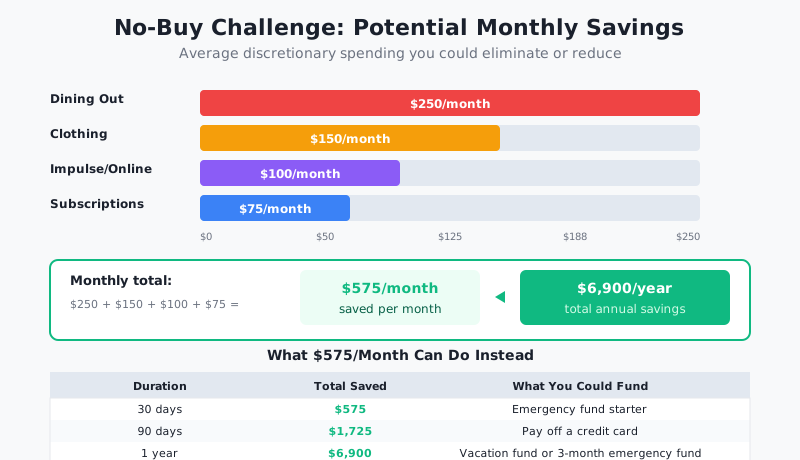
A typical 3-month no-buy challenge shows how quickly the savings add up, even for someone skeptical it would stick. Cutting coffee shop visits ($135/month), dining out ($400/month), and impulse online shopping ($265/month) adds up fast. By the end of those 90 days, the total saved reaches $2,400 -- money that can go straight into an emergency fund. The hardest part is usually the first two weeks; after that, the urge to browse shopping apps out of boredom fades, replaced by more appreciation for what's already owned.
Use our No-Buy Challenge Calculator to calculate your personal savings potential across all 7 spending categories.
What Is a No-Buy Challenge?
A no-buy challenge is a personal commitment to stop buying non-essential items for a defined period. Participants set clear rules about what they will and will not purchase, then track their progress and savings over time.
The concept is not new -- frugality movements have existed for decades -- but the no-buy challenge gained mainstream popularity through social media. The hashtag #NoBuy2026 has exploded across TikTok and Instagram, with creators documenting their journeys and sharing real savings numbers. According to Yahoo Finance, the "No Buy 2026" trend is one of the fastest-growing financial movements of the year, building on the success of #NoBuy2025 before it.
The Reddit community r/nobuy has grown to over 67,000 members who hold each other accountable and share strategies for resisting impulse purchases. According to a Chime survey reported by Yahoo Finance, 59% of Americans tried a money-saving trend in 2025, and 64% are considering a financial resolution for 2026 -- up from 56% the year before.
Why People Start No-Buy Challenges
The motivations vary, but most participants cite one or more of these reasons:
- Debt elimination -- redirect discretionary spending toward paying off credit cards, student loans, or car payments
- Savings goals -- build an emergency fund, save for a down payment, or fund a major purchase
- Mindful consumption -- break the cycle of impulse buying and overconsumption
- Environmental concerns -- reduce waste by purchasing fewer disposable or short-lived items
- Mental clarity -- stop the constant mental load of browsing, comparing, and buying
The results can be dramatic. Vice reported that one participant, Elysia Berman, saved tens of thousands of dollars in just nine months and paid down a quarter of her debt. Another participant paid off $35,000 in debt in 18 months by combining a no-buy period with downsizing.
No-Buy vs Low-Buy vs No-Spend: What's the Difference?
These three terms are often used interchangeably, but they represent different levels of spending restriction. Understanding the differences helps you choose the right challenge for your lifestyle.
| Feature | No-Buy Challenge | Low-Buy Challenge | No-Spend Challenge |
|---|---|---|---|
| Definition | Eliminate non-essential purchases entirely | Allow a small, planned budget for non-essentials | No spending at all on designated days/weeks |
| Duration | 30 days to 1 year | 30 days to 1 year | 1 day to 1 month |
| Groceries | Allowed | Allowed | Not allowed on challenge days |
| Bills & rent | Allowed | Allowed | Not allowed on challenge days |
| Dining out | Not allowed | Limited (e.g., once per month) | Not allowed on challenge days |
| Clothing | Not allowed (unless replacing a necessity) | Small budget allowed (e.g., $50/month) | Not allowed on challenge days |
| Difficulty | High | Moderate | Very high (short burst) |
| Best for | Serious savers and debt payoff | Beginners and lifestyle maintainers | Weekly challenges and habit building |
| Typical savings | $5,000-$15,000/year | $2,500-$7,500/year | $200-$500/month |
Tip
Start with a 1-month no-buy trial before committing to a full year. This lets you identify your biggest spending triggers, test your rules, and build confidence. Many people find that a successful 30-day challenge naturally extends to 3 or 6 months.
The key distinction is that a no-buy challenge targets specific spending categories while still allowing essential purchases. A no-spend challenge is more extreme -- on designated days, you spend zero dollars on anything. Most financial experts recommend the no-buy approach because it is sustainable long-term, while no-spend days work better as periodic resets.
Use our Budget Calculator to see how your current discretionary spending compares to the 50/30/20 framework. For a deeper breakdown, read our 50/30/20 Budget Rule Guide.
How Much Can You Save with a No-Buy Challenge?
The savings depend on your current spending habits, but the numbers are significant for most households. According to the Bureau of Labor Statistics Consumer Expenditure Survey, the average American household spends approximately $72,967 per year, with roughly 25-30% going toward discretionary categories.
Here is a realistic breakdown of what the average person spends on common discretionary categories and what eliminating them could save:
| Category | Monthly Spend | Annual Spend | After No-Buy (Full) | After Low-Buy (50%) |
|---|---|---|---|---|
| Coffee shops | $90 | $1,080 | $0 | $540 |
| Dining out | $200 | $2,400 | $0 | $1,200 |
| Clothing & accessories | $120 | $1,440 | $0 | $720 |
| Subscriptions & streaming | $90 | $1,080 | $0 | $540 |
| Entertainment | $80 | $960 | $0 | $480 |
| Beauty & personal care | $50 | $600 | $0 | $300 |
| Impulse & online shopping | $100 | $1,200 | $0 | $600 |
| Total | $730 | $8,760 | $8,760 saved | $4,380 saved |
These figures represent moderate spending levels. If you live in a major metro area or have higher lifestyle expenses, your discretionary spending could easily be $1,200 to $1,500 per month -- putting your potential no-buy savings at $14,400 to $18,000 per year.
Savings by Income Level
Your income does not determine how much you can save with a no-buy challenge, but it does influence your spending habits. Here is how no-buy savings typically scale:
| Annual Income | Estimated Monthly Discretionary | Annual No-Buy Savings | Savings as % of Income |
|---|---|---|---|
| $35,000 | $450 | $5,400 | 15.4% |
| $50,000 | $650 | $7,800 | 15.6% |
| $75,000 | $900 | $10,800 | 14.4% |
| $100,000 | $1,200 | $14,400 | 14.4% |
| $150,000 | $1,800 | $21,600 | 14.4% |
Important
Needs vs. wants is the foundation of every no-buy challenge. A "need" is something required for survival, health, or earning income (rent, groceries, medication, work transportation). A "want" is everything else. When in doubt, wait 48 hours before buying -- if you still need it after two days, it is probably a need.
Track your exact savings potential with our No-Buy Challenge Calculator, which breaks down every category and shows your projected savings over 1 month, 6 months, and a full year.
The 7 Categories to Track in Your No-Buy Challenge
Successful no-buy challenges track spending across specific categories rather than trying to restrict all spending at once. Here are the 7 most impactful categories to monitor, with national average spending data and calculator-ready numbers.
1. Coffee and Beverages -- $1,080/Year
The average coffee drinker spends $3 to $5 per specialty drink, often 4 to 5 times per week. That adds up to $90 per month or $1,080 per year on drinks you could make at home for under $0.50 each.
No-buy alternative: Invest $30 in a quality coffee maker and buy whole beans. Your per-cup cost drops to $0.25 to $0.50, saving you over $1,000 annually.
2. Dining Out and Takeout -- $2,400/Year
Restaurant meals, takeout, and food delivery apps account for one of the largest discretionary expenses. The average household spends $200 per month on eating out. With delivery app markups (fees, tips, service charges), a $15 meal can easily cost $25 to $30 delivered.
No-buy alternative: Meal prep on weekends, batch cook freezer meals, and plan your grocery list. Use our Tip Calculator to at least save on tip math when you do eat out during your post-challenge maintenance phase.
3. Clothing and Accessories -- $1,440/Year
Fast fashion and trend cycles drive Americans to spend an average of $120 per month on clothing, shoes, and accessories. Much of this goes unworn -- studies show the average person wears only 20% of their wardrobe regularly.
No-buy alternative: Shop your own closet. Create a capsule wardrobe with versatile pieces. If something wears out during your challenge, replace only the essential item and only with a basic version.
4. Subscriptions and Streaming -- $1,080/Year
The average American maintains 4 to 6 paid subscriptions across streaming, music, fitness apps, meal kits, and software. At $15 to $20 each, these passive charges add up to $90 per month without you even noticing.
No-buy alternative: Audit every recurring charge. Cancel everything except one or two you actively use weekly. Use free library resources for books, movies, and music. Many libraries offer free access to streaming platforms and digital content.
5. Entertainment and Events -- $960/Year
Movies, concerts, sporting events, amusement parks, and recreational activities average $80 per month. Factor in parking, concessions, and merchandise, and individual events can cost $100 to $300.
No-buy alternative: Explore free community events, hiking, parks, library programs, and home movie nights. Many museums and attractions offer free admission days.
6. Beauty and Personal Care -- $600/Year
Beyond basic hygiene products (which are allowed as needs), discretionary beauty spending on cosmetics, skincare upgrades, salon visits, and spa treatments averages $50 per month.
No-buy alternative: Use up existing products before buying new ones. Learn basic self-care skills like at-home haircuts and manicures. Stick to drugstore basics for hygiene needs.
7. Impulse and Online Shopping -- $1,200/Year
This is the catch-all category for unplanned purchases: Amazon orders, Target runs that exceed your list, hobby supplies, gadgets, and home decor. Impulse spending averages $100 per month, but many people underestimate this number because the purchases feel small individually.
No-buy alternative: Delete shopping apps from your phone. Unsubscribe from promotional emails. Remove saved credit cards from online stores. Implement a 72-hour rule for any non-essential purchase.
Track all 7 categories with our No-Buy Challenge Calculator and see your combined savings grow in real time.
How to Start a No-Buy Challenge: Step-by-Step
Starting a no-buy challenge without a plan is the fastest way to fail. Follow these steps to set yourself up for success.
Step 1: Audit Your Current Spending
Before you can cut spending, you need to know where your money goes. Pull your bank and credit card statements for the last 3 months and categorize every transaction.
What to look for:
- Recurring charges you forgot about
- Categories where you consistently overspend
- Emotional spending patterns (stress shopping, boredom buying)
- The ratio of needs to wants in your total spending
Use our Paycheck Calculator to understand exactly how much take-home pay you have available, then compare that to your actual spending.
Step 2: Define Your Rules Clearly
Ambiguous rules lead to rationalization and failure. Write down exactly what is allowed and what is not in each category. Be specific.
Good rule: "No clothing purchases of any kind unless a work-required item is damaged beyond repair."
Bad rule: "Try to buy less clothing."
Step 3: Choose Your Duration
| Duration | Best For | Difficulty | Expected Savings |
|---|---|---|---|
| 1 month | Beginners, testing the waters | Low | $500-$1,000 |
| 3 months | Building habits, quarterly goal | Moderate | $1,500-$3,000 |
| 6 months | Serious savers, debt payoff push | High | $3,000-$6,000 |
| 1 year | Maximum savings, lifestyle reset | Very high | $6,000-$15,000 |
Step 4: Set Up Your Environment
Your environment determines your behavior more than willpower does. Make these changes before Day 1:
- Delete shopping apps from your phone (Amazon, Target, Shein, Temu)
- Unsubscribe from all marketing emails -- every retailer, every brand
- Unfollow shopping influencers and haul content creators on social media
- Remove saved payment methods from online stores
- Block shopping websites using a browser extension during your challenge
- Tell someone -- accountability increases success rates dramatically
Step 5: Create a Tracking System
What gets measured gets managed. Track every purchase you avoid and calculate the running savings total. Our No-Buy Challenge Calculator does this automatically, but you can also use a simple spreadsheet or notebook.
Step 6: Plan Your Response to Temptation
You will be tempted. Have a plan ready:
- Craving coffee? Make it at home and transfer the $5 you would have spent to savings
- Want to order takeout? Cook a simple meal and add the $30 delivery cost to your savings tracker
- Spotted a sale? Close the tab, walk away, and revisit in 72 hours -- most urges pass within 24 hours
- Feeling deprived? Revisit your savings tracker and calculate what that money will become if invested
Warning
Beware the deprivation mindset. A no-buy challenge should feel empowering, not punishing. If you find yourself constantly miserable, resentful, or binge-buying at the end, you have set your rules too strict. Adjust to a low-buy approach before you quit entirely. The goal is sustainable behavior change, not white-knuckle willpower.
No-Buy Challenge Rules: What's Allowed and What's Not
Clear rules are the backbone of a successful no-buy challenge. Here is a comprehensive guide to categorizing your spending.
| Category | Allowed (Needs) | Not Allowed (Wants) |
|---|---|---|
| Food | Groceries, basic ingredients | Restaurants, takeout, delivery, coffee shops |
| Housing | Rent/mortgage, utilities, basic repairs | Home decor, furniture upgrades, renovations for aesthetics |
| Transportation | Gas, insurance, necessary maintenance | Car accessories, upgrades, car washes beyond basic |
| Health | Prescriptions, doctor visits, basic toiletries | Cosmetics, spa treatments, elective procedures |
| Clothing | Replacement of worn-out essentials only | New outfits, accessories, trend items, shoes beyond need |
| Technology | Necessary repairs, required work software | New gadgets, upgrades, apps, games |
| Entertainment | Free activities, library resources | Movies, concerts, streaming upgrades, hobby supplies |
| Gifts | You may set a modest gift budget | Expensive gifts, buying gifts for yourself disguised as "for others" |
The Gray Areas
Every no-buy challenge encounters gray areas. Here are the most common and how to handle them:
Gifts for others: Most participants allow a modest gift budget ($20 to $30 per occasion) for birthdays and holidays. The key is planning ahead and setting a hard limit.
Replacing broken items: If your only pair of work shoes falls apart, replacing them is a need. If you have three pairs and one breaks, it is a want. Apply the "can I function without this?" test.
Professional development: Books, courses, or tools directly required for your job or career growth are generally allowed, but be honest about whether you are using "professional development" as an excuse to shop.
Social activities: You can socialize without spending. Suggest free alternatives like potluck dinners, hiking, game nights, or park meetups instead of restaurants and bars.
3 No-Buy Challenge Levels
Not everyone needs to go cold turkey. Choose the level that matches your goals and lifestyle.
Level 1: Full No-Buy (100% Cut)
Who it is for: Those with significant debt, aggressive savings goals, or a desire for a complete lifestyle reset.
Rules: Zero discretionary purchases across all 7 categories for the duration of the challenge.
| Category | Monthly Savings | 3-Month Savings | Annual Savings |
|---|---|---|---|
| Coffee | $90 | $270 | $1,080 |
| Dining out | $200 | $600 | $2,400 |
| Clothing | $120 | $360 | $1,440 |
| Subscriptions | $90 | $270 | $1,080 |
| Entertainment | $80 | $240 | $960 |
| Beauty | $50 | $150 | $600 |
| Impulse | $100 | $300 | $1,200 |
| Total | $730 | $2,190 | $8,760 |
Level 2: Low-Buy (50% Reduction)
Who it is for: Beginners, families, or anyone who wants sustainable savings without extreme restriction.
Rules: Cut each discretionary category by 50%. Allow yourself one coffee shop visit per week instead of daily, eat out twice a month instead of weekly, and so on.
| Category | Monthly Savings | 3-Month Savings | Annual Savings |
|---|---|---|---|
| Coffee | $45 | $135 | $540 |
| Dining out | $100 | $300 | $1,200 |
| Clothing | $60 | $180 | $720 |
| Subscriptions | $45 | $135 | $540 |
| Entertainment | $40 | $120 | $480 |
| Beauty | $25 | $75 | $300 |
| Impulse | $50 | $150 | $600 |
| Total | $365 | $1,095 | $4,380 |
Level 3: Moderate Cut (30% Reduction)
Who it is for: People who want to be more mindful without drastically changing their lifestyle. A good maintenance phase after completing a more intensive challenge.
Rules: Reduce each category by roughly 30%. Focus on eliminating the easiest waste first -- unused subscriptions, delivery app markups, and impulse Amazon orders.
| Category | Monthly Savings | 3-Month Savings | Annual Savings |
|---|---|---|---|
| Coffee | $27 | $81 | $324 |
| Dining out | $60 | $180 | $720 |
| Clothing | $36 | $108 | $432 |
| Subscriptions | $27 | $81 | $324 |
| Entertainment | $24 | $72 | $288 |
| Beauty | $15 | $45 | $180 |
| Impulse | $30 | $90 | $360 |
| Total | $219 | $657 | $2,628 |
Use our No-Buy Challenge Calculator to customize these levels based on your actual spending in each category.
Investment Power: What Your No-Buy Savings Could Become
The real power of a no-buy challenge is not just what you save -- it is what that money becomes when invested. Here is what happens when you invest your no-buy savings at an average stock market return of 8% annually.
| Challenge Level | Annual Savings | After 5 Years | After 10 Years | After 20 Years |
|---|---|---|---|---|
| Full No-Buy (100%) | $8,760 | $52,790 | $131,650 | $430,820 |
| Low-Buy (50%) | $4,380 | $26,395 | $65,825 | $215,410 |
| Moderate (30%) | $2,628 | $15,837 | $39,495 | $129,246 |
Read those numbers again. A full no-buy challenge, sustained over time with the savings invested, could generate over $430,000 in 20 years. Even the moderate 30% reduction turns into nearly $130,000.
This is the compound interest effect in action. Your savings earn returns, those returns earn returns, and the growth accelerates over time. Our Savings Goal Calculator can model these projections with your exact numbers. For a deeper understanding of how compound growth works, read our Savings Goal Guide.
Monthly Investment Breakdown
If you invest your no-buy savings monthly instead of in a lump sum, the growth is even more powerful due to dollar-cost averaging:
- $730/month (Full No-Buy) invested at 8% annual return = $53,380 after 5 years
- $365/month (Low-Buy) invested at 8% = $26,690 after 5 years
- $219/month (Moderate) invested at 8% = $16,014 after 5 years
According to the Federal Reserve's Survey of Consumer Finances, the median American household savings account balance is approximately $8,000. A single year of a full no-buy challenge could more than double that.
Tip
Automate the transfer. Every time you skip a discretionary purchase, transfer that exact amount from your checking to a savings or investment account. Seeing the balance grow in real time is one of the most powerful motivators to keep your challenge going.
Common No-Buy Challenge Mistakes (and How to Avoid Them)
After researching hundreds of no-buy challenge stories, these are the mistakes that derail people most often.
Mistake 1: Rules That Are Too Vague
"I will spend less" is not a rule. "I will not purchase any clothing, accessories, beauty products, or home decor items for 90 days" is a rule. Vague commitments give your brain permission to rationalize purchases.
Fix: Write your rules down in a document or note. Review them before any purchase. Share them with an accountability partner.
Mistake 2: Not Replacing the Habit
Shopping fills emotional needs -- boredom, stress relief, social connection, the dopamine hit of a new purchase. If you remove shopping without replacing it with something that fills the same need, you will relapse.
Fix: Identify why you shop (boredom? stress? socializing?) and find free alternatives. Library visits, exercise, cooking new recipes, free community events, and nature walks are proven mood boosters that cost nothing.
Mistake 3: Going Too Extreme Too Fast
Jumping from heavy spending to a 100% no-buy year is like going from the couch to running a marathon. You will burn out. One blogger documented saving $2,432 in their first year with a graduated approach, starting moderate and increasing restrictions over time.
Fix: Start with Level 2 (Low-Buy) for the first month, then move to Level 1 (Full No-Buy) once you have built the habits. Or start with one category at a time -- cut coffee shop visits in Month 1, add dining out in Month 2, and so on.
Mistake 4: Not Tracking Savings
If you do not see the money accumulating, the challenge feels like pure deprivation. The psychological power of watching your savings grow is what sustains motivation.
Fix: Use our No-Buy Challenge Calculator to track every dollar you do not spend. Update it weekly or after every resisted temptation. Celebrate milestones at $500, $1,000, and $5,000.
Mistake 5: Treating Slip-Ups as Total Failure
Buying one coffee does not ruin your no-buy challenge any more than eating one cookie ruins a diet. The all-or-nothing mindset causes people to abandon the entire challenge after a single mistake.
Fix: Log the purchase, note the trigger, adjust your strategy, and keep going. What matters is the overall trend, not perfection. If you save 85% of what you would have spent, that is still thousands of dollars.
Mistake 6: Not Telling Anyone
Doing a no-buy challenge in secret makes it easier to cheat and harder to maintain. Social accountability is one of the strongest behavior-change tools available.
Fix: Tell at least one person -- a partner, friend, or family member. Better yet, join the r/nobuy community on Reddit (67,000+ members) or follow #NoBuy2026 creators on social media for daily motivation.
Mistake 7: Ignoring the Underlying Issues
A no-buy challenge is a behavior-change tool, not therapy. If you are using shopping to cope with anxiety, depression, or compulsive behavior, the challenge may surface deeper issues that need professional support.
Fix: If shopping feels compulsive rather than habitual, consider speaking with a financial therapist or counselor. The Financial Therapy Association maintains a directory of certified professionals.
When a No-Buy Challenge Isn't Right for You
A no-buy challenge is a powerful tool, but it is not the right approach for everyone in every situation.
You might want to skip the no-buy challenge if:
-
You are already living paycheck to paycheck with minimal discretionary spending. If your budget is already tight and you are not buying wants, the issue is income, not spending. Focus on earning more rather than cutting further.
-
You have a medical or mental health condition that requires spending. Prescribed treatments, therapy sessions, and health-related purchases are needs, not wants. Never compromise your health for a savings challenge.
-
You are in a period of major life transition. Starting a new job, moving to a new city, or welcoming a baby all require purchases that would be impractical to restrict. Wait until your life stabilizes.
-
You have a history of disordered eating or compulsive restriction. For some people, extreme restriction in any area can trigger unhealthy patterns. A low-buy or moderate approach may be healthier.
-
Your partner or household is not on board. A no-buy challenge that creates constant conflict at home does more harm than good. Align on the rules together or consider individual category challenges.
If a full no-buy challenge is not right for you, consider the 50/30/20 budgeting approach instead. It provides structure and savings without the restriction. Our Budget Calculator makes it easy to implement.
You can also use the Tariff Impact Calculator to understand how rising prices affect your spending power, which may motivate you to cut discretionary categories even without a formal challenge.
Making Your No-Buy Challenge Permanent
The most common regret among no-buy challenge participants is not that they did it -- it is that they stopped. The habits you build during a 3-month or 12-month challenge can become permanent lifestyle changes if you approach the transition intentionally.
The Post-Challenge Plan
When your challenge ends, do not go back to your old spending levels. Instead:
-
Review your data. Look at your total savings, which categories were easiest to cut, and which restrictions felt unsustainable.
-
Set a new baseline. If you were spending $730/month on discretionary items before and saved $730/month during the challenge, your new baseline might be $250 to $350/month -- a permanent 50-65% reduction.
-
Keep tracking. The habit of monitoring spending is more valuable than any individual challenge. Continue using our No-Buy Challenge Calculator to maintain awareness.
-
Invest the difference. Set up automatic transfers for the amount you were saving during the challenge. If the money moves to investments before you see it in your checking account, you will not miss it.
-
Schedule periodic resets. Even after the formal challenge ends, do a 1-week or 1-month no-buy reset every quarter to recalibrate your spending habits.
Frequently Asked Questions
What is a no-buy challenge?
A no-buy challenge is a personal commitment to stop purchasing non-essential items for a defined period, typically ranging from 30 days to a full year. Participants create specific rules about which spending categories to eliminate (such as dining out, clothing, entertainment, and impulse purchases) while continuing to buy necessities like groceries, rent, utilities, and medications. The goal is to save money, reduce debt, and build more mindful spending habits. Use our No-Buy Challenge Calculator to see how much you could save.
How much money can you save with a no-buy year?
The average participant saves between $5,000 and $15,000 during a no-buy year, depending on their current spending habits and income level. Based on national averages across 7 discretionary categories (coffee, dining, clothing, subscriptions, entertainment, beauty, and impulse shopping), eliminating these purchases saves approximately $8,760 per year. Higher earners in expensive metro areas can save $15,000 to $20,000 or more. Some documented cases show even more dramatic results -- one participant cleared tens of thousands in debt in under a year.
What are the rules of a no-buy challenge?
The rules are personal and self-defined, but most participants follow this framework: essential spending (groceries, rent, utilities, medical, transportation) is always allowed. Non-essential spending (dining out, clothing, entertainment, beauty products, impulse purchases, subscriptions) is eliminated or heavily restricted. Most people also allow a small budget for gifts and replacement of truly worn-out essentials. The most important rule is specificity -- write down exactly what is and is not allowed in each category before you start.
Is a no-buy challenge realistic?
Yes, but the key is choosing the right level. A full 100% no-buy challenge for an entire year is difficult and best suited for highly motivated individuals. A low-buy challenge (50% reduction) or a moderate challenge (30% reduction) is realistic for most people and still produces savings of $2,600 to $4,400 per year. Starting with a 30-day trial is the most realistic approach for beginners. According to Yahoo Finance, the growing popularity of the trend suggests millions of people find it achievable.
What's the difference between a no-buy and a low-buy challenge?
A no-buy challenge eliminates non-essential purchases entirely -- zero coffee shops, zero dining out, zero clothing purchases unless replacing a true necessity. A low-buy challenge allows a small, planned budget for non-essentials, typically 50% of your previous spending. For example, you might allow one restaurant meal per month, a $30 clothing budget, and one streaming subscription. The low-buy approach is more sustainable long-term and better for beginners, while the full no-buy produces faster savings results. Our Budget Calculator can help you set appropriate limits for either approach.
How do I track my no-buy challenge savings?
The most effective method is to calculate what you would have spent and record it as savings each time you resist a purchase. Our No-Buy Challenge Calculator automates this by letting you input your typical spending in each of the 7 categories and showing your projected savings over time. You can also use a simple spreadsheet: create columns for date, item you did not buy, amount saved, and running total. Many participants also use the Savings Goal Calculator to set a target and track progress toward it.
Does a no-buy challenge include groceries?
No. Groceries are classified as a need, not a want, and are always allowed during a no-buy challenge. You need to eat, and cooking at home is actually one of the key strategies for success since it replaces expensive restaurant meals. However, "groceries" means basic food and household supplies -- not gourmet ingredients, specialty snacks, or premium items you do not normally buy. If you find yourself spending $50 on artisanal cheese and craft beer, you are using "groceries" as a loophole.
What do I do if I fail my no-buy challenge?
First, redefine "failure." Buying one unplanned item does not mean you failed -- it means you had a slip. Log what you bought, how much it cost, what triggered the purchase, and what you could do differently next time. Then continue the challenge. If you are consistently breaking your rules, your challenge level may be too aggressive. Drop from Full No-Buy to Low-Buy, or focus on fewer categories. The goal is long-term behavior change, not perfection. Even saving 70% of what you would have spent is a significant financial win.
Related Articles
- 50/30/20 Budget Rule Guide -- Learn the foundational budgeting rule that complements a no-buy challenge
- Savings Goal Guide -- Set and track your savings targets with interest calculations included
- Debt Payoff Complete Guide -- Put your no-buy savings toward accelerating debt elimination
Related Calculators
- No-Buy Challenge Calculator -- Calculate exactly how much you will save across all 7 categories
- Budget Calculator -- Plan your complete monthly budget using the 50/30/20 rule
- Savings Goal Calculator -- Set savings targets and see how quickly you can reach them
This article provides general financial information for educational purposes. Consult a qualified financial advisor for personalized recommendations.
This article is provided for informational and educational purposes only. Content should not be considered professional financial, medical, legal, or other advice. Always consult a qualified professional before making important decisions. UseCalcPro is not responsible for any actions taken based on the information in this article.
Try These Calculators
Calculate how much you'll save with a no-buy or low-buy challenge in 2026. Enter your actual discretionary spending to see your total savings potential.
Calculate how much the 2026 egg price surge really costs your family weekly and yearly. With eggs at $5.90/dozen, see your extra annual spending impact.
Track and calculate the true total cost of all your subscriptions. See monthly, yearly, and decade costs for Netflix, Spotify, streaming services, and more.
Calculate your 2026 tax savings under the OBBBA tax reform. Compare your tax bill to what it would be if TCJA had expired — most families save $1,500-4,000.
Set a savings goal, enter your monthly deposit and interest rate, and see exactly how long it takes to reach your target with a month-by-month breakdown.