How to Pay Off Credit Card Debt: A Step-by-Step Calculator Guide
A credit card payoff calculator shows exactly how long it will take to eliminate your credit card balance based on your current balance, APR, and monthly payment. With the average credit card APR exceeding 22% in 2026, a $7,000 balance with minimum-only payments takes over 17 years to pay off and costs $10,600+ in interest. Use our Credit Card Calculator to see your exact payoff timeline.
Credit card interest compounds in a way that surprises most people the first time. A common pattern: someone in their mid-20s charges $6,200 for a kitchen renovation onto a 24.99% APR card, planning to pay it off "in a few months." Eighteen months later, they've paid $2,800 and still owe $5,100 — nearly all of it went to interest. That is the case for always running the numbers before carrying a balance.
How Credit Card Interest Actually Works
Credit card interest isn't simple interest — it compounds daily, meaning you pay interest on your interest. Understanding this mechanism is essential to building an effective payoff strategy.
Daily Compounding Explained
Your credit card company divides your APR by 365 to get a Daily Periodic Rate (DPR), then applies it to your balance every day:
Daily Periodic Rate = APR ÷ 365
Daily Interest = Current Balance × DPR
Example: $8,000 balance at 22% APR
| Period | Calculation | Interest Charged |
|---|---|---|
| Daily | $8,000 × (0.22 ÷ 365) | $4.82 per day |
| Monthly | $4.82 × 30 | ~$145 per month |
| Annually | $8,000 × 0.22 | ~$1,760 per year |
Warning
Nearly all your minimum payment goes to interest. On an $8,000 balance at 22% APR, the minimum payment is roughly $160 (2% of balance). Of that $160, approximately $145 covers interest — only $15 reduces your actual balance. That's why minimum payments take decades.
The Average Daily Balance Method
Most credit cards use the "average daily balance" method. Your balance is averaged across every day of the billing cycle, and interest is calculated on that average. This means paying mid-cycle actually reduces your interest charge.
How mid-month payments help:
| Strategy | Average Daily Balance | Monthly Interest |
|---|---|---|
| Pay $300 on due date | $8,000 | $145 |
| Pay $150 twice (1st + 15th) | ~$6,500 | $118 |
| Pay $75 weekly | ~$5,900 | $107 |
Tip
Make payments every time you get paid. If you're paid biweekly, make a payment each payday. This lowers your average daily balance and reduces interest by 15-25% compared to one monthly payment of the same total amount.
Step-by-Step: Pay Off Your Credit Card Debt
Step 1: Know Exactly What You Owe
Log into each credit card account and record:
- Current balance
- APR (check for different rates on purchases vs. cash advances)
- Minimum payment
- Credit limit
| Card | Balance | APR | Minimum | Utilization |
|---|---|---|---|---|
| Chase Visa | $4,200 | 22.99% | $84 | 56% |
| Citi Mastercard | $2,800 | 19.99% | $56 | 35% |
| Capital One | $1,500 | 24.99% | $30 | 75% |
| Total | $8,500 | 22.3% avg | $170 | — |
Step 2: Calculate Your Payoff Timeline
Enter each card's details into our Credit Card Calculator. You'll see exactly how long payoff takes at different payment levels.
$8,500 total debt at 22.3% average APR:
| Monthly Payment | Payoff Time | Total Interest | Total Paid |
|---|---|---|---|
| $170 (minimums) | 12+ years | $12,378 | $20,878 |
| $300 | 36 months | $2,326 | $10,826 |
| $450 | 22 months | $1,387 | $9,887 |
| $600 | 16 months | $965 | $9,465 |
Step 3: Choose Your Payoff Strategy
Option A: Avalanche (saves the most money) Pay minimums on Chase and Citi, put all extra toward Capital One (24.99%). When Capital One is paid off, roll that payment to Chase (22.99%), then Citi.
Option B: Snowball (fastest first win) Pay minimums on Chase and Citi, put all extra toward Capital One ($1,500 — smallest balance). Eliminate it in about 4 months for a quick confidence boost.
In this case, both methods target Capital One first because it has both the highest rate and smallest balance. That's the ideal scenario. For a deeper comparison of these methods, read our Debt Payoff Complete Guide.
Step 4: Stop Adding to the Balance
This is non-negotiable. While paying off credit cards:
- Remove cards from online shopping accounts
- Leave cards at home (or freeze them in ice)
- Use cash or debit for daily purchases
- Delete saved payment methods from apps
Step 5: Automate and Track
Set up automatic payments for more than the minimum on your target card. Track balances monthly. Use our Debt Payoff Calculator to update your payoff date as balances change.
Balance Transfer: The 0% APR Strategy
A balance transfer moves your existing credit card debt to a new card with a 0% introductory APR period, typically lasting 12-21 months.
How Balance Transfers Work
| Factor | Details |
|---|---|
| Intro APR | 0% for 12-21 months |
| Transfer fee | 3-5% of transferred amount |
| Regular APR | 20-26% after intro period |
| Credit needed | Good to Excellent (700+) |
Balance Transfer Math: $8,500 Example
| Scenario | Stay at 22.3% | Transfer to 0% (18 months) |
|---|---|---|
| Monthly payment | $500 | $500 |
| Payoff time | 19 months | 17 months |
| Interest paid | $1,623 | $0 |
| Transfer fee (3%) | $0 | $255 |
| Total cost | $1,623 | $255 |
| Savings | — | $1,368 |
Important
Have a payoff plan before transferring. If you can't pay off the full balance during the 0% period, the remaining amount gets hit with the card's regular APR (usually 20%+). Divide your balance by the number of promo months to get your required monthly payment: $8,500 ÷ 18 = $473/month.
Negotiating a Lower Interest Rate
Before pursuing a balance transfer, try calling your current card issuer. According to a survey by CreditCards.com, 76% of cardholders who asked for a lower rate received one.
The Negotiation Script
- Call the number on the back of your card
- Say: "I've been a customer for [X years] and I'd like to discuss my interest rate. I've received offers from other cards at lower rates and I'm considering transferring my balance."
- If they say no: Ask to speak with a supervisor or the retention department
- Be specific: "I'm looking for a rate closer to 15% [or whatever competitive rate you've found]"
What to Expect
| Your Credit | Success Rate | Typical Reduction |
|---|---|---|
| Excellent (750+) | 70-80% | 5-10 percentage points |
| Good (700-749) | 50-65% | 3-6 percentage points |
| Fair (650-699) | 30-40% | 1-3 percentage points |
A 5-point reduction on $8,500 (from 22% to 17%) saves $425 in interest over a 2-year payoff period.
When to Consider Debt Consolidation
If you have multiple high-rate credit cards, a consolidation loan may simplify your payments and reduce interest. The key is getting a rate significantly lower than your current average.
Compare your current cost vs. a personal loan:
| Factor | Multiple Credit Cards | Personal Loan |
|---|---|---|
| Average rate | 22% | 10-14% (good credit) |
| Payment type | Variable minimums | Fixed monthly |
| Payoff guarantee | No (can revolve forever) | Yes (fixed term) |
| Monthly payment | Varies | Consistent |
Use our Personal Loan Calculator to compare specific consolidation scenarios, and read our Debt Consolidation Guide for a full breakdown of options.
Tip
Critical rule after consolidation: close or freeze the credit cards. The most common consolidation mistake is paying off cards with a loan and then running the cards back up. This leaves you with the original debt PLUS the new loan. If you consolidate, treat those cards as off-limits.
Common Credit Card Payoff Mistakes
Mistake 1: Paying Only the Minimum
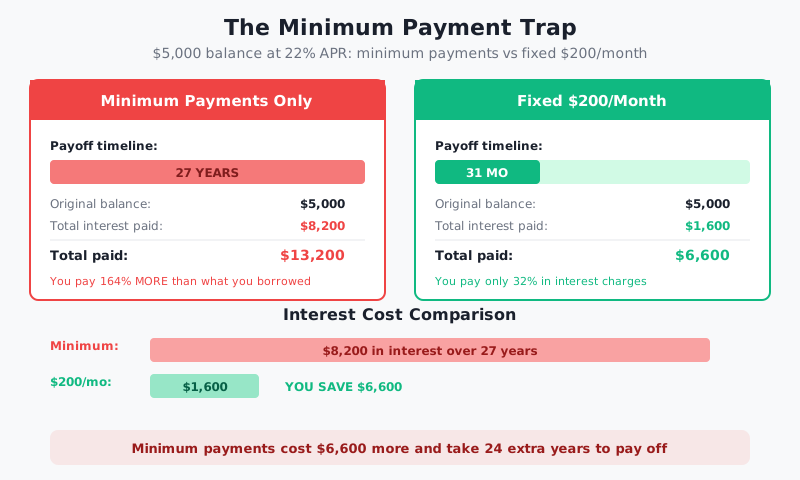
The minimum payment trap is the credit card industry's most profitable feature. On a $6,000 balance at 22% APR, minimum-only payments ($120/month) take over 8 years and cost $5,578 in interest — nearly doubling your original balance. Always pay more than the minimum, even if it's just $25-50 extra.
Mistake 2: Not Having a Target Date
Without a specific payoff date, credit card debt becomes permanent. Set a concrete goal: "I will pay off $8,500 by December 2027." Then divide the total by months remaining to find your required monthly payment. Our Credit Card Calculator makes this calculation instant.
Mistake 3: Continuing to Use Cards During Payoff
Every new charge resets your progress. If you put $200 on a card while paying $300/month, only $100 goes toward reducing the existing balance. Commit to cash or debit during your payoff journey.
Mistake 4: Ignoring Annual Fees on Zero-Balance Cards
After paying off a card, check if it has an annual fee. If so, either downgrade to a no-fee version or ensure the rewards justify the cost. A $95 annual fee on a card you don't use is just throwing money away.
Credit Card Payoff and Your Credit Score
Paying off credit card debt is one of the most effective ways to improve your credit score. Your credit utilization ratio — total balances divided by total credit limits — accounts for 30% of your FICO score.
| Credit Utilization | Score Impact | Example ($10K total limit) |
|---|---|---|
| 0-9% | Excellent | $0-900 balance |
| 10-29% | Good | $1,000-2,900 balance |
| 30-49% | Fair | $3,000-4,900 balance |
| 50-74% | Poor | $5,000-7,400 balance |
| 75%+ | Very Poor | $7,500+ balance |
According to the Consumer Financial Protection Bureau, reducing utilization from 75% to under 30% can improve your score by 50-100+ points within one to two billing cycles. Check your estimated score with our Credit Score Calculator.
Frequently Asked Questions
How much of my credit card payment goes to interest?
It depends on your balance and APR. On a $5,000 balance at 22% APR, roughly $92 of each month's charges go to interest. If your minimum payment is $100, only $8 reduces your principal. Paying $300/month means $208 goes to principal, which is why larger payments are dramatically more effective.
Should I pay off the card with the highest balance or highest rate?
Pay off the highest interest rate first (avalanche method) to minimize total interest. The highest balance isn't necessarily the most expensive debt — a $2,000 card at 26% costs more per dollar than a $5,000 card at 16%. However, if you need motivation, start with the smallest balance (snowball method).
Can I negotiate credit card debt with my issuer?
If you're truly struggling, credit card companies may offer hardship programs: temporary 0% APR for 6-12 months, reduced minimums, or waived fees. Call and explain your situation honestly. Some issuers also offer settlement (paying less than owed), but this damages your credit score significantly.
Is it better to pay credit cards weekly or monthly?
Paying weekly or biweekly is better because it reduces your average daily balance, resulting in less interest. If you can afford $500/month, paying $125 weekly saves roughly $100-200 in annual interest on a $8,000 balance at 22% APR.
Should I close credit cards after paying them off?
Generally no. Keep old cards open with zero balances. Closing a card reduces your total credit limit, which increases your utilization ratio and can lower your score. If the card has an annual fee you don't want to pay, downgrade to a no-fee version instead of closing.
How do cash advances differ from purchases?
Cash advances typically carry a higher APR (often 25-29%), have no grace period (interest starts immediately), and incur a fee (3-5% of the amount). Never use credit card cash advances for debt payoff or regular expenses.
Related Articles
- Debt Payoff Complete Guide — Comprehensive strategies for all types of debt repayment
- Debt Consolidation Guide — How to combine multiple debts into one payment
- Credit Score FAQ — How credit card debt affects your score and how to rebuild
Related Calculators
- Credit Card Calculator — Calculate your credit card payoff timeline and interest
- Debt Payoff Calculator — Model your complete debt-free date
- Debt Consolidation Calculator — Compare consolidation savings
- Personal Loan Calculator — Calculate consolidation loan payments
- Credit Score Calculator — Estimate how payoff affects your score
This article provides general financial information for educational purposes. Credit card terms, rates, and options vary by issuer and individual creditworthiness. Consult a financial advisor for personalized debt management advice.
This article is provided for informational and educational purposes only. Content should not be considered professional financial, medical, legal, or other advice. Always consult a qualified professional before making important decisions. UseCalcPro is not responsible for any actions taken based on the information in this article.
Try These Calculators
Enter your balance, APR, and monthly payment to see how long it takes to pay off your credit card and how much total interest you will pay over its life.
Calculate how long it will take to pay off your debt. See total interest paid and payoff date based on your balance, interest rate, and monthly payment.
Enter your home value and mortgage balance to see how much HELOC you qualify for. Shows draw period and repayment payments plus total interest over the life.
Calculate student loan payments, total interest, and payoff date. Plan your student loan repayment with grace period and different repayment terms. Compare.
See how much interest you save by switching to bi-weekly mortgage payments. Compare payoff timelines and total interest between monthly and bi-weekly plans.