Personal Loan Comparison: Rates, Terms, and Lender Types Explained
A personal loan is a fixed-rate, fixed-term unsecured loan that you repay in equal monthly installments, typically ranging from $1,000 to $100,000 with terms of 2-7 years. Rates vary widely — from 7% for excellent credit to 36% for poor credit — so comparing lenders is essential. Use our Personal Loan Calculator to calculate exact payments for any rate and term combination.
Consider a representative case: refinancing $18,000 in credit card debt into a personal loan. The rate difference between a first offer (16.5% from a bank) and the best offer (9.9% from an online lender) saved $3,400 in interest over 4 years. A 30-minute comparison literally paid $3,400 — yet most people accept the first offer they get.
Personal Loan Rates by Credit Score
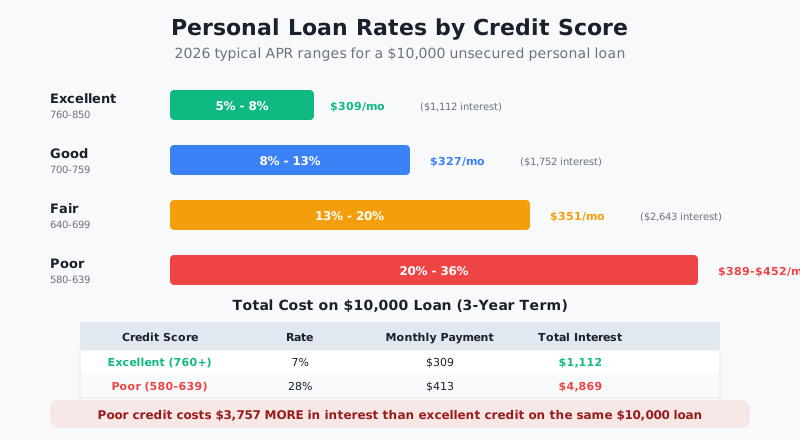
Your credit score is the single biggest factor determining your personal loan rate. Here's what to expect in 2026:
| Credit Score | Rating | Typical APR Range | $10,000 Loan (3yr) Payment | Total Interest |
|---|---|---|---|---|
| 760-850 | Excellent | 7.0-10.9% | $309-$327 | $1,112-$1,752 |
| 700-759 | Good | 11.0-15.9% | $327-$346 | $1,752-$2,470 |
| 640-699 | Fair | 16.0-23.9% | $351-$389 | $2,643-$3,983 |
| 580-639 | Poor | 24.0-32.0% | $389-$434 | $3,983-$5,640 |
| Below 580 | Very Poor | 32.0-36.0%+ | $434-$452 | $5,640-$6,267 |
Important
Compare APR, not just interest rate. APR includes origination fees and other costs. A loan at 10% interest with a 5% origination fee has an effective APR higher than 10%. The Federal Reserve requires lenders to disclose APR so you can make accurate comparisons.
Types of Personal Loan Lenders Compared
Banks
Traditional banks (Chase, Bank of America, Wells Fargo, Citibank) offer personal loans with the backing of established institutions.
| Pros | Cons |
|---|---|
| Existing relationship may help | Higher rates than online lenders |
| In-person support | Stricter credit requirements (680+) |
| Established reputation | Slower approval (3-7 days) |
| May offer rate discounts for autopay | Limited loan amounts |
Credit Unions
Credit unions are member-owned non-profits that often offer the best rates, especially for borrowers with fair credit.
| Pros | Cons |
|---|---|
| Lowest rates (often 2-3% below banks) | Must be a member |
| More flexible credit requirements | Smaller loan amounts |
| Personal service | Fewer online tools |
| May accept lower scores (580+) | Slower processing |
Tip
Anyone can join a credit union. Many credit unions have open membership through community charters or employer groups. Check the National Credit Union Administration to find one you can join. Their personal loan rates are consistently 2-5% lower than bank rates.
Online Lenders
Online lenders (SoFi, LightStream, Upgrade, Prosper, LendingClub, Upstart) have streamlined the personal loan process.
| Pros | Cons |
|---|---|
| Fast approval (same day) | No in-person support |
| Competitive rates | Some charge origination fees |
| Soft credit check for prequalification | Newer companies (less track record) |
| Wide range of amounts and terms | Rates can be high for poor credit |
Peer-to-Peer (P2P) Platforms
P2P platforms connect borrowers with individual investors who fund loans.
| Pros | Cons |
|---|---|
| May approve lower credit scores | Higher rates for risky borrowers |
| Alternative underwriting models | Origination fees (1-8%) |
| Fixed rates and terms | Smaller max loan amounts |
Key Factors to Compare
When shopping for personal loans, compare these seven factors across every lender:
| Factor | What to Look For | Red Flag |
|---|---|---|
| APR | Lowest available for your credit | APR much higher than rate |
| Origination fee | 0-1% ideal, up to 8% exists | Fee over 5% |
| Loan term | Match to your payoff goal | Only offering 7-year terms |
| Monthly payment | Fits your budget | Must borrow more to cover fees |
| Prepayment penalty | Should be $0 | Any penalty for early payoff |
| Funding speed | 1-5 business days typical | More than 2 weeks |
| Customer service | Phone support, online tools | No human contact option |
Origination Fees: The Hidden Cost
Some lenders charge an origination fee of 1-8% that's deducted from your loan proceeds. This means you receive less than you borrow.
Example: $15,000 loan with 5% origination fee
- You receive: $14,250 (after $750 fee)
- You repay: $15,000 + interest
- To actually get $15,000 in hand, you'd need to borrow $15,789
| Origination Fee | $10,000 Loan | $15,000 Loan | $25,000 Loan |
|---|---|---|---|
| 0% | Receive $10,000 | Receive $15,000 | Receive $25,000 |
| 1% | Receive $9,900 | Receive $14,850 | Receive $24,750 |
| 3% | Receive $9,700 | Receive $14,550 | Receive $24,250 |
| 5% | Receive $9,500 | Receive $14,250 | Receive $23,750 |
| 8% | Receive $9,200 | Receive $13,800 | Receive $23,000 |
Warning
A low rate with a high fee can cost more than a slightly higher rate with no fee. A $15,000 loan at 9% with a 6% origination fee costs more over 3 years than the same loan at 10.5% with no fee. Always compare total cost (all payments + fees), not just the interest rate.
Personal Loans for Debt Consolidation
The most popular use of personal loans is consolidating credit card debt. According to the Consumer Financial Protection Bureau (CFPB), debt consolidation can simplify payments and reduce interest costs when done correctly.
Consolidation Comparison: Credit Cards vs. Personal Loan
Scenario: $20,000 in credit card debt at 22% average APR
| Metric | Credit Cards (min payments) | Personal Loan (11%, 4yr) | Personal Loan (11%, 3yr) |
|---|---|---|---|
| Monthly payment | $400 | $517 | $654 |
| Payoff time | 9+ years | 4 years | 3 years |
| Total interest | $17,800+ | $4,847 | $3,560 |
| Total paid | $37,800+ | $24,847 | $23,560 |
| Interest saved | — | $12,953 | $14,240 |
Use our Debt Consolidation Calculator to run your specific numbers. For step-by-step consolidation instructions, see our Debt Consolidation Guide.
How Much Can You Realistically Borrow?
Lenders use your debt-to-income (DTI) ratio — total monthly debt payments divided by gross monthly income — to determine how much you can borrow.
| DTI Ratio | Approval Odds | Notes |
|---|---|---|
| Under 20% | Excellent | Best rates and terms |
| 20-35% | Good | Most lenders approve |
| 36-43% | Fair | Some lenders, higher rates |
| 44-50% | Poor | Few lenders, high rates |
| Over 50% | Very unlikely | Most lenders decline |
Use our Debt Payoff Calculator to see how current payments affect your DTI.
Secured vs. Unsecured Personal Loans
| Feature | Unsecured | Secured |
|---|---|---|
| Collateral | None required | Car, savings, CD, or other asset |
| Rates | 7-36% | 3-18% |
| Credit needed | 580+ (higher is better) | Can be lower (550+) |
| Approval odds | Depends on credit | Higher (lender has collateral) |
| Risk | Credit damage if default | Lose collateral + credit damage |
| Best for | Good credit, no assets to risk | Lower credit, need lower rate |
| Common types | Most personal loans | Share-secured, auto-secured |
Tip
Share-secured loans from credit unions are an underused option. You deposit money (say $5,000) into a savings account as collateral, then borrow against it at 2-5% interest. You keep earning interest on the savings while the loan builds your credit. It's one of the cheapest ways to borrow.
How to Apply: Step-by-Step
Step 1: Check Your Credit
Know your credit score before applying. Use our Credit Score Calculator for an estimate, and pull your free annual report from AnnualCreditReport.com.
Step 2: Prequalify with Multiple Lenders
Most online lenders offer prequalification with a soft credit pull (no score impact). Apply with 3-5 lenders to compare rates.
Step 3: Compare Offers Side-by-Side
| Criteria | Lender A | Lender B | Lender C |
|---|---|---|---|
| APR | 11.5% | 9.9% | 13.2% |
| Origination fee | 3% ($450) | 0% | 5% ($750) |
| Term | 4 years | 3 years | 5 years |
| Monthly payment | $398 | $484 | $341 |
| Total interest | $3,614 | $2,441 | $5,460 |
| Total cost (interest + fees) | $4,064 | $2,441 | $6,210 |
In this example, Lender B saves $1,623 vs. Lender A and $3,769 vs. Lender C — despite having the highest monthly payment.
Step 4: Accept the Best Offer and Fund
Once you choose a lender:
- Complete the full application
- Submit income verification (pay stubs, tax returns)
- Sign the loan agreement
- Receive funds (1-5 business days)
- Pay off existing debts immediately
Step 5: Set Up Autopay
Most lenders offer a 0.25-0.50% rate discount for autopay enrollment. On a $15,000 loan, that's $37-75 in annual savings.
When a Personal Loan Is NOT the Right Choice
| Situation | Better Alternative |
|---|---|
| Debt under $3,000 | Avalanche/snowball payoff method |
| Can pay off in 6-12 months | Balance transfer credit card (0% intro) |
| Very poor credit (below 580) | Non-profit debt management plan |
| Unstable income | Income-driven plan (student loans) or DMP |
| Spending habits unchanged | Credit counseling first |
| Debt exceeds 50% of income | Consult bankruptcy attorney |
For credit card-specific payoff strategies that don't require a new loan, see our Credit Card Payoff Guide.
Worked Example: Finding the Best Loan
James, 32, wants to consolidate $12,000 in credit card debt (23% avg APR). Credit score: 720.
He prequalifies with 4 lenders:
| Lender | Type | APR | Fee | Term | Monthly | Total Interest | Total Cost |
|---|---|---|---|---|---|---|---|
| His bank | Bank | 14.5% | 0% | 3 yr | $413 | $2,859 | $14,859 |
| Local CU | Credit union | 9.2% | 0% | 3 yr | $383 | $1,772 | $13,772 |
| Online A | Online | 10.8% | 2% | 3 yr | $392 | $2,126 | $14,366 |
| Online B | Online | 8.9% | 4% | 4 yr | $298 | $2,297 | $14,777 |
Best choice: Local credit union — lowest total cost ($13,772), no fees, and the 3-year term means faster debt freedom.
Frequently Asked Questions
How quickly can I get a personal loan?
Online lenders are fastest: approval in minutes to hours, funding in 1-3 business days. Banks take 3-7 days for approval and 2-5 days for funding. Credit unions vary but typically 2-7 days total. Some lenders like LightStream offer same-day funding for excellent credit.
Does applying for a personal loan hurt my credit?
Prequalification uses a soft credit pull (no impact). The formal application uses a hard pull, which may lower your score by 5-10 points temporarily. Multiple applications within 14-45 days (depending on scoring model) typically count as a single inquiry for rate shopping.
Can I pay off a personal loan early?
Most personal loans have no prepayment penalty, meaning you can pay extra or pay off early without fees. Always confirm "no prepayment penalty" in your loan terms. Early payoff saves significant interest — paying off a 3-year loan in 2 years can save 30-40% of total interest.
What happens if I miss a personal loan payment?
Most lenders charge a late fee ($25-50) after a grace period (usually 10-15 days). After 30 days late, it's reported to credit bureaus and your score drops significantly. After 90+ days, the loan may go to collections. Set up autopay to prevent this.
Can I get a personal loan with a co-signer?
Yes, and a co-signer with strong credit can significantly improve your rate. According to Experian, co-signed loans may see rate reductions of 3-8 percentage points. However, the co-signer is equally responsible for the debt if you can't pay.
How do personal loans compare to credit cards for large purchases?
Personal loans are better for planned large expenses because they have fixed rates (typically 7-20%), fixed terms, and guaranteed payoff dates. Credit cards charge higher rates (20%+), have variable minimums, and no guaranteed payoff. Use a personal loan for any purchase over $3,000 that you can't pay off within 2-3 months.
Related Articles
- Debt Payoff Complete Guide — Comprehensive strategies for eliminating all types of debt
- Debt Consolidation Guide — When and how to combine debts effectively
- Credit Card Payoff Guide — Strategies to tackle credit card debt specifically
Related Calculators
- Personal Loan Calculator — Calculate monthly payments and total cost
- Debt Consolidation Calculator — Compare current debts vs. consolidation
- Debt Payoff Calculator — Model your complete debt-free timeline
- Credit Card Calculator — Calculate credit card payoff costs
- Credit Score Calculator — Estimate your score before applying
This comparison guide provides general financial information for educational purposes. Personal loan rates, terms, and availability vary by lender and individual creditworthiness. Always read loan agreements carefully before signing.
This article is provided for informational and educational purposes only. Content should not be considered professional financial, medical, legal, or other advice. Always consult a qualified professional before making important decisions. UseCalcPro is not responsible for any actions taken based on the information in this article.
Try These Calculators
Enter your loan amount, interest rate, and term to see monthly payments and total interest for a personal loan. Includes amortization schedule breakdown.
Estimate 2026 personal loan monthly payments by credit tier, term, and amount. 740+ scores get 6.5-12% APR; subprime pays 28-36% APR. Quote $1K-$100K fast.
Calculate your savings from consolidating multiple debts into one loan. Compare current payments vs consolidated loan payments and total interest savings.
Enter your home value and mortgage balance to see how much HELOC you qualify for. Shows draw period and repayment payments plus total interest over the life.
Calculate student loan payments, total interest, and payoff date. Plan your student loan repayment with grace period and different repayment terms. Compare.