401(k) Contribution Guide: How Much Should You Contribute in 2025?
The biggest financial mistake of my 20s? Contributing only 3% to my 401(k) — just enough to "get the match." I left years of additional tax savings and compound growth on the table because I wanted more money for, honestly, stuff I can't even remember buying.
When I finally ran the numbers at 30, I realized that 3% versus 15% contribution meant the difference between retiring at 65 or working until 72. I've been maxing out ever since.
You should contribute at least enough to your 401(k) to get your full employer match—typically 3-6% of your salary. Ideally, aim for 10-15% of your income, including the match. If you can max out at $23,500 (or $31,000 if 50+), you'll supercharge your retirement savings. Use our 401(k) Calculator to see how different contribution levels affect your retirement balance.
Understanding 401(k) Basics
A 401(k) is an employer-sponsored retirement savings plan that offers significant tax advantages. Named after section 401(k) of the Internal Revenue Code, it's the primary retirement vehicle for millions of Americans.
How a 401(k) Works
- You contribute pre-tax dollars (Traditional) or after-tax dollars (Roth)
- Money grows tax-deferred or tax-free
- Employer may match a portion of your contributions
- You pay taxes on withdrawals in retirement (Traditional) or nothing (Roth)
Tip
Traditional 401(k) contributions reduce your taxable income today. Contributing $10,000 in the 22% bracket saves you $2,200 in taxes this year.
2025 401(k) Contribution Limits
The IRS sets annual limits on 401(k) contributions:
| Age Group | Employee Contribution | Catch-up Contribution | Total Possible |
|---|---|---|---|
| Under 50 | $23,500 | N/A | $23,500 |
| 50 and older | $23,500 | $7,500 | $31,000 |
Total contribution limit (including employer contributions): $70,000 for 2025
Important
These limits apply to all your 401(k) accounts combined. If you have multiple jobs with 401(k) plans, your total employee contributions can't exceed the annual limit.
How Much Should YOU Contribute?
The Minimum: Get Your Full Match
At the very least, contribute enough to capture your full employer match. This is essentially free money with an instant 50-100% return.
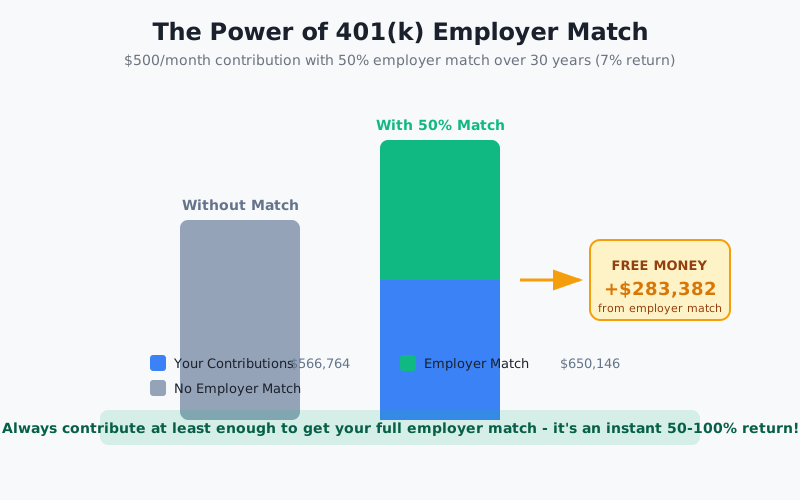
Common matching formulas:
- 50% match up to 6% of salary = 3% free money
- 100% match up to 3% of salary = 3% free money
- 100% match up to 4% of salary = 4% free money
Example:
- Salary: $75,000
- Employer matches 50% up to 6%
- You contribute 6% = $4,500
- Employer adds 3% = $2,250
- Total: $6,750 (you only "paid" $4,500)
Warning
According to Vanguard research, about 25% of employees don't contribute enough to get their full match, leaving billions of dollars on the table annually.
The Ideal: 10-15% of Income
Financial experts, including those at Fidelity, recommend saving 15% of your pre-tax income for retirement, including employer match.
| Your Contribution | Employer Match | Total | Assessment |
|---|---|---|---|
| 3% | 3% | 6% | Below target |
| 6% | 3% | 9% | Getting close |
| 10% | 3% | 13% | Good |
| 12% | 3% | 15% | Ideal |
The Aggressive: Max It Out
If you can afford to max out your 401(k), you'll significantly accelerate your retirement timeline:
Example: $23,500/year for 30 years at 7% return = $2.36 million
Use our Compound Interest Calculator to model different scenarios.
Traditional vs. Roth 401(k)
Many employers now offer both options:
| Feature | Traditional 401(k) | Roth 401(k) |
|---|---|---|
| Contributions | Pre-tax | After-tax |
| Tax benefit | Reduce taxes now | Tax-free withdrawals |
| Withdrawals | Taxed as income | Tax-free |
| Best if | Higher tax bracket now | Lower tax bracket now |
When to Choose Traditional
- You're in a high tax bracket now
- You expect lower income in retirement
- You want to reduce current taxable income
- Your state has high income taxes and you'll retire elsewhere
When to Choose Roth
- You're early in your career with lower income
- You expect higher income/tax rates in retirement
- You want tax diversification
- You're approaching retirement with substantial traditional 401(k) balance
Tip
Consider splitting contributions between Traditional and Roth for tax diversification. This gives you flexibility in retirement to manage your tax bracket.
Strategies to Maximize Your 401(k)
1. Start Early and Contribute Consistently
Thanks to compound interest, starting early is the biggest factor in building wealth:
| Age Started | Monthly Contribution | Value at 65 (7% return) |
|---|---|---|
| 25 | $500 | $1,199,052 |
| 30 | $500 | $829,421 |
| 35 | $500 | $566,764 |
| 40 | $500 | $381,505 |
2. Increase Contributions Annually
Use the "escalator" approach:
- Start with at least enough for the full match
- Increase by 1-2% each year
- Boost contributions when you get raises
Most 401(k) plans let you set up automatic annual increases.
3. Don't Leave Money on the Table
Contribute at least the amount needed for your full employer match before doing anything else with your money—including paying off low-interest debt.
4. Use Catch-Up Contributions After 50
Once you turn 50, you can contribute an extra $7,500 per year. This is crucial for late starters or those wanting to accelerate retirement savings.
Impact of catch-up contributions (15 years, 7% return):
- Without catch-up: $741,697
- With catch-up: $979,000
- Extra retirement income: ~$237,000
5. Roll Over Old 401(k)s
When you leave a job, don't cash out your 401(k). Instead:
- Roll into your new employer's 401(k), or
- Roll into a Traditional IRA for more investment options
Cashing out triggers income taxes plus a 10% penalty if you're under 59½.
Common 401(k) Mistakes to Avoid
1. Not Contributing Enough for the Match
This is the number one mistake. You're literally leaving free money on the table.
2. Cashing Out When Changing Jobs
A $50,000 401(k) cashed out at age 30 could be worth over $400,000 at retirement. The 10% penalty and taxes are just the beginning of what you lose.
3. Taking a 401(k) Loan
While sometimes necessary, 401(k) loans:
- Remove money from compound growth
- Must be repaid quickly if you leave your job
- Can trigger taxes and penalties if not repaid
4. Investing Too Conservatively
Young investors should be aggressive. Being too conservative costs you growth potential when you have decades to recover from market downturns.
5. Not Rebalancing
Your asset allocation drifts over time. Rebalance annually to maintain your target mix. Learn more in our investment basics guide.
Warning
Don't check your 401(k) balance daily. Market fluctuations are normal, and short-term losses are meaningless if you have decades until retirement.
401(k) Vesting Schedules
Employer matches often come with a vesting schedule—you must work a certain number of years to "own" the full match:
| Type | How It Works |
|---|---|
| Immediate | You own 100% of match immediately |
| Cliff | 0% until year 3, then 100% |
| Graded | 20% per year over 5 years |
Example of graded vesting:
| Years of Service | Vested % | On $10,000 Match |
|---|---|---|
| 1 | 20% | $2,000 |
| 2 | 40% | $4,000 |
| 3 | 60% | $6,000 |
| 4 | 80% | $8,000 |
| 5+ | 100% | $10,000 |
Tip
If you're considering leaving your job and are close to a vesting milestone, it might be worth waiting to capture more of your employer match.
401(k) Investment Options
Most 401(k) plans offer several investment options:
Target Date Funds
- Automatically adjust allocation as you approach retirement
- Great for hands-off investors
- Choose the fund closest to your expected retirement year
Index Funds
- Low fees (often 0.03-0.20%)
- Track market performance
- Best for cost-conscious investors
Actively Managed Funds
- Higher fees (often 0.50-1.50%)
- Attempt to beat the market
- Research shows most underperform index funds over time
Important
Pay attention to expense ratios. A 1% higher fee on a $500,000 portfolio costs you $5,000 per year—money that could be compounding for your retirement.
How Your 401(k) Fits Into Your Retirement Plan
Your 401(k) is one piece of your overall retirement plan. Consider your full strategy:
- 401(k) - Maximize employer match, aim for 10-15% total
- IRA - Traditional or Roth for additional tax-advantaged savings
- HSA - If eligible, triple tax advantage
- Taxable Brokerage - For goals beyond tax-advantaged limits
Use our Retirement Calculator to see how all your savings work together.
Frequently Asked Questions
How much of my paycheck should go to 401(k)?
Aim for at least enough to get your full employer match (typically 3-6% of your salary). Ideally, contribute 10-15% of your income including the match. If you can max out at $23,500 (or $31,000 if 50+), that's even better. Use our 401(k) Calculator to see how different percentages affect your retirement savings.
Should I max out my 401(k)?
If you can afford to max out your 401(k) ($23,500 in 2025), it's an excellent choice. However, priorities should be:
- Get your full employer match first
- Pay off high-interest debt (above 7-8%)
- Build an emergency fund
- Then work toward maxing out
If you're over 50, consider the additional $7,500 catch-up contribution.
What happens if I contribute too much to my 401(k)?
If you exceed the annual limit, you have until April 15 of the following year to withdraw the excess. Otherwise, you'll be taxed twice on the excess—once when contributed and again when withdrawn. Your plan administrator should help prevent over-contribution, but it's your responsibility to track if you have multiple 401(k)s.
Can I have a 401(k) and an IRA?
Yes! You can contribute to both a 401(k) and an IRA. However, your ability to deduct traditional IRA contributions phases out at higher incomes if you have a workplace retirement plan. Roth IRA eligibility also phases out at higher incomes. Having both accounts provides tax diversification for retirement.
Should I prioritize 401(k) or paying off debt?
It depends on the interest rate:
- Always get your full employer match first (instant 50-100% return)
- Pay off high-interest debt (credit cards, personal loans above 8%)
- Then maximize retirement contributions
- Low-interest debt (mortgages around 4-5%) can wait while you invest
When can I withdraw from my 401(k)?
You can withdraw without penalty at age 59½. Before that, withdrawals are subject to a 10% early withdrawal penalty plus income taxes. Exceptions include:
- Age 55+ and leaving your job
- Disability
- Substantially equal periodic payments
- Certain hardships (with penalties)
Starting at age 73, you must take Required Minimum Distributions (RMDs).
Related Articles
- Retirement Planning Complete Guide — Build your complete retirement strategy
- The Power of Compound Interest — See how early contributions multiply over time
- Investment Basics for Beginners — Understand your 401(k) investment options
- When Can You Retire? — Calculate your optimal retirement age
Related Calculators
- 401(k) Calculator — Project your 401(k) balance at retirement
- Retirement Calculator — Calculate your total retirement needs
- Compound Interest Calculator — See how contributions grow over time
- Investment Calculator — Compare investment scenarios
This article provides general financial information for educational purposes. Consider consulting with a qualified financial advisor for personalized 401(k) and retirement planning advice.
This article is provided for informational and educational purposes only. Content should not be considered professional financial, medical, legal, or other advice. Always consult a qualified professional before making important decisions. UseCalcPro is not responsible for any actions taken based on the information in this article.
Try These Calculators
Enter your salary, contribution rate, and employer match to project your 401(k) balance at retirement. Shows growth breakdown by contributions vs returns.
Enter your age, savings, and monthly contributions to see if you are on track for retirement. Includes 4% rule projections and Social Security estimates.
Set a savings goal, enter your monthly deposit and interest rate, and see exactly how long it takes to reach your target with a month-by-month breakdown.
Enter your monthly expenses and savings rate to find your emergency fund target. Shows how many months you can cover now and how long to reach 3-6 months.
Enter your salary, state, filing status, and 401(k) contributions to see net pay after federal, state, Social Security, and Medicare taxes are withheld.