When Can You Retire? How to Find Your Optimal Retirement Age
Someone who retires at 62 may spend 25 years in retirement — traveling, taking up woodworking, or simply enjoying grandkids. Someone else may work until 71, not by choice but by necessity.
Income alone doesn't explain the difference. Planning does: knowing your number (the exact amount you need to retire) by age 40 and working backward beats hoping things will "work out."
You can retire when your savings, investments, and guaranteed income sources can sustain your lifestyle indefinitely—typically when your assets reach 25-30 times your annual expenses. For most Americans, this falls between ages 60-70, but with aggressive saving, early retirement in your 40s or 50s is possible. Use our Retirement Calculator to find your specific retirement age.
Understanding Retirement Age Milestones
Several ages matter for retirement planning:
Age 50: Catch-Up Contributions Begin
At 50, you can make extra contributions to retirement accounts:
- 401(k) catch-up: +$7,500/year (total $31,000 for 2025)
- IRA catch-up: +$1,000/year (total $8,000 for 2025)
See our 401(k) contribution guide for maximizing these limits.
Age 55: Rule of 55
If you leave your job at 55 or later, you can withdraw from that employer's 401(k) without the 10% early withdrawal penalty (taxes still apply).
Age 59½: Penalty-Free Retirement Account Access
Withdraw from 401(k)s and IRAs without the 10% penalty. Traditional account withdrawals are still taxed as income.
Age 62: Early Social Security
You can claim Social Security, but benefits are permanently reduced:
- Claiming at 62: 70% of full benefit
- Claiming at 65: 86.7% of full benefit
- Claiming at 67: 100% of full benefit (for those born 1960+)
Age 65: Medicare Eligibility
Health insurance through Medicare begins. Before 65, you need private insurance or employer coverage.
Age 67: Full Retirement Age (FRA)
For those born 1960 or later, this is when you receive 100% of Social Security benefits.
| Birth Year | Full Retirement Age |
|---|---|
| 1943-1954 | 66 |
| 1955 | 66 and 2 months |
| 1956 | 66 and 4 months |
| 1957 | 66 and 6 months |
| 1958 | 66 and 8 months |
| 1959 | 66 and 10 months |
| 1960+ | 67 |
Age 70: Maximum Social Security Benefit
Benefits increase 8% per year for each year you delay past FRA. At 70, you receive 124% of your full benefit. No reason to delay past 70—benefits stop increasing.
Tip
If you're healthy and have other income sources, delaying Social Security to 70 can provide significantly more lifetime income. The 8% annual increase is essentially a guaranteed return.
How to Calculate Your Retirement Age
Step 1: Determine Your Retirement Number
Use the 25x Rule: Multiply your expected annual retirement expenses by 25.
Example:
- Expected annual expenses: $60,000
- Retirement number: $60,000 × 25 = $1,500,000
This assumes the 4% withdrawal rule—withdrawing 4% annually with high probability of not running out of money over 30 years.
For a more conservative approach (longer retirement or uncertain returns), use 30x or 33x.
Step 2: Calculate Your Current Trajectory
Use our Retirement Calculator to project when you'll hit your number:
Inputs:
- Current savings: $250,000
- Monthly contribution: $1,500
- Expected return: 7%
- Target: $1,500,000
Result: You'll reach your target in approximately 17 years.
Step 3: Factor in Social Security
Estimate your Social Security benefit at SSA.gov.
If Social Security provides $24,000/year, your savings only need to cover the remaining $36,000:
- New target: $36,000 × 25 = $900,000
This could mean retiring years earlier.
Step 4: Account for Healthcare
Before Medicare at 65, you need private health insurance:
- ACA marketplace: $500-$1,500/month for couple
- COBRA: Up to 18 months after leaving job
- Health sharing plans: $200-$500/month
Budget at least $12,000-$18,000/year for pre-Medicare healthcare.
Factors That Affect Your Retirement Age
Your Savings Rate
The single biggest factor. A higher savings rate means faster retirement:
| Savings Rate | Years to Retirement* |
|---|---|
| 10% | 51 years |
| 20% | 37 years |
| 30% | 28 years |
| 40% | 22 years |
| 50% | 17 years |
| 60% | 12.5 years |
| 70% | 8.5 years |
*Assuming starting from zero, 5% real returns, and 4% withdrawal rate
Important
Increasing your savings rate has a double effect: you save more AND learn to live on less (reducing your retirement target).
Your Expenses
Lower expenses = lower retirement target = earlier retirement.
| Annual Expenses | 25x Target | Impact |
|---|---|---|
| $80,000 | $2,000,000 | Baseline |
| $60,000 | $1,500,000 | Retire 5-7 years earlier |
| $40,000 | $1,000,000 | Retire 10-15 years earlier |
Investment Returns
Returns vary, but planning for 6-7% (after inflation) is reasonable for a stock-heavy portfolio:
$500/month for 30 years:
- At 5%: $416,000
- At 7%: $567,000
- At 9%: $789,000
Learn more about investing in our investment basics guide.
When You Start Saving
Thanks to compound interest, starting early dramatically affects retirement age:
| Starting Age | Monthly Savings | Retirement Age (hitting $1M) |
|---|---|---|
| 25 | $500 | 57 |
| 30 | $500 | 61 |
| 35 | $500 | 65 |
| 40 | $500 | 70 |
Same monthly contribution, but starting at 25 means retiring 13 years earlier than starting at 40.
Pension or Other Income
If you have guaranteed income (pension, rental properties, annuities), it reduces the savings you need:
Example:
- Annual expenses: $60,000
- Pension: $20,000/year
- Social Security: $20,000/year
- Gap to fund: $20,000/year
- Savings needed: $20,000 × 25 = $500,000
Early Retirement (Before 59½)
The FIRE Movement
FIRE (Financial Independence, Retire Early) followers achieve retirement in their 30s-50s through:
- Aggressive saving (50-70% of income)
- Frugal living (reducing expenses dramatically)
- Smart investing (low-cost index funds)
- Multiple income streams (dividends, rental income)
Types of FIRE:
- LeanFIRE: Minimal expenses ($30,000-$40,000/year)
- Regular FIRE: Moderate lifestyle ($50,000-$75,000/year)
- FatFIRE: Comfortable lifestyle ($100,000+/year)
Accessing Money Before 59½
You can retire early, but need strategies to access funds:
1. Roth IRA Contributions You can always withdraw Roth contributions (not earnings) tax and penalty-free.
2. Rule of 55 Leave your employer at 55+ and access that 401(k) penalty-free.
3. 72(t) SEPP Substantially Equal Periodic Payments let you withdraw from IRAs before 59½ without penalty (but with complex rules).
4. Taxable Brokerage Account No withdrawal restrictions. Pay capital gains tax (lower than income tax) on profits.
5. Roth Conversion Ladder Convert Traditional IRA to Roth each year. After 5 years, withdraw conversions penalty-free.
Warning
Early retirement requires careful planning for healthcare. A medical emergency without insurance could devastate your finances. Budget conservatively for pre-Medicare healthcare costs.
Working Longer: The Powerful Option
If you're behind on savings, working even a few extra years has outsized benefits:
Each Extra Year Provides:
- One more year of saving
- One more year of compound growth
- One fewer year of withdrawals
- Higher Social Security benefits
- Potentially one more year of employer match
Example: Retiring at 67 vs. 65:
| Factor | Retire at 65 | Retire at 67 |
|---|---|---|
| Extra savings (2 years × $20,000) | — | +$40,000 |
| Portfolio growth (7% × 2 years) | — | +$105,000* |
| Years of withdrawals | 25 | 23 |
| Social Security increase | — | ~+$400/month |
*On $750,000 portfolio
Those 2 extra years could mean $200,000+ more lifetime wealth and income.
Part-Time Work in Early Retirement
"Semi-retirement" offers the best of both worlds:
- Work 10-20 hours/week doing something enjoyable
- Earn $10,000-$30,000/year
- Reduce portfolio withdrawals
- Maintain social connections and purpose
- Delay Social Security for higher benefits
Even $15,000/year in part-time income reduces the savings you need by $375,000 (at 4% withdrawal rate).
The Social Security Decision
When to claim is one of the most impactful retirement decisions:
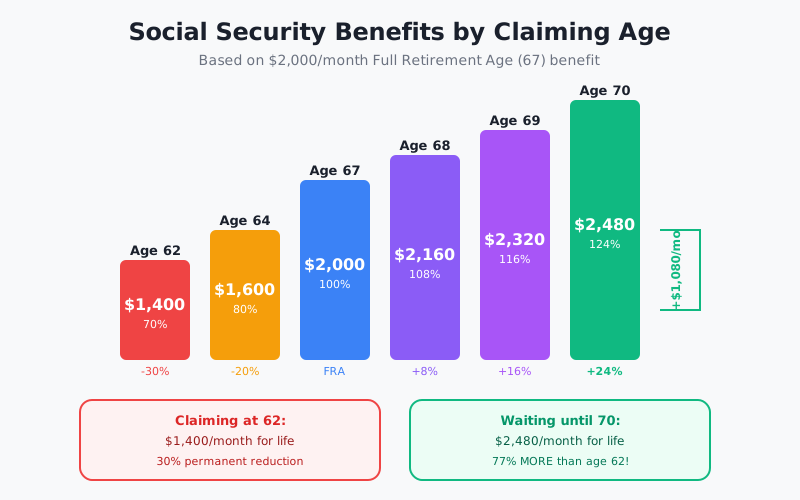
Monthly Benefit by Claiming Age
For someone with a $2,000/month benefit at age 67:
| Claiming Age | Monthly Benefit | % of Full Benefit |
|---|---|---|
| 62 | $1,400 | 70% |
| 63 | $1,500 | 75% |
| 64 | $1,600 | 80% |
| 65 | $1,733 | 86.7% |
| 66 | $1,867 | 93.3% |
| 67 (FRA) | $2,000 | 100% |
| 68 | $2,160 | 108% |
| 69 | $2,320 | 116% |
| 70 | $2,480 | 124% |
When to Claim Early (62-66)
- You need the money to cover expenses
- You're in poor health with lower life expectancy
- You have a spouse who can claim higher benefits later
- You have other income and won't work
When to Delay (67-70)
- You're healthy with longevity in your family
- You have other income sources
- You want maximum lifetime income
- You're still working (benefits may be reduced anyway)
Tip
The "break-even" age for waiting is typically around 80-82. If you live past that, delaying was the right choice. Given average life expectancy of 78 (men) to 82 (women), delaying often makes sense for healthy individuals.
Creating Your Retirement Age Plan
Scenario Planning
Calculate your retirement age under different assumptions:
| Scenario | Savings Rate | Returns | Retirement Age |
|---|---|---|---|
| Conservative | Current | 5% | 68 |
| Baseline | Current | 7% | 64 |
| Optimistic | +10% savings | 7% | 60 |
| Aggressive | +20% savings | 7% | 56 |
Use our Retirement Calculator to run your own scenarios.
Flexibility Is Key
Build in flexibility:
- Multiple income streams
- Lower expense capability
- Skills for part-time work
- Geographic flexibility (lower cost locations)
Regular Reassessment
Review your retirement timeline annually:
- Update projections with actual returns
- Adjust for life changes
- Refine expense estimates
- Check progress toward target
Frequently Asked Questions
What is the average retirement age?
The average retirement age in the US is around 64 for men and 62 for women, according to the Census Bureau. However, "average" includes both those who retire by choice and those forced out by health or job loss. The optimal retirement age depends entirely on your individual financial situation.
How do I know if I have enough to retire?
You likely have enough when your retirement savings equal 25 times your annual expenses (the 4% rule). For example, $1.5 million supports $60,000/year in expenses. Add Social Security and other guaranteed income to reduce the savings needed. Use our Retirement Calculator to check if your current savings and trajectory will support retirement.
Can I retire at 55?
Yes, if you have sufficient savings and a plan for healthcare until Medicare at 65. You can access 401(k) funds penalty-free if you leave that employer at 55+ (Rule of 55). You'll need roughly $1-2 million in savings for a comfortable early retirement, depending on lifestyle and location.
What happens to my 401(k) if I retire before 59½?
You'll pay a 10% penalty plus income taxes on withdrawals before 59½. Exceptions include the Rule of 55 (leaving employer at 55+), 72(t) SEPP withdrawals, disability, and certain other circumstances. Consider building taxable investments or Roth contributions for early retirement access. See our 401(k) guide for details.
Should I take Social Security at 62 or wait?
It depends on your health, other income, and life expectancy. Taking at 62 means 30% less monthly income for life, but more total checks. Waiting until 70 provides 76% more than at 62 and often more lifetime income if you live past 80-82. If you're healthy with longevity in your family, waiting typically pays off.
How much does delaying retirement help?
Each additional year of work provides: one more year of savings and investment growth, one fewer year of withdrawals, higher Social Security benefits (8% per year up to 70), and potentially more employer match. Working just 2 extra years can add $100,000-$200,000+ to your lifetime wealth.
Related Articles
- Retirement Planning Complete Guide — Your comprehensive roadmap to retirement
- 401(k) Contribution Guide — Maximize your employer retirement plan
- The Power of Compound Interest — Understand how time grows your wealth
- Investment Basics for Beginners — Start investing for retirement
- Savings Goals Guide — Set and achieve your retirement savings targets
Related Calculators
- Retirement Calculator — Calculate when you can retire
- 401(k) Calculator — Project your 401(k) balance
- Compound Interest Calculator — See how investments grow over time
- Savings Goal Calculator — Track progress toward retirement
- Investment Calculator — Model different investment scenarios
This article provides general financial information for educational purposes. Retirement planning involves many personal factors. Consider consulting with a certified financial planner for personalized advice.
This article is provided for informational and educational purposes only. Content should not be considered professional financial, medical, legal, or other advice. Always consult a qualified professional before making important decisions. UseCalcPro is not responsible for any actions taken based on the information in this article.
Try These Calculators
Enter your age, savings, and monthly contributions to see if you are on track for retirement. Includes 4% rule projections and Social Security estimates.
Calculate your FIRE number and years to financial independence. Plan early retirement with savings rate analysis, investment growth, and safe withdrawal rate.
Enter your salary, contribution rate, and employer match to project your 401(k) balance at retirement. Shows growth breakdown by contributions vs returns.
Enter your net self-employment earnings to see your Social Security and Medicare tax breakdown, deductible half, effective rate, and monthly tax amount.
Estimate 2026 US auto insurance monthly premium by driver age, driving record, vehicle type, credit tier, and ZIP. Full coverage averages $177/mo nationally.