Investment Basics for Beginners: How to Start Investing in 2025
It's common to spend years "learning about investing" before actually investing a dollar -- reading books, listening to podcasts, analyzing stocks — while the market goes up 47% and idle savings earn just 0.5%.
The lesson: you don't need to understand everything to start. You need to start to understand anything.
To start investing, open a brokerage account, deposit money, and buy diversified low-cost index funds—that's genuinely all most beginners need. You don't need to pick individual stocks or understand complex financial instruments. Use our Investment Calculator to see how even small investments grow over time.
Why You Need to Invest
Saving money in a bank account isn't enough. Here's why:
Inflation Erodes Cash
Inflation averages about 3% annually. A dollar today will be worth only $0.55 in 20 years.
| Year | $10,000 Cash (2% savings) | $10,000 Invested (7% return) |
|---|---|---|
| 10 | $12,190 | $19,672 |
| 20 | $14,859 | $38,697 |
| 30 | $18,114 | $76,123 |
After 30 years, the invested money is worth 4x more than the cash in savings.
Warning
Keeping large sums in a savings account may feel "safe," but you're actually losing purchasing power to inflation every year.
The Stock Market Has Always Gone Up (Long-Term)
Despite crashes, recessions, and crises, the S&P 500 has returned about 10% annually since 1926. According to NYU Stern School, there has never been a 20-year period with negative returns.
Types of Investments
Stocks
What they are: Ownership shares in a company.
Risk level: Higher
Potential return: 8-12% annually (historically)
When you buy stock in Apple, you own a tiny piece of the company. If Apple does well, your shares increase in value.
Bonds
What they are: Loans you make to companies or governments.
Risk level: Lower
Potential return: 3-6% annually
Bonds pay regular interest and return your principal at maturity. They're more stable than stocks but offer lower returns.
Mutual Funds
What they are: Pooled money invested in many stocks or bonds.
Risk level: Varies (depends on fund type)
Potential return: 6-10% annually
Professional managers pick investments. Fees tend to be higher (0.50-1.50% annually).
Exchange-Traded Funds (ETFs)
What they are: Similar to mutual funds but trade like stocks.
Risk level: Varies (depends on fund type)
Potential return: 6-10% annually
Often track an index with very low fees (0.03-0.20%). This is often the best choice for beginners.
Index Funds
What they are: Funds that track a market index (like the S&P 500).
Risk level: Moderate
Potential return: 7-10% annually
No active management means ultra-low fees. You get the market's average return, which beats most professional managers.
Tip
Index funds are recommended by Warren Buffett for most investors. He famously bet $1 million that an S&P 500 index fund would beat hedge funds over 10 years—and won.
How to Start Investing: Step by Step
Step 1: Set Your Goals
What are you investing for?
| Goal | Time Horizon | Risk Tolerance |
|---|---|---|
| Retirement | 20-40 years | Higher |
| House down payment | 5-10 years | Moderate |
| Emergency fund | Immediate | Low (don't invest this) |
| Child's education | 10-18 years | Moderate-High |
Your time horizon determines how much risk you can take. Longer timelines allow for more aggressive investing because you can ride out market downturns.
Read our complete retirement planning guide for long-term strategies.
Step 2: Understand Your Risk Tolerance
How would you react if your $10,000 investment dropped to $7,000?
- Aggressive investor: "Great, stocks are on sale. I'll buy more."
- Moderate investor: "Uncomfortable, but I'll hold steady."
- Conservative investor: "I can't sleep. I need to sell."
Be honest with yourself. There's no wrong answer, but your allocation should match your temperament.
Step 3: Choose Your Account Type
For retirement:
- 401(k) through your employer
- Traditional IRA (tax-deductible contributions)
- Roth IRA (tax-free withdrawals)
For other goals:
- Taxable brokerage account (most flexible)
- 529 Plan (for education)
- HSA (for healthcare, with investment option)
Step 4: Open an Account
Popular brokerages for beginners (all offer commission-free trading):
| Broker | Best For | Minimum |
|---|---|---|
| Fidelity | All-around excellent | $0 |
| Vanguard | Index fund investors | $0 |
| Charles Schwab | Full-service | $0 |
| Robinhood | Simple mobile app | $0 |
The process takes about 10 minutes online. You'll need:
- Social Security number
- Bank account for transfers
- Basic personal information
Step 5: Fund Your Account
Start with whatever you can afford. Even $100/month adds up:
$100/month at 7% for 30 years = $121,997
Set up automatic monthly transfers so you never forget to invest.
Step 6: Choose Your Investments
For beginners, simple is better:
Option 1: Target-Date Fund
- One fund that holds everything you need
- Automatically adjusts as you age
- Example: "Target Retirement 2055 Fund"
Option 2: Three-Fund Portfolio
- US Stock Index Fund (e.g., VTSAX)
- International Stock Index Fund (e.g., VTIAX)
- Bond Index Fund (e.g., VBTLX)
Option 3: Single Index Fund
- Total Market Index (VTI/VTSAX)
- S&P 500 Index (VOO/VFIAX)
Tip
Don't overthink this. A simple portfolio of low-cost index funds will outperform most complex strategies over the long term.
Asset Allocation by Age
Your mix of stocks and bonds should evolve with age:
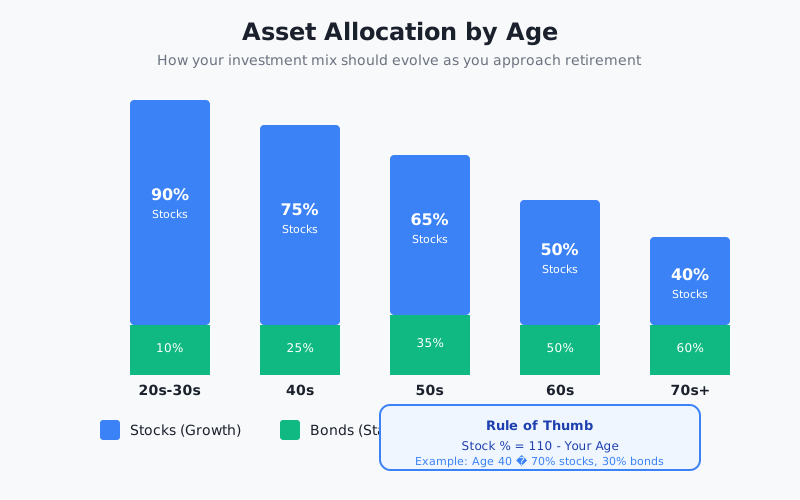
20s-30s: Aggressive
- Stocks: 80-90%
- Bonds: 10-20%
You have decades to recover from downturns. Maximize growth potential.
40s: Growth
- Stocks: 70-80%
- Bonds: 20-30%
Still growth-focused but starting to add stability.
50s: Balanced
- Stocks: 60-70%
- Bonds: 30-40%
Protecting accumulated wealth while still growing.
60s+: Conservative
- Stocks: 40-60%
- Bonds: 40-60%
Prioritize capital preservation and income. But don't go too conservative—you may live 30 more years.
Rule of thumb: Subtract your age from 110 or 120 to get your stock allocation percentage.
Key Investing Principles
1. Start Early
Thanks to compound interest, time is your greatest advantage:
| Starting Age | $500/month at 7% | Value at 65 |
|---|---|---|
| 25 | 40 years | $1,199,052 |
| 35 | 30 years | $566,764 |
| 45 | 20 years | $260,464 |
Starting 10 years earlier more than doubles your wealth.
2. Invest Regularly (Dollar-Cost Averaging)
Investing a fixed amount regularly (monthly) means you:
- Buy more shares when prices are low
- Buy fewer shares when prices are high
- Avoid trying to time the market
This reduces the impact of volatility and removes emotion from investing.
3. Keep Costs Low
Fees compound just like returns, but working against you:
| Annual Fee | $10,000 over 30 years (7% return) |
|---|---|
| 0.03% | $74,017 |
| 0.50% | $66,439 |
| 1.00% | $57,435 |
| 2.00% | $43,219 |
A 1% higher fee costs you $16,582 on a single $10,000 investment.
Important
Always check expense ratios before investing. Index funds typically charge 0.03-0.20%. Avoid funds with fees above 0.50% unless there's a very specific reason.
4. Diversify
Don't put all your eggs in one basket. Spreading investments across:
- Many companies (stocks)
- Different sectors (tech, healthcare, energy)
- Asset classes (stocks, bonds)
- Geographic regions (US, international)
One index fund can hold thousands of companies, providing instant diversification.
5. Don't Try to Time the Market
Even professional investors can't consistently predict market movements. Studies show that missing just the 10 best days in the market dramatically reduces returns:
$10,000 invested in S&P 500 over 20 years:
- Stayed invested: $64,844
- Missed 10 best days: $29,708
- Missed 20 best days: $18,829
Stay invested through ups and downs.
6. Think Long-Term
The stock market will go down—sometimes dramatically. In 2008, it dropped 37%. In 2020, it dropped 34% in a month. Both times, it recovered and reached new highs.
Tip
If seeing your portfolio drop 30% would make you panic and sell, increase your bond allocation. It's better to have lower average returns than to sell at the bottom.
Common Beginner Mistakes
1. Waiting for the "Right Time"
There's never a perfect time to invest. Waiting typically means missing gains. Time in the market beats timing the market.
2. Checking Portfolio Daily
Frequent checking leads to emotional decisions. Set it, forget it, and check quarterly at most.
3. Panic Selling During Crashes
Market downturns are when long-term investors should be buying, not selling. Every major crash has been followed by recovery.
4. Picking Individual Stocks
Without extensive research, stock picking is gambling. Index funds provide better risk-adjusted returns for most investors.
5. Paying High Fees
A 2% annual fee seems small but costs hundreds of thousands over a lifetime. Always prioritize low-cost funds.
6. Not Starting Because You Don't Know Enough
You don't need to be an expert. A simple portfolio of index funds is sufficient for most people's entire investing lives.
How to Calculate Investment Returns
Use the ROI (Return on Investment) formula:
ROI = (Final Value - Initial Investment) / Initial Investment × 100
Example:
- Invested: $10,000
- Current value: $15,000
- ROI = ($15,000 - $10,000) / $10,000 × 100 = 50%
Use our Investment Calculator or ROI Calculator to project future returns.
Frequently Asked Questions
How much money do I need to start investing?
You can start with as little as $1 at most brokerages. Many mutual funds have no minimums for retirement accounts. The important thing is to start—even small amounts compound over time. $100/month for 30 years at 7% grows to nearly $122,000. Use our Investment Calculator to see how your contributions grow.
Is investing risky?
All investing involves some risk, but not investing is also risky due to inflation. Historically, a diversified portfolio of stocks and bonds has always provided positive returns over 20+ year periods. The key is matching your investments to your timeline and risk tolerance.
Should I pay off debt or invest?
Generally:
- Contribute enough to get your full 401(k) match (50-100% instant return)
- Pay off high-interest debt (above 7-8%)
- Build an emergency fund (3-6 months expenses)
- Maximize retirement contributions
- Pay extra on low-interest debt (mortgages, student loans)
What's the difference between ETFs and mutual funds?
ETFs trade like stocks throughout the day, while mutual funds trade once daily. ETFs often have lower minimums and slightly lower fees. For practical purposes, both work well for long-term investing. Index fund ETFs and index mutual funds tracking the same index will have nearly identical performance.
How do I know which stocks to buy?
For most investors, don't try to pick individual stocks. Buy index funds that hold hundreds or thousands of stocks automatically. This provides diversification and historically outperforms most stock-picking strategies. If you want individual stock exposure, limit it to 5-10% of your portfolio.
What's the best investment for beginners?
A target-date retirement fund or a total stock market index fund is ideal for beginners. These provide instant diversification, professional management, and low fees. You can build a complete portfolio with just one or two funds.
Related Articles
- Retirement Planning Complete Guide — Your complete roadmap to financial security
- 401(k) Contribution Guide — Maximize your employer-sponsored retirement plan
- The Power of Compound Interest — Understand how your investments grow
- Savings Goals Guide — Set and achieve your financial objectives
Related Calculators
- Investment Calculator — Project your investment growth
- ROI Calculator — Calculate return on investment
- Compound Interest Calculator — See how money grows over time
- 401(k) Calculator — Plan your 401(k) contributions
- Stock Return Calculator — Analyze stock performance
- Retirement Calculator — Calculate your retirement needs
This article provides general financial information for educational purposes. Investing involves risk, including the potential loss of principal. Consider consulting with a qualified financial advisor before making investment decisions.
This article is provided for informational and educational purposes only. Content should not be considered professional financial, medical, legal, or other advice. Always consult a qualified professional before making important decisions. UseCalcPro is not responsible for any actions taken based on the information in this article.
Try These Calculators
Project investment growth: turn $10,000 into $? over 10, 20, or 30 years. See monthly contributions, compound interest, and inflation-adjusted returns.
Enter your purchase price, sale price, and holding period to calculate capital gains tax. Shows long-term vs short-term rates, NIIT, and net profit after tax.
Calculate stock return with dividends, annualized %, and after-tax profit. Enter buy price, sell price, shares, and holding period for a full breakdown.
Estimate fair market rent from square footage, bedrooms, bathrooms, and location factors. Compare your rental price against market averages competitively.
Estimate 2026 personal umbrella insurance annual cost by coverage, household, assets, and pool/teen risks. $1M averages $300-$400/yr for most US homes.