Brake Pad Mileage Chart 2026: How Long Pads Last by Material & Vehicle
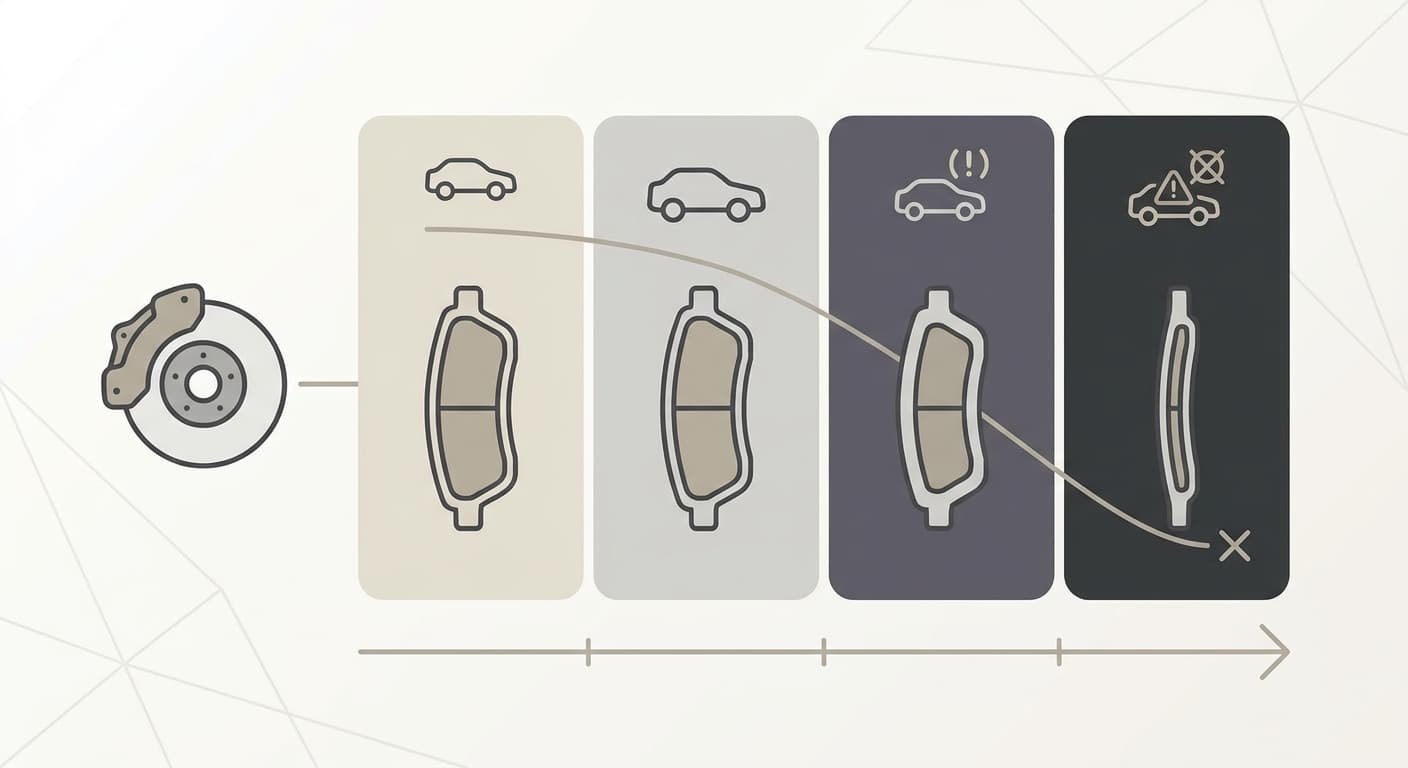
Brake pads last 30,000 to 70,000 miles in 2026, and the single biggest variable is the friction material: ceramic pads run 50,000-70,000 miles, semi-metallic 40,000-60,000, and organic 30,000-40,000. Front pads wear roughly 2-3x faster than rear pads because they do 60-70% of the braking. Estimate the miles left on your own pads with the Brake Pad Life Calculator before you book a shop visit.
The same reader question comes up constantly: "My pads are at 35,000 miles, do I need to replace them?" The honest answer always depends on three things: the pad material, where you drive, and which axle. One reader with ceramic pads on a highway commute was still at 6mm at 58,000 miles. Another, hauling a trailer through Colorado on semi-metallic pads, went metal-on-metal at 19,000 — but only because a seized caliper had been dragging one front pad against the rotor the whole time. Same question, wildly different mileage. That gap is exactly what this chart explains.
This is the lifespan guide — how many miles a set of pads lasts and how to read your wear. It is not a price guide. For dollar figures, see our companion articles on how much brake pads cost in 2026 and how much a brake job costs in 2026.
Brake Pad Mileage Chart by Material
The friction compound is the first lever on pad life. The three mainstream materials — organic, semi-metallic, and ceramic — wear at meaningfully different rates. According to AutoZone, brake pads last between 25,000 and 70,000 miles depending on material and driving conditions, with most drivers replacing around 40,000-60,000 miles.
| Pad Material | Mileage Range | Typical Midpoint | Best For |
|---|---|---|---|
| Organic (NAO) | 30,000 – 40,000 mi | 35,000 mi | Light commuter cars, budget jobs |
| Semi-metallic | 40,000 – 60,000 mi | 50,000 mi | Trucks, towing, hard braking |
| Ceramic | 50,000 – 70,000 mi | 60,000 mi | Daily drivers wanting long life |
Lifespan by friction material, 2026. Sources: AutoZone, Motorist Assurance Program.
Organic pads: 30,000-40,000 miles
Organic pads — also called NAO, for non-asbestos organic — are made from cellulose, rubber, glass, and resin. They are the softest and quietest compound when new, and the gentlest on rotors. The tradeoff is the shortest lifespan: organic pads wear out in 30,000 to 40,000 miles and fade under repeated hard braking. They are the default on many entry-level sedans because they are cheap to manufacture, but they need replacing sooner than the alternatives.
Semi-metallic pads: 40,000-60,000 miles
Semi-metallic pads blend 30-65% steel fiber with other materials. That metal content gives stronger bite and far better heat dissipation, which is why they are standard on trucks, towing rigs, and any vehicle that brakes hard. Lifespan lands in the 40,000-60,000 mile band. The downsides are more brake dust on the wheels and a bit more noise — a faint groan during light braking is normal for this compound, not a wear warning.
Ceramic pads: 50,000-70,000 miles
Ceramic pads use ceramic fibers with a small amount of copper. They are the premium tier and earn the longest lifespan: 50,000 to 70,000 miles. They run the quietest, throw off the least visible dust, and hold consistent performance across a wide temperature range. For a daily driver where you want the longest possible interval between brake jobs, ceramic is the mileage winner.
Tip
Match the compound to how you actually drive, not to the price tag. A half-ton truck towing 5,000 pounds on ceramic pads can burn through them in 20,000 miles because ceramic is tuned for steady thermal performance, not heavy momentary heat loads. Semi-metallic is the right pick for that vehicle.
Front vs Rear Brake Pad Mileage
Front and rear pads do not wear at the same rate, and that surprises most drivers. Front brakes handle 60-70% of total braking force because weight transfers forward every time you slow down. The result: front pads wear roughly 2-3x faster than rear pads. According to industry service data, most front pads last 25,000-60,000 miles while rear pads stretch to 40,000-70,000 miles.
| Axle | Typical Mileage Range | Share of Braking Force | Replacement Frequency |
|---|---|---|---|
| Front | 25,000 – 60,000 mi | 60 – 70% | Roughly every other rear replacement |
| Rear | 40,000 – 70,000 mi | 30 – 40% | About half as often as front |
Front vs rear pad lifespan, 2026. Front wears 2-3x faster due to forward weight transfer.
This is why mechanics quote front and rear replacement separately. Replacing all four pads when only the fronts are worn wastes money — the rears often have 40-60% of their life left. Always replace both pads on the same axle together (left and right) to keep braking balanced, but treat each axle as its own replacement decision.
Warning
Never replace just one side of an axle. Mismatched friction between left and right creates pulling under braking, which is a genuine safety issue. Most reputable shops will refuse a one-side job for that reason.
How Driving Style and Terrain Change the Numbers
The mileage chart assumes average conditions. Your real lifespan can swing 30% in either direction based on how and where you drive. The Brake Pad Life Calculator bakes these multipliers in, but it helps to understand them.
| Factor | Multiplier vs Average | Effect on a 60,000 mi Ceramic Set |
|---|---|---|
| Gentle / highway driving | 1.25 – 1.3x | ~75,000 – 78,000 mi |
| Average mixed driving | 1.0x | 60,000 mi |
| City stop-and-go | 0.8x | ~48,000 mi |
| Aggressive driving | 0.7x | ~42,000 mi |
| Mountain / heavy towing | 0.7x | ~42,000 mi |
Driving-condition multipliers applied to a 60,000-mile ceramic baseline. Re-derive: 60,000 x 1.25 = 75,000; 60,000 x 0.8 = 48,000; 60,000 x 0.7 = 42,000.
City driving with frequent stops can cut pad life by 20% because every stoplight is another braking cycle. Aggressive driving — hard, late braking — knocks off roughly 30%. Mountain roads with sustained downhill braking are the harshest, also around a 30% reduction, because the pads never get a chance to cool. By contrast, steady highway miles where you rarely touch the brakes can stretch a set 25-30% past its rated mileage.
Worked example: a city-driven sedan
Take a sedan with semi-metallic pads, rated at a 50,000-mile midpoint. Drive it almost entirely in city stop-and-go (0.8x multiplier) and the realistic lifespan drops to 50,000 x 0.8 = 40,000 miles. If that driver also brakes aggressively (an additional 0.7x), the math compounds: 50,000 x 0.8 x 0.7 = 28,000 miles. That is why two identical cars with identical pads can need service 20,000 miles apart.
Worked example: a highway-driven hybrid
Now a hybrid with ceramic pads, rated at 60,000 miles. Regenerative braking already does much of the slowing, and the owner drives gentle highway miles (1.3x). The pads can realistically reach 60,000 x 1.3 = 78,000 miles, and on some hybrids and EVs the original pads survive past 100,000 miles because the friction brakes are used so lightly. The Gas Mileage Calculator is a useful companion here — the same gentle-driving habits that stretch pad life also lift your MPG.
Reading Pad Thickness: The Other Way to Measure Wear
Mileage is a prediction; thickness is the actual measurement. New brake pads are 10-12mm thick. The replacement threshold is 3mm — the point where the built-in wear indicator tab starts squealing against the rotor. Below 2mm, stopping distance increases sharply and the metal backing plate risks grinding the rotor, which adds $150-$400 in rotor replacement.
| Pad Thickness | Condition | Action Needed |
|---|---|---|
| 10 – 12mm | New | None |
| 6 – 8mm | ~50% worn | Monitor every 10,000 miles |
| 3 – 4mm | Worn | Schedule replacement soon |
| 2 – 3mm | Critical | Replace immediately |
| Below 2mm | Unsafe | Stop driving — rotor damage likely |
Pad thickness wear chart. Replace at 3mm; below 2mm braking is unsafe.
You can read thickness without removing the wheel on most modern cars — there is a slot in the caliper that exposes the pad edge. Pair the thickness reading with your mileage to sanity-check the calculator's estimate. If a ceramic set rated for 60,000 miles is already at 3mm by 30,000 miles, something is wrong: a sticking caliper, a dragging parking brake, or a much harsher duty cycle than assumed.
Important
A squeal when braking is the wear indicator doing its job at 2-3mm thickness — schedule service. A grinding, metal-on-metal sound means the friction material is gone and the backing plate is cutting the rotor. Grinding is not a "soon" warning; it means stop driving and replace now.
When to Replace: Putting Mileage and Thickness Together
The smartest approach combines both signals. Use the mileage chart to set an inspection schedule, then confirm with a thickness measurement before authorizing any work. A common, costly mistake is replacing on mileage alone — paying for a brake job at 40,000 miles when the pads still measure 6mm and have 20,000 good miles left.
Here is the practical decision sequence:
- Estimate your remaining miles with the Brake Pad Life Calculator using your material, driving style, terrain, and vehicle weight.
- Confirm with thickness — measure or have the shop measure each axle and write the reading on the invoice.
- Replace per axle, not per car — fronts almost always go first; rears usually have life remaining.
- Price the job once replacement is confirmed using the Brake Pad Replacement Cost Calculator, which prices a pad-only job by vehicle and shop type.
- Check whether rotors are involved — if the pads went metal-on-metal or the pedal pulses, you may need rotor work too, which the Brake Repair Service Cost Calculator covers.
Heavier vehicles compress the whole chart. A full-size truck or SUV generates more kinetic energy that the brakes must convert to heat, so the same ceramic pads that hit 60,000 miles on a sedan might reach only 45,000-50,000 on a 5,500-pound SUV. The Tire Wear Calculator follows the same weight-driven pattern — heavy vehicles eat both pads and tires faster.
Tip
Bed in new pads with about 30 gentle stops from 30 mph after installation. This transfers a thin, even layer of pad material onto the rotor and prevents the uneven deposits that cause early pulsation. Skipping the bed-in is a common reason "new" brakes feel rough within a few hundred miles.
Frequently Asked Questions
What does a brake pad mileage chart show?
A brake pad mileage chart shows how long pads last by friction material: organic pads run 30,000-40,000 miles, semi-metallic 40,000-60,000 miles, and ceramic 50,000-70,000 miles in 2026, with front pads wearing 2-3x faster than rear pads.
How much does brake pad replacement cost?
A pad-only replacement averages about $150 per axle and rises to roughly $300 per axle on heavier or premium vehicles, with all four pads running $230-$600 including parts and labor according to J.D. Power; see our brake pad cost guide for the full breakdown.
How do I know when my brake pads need replacing?
Replace brake pads at 3mm thickness — the point where the wear indicator squeals — and never let them reach below 2mm; warning signs include high-pitched squealing, grinding, pedal pulsation, longer stopping distances, and pulling to one side.
Do front and rear brake pads wear out at the same time?
No — front pads wear 2-3x faster because they handle 60-70% of braking force, so fronts typically need replacement every 25,000-60,000 miles while rears last 40,000-70,000 miles; replace each axle independently rather than all four at once.
Which brake pad material lasts the longest?
Ceramic pads last the longest at 50,000-70,000 miles, followed by semi-metallic at 40,000-60,000 miles and organic at 30,000-40,000 miles, though heavy towing favors semi-metallic because ceramic struggles with sustained heavy heat loads.
Can I make my brake pads last longer?
Yes — gentle highway driving extends pad life 25-30% above the rated mileage, while city stop-and-go, aggressive braking, and mountain driving each cut it by 20-30%, so coasting to stops and avoiding hard late braking is the single biggest lever you control.
Do brake pads last longer on hybrids and EVs?
Yes — regenerative braking does much of the slowing, so friction pads on many hybrids and EVs survive past 100,000 miles, far beyond the 50,000-70,000 mile ceramic norm, because the physical brakes are used so lightly.
Related Articles
- How Much Do Brake Pads Cost in 2026? — Parts and installed pricing by material and vehicle class once you confirm replacement is due.
- How Much Is a Brake Job in 2026? — Full job pricing when rotors, calipers, or fluid are also involved.
- Enclosed Auto Transport Rates 2026 — Another per-unit auto-cost guide built the same data-driven way.
Related Calculators
- Brake Pad Life Calculator — Estimate remaining pad miles by material, driving style, terrain, and vehicle weight.
- Brake Pad Replacement Cost Calculator — Price a pad-only job by vehicle, axles, and shop type.
- Brake Repair Service Cost Calculator — Full brake job pricing including rotors, calipers, and fluid flush.
- Tire Wear Calculator — Track tire life, which follows the same weight-driven wear curve as pads.
- Gas Mileage Calculator — Gentle driving that stretches pad life also lifts your MPG.
This article provides general information for educational purposes. Consult a qualified mechanic for inspection and personalized recommendations on your vehicle's brakes.
This article is provided for informational and educational purposes only. Content should not be considered professional financial, medical, legal, or other advice. Always consult a qualified professional before making important decisions. UseCalcPro is not responsible for any actions taken based on the information in this article.
Try These Calculators
Estimate brake pad life remaining based on material, driving style, terrain, and vehicle type. Get front vs rear wear rates and replacement cost ranges.
Estimate 2026 brake pad replacement cost by vehicle, axles, and pad material. Pad-only jobs run $150–$650 at mainstream shops, up to $1,500 on performance cars.
Track your running shoe mileage and find out when to replace them. Estimate shoe lifespan based on weekly miles, body weight, terrain, and running style.
Estimate remaining tire life based on tread depth, driving style, and alignment. Get safety status, replacement timeline, and cost-per-mile breakdowns.