High Density Planting Chart for Vegetables (2026 Spacing Guide)
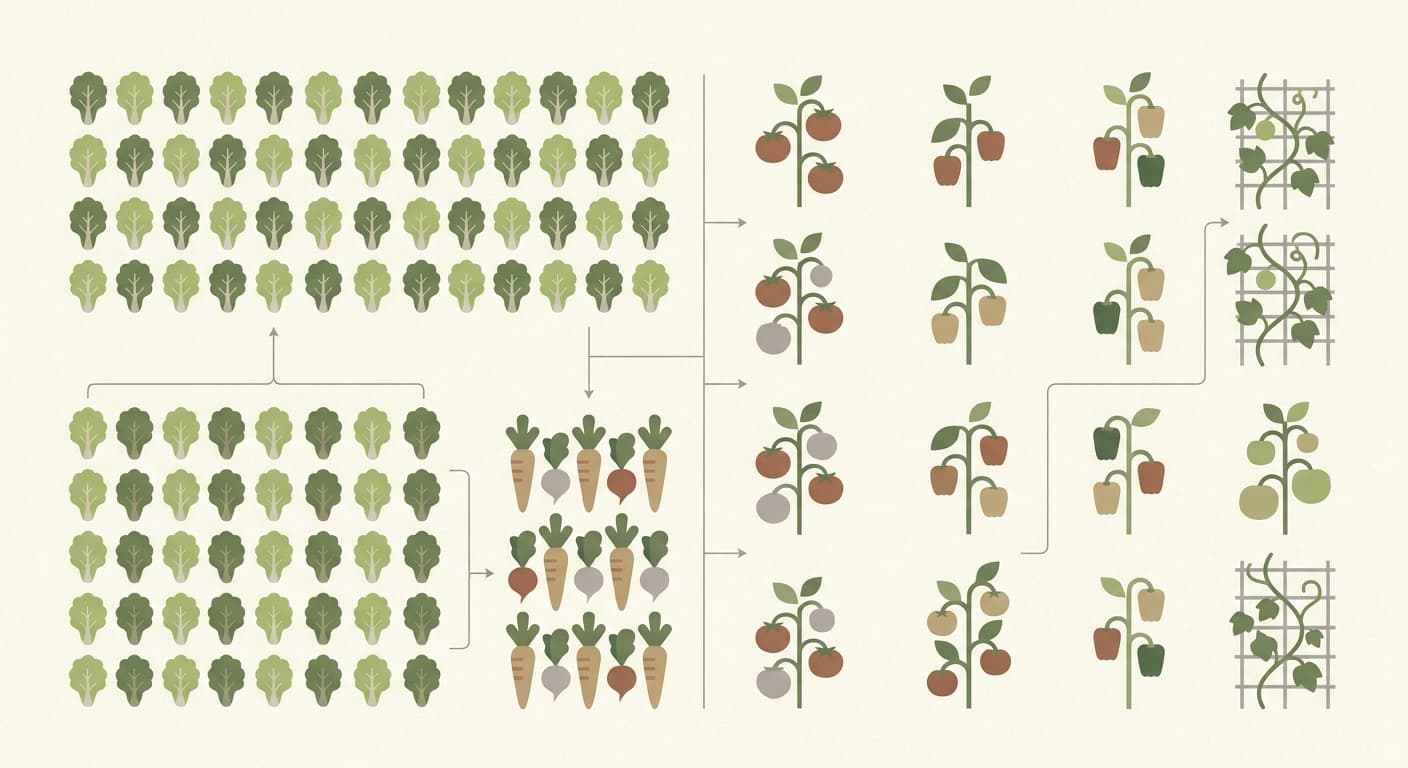
A high density planting chart assigns each vegetable 1, 4, 9, or 16 plants per square foot based on its mature size — tomatoes get 1, lettuce 4, beets 9, and radishes 16. The rule comes from one formula: plants per square = (12 ÷ in-row spacing in inches)². A 4×4 ft bed holds 16 squares, so a single bed can grow anywhere from 16 tomatoes to 256 radishes. Match crops to the chart instantly with our Square Foot Garden Calculator.
The most common mistake in laying out intensive beds is reading the back of the seed packet literally. A packet that says "thin to 3 inches apart, rows 12 inches apart" is written for tractor-row farming. In a raised bed with no walking rows, that same carrot gets 3-inch spacing in every direction — which turns a 12-plant row into a 16-plant square. Trusting packet row-spacing on a 4×8 bed this way can mean planting about 90 carrots where the bed could have held over 500. That gap between row math and grid math is exactly what this chart fixes.
This guide is the reference chart, not the tool: it gives you the density for 25+ crops, the per-bed plant counts for the three most common bed sizes, and the realistic yields each density produces. When you want to plug in your own bed dimensions, the calculator does the arithmetic for you.
The High Density Planting Chart: 1-4-9-16 Plants Per Square Foot
The entire system rests on four density tiers tied to in-row spacing. According to Square Foot Gardening's official spacing guide, you grow 1, 4, 9, or 16 equally spaced plants per square foot depending on the plant's mature size. The math is a single squared fraction.
The formula is plants per square = (12 ÷ spacing)², where spacing is the recommended distance between plants in inches:
- 12-inch spacing → (12 ÷ 12)² = 1 plant per square
- 6-inch spacing → (12 ÷ 6)² = 4 plants per square
- 4-inch spacing → (12 ÷ 4)² = 9 plants per square
- 3-inch spacing → (12 ÷ 3)² = 16 plants per square
This works because intensive beds eliminate walking rows. The University of Wisconsin Extension square foot gardening fact sheet notes that the grid method produces the same harvest as a traditional row garden in roughly 20% of the space. Every square inch grows food instead of serving as a path.
| Density Tier | In-Row Spacing | Plants per Square Foot | Example Vegetables |
|---|---|---|---|
| Extra-large | 12" | 1 | Tomato, pepper, broccoli, cabbage, eggplant |
| Large | 6" | 4 | Lettuce, Swiss chard, basil, parsley, kohlrabi |
| Medium | 4" | 9 | Beet, bush bean, spinach, turnip, leek |
| Small | 3" | 16 | Carrot, radish, onion, chive, scallion |
Tip
When a seed packet only lists "thin to X inches," that X is your in-row spacing. Drop it into the formula (12 ÷ X)² and round down to the nearest tier (1, 4, 9, or 16). A packet saying "thin to 2 inches" rounds to the 16-per-square tier, not 36 — crowding below 3 inches starves roots.
To assign every square in your bed at once, the Square Foot Garden Calculator maps each crop to its tier automatically. For odd in-row distances that don't match a tier neatly, the Seed Spacing Calculator computes exact plant counts from raw spacing numbers.
Crop-by-Crop Density Chart: 25+ Vegetables
The four tiers cover most crops, but a few oversized plants (vine tomatoes, squash, cucumbers) need more than one square. The chart below lists the assigned density and the resulting plant count for a standard 4×8 ft bed, which contains 32 one-foot squares.
Plants Per Square and Per 4×8 ft Bed
| Vegetable | In-Row Spacing | Plants / Square | Squares Needed | Plants in a 4×8 Bed (32 sq) |
|---|---|---|---|---|
| Radish | 3" | 16 | 1 | 512 |
| Carrot | 3" | 16 | 1 | 512 |
| Onion (bulb) | 3" | 16 | 1 | 512 |
| Scallion | 3" | 16 | 1 | 512 |
| Beet | 4" | 9 | 1 | 288 |
| Bush bean | 4" | 9 | 1 | 288 |
| Spinach | 4" | 9 | 1 | 288 |
| Turnip | 4" | 9 | 1 | 288 |
| Lettuce (leaf) | 6" | 4 | 1 | 128 |
| Swiss chard | 6" | 4 | 1 | 128 |
| Basil | 6" | 4 | 1 | 128 |
| Parsley | 6" | 4 | 1 | 128 |
| Pepper | 12" | 1 | 1 | 32 |
| Broccoli | 12" | 1 | 1 | 32 |
| Cabbage | 12" | 1 | 1 | 32 |
| Eggplant | 12" | 1 | 1 | 32 |
| Kale | 12" | 1 | 1 | 32 |
| Tomato (staked) | 18–24" | — | 2 | 16 |
| Cucumber (trellised) | 18" | — | 2 | 16 |
| Summer squash | 24" | — | 4 | 8 |
| Winter squash (vine) | 24"+ | — | 4 | 8 |
The per-bed counts come straight from the density multiplied by 32 squares. Radishes at 16 per square × 32 squares = 512 plants if the whole bed were radishes. Tomatoes need 2 squares each, so 32 ÷ 2 = 16 plants; squash needs 4 squares, so 32 ÷ 4 = 8 plants. The Plant Spacing Chart from Garden Betty confirms these intensive distances and notes that staggering plants in a triangular (offset) pattern instead of a square grid fits about 10–15% more plants into the same area.
Warning
Nobody plants an entire bed with one crop. The 512-radish figure is a ceiling, not a plan — it shows the bed's capacity at that density. A real bed mixes tiers: a few tomato squares, several lettuce squares, one or two radish squares for succession. Use the Garden Bed Planner to allocate squares across multiple crops without double-counting.
Crops That Need More Than One Square
Three categories break the 1-per-square ceiling. Indeterminate tomatoes need 18–24 inches even when staked, so they occupy 1–2 squares each. Bush-type cucumbers fit one square trellised; vining types need 2. Squash is the space hog — a single zucchini plant sprawls across 4 squares (a 2×2 ft block). Plan these first, then fill the remaining squares with small crops.
How Many Plants Fit by Bed Size
Bed size sets your total square count, and square count sets your capacity. Every standard bed is 4 feet wide because that is the farthest most people can reach without stepping on soil. Length is the variable. The Old Farmer's Almanac square foot garden plan recommends a 4×4 starter for the same reachability reason.
Squares and Capacity by Bed Size
| Bed Size | Total Squares | Max Radishes (16/sq) | Max Lettuce (4/sq) | Max Tomatoes (2 sq each) |
|---|---|---|---|---|
| 3×3 ft | 9 | 144 | 36 | 4 |
| 4×4 ft | 16 | 256 | 64 | 8 |
| 4×8 ft | 32 | 512 | 128 | 16 |
| 4×12 ft | 48 | 768 | 192 | 24 |
Each cell is the square count times the per-square density. A 4×4 bed (16 squares) holds 16 × 16 = 256 radishes, 16 × 4 = 64 lettuce, or 16 ÷ 2 = 8 staked tomatoes. A 4×12 bed (48 squares) triples the 4×4 figures: 48 × 16 = 768 radishes. The pattern is linear in square count, which is why doubling bed length doubles capacity.
Important
Bed depth matters as much as width for high-density planting. Shallow 6-inch beds suit leafy and small crops, but root vegetables at 16-per-square need 12 inches of loose soil to size up. Crowding carrots above shallow, compacted soil produces forked, stunted roots regardless of correct surface spacing.
Worked Example: A Mixed 4×8 ft Bed (32 Squares)
Here is a realistic full-season allocation that uses every square without overcrowding. The math reconciles to exactly 32 squares.
- 8 squares of tomatoes: 4 staked plants (2 squares each) → 4 plants
- 6 squares of lettuce at 4/sq → 24 plants
- 6 squares of carrots at 16/sq → 96 plants
- 4 squares of bush beans at 9/sq → 36 plants
- 4 squares of peppers at 1/sq → 4 plants
- 2 squares of basil at 4/sq → 8 plants
- 2 squares of radishes at 16/sq → 32 plants
Square check: 8 + 6 + 6 + 4 + 4 + 2 + 2 = 32 squares. Plant total: 4 + 24 + 96 + 36 + 4 + 8 + 32 = 204 plants. The Vegetable Yield Calculator turns those plant counts into a pounds-of-harvest estimate per crop.
What Each Density Actually Yields
High density only pays off if the plants still produce. Intensive spacing works because the soil is improved (loose, compost-rich) enough to support roots at tighter distances. The biointensive method documented by ecology educators shows that offset (hexagonal) spacing can yield up to two to four times conventional row output per unit of area when soil is deeply prepared.
The per-square pound ranges below are illustrative planning estimates, not measured trial data — actual harvests swing widely with variety, soil, climate, and season length. Treat them as a relative comparison between tiers rather than a guarantee.
Illustrative Season Yield by Density Tier
| Density Tier | Example Crop | Plants / Square | Approx. Yield per Square / Season* |
|---|---|---|---|
| 16 / square | Radish | 16 | 1–2 lbs (4 successions = 4–8 lbs) |
| 16 / square | Carrot | 16 | 1–2 lbs |
| 9 / square | Bush bean | 9 | 1–2 lbs |
| 9 / square | Beet | 9 | 1–2 lbs |
| 4 / square | Lettuce | 4 | 1–3 lbs (3 successions) |
| 1 / square | Pepper | 1 | 2–5 lbs |
| 2 squares | Tomato (staked) | 0.5 | 10–25 lbs total per plant |
*Illustrative estimates for well-prepared soil; not from a controlled yield trial.
The single highest-value square is the tomato block. One staked tomato across 2 squares can produce 10–25 pounds of fruit over a season — far more dollar value per square foot than any small crop. Radishes win on speed instead: at 25 days to harvest, one square supports 4 successions, turning 1–2 pounds into 4–8 pounds across the season. For more on translating these densities into a planted layout, see how gardeners size beds in our vegetable garden calculator patterns report.
Tip
The smartest high-density layout pairs fast and slow crops in the same area. Sow radishes (25 days) between pepper transplants (60–80 days). The radishes harvest and free their space long before the peppers fill out — a free crop with zero added square footage.
How to Use the Density Chart in 4 Steps
Turning the chart into a planted bed takes four steps. None require math beyond looking up a tier.
- Measure your bed and count squares. Length (ft) × width (ft) = total squares. A 4×8 bed = 32 squares.
- List your crops and pull each density from the chart (1, 4, 9, or 16; tomatoes and squash need 2–4 squares).
- Allocate squares to crops until they sum to your total. Plan big plants (tomato, squash) first, then fill with small crops.
- Multiply each crop's squares by its density for plant counts, then add a 20% seed buffer for germination loss.
The Square Foot Garden Calculator automates steps 1, 2, and 4. For beds with irregular spacing or row-style planting, the Seed Spacing Calculator handles arbitrary in-row and between-row distances. Deciding between a raised grid and a traditional plot first? Compare the two approaches in our raised bed vs in-ground garden breakdown.
Frequently Asked Questions
What is a high density planting chart for vegetables?
A high density planting chart assigns each vegetable a fixed number of plants per square foot — 1, 4, 9, or 16 — based on its in-row spacing, calculated as (12 ÷ spacing in inches)². Tomatoes get 1 per square, lettuce 4, beets 9, and radishes or carrots 16.
How many plants can I grow per square foot?
You can grow 1, 4, 9, or 16 plants per square foot depending on mature size: 1 for 12-inch crops like peppers and broccoli, 4 for 6-inch crops like lettuce, 9 for 4-inch crops like beets, and 16 for 3-inch crops like radishes and carrots.
How do I convert seed-packet spacing into plants per square foot?
Take the "thin to X inches" number from the packet as your in-row spacing, then compute (12 ÷ X)² and round down to the nearest tier. A packet saying "thin to 4 inches" gives (12 ÷ 4)² = 9 plants per square foot.
How many vegetables fit in a 4×8 raised bed?
A 4×8 ft bed has 32 one-foot squares, so capacity ranges from 16 tomatoes (2 squares each) to 512 radishes (16 per square). A realistic mixed bed holds roughly 200 plants across several crops, such as 4 tomatoes, 24 lettuce, 96 carrots, 36 beans, 4 peppers, 8 basil, and 32 radishes.
Does high density planting reduce yield per plant?
Per-plant yield can drop when crops are crowded below their recommended spacing — overcrowded tomatoes noticeably underproduce as plants compete for light, water, and nutrients — but total bed yield rises because intensive beds use space that would otherwise be walking rows. With deeply improved soil, biointensive spacing can yield two to four times conventional row output per square foot.
Which vegetables need more than one square foot?
Indeterminate tomatoes need 1–2 squares each, vining cucumbers need 2 squares, and summer or winter squash need 4 squares (a 2×2 ft block). Plant these space hogs first, then fill the remaining squares with small high-density crops.
How deep should soil be for high-density vegetable planting?
Leafy and small crops grow well in 6 inches of soil, but root vegetables planted at 9–16 per square need 12 inches of loose, compost-rich soil to size up properly. Shallow or compacted soil produces forked, stunted roots even at correct surface spacing.
Related Articles
- Vegetable Garden Calculator Usage Patterns 2026 — Real usage data on how gardeners size and plan their beds.
- Raised Bed vs In-Ground Garden Cost 2026 — Compare the two systems before committing to a grid layout.
Related Calculators
- Square Foot Garden Calculator — Assigns each crop its density tier and totals plants per bed.
- Seed Spacing Calculator — Computes plant and seed counts from any in-row and row spacing.
- Garden Bed Planner — Allocates squares across multiple crops in one layout.
- Vegetable Yield Calculator — Estimates harvest pounds from your planned plant counts.
This article provides general information for educational purposes. Growing conditions, soil quality, and climate affect results. Consult local extension services for region-specific planting guidance.
This article is provided for informational and educational purposes only. Content should not be considered professional financial, medical, legal, or other advice. Always consult a qualified professional before making important decisions. UseCalcPro is not responsible for any actions taken based on the information in this article.
Try These Calculators
Plan your garden layout with correct plant and row spacing. Enter bed dimensions and crop type to get exact plant counts, row counts, and seed quantities.
Plan a square foot garden with plant-per-square spacing for 20+ vegetables. Calculate soil volume, bed layout, harvest value estimates, and total costs.
Calculate how many light fixtures you need and optimal grid spacing for any room. Get lumens requirements by room type and annual energy cost estimates.