How Much Does a Fence Cost in 2026? (National Averages & Material Prices)

The average fence costs $15 to $45 per linear foot installed in 2026, with a typical 150-linear-foot wood privacy fence running $2,250-$6,750 fully installed. Chain link starts at $10-$35/linear ft, wood privacy runs $15-$45/linear ft, vinyl costs $30-$60/linear ft, and wrought iron reaches $30-$100/linear ft. Labor accounts for roughly 50% of total project cost across all fence types.
Installing or supervising 22 residential fences across Pennsylvania and New Jersey shows the number-one budget killer is not the fence itself -- it is what sits underneath it. A 200-linear-foot cedar privacy fence in Bucks County came to $9,800 installed, and $1,400 of that was removing an old chain link fence, pulling concrete footings, and re-grading the fence line. The cedar boards and posts? $4,200. The lesson worth repeating to homeowners: budget for what you cannot see, because the ground does not care about your Pinterest board.
Use our Fence Calculator to get a personalized estimate based on your exact linear footage, material choice, and gate requirements.
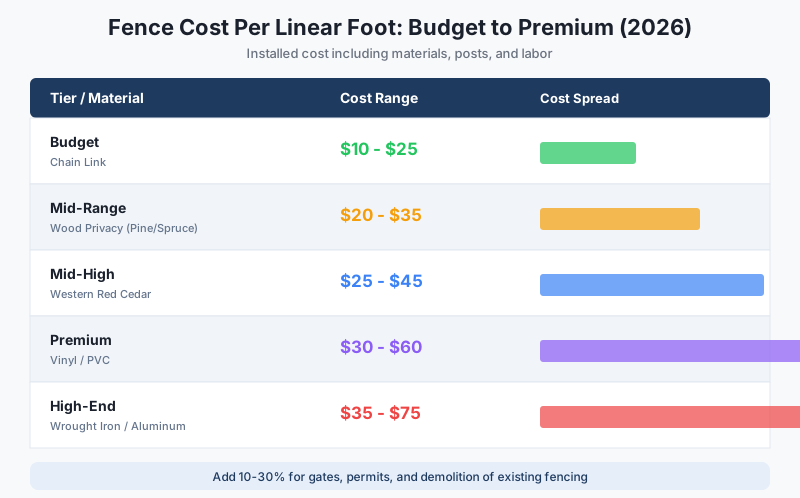
Fence Cost at a Glance: Budget, Mid-Range & Premium
The table below shows what you can expect to pay per linear foot for materials and installation, plus total project cost for a standard 150 linear foot perimeter fence.
| Cost Tier | Material | Installed Cost/linear ft | 150 ft Total |
|---|---|---|---|
| Budget | Chain link (4 ft) | $10 - $35 | $1,500 - $5,250 |
| Mid-range | Wood privacy (6 ft) | $15 - $45 | $2,250 - $6,750 |
| Mid-high | Cedar privacy (6 ft) | $25 - $48 | $3,750 - $7,200 |
| Premium | Vinyl / Composite | $30 - $60 | $4,500 - $9,000 |
| High-end | Aluminum ornamental / Wrought iron | $25 - $100 | $3,750 - $15,000 |
Tip
The "installed cost" includes labor, posts, concrete, and hardware. Gates, permits, demolition of old fencing, and grading on sloped lots add 10-30% to these base numbers.
Material Cost Breakdown
Chain Link ($10-$35/linear ft installed)
Chain link is the most affordable fencing option and the go-to for utility enclosures, dog runs, and property boundaries where aesthetics are secondary. A standard 4-foot residential chain link fence costs $10-$18 per linear foot installed, while 6-foot, heavier-gauge, or vinyl-coated chain link with slats runs $20-$35 per linear foot. Galvanized chain link lasts 15-20 years; vinyl-coated chain link (black or green) costs $2-$4 more per foot but looks significantly better and resists corrosion longer.
Wood Privacy ($15-$45/linear ft installed)
Pressure-treated pine is the most popular fence material in America, and for good reason -- it is affordable, easy to work with, and holds stain well. A standard 6-foot dog-ear privacy fence runs $15-$28 per linear foot installed with 4x4 posts set in concrete, climbing toward $45 with board-on-board or shadow box styles that use more lumber. Expect to stain or seal every 2-3 years at $1-$2 per linear foot per application.
Cedar ($25-$48/linear ft installed)
Cedar offers natural rot resistance and a warm, distinctive grain that pressure-treated pine cannot match. Western red cedar fence boards run $4-$8 per board foot, making a 6-foot privacy fence $25-$48 per linear foot installed. Cedar prices have climbed 10-15% since 2024, largely due to reduced harvests in British Columbia. Left untreated, cedar weathers to a silver-gray patina within 1-2 years. Annual sealing ($1.50-$2.50/linear ft) preserves the original tone.
Vinyl ($30-$60/linear ft installed)
Vinyl fencing has gained significant market share over the past decade thanks to zero-maintenance appeal and 20-30 year manufacturer warranties. A 6-foot vinyl privacy fence costs $30-$50 per linear foot installed, while semi-privacy and picket styles run $25-$40. Premium vinyl with a wood-grain texture reaches $45-$60 per linear foot. Vinyl will never rot, warp, or require painting, but it can crack in extreme cold and has limited color options compared to paintable wood.
Aluminum Ornamental ($25-$55/linear ft installed)
Aluminum fencing mimics the look of wrought iron at roughly half the weight and half the maintenance. Installed costs run $25-$55 per linear foot for standard 4-5 foot ornamental panels. Aluminum will not rust, does not need painting, and typically carries a lifetime structural warranty. The trade-off is zero privacy -- ornamental fencing is open by design, making it best suited for front yards, pool enclosures, and decorative boundaries.
Wrought Iron ($30-$100/linear ft installed)
True wrought iron is the most durable and expensive residential fencing option. Installed costs range from $30 per linear foot for simple panel runs up to $100 for ornate, custom-fabricated designs. Wrought iron requires periodic rust treatment and repainting every 3-5 years ($2-$4/linear ft), but a well-maintained iron fence can last 50+ years. Most "wrought iron" sold today is actually fabricated steel designed to look like traditional ironwork.
Composite ($35-$55/linear ft installed)
Composite fencing (wood fiber plus plastic) occupies the space between wood and vinyl. Installed costs run $35-$55 per linear foot for 6-foot privacy panels. Like composite decking, composite fences resist rot, insects, and fading without staining or painting. The 25-year warranties are standard. The main drawback is weight -- composite panels are significantly heavier than wood, requiring sturdier posts and more labor during installation.
Labor Cost Breakdown
Labor typically accounts for about 50% of total fence cost. Here is what the labor budget covers for a standard 150-linear-foot fence:
| Labor Component | Cost Range | Notes |
|---|---|---|
| Post hole digging | $3 - $8/post | Auger rental or manual; rocky soil costs more |
| Post setting (concrete) | $5 - $15/post | 2-3 bags of concrete per post |
| Rail and panel installation | $8 - $18/linear ft | Varies by material weight and style |
| Gate installation (walk) | $150 - $350/gate | Includes hardware and alignment |
| Gate installation (double drive) | $300 - $600/gate | For vehicle access, heavier hardware |
| Old fence removal | $3 - $5/linear ft | Disposal fees may be extra |
| Permit | $50 - $250 | Required in most jurisdictions |
| Property survey | $300 - $600 | Strongly recommended before any fence build |
Warning
Do not skip the property survey. Fence disputes over property lines regularly end up in court. A $300-$600 survey is cheap insurance against a $5,000 tear-down-and-rebuild when a neighbor proves the fence is 8 inches over the property line. Most municipalities also require a survey before issuing a fence permit.
Regional Cost Variation
Where you live has a major impact on fence pricing. Labor rates, soil conditions, and local code requirements all vary by region.
| Region | Installed Cost/linear ft | vs. National Average | Key Factors |
|---|---|---|---|
| Northeast | $22 - $55 | +10% to +20% | High labor costs, rocky soil, frost line depth 36-48" |
| South | $13 - $38 | -10% to -15% | Lower labor rates, year-round building, easier soil |
| Midwest | $15 - $45 | -5% to +5% | Competitive market, moderate labor, deep frost lines |
| West Coast | $20 - $58 | +15% to +25% | Highest labor costs, fire-resistant material requirements |
| Mountain West | $16 - $48 | +0% to +10% | Moderate labor, wind load considerations, variable soil |
These ranges reflect 2026 pricing from contractor surveys by HomeGuide, Angi, and HomeAdvisor. Your actual cost depends on local market conditions, contractor availability, and time of year.
DIY vs. Contractor: What You Actually Save
Installing a fence yourself can cut total cost by 40-50%, but only if you have the tools, the back, and the patience. Here is a realistic comparison for a 150 linear foot, 6-foot wood privacy fence:
| Factor | DIY | Professional |
|---|---|---|
| Materials (150 ft, PT wood) | $1,800 - $2,800 | $1,800 - $2,800 |
| Labor | $0 (your time) | $1,800 - $3,000 |
| Tool rental (auger, level, saw) | $200 - $400 | Included |
| Concrete and hardware | $250 - $400 | Included in quote |
| Permit | $50 - $250 | Often handled by contractor |
| Property survey | $300 - $600 | May be required either way |
| Time | 3-5 weekends | 2-4 days |
| Total | $2,600 - $4,450 | $4,200 - $6,800 |
| Savings | 35-50% | -- |
What DIY can handle: Straight runs of dog-ear or board-on-board privacy fence on flat, rock-free ground with no utilities below grade.
What needs a pro: Slopes steeper than 6 inches per panel, rocky or clay soil, fences over 6 feet tall, ornamental metal, and anything within 5 feet of a utility easement. Also, most vinyl and composite fence systems are panel-based and significantly heavier than wood -- professional installation prevents cracked panels and misaligned posts.
Factors That Affect Your Fence Cost
1. Linear Footage
This is the single biggest cost driver. Every additional linear foot adds $15-$45 to your project. A typical suburban backyard perimeter runs 150-250 linear feet. Corner lots and large properties can exceed 400 feet easily.
2. Fence Height
Standard residential fences are 4 or 6 feet tall. Going from 4 to 6 feet increases material cost by 30-50% and adds labor time for taller, heavier panels. Some municipalities restrict fence height to 4 feet in front yards and 6 feet in back yards -- check your local zoning code before ordering materials.
3. Terrain and Soil
Flat, obstacle-free ground is the cheapest to fence. Slopes require either stepped panels (stair-step look) or racked panels (panels that follow the slope angle), both of which add 10-20% in labor. Rocky soil, tree roots, and high water tables make post-hole digging significantly harder and more expensive -- rocky-soil post installation commonly runs $25-$40 per hole versus $8-$12 on clean dirt.
4. Gates
Every fence needs at least one gate, and gates are disproportionately expensive relative to fence panels. A basic walk gate costs $150-$350, a double drive gate for vehicle access runs $300-$600, and custom arched or decorative gates can exceed $800. Heavy gates also need beefier posts and more concrete, adding to the structural cost.
5. Demolition and Disposal
If you are replacing an existing fence, removal and disposal costs $3-$5 per linear foot. A 150-foot old fence costs $450-$750 to remove. Chain link is the cheapest to remove; concrete-set wood posts are the most labor-intensive. Some contractors include removal in their quote; others charge separately.
6. Permits and HOA Requirements
Fence permits range from $50-$250 in most jurisdictions. HOA communities often restrict material type, color, height, and even the direction the "finished side" faces. Violating HOA rules can result in fines and forced removal. Always check both municipal code and HOA covenants before finalizing your fence plan.
How to Get the Best Price
- Get 3-5 itemized quotes. Fence contractor pricing varies 20-35% in most markets. Insist on line-item breakdowns that separate materials, labor, gates, concrete, and permits.
- Verify the property line. A $300-$600 survey prevents a $5,000+ mistake. Some fence contractors will split the survey cost.
- Build in the off-season. Fence contractors are slowest from November through February in most of the country. Off-season jobs often come with 10-15% discounts.
- Consider a hybrid approach. Set posts yourself (the hardest part), then hire a contractor to install panels and gates. This splits the savings while keeping the precision work professional.
- Buy materials at contractor pricing. If you are doing DIY, ask your local lumber yard about contractor discounts -- many will extend them if your order exceeds $1,500.
- Skip unnecessary upgrades. Post caps, lattice toppers, and decorative trim look great but add $3-$8 per linear foot. Decide what matters most to you and cut the rest.
Related Articles
- Fence Installation Cost in 2026: Price Per Foot by Material — The install-focused companion: how labor and materials split, commercial fence pricing, and how to bid the job out across contractors.
Frequently Asked Questions
How much does a 150-foot privacy fence cost in 2026?
A 150-linear-foot, 6-foot wood privacy fence costs $2,250-$6,750 fully installed in 2026, before gates and removal. This is the most common residential fence project size, typically enclosing a standard suburban backyard.
- Pressure-treated wood (installed): $2,250-$6,750 ($15-$45/ft)
- Cedar (installed): $3,750-$7,200 ($25-$48/ft)
- Vinyl (installed): $4,500-$9,000 ($30-$60/ft)
- Walk gate (1): $150-$350
- Permit and survey: $350-$850
- Old fence removal (if applicable): $450-$750
The total depends on material choice, soil conditions, number of gates, and whether you need the old fence removed first. Budget an extra 10-15% contingency for unexpected issues like hidden rocks, root systems, or property line adjustments.
Is vinyl fencing worth the extra cost over wood?
Vinyl costs 40-70% more upfront than pressure-treated wood, but the 15-year cost comparison favors vinyl for most homeowners. The maintenance math is what tips the scale:
- PT wood fence (15 years): $5,250 installation + $2,250-$4,500 staining (5-7 applications) + $800-$1,500 board replacements = $8,300-$11,250
- Vinyl fence (15 years): $7,500 installation + $0 maintenance = $7,500
By year 10-12, vinyl becomes the cheaper option because wood requires staining every 2-3 years at $1-$2 per linear foot, plus inevitable board replacements from rot, warping, and insect damage. Vinyl never needs painting, staining, or sealing. The main downsides are limited color choices, potential cracking in extreme cold below -20F, and a more uniform look that some homeowners find less appealing than natural wood grain.
How long does fence installation take?
A professional crew typically installs 100-200 linear feet of fence per day, making most residential projects a 2-4 day job. Complex projects with slopes, rocky soil, or multiple gates can extend to a full week.
- Permit approval: 1-3 weeks (apply well before your preferred start date)
- Property survey (if needed): 1-2 weeks to schedule
- Post hole digging and setting: 1-2 days for 150 feet
- Panel/board installation: 1-2 days
- Gate hanging and hardware: Half a day
- Inspection (if required): 1-3 days after completion
DIY builds typically span 3-5 weekends for a 150-foot wood fence, with post setting being the most physically demanding and time-consuming phase. Renting a two-person power auger ($50-$75/day) is a must unless you enjoy digging 25-30 holes by hand.
Does a fence increase home value?
A well-maintained fence can increase home value by 1-5%, depending on the material, condition, and local market. According to real estate data from HomeLight and Zillow, privacy fencing is one of the most requested features among home buyers, particularly families with children and pet owners.
- Wood privacy fence: Adds $2,000-$5,000 in perceived value on a $300,000-$400,000 home
- Vinyl or composite: Slightly higher return due to "move-in ready" appeal -- no immediate maintenance needed
- Chain link: Minimal impact on value; can actually hurt curb appeal in some neighborhoods
- Wrought iron or ornamental aluminum: Strong positive impact on curb appeal for homes valued above $500,000
The return depends heavily on your neighborhood. In family-oriented suburbs where every other house has a fence, not having one can actually reduce your home value. In rural areas or large-lot communities, a fence matters less.
What is the cheapest type of fence to install?
Chain link is the cheapest fence at $10-$35 per linear foot installed, followed by basic pressure-treated wood at $15-$45 per linear foot. For homeowners on a tight budget, here are the most cost-effective options:
- Cheapest overall: 4-foot galvanized chain link at $10-$18/linear ft installed (150 ft = $1,500-$2,700)
- Cheapest privacy fence: 6-foot dog-ear pressure-treated wood at $15-$28/linear ft installed (150 ft = $2,250-$4,200)
- DIY rock bottom: PT wood materials only for 150 ft = $1,800-$2,800 + $200-$400 tool rental
- Cheapest "nice" fence: 4-foot cedar picket at $18-$30/linear ft installed
Even budget fences need proper post installation. Skimping on post depth or concrete saves $200-$400 upfront but guarantees leaning posts within 2-3 years. Set every post in concrete, minimum 24 inches deep (deeper in frost-prone regions), or you will be re-doing the work sooner than you think.
Do I need a permit to build a fence?
Most municipalities require a fence permit, typically costing $50-$250, and you should always check local requirements before breaking ground. Permit rules vary widely by jurisdiction, but common requirements include:
- Height restrictions: 4 feet maximum in front yards, 6 feet in side and back yards in most residential zones
- Setback requirements: Fence must be 2-12 inches inside the property line (not on it) in many jurisdictions
- Finished side out: Many codes require the "good side" of the fence to face your neighbor
- Utility clearance: Call 811 before digging -- it is free, required by law, and prevents hitting buried gas, electric, or water lines
- HOA approval: Separate from the municipal permit; HOA review can take 2-6 weeks
Skipping the permit is not worth the risk. Homeowners get forced to move fences that are 6 inches over the property line more often than you would expect -- costs range from $3,200 to relocate a 100-foot section to a $2,800 settlement paid to a neighbor. A $300-$600 property survey and a $50-$250 permit would have prevented both situations entirely.
Cost data sourced from HomeGuide, Angi, HomeAdvisor, and HomeWyse. Prices reflect 2026 national averages and may vary by region.
This article is provided for informational and educational purposes only. Content should not be considered professional financial, medical, legal, or other advice. Always consult a qualified professional before making important decisions. UseCalcPro is not responsible for any actions taken based on the information in this article.
Try These Calculators
Estimate fence posts, rails, panels, gates, and total project cost for wood or vinyl fences. Enter fence length and spacing to get a full material list.
Estimate 2026 gutter cleaning service cost by linear feet, home height, roof pitch, and debris level. Most single-story jobs run $100 to $250 per visit.
Estimate 2026 invisible fence cost by system type, acreage, and dog count. Buried wire $1,500-$4,500, wireless $250-$600, GPS collar $800-$1,500 installed.
Estimate 2026 soffit and fascia repair cost by linear feet, material, and rot. Vinyl, aluminum, and wood jobs typically run $600 to $6,000 nationwide.
Estimate 2026 fence installation cost by linear feet, material, height, and region. Wood, vinyl, chain link, and aluminum quotes from $1,200 to $20,000.