How Much Does a Paver Patio Cost in 2026? (Materials, Labor & Size)
What You'll Need

Alliance Gator G2 Maxx Polymeric Sand Slate Gray 50 lb Professional Paver Joint Sand for Patio, Driveway & Walkway, Rain Safe, Fast-Setting Joint Stabilizing Sand

10 Pound Charcoal Gray DOMINATOR Polymeric Sand with Revolutionary Ceramic Flex Technology for Stabilizing Paver Joints/Gaps, 1/8” up to 4”, Professional Grade Results

Vodaland Permeable HexPave System - Grass & Gravel Pavers - 100% Recycled PPE Plastic, Handles 27,000 lbs, 1" Depth, 65 s.f / 22 Units
Alliance Gator G2 Maxx Polymeric Sand Slate Gray 50 lb Professional Paver Joint Sand for Patio, Driveway & Walkway, Rain Safe, Fast-Setting Joint Stabilizing Sand
10 Pound Charcoal Gray DOMINATOR Polymeric Sand with Revolutionary Ceramic Flex Technology for Stabilizing Paver Joints/Gaps, 1/8” up to 4”, Professional Grade Results
Vodaland Permeable HexPave System - Grass & Gravel Pavers - 100% Recycled PPE Plastic, Handles 27,000 lbs, 1" Depth, 65 s.f / 22 Units
As an Amazon Associate, we earn from qualifying purchases.
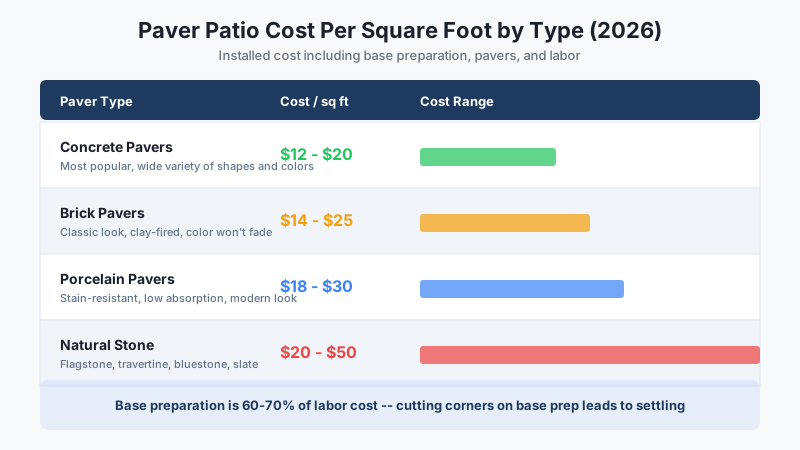
A paver patio costs $12 to $28 per square foot installed in 2026, with total projects ranging from $1,200 for a small 100 sq ft pad to $16,000+ for a large 500 sq ft patio with premium materials. Concrete pavers run $12-$20/sq ft installed, brick pavers cost $14-$25/sq ft, natural stone reaches $20-$50/sq ft, and porcelain pavers fall in the $18-$30/sq ft range. Labor and base preparation account for roughly 60-70% of total project cost.
Across projects from sandy Florida lots to clay-heavy Pennsylvania yards, the number one thing that separates a patio that lasts 25 years from one that buckles in three is the base work nobody wants to pay for. One 300 sq ft brick paver patio in Bucks County was quoted at $7,800 installed, against a competing quote of $4,200 for the same job. The homeowner took the cheaper bid. Six months later, the patio had to be ripped out and redone -- the base was 2 inches of sand on raw clay. The $3,600 "saved" turned into $12,000 total. Cheap base prep is the most expensive mistake in paver work.
Use our Paver Calculator to get a personalized estimate based on your exact dimensions and material choice.
Paver Patio Cost at a Glance
The table below shows what you can expect to pay per square foot for materials and installation across the four main paver types in 2026.
| Paver Type | Material Cost/sq ft | Installed Cost/sq ft | 300 sq ft Total |
|---|---|---|---|
| Concrete pavers | $4 - $6 | $12 - $20 | $3,600 - $6,000 |
| Brick pavers | $4 - $15 | $14 - $25 | $4,200 - $7,500 |
| Porcelain pavers | $8 - $15 | $18 - $30 | $5,400 - $9,000 |
| Natural stone | $8 - $30 | $20 - $50 | $6,000 - $15,000 |
Tip
The "installed cost" includes excavation, gravel base, sand bedding, laying, and polymeric sand joints. Edging, sealing, and complex patterns add 10-25% to these base numbers.
Cost by Patio Size
Patio size is the single biggest cost driver. Here is what each size bracket looks like in 2026, using mid-range concrete pavers as the baseline and natural stone as the premium example.
| Patio Size | Sq Ft | Concrete Pavers (installed) | Brick Pavers (installed) | Natural Stone (installed) |
|---|---|---|---|---|
| Small | 100 | $1,200 - $2,000 | $1,400 - $2,500 | $2,000 - $5,000 |
| Medium | 300 | $3,600 - $6,000 | $4,200 - $7,500 | $6,000 - $15,000 |
| Large | 500 | $6,000 - $10,000 | $7,000 - $12,500 | $10,000 - $25,000 |
| Extra large | 800+ | $9,600 - $16,000 | $11,200 - $20,000 | $16,000 - $40,000 |
Larger patios generally cost less per square foot because base prep and mobilization costs are spread over more area. A 100 sq ft patio might run $20/sq ft installed while the same materials on a 500 sq ft project drop to $14/sq ft. The base machine is already there, the gravel delivery is already paid for, and the crew is already on site.
Cost by Material
Concrete Pavers ($12-$20/sq ft installed)
Concrete pavers are the most popular choice for residential patios, and for good reason. Materials run $4-$6 per square foot, they come in dozens of shapes, colors, and textures, and any competent crew can lay them quickly. A standard 4x8 concrete paver from manufacturers like Belgard, Pavestone, or Unilock costs $0.50-$1.50 per unit depending on finish.
Concrete pavers are manufactured to tight tolerances, which means consistent joints and faster installation. A three-person crew can lay 200-300 sq ft of rectangular concrete pavers in a day on a properly prepared base. The downside is color fade -- concrete pavers lose 10-15% of their original color intensity over the first 5 years unless sealed. Integral color (mixed into the entire paver) holds up better than surface-applied color.
Brick Pavers ($14-$25/sq ft installed)
Clay brick pavers cost $4-$15 per square foot for materials, with the range depending heavily on whether you buy standard machine-made bricks or tumbled, hand-molded units. A standard 4x8 clay brick paver runs $0.60-$2.50 per unit. Brands like Pine Hall Brick and General Shale dominate the market.
The advantage of brick is color permanence. Clay is fired at 2,000+ degrees, so the color goes all the way through and does not fade. A 30-year-old brick patio looks essentially the same as a new one, minus some surface wear. The trade-off is fewer shape options -- brick pavers are mostly rectangular, which limits pattern variety compared to concrete.
Natural Stone ($20-$50/sq ft installed)
Natural stone is the premium tier, and the price range is enormous because "natural stone" covers everything from budget flagstone to imported Italian travertine. Here is how the main types break down:
| Stone Type | Material Cost/sq ft | Installed Cost/sq ft | Typical Source |
|---|---|---|---|
| Flagstone (irregular) | $8 - $15 | $20 - $35 | Domestic quarries |
| Flagstone (cut/gauged) | $12 - $22 | $25 - $45 | Domestic |
| Travertine | $10 - $25 | $25 - $45 | Turkey, Mexico |
| Bluestone | $12 - $20 | $25 - $40 | Northeast US |
| Granite | $15 - $30 | $30 - $50 | Brazil, India, domestic |
| Slate | $10 - $20 | $22 - $38 | Vermont, imported |
Natural stone installation takes significantly longer than manufactured pavers because of irregular thickness and sizing. A crew that lays 250 sq ft of concrete pavers in a day might only lay 100-150 sq ft of irregular flagstone. That labor difference is baked into the installed price.
Porcelain Pavers ($18-$30/sq ft installed)
Porcelain pavers are the newest category in the outdoor market. Materials run $8-$15 per square foot, and they are essentially large-format porcelain tiles (typically 24x24 or 24x36) rated for outdoor use. They are nearly impervious to moisture absorption (less than 0.5%), which makes them freeze-thaw resistant and stain-proof.
The catch is installation complexity. Porcelain pavers are thinner than concrete or brick (typically 20mm vs 60mm), which means the base must be perfectly level. They also require pedestal systems or mortar beds for certain applications, which adds labor cost. Cutting porcelain requires a wet saw with a diamond blade rated for porcelain -- a standard masonry saw will crack them.
Labor and Base Preparation
Labor and base work account for 60-70% of total installed cost. Here is a detailed breakdown of where that money goes.
| Component | Cost Range | What It Covers |
|---|---|---|
| Excavation | $1.50 - $3.00/sq ft | Digging out 8-12 inches of soil, hauling away spoils |
| Gravel base (6-8 inches) | $1.50 - $3.00/sq ft | Crushed stone (3/4" minus), machine compacted in 2-inch lifts |
| Sand bedding (1 inch) | $0.50 - $1.00/sq ft | Coarse concrete sand, screeded level |
| Paver laying | $5 - $10/sq ft | Setting pavers, cutting edges, maintaining pattern |
| Polymeric sand | $0.50 - $1.00/sq ft | Joint fill that hardens to resist weeds and washout |
| Edge restraint | $5 - $15/linear ft | Aluminum or plastic edging, spiked into base |
| Compaction (final) | $0.50 - $1.00/sq ft | Plate compactor over finished surface to seat pavers |
Warning
Do not skip base compaction. Every 2-inch lift of gravel must be compacted separately with a plate compactor. Dumping 8 inches of gravel and compacting once is a guaranteed failure -- the bottom layers will settle unevenly, and your patio will develop dips and trip hazards within two years.
The base is where the real cost lives. A proper paver base for a 300 sq ft patio requires roughly 5 cubic yards of crushed gravel and 0.5 cubic yards of sand. Material cost alone is $300-$600, but the labor to excavate, deliver, spread, and compact is $900-$1,800. Skimping on the base is the single most common way contractors cut corners on low bids.
Regional Cost Variation
Where you live changes paver patio pricing significantly, mostly due to labor rates and seasonal constraints.
| Region | Installed Cost/sq ft | vs. National Average | Key Factors |
|---|---|---|---|
| Northeast | $16 - $35 | +15% to +25% | High labor rates, frost depth 36-48", shorter season |
| Southeast | $10 - $24 | -10% to -15% | Lower labor, minimal frost concern, year-round work |
| Midwest | $12 - $28 | -5% to +5% | Moderate labor, freeze-thaw cycles demand deep base |
| West Coast | $18 - $38 | +20% to +30% | Highest labor rates, seismic considerations, fire codes |
| Mountain West | $14 - $30 | +0% to +10% | Moderate labor, altitude drainage issues, snow load |
Frost depth matters more than most homeowners realize. In the Southeast, a 4-inch gravel base is often sufficient. In Minnesota or Vermont, you need 10-12 inches of base material below frost line to prevent heaving. That extra 6-8 inches of gravel and excavation adds $2-$4 per square foot to the project.
Paver Patterns and Their Cost Impact
Pattern choice affects both material waste and labor time. Simple patterns install faster, require fewer cuts, and waste less material.
| Pattern | Labor Premium | Material Waste | Difficulty |
|---|---|---|---|
| Running bond (offset) | Baseline | 5-8% | Easy |
| Stack bond (grid) | Baseline | 3-5% | Easy |
| Herringbone (45-degree) | +10-15% | 10-15% | Moderate |
| Herringbone (90-degree) | +10-12% | 8-12% | Moderate |
| Circular / fan | +15-20% | 15-20% | Hard |
| Random / ashlar | +5-10% | 10-15% | Moderate |
| Basketweave | +5-8% | 5-10% | Moderate |
Herringbone is the most popular upgrade from running bond, and for good reason -- it creates an interlocking structure that resists lateral shifting better than any other pattern. If your patio will bear vehicle traffic (driveway extension) or heavy foot traffic, herringbone is worth the premium. For a purely decorative patio, running bond is perfectly adequate and saves you 10-15% on labor.
Circular patterns around a fire pit or center feature look impressive but require the most cuts and the most skill. Every paver at the perimeter needs a custom angle cut. Budget an extra $300-$600 in labor for a 10-foot diameter circle within a standard rectangular patio.
Factors That Affect Your Total Cost
1. Patio Size and Shape
Rectangular patios are the cheapest to install. Curved edges, L-shapes, and wraparound designs add 10-20% to labor because every curve means custom paver cuts. A 300 sq ft rectangle might cost $5,400 installed; the same area in an organic curve could run $6,500.
2. Material Grade
Within each paver type, there are budget and premium tiers. Standard gray concrete pavers run $4/sq ft; textured, tumbled, or permeable concrete pavers run $6-$10/sq ft. The paver itself is only 30-40% of installed cost, so upgrading material has a smaller impact than you might expect.
3. Site Slope and Grading
A flat, well-drained lot is the cheapest starting point. Slopes require retaining walls ($20-$50 per face foot), stepped terraces, or drainage channels -- all of which add $1,000-$5,000+ to the project depending on severity. If water flows toward your house, you need to regrade before any paver work begins.
4. Drainage Requirements
Proper drainage is non-negotiable. At minimum, the patio must slope 1/4 inch per foot away from the house. If your lot has poor drainage, you may need a French drain ($10-$25 per linear foot) or a catch basin system ($200-$500 per basin). Permeable pavers ($6-$10/sq ft materials) eliminate some drainage concerns but cost more upfront.
5. Access and Logistics
If a skid steer cannot reach your backyard, everything gets carried by hand or wheelbarrow. Five cubic yards of gravel carried through a 36-inch gate adds a full day of labor. Tight access can increase the total project cost by 15-25%.
6. Demolition of Existing Surface
Removing an old concrete slab costs $3-$6 per square foot. Removing an existing paver patio costs $2-$4 per square foot since the pavers lift out more easily. Either way, disposal fees for a 300 sq ft slab run $300-$600 depending on your local dump rates.
Maintenance Costs
Pavers are low-maintenance, not no-maintenance. Here is what ongoing upkeep costs over the life of the patio.
| Maintenance Task | Cost | Frequency | Notes |
|---|---|---|---|
| Sealing | $1 - $3/sq ft | Every 2-3 years | Protects color, prevents staining, hardens joints |
| Polymeric sand replacement | $0.50 - $1.00/sq ft | Every 3-5 years | Re-apply to joints that have washed out |
| Weed treatment | $50 - $150 | Annually | Pre-emergent herbicide in spring |
| Re-leveling (spot repair) | $200 - $500 per area | As needed | Lift sunken pavers, add sand, reset |
| Power washing | $0.15 - $0.30/sq ft | Annually | Clean moss, algae, dirt buildup |
For a 300 sq ft patio, annual maintenance runs $100-$250 per year when averaged over a 10-year period. Sealing is the biggest single expense -- a professional application on 300 sq ft runs $300-$900. DIY sealing with a pump sprayer and a $90 bucket of paver sealer cuts that to $90-$150, and it is one of the few maintenance tasks where DIY results are genuinely comparable to professional work.
Sealed pavers resist oil stains, efflorescence (white mineral deposits), and color fade. Unsealed pavers develop a natural patina that some homeowners prefer, but they are harder to clean when something spills.
DIY vs. Professional Installation
A paver patio is one of the more realistic DIY hardscape projects, but only if you understand what you are signing up for.
| Factor | DIY | Professional |
|---|---|---|
| Material cost (300 sq ft, concrete pavers) | $1,800 - $3,000 | $1,800 - $3,000 |
| Labor | $0 (your time) | $3,000 - $6,000 |
| Tool rental (compactor, saw, levels) | $200 - $400 | Included |
| Gravel and sand delivery | $300 - $600 | Included in bid |
| Time | 3-5 weekends | 2-4 days |
| Total | $2,300 - $4,000 | $4,800 - $9,000 |
| Savings | 45-55% | -- |
What DIY can handle: Rectangular patios under 200 sq ft on relatively flat ground with basic patterns (running bond, stack bond). Concrete pavers are the easiest material for DIY because of uniform thickness and consistent sizing.
What needs a pro: Anything over 300 sq ft, sloped sites requiring grading, natural stone (irregular thickness demands experience), circular patterns, and patios adjacent to foundations where drainage errors can cause water intrusion.
The hardest part of DIY paver work is not laying the pavers -- it is getting the base right. Excavating 8-10 inches of soil from 300 sq ft by hand produces roughly 9 cubic yards of spoils. That is 15-20 wheelbarrow loads to move somewhere. Then you need 5 cubic yards of gravel delivered and spread in compacted lifts. Rent a plate compactor ($80-$120/day) and plan on two full days just for base preparation before you touch a single paver.
If the base work or tight access is more than you want to take on, getting a few quotes is the fastest way to pressure-test the numbers above against your actual yard.
Frequently Asked Questions
How much does a 12x12 paver patio cost?
A 12x12 paver patio (144 sq ft) costs $1,700 to $4,000 installed with concrete pavers, or $2,900 to $7,200 with natural stone. This is the most common "starter" patio size, large enough for a small dining set or four chairs around a fire pit.
- Concrete pavers: 144 sq ft x $12-$20/sq ft = $1,728-$2,880, typically rounded to $1,700-$3,000 after edge cuts and waste
- Brick pavers: 144 sq ft x $14-$25/sq ft = $2,016-$3,600
- Natural stone: 144 sq ft x $20-$50/sq ft = $2,880-$7,200, with most flagstone projects landing around $3,500-$5,000
- DIY savings: Materials only for a 12x12 with concrete pavers run $700-$1,200 including gravel, sand, and edging
At 144 sq ft, you are in the range where DIY is genuinely feasible for a motivated homeowner with a free weekend and a rented plate compactor.
Is a paver patio cheaper than poured concrete?
Paver patios typically cost 20-40% more than poured concrete, but they offer significantly lower long-term repair costs. A poured concrete patio runs $8-$18 per square foot installed versus $12-$28 for pavers. However, when a poured slab cracks -- and it will crack eventually -- you are looking at $500-$2,000 for cosmetic patching or $3,000-$8,000 for a full tear-out and replacement.
- Poured concrete: $8-$18/sq ft installed, 15-25 year lifespan before major cracking, full replacement required for structural failure
- Concrete pavers: $12-$20/sq ft installed, 25-50 year lifespan, individual pavers replaceable for $2-$5 each
- Break-even point: Over a 30-year period, a paver patio and a poured concrete patio often cost within 10% of each other when you factor in one slab replacement
- Resale value: According to the National Association of Realtors, a paver patio returns 50-75% of its cost at resale versus 30-50% for poured concrete
If your budget is tight and you need a patio now, poured concrete is the cheaper option. If you are building for 20+ years, pavers win on total cost of ownership.
How long does a paver patio last?
A properly installed paver patio lasts 25 to 50 years, with some brick and natural stone installations lasting 100+ years. The pavers themselves are essentially permanent -- it is the base underneath that determines actual lifespan. A patio with a properly compacted 6-8 inch gravel base, geotextile fabric, and adequate drainage will outlast the homeowner.
- Concrete pavers: 25-40 years before color fade becomes noticeable; structurally sound for 50+ years
- Brick pavers: 50-100 years; clay does not fade, crack, or degrade under normal residential use
- Natural stone: 75-100+ years; granite and bluestone are measured in centuries, not decades
- Failure points: Base settlement (2-10 years if poorly installed), joint washout (3-5 years without polymeric sand), edge creep (5-10 years without proper restraint)
The biggest threat to longevity is tree roots. A patio installed within 10 feet of a large tree will likely need section repairs within 10-15 years as roots push through the base layer.
What is the best paver material for a patio?
Concrete pavers offer the best balance of cost, durability, and design options for most residential patios. They cost 30-50% less than natural stone, come in hundreds of colors and shapes, and are available at every home center and masonry supply yard in the country.
- Best overall value: Concrete pavers -- $12-$20/sq ft installed, 25-50 year lifespan, low maintenance
- Best for color permanence: Brick pavers -- clay color never fades, but limited shape options
- Best for luxury appearance: Natural stone (bluestone or travertine) -- unique character, highest resale impact
- Best for modern design: Porcelain pavers -- large format, uniform appearance, stain-proof
- Best for drainage: Permeable concrete pavers -- allow water infiltration, may reduce drainage costs
For 90% of residential patios, standard concrete pavers in a neutral color with a tumbled finish are the practical choice. They look good, last decades, and if one cracks in 15 years, it can be pulled out and replaced for under $5.
Can I install pavers over an existing concrete slab?
Yes, you can install pavers over existing concrete if the slab is structurally sound, level, and drains properly. This method eliminates excavation and base costs, potentially saving $3-$6 per square foot. However, the slab must be in good condition -- no major cracks, no heaving, and no standing water.
- Overlay method: Apply 1 inch of sand or mortar bed over the slab, set pavers, fill joints. Total height addition: 3-4 inches
- Cost savings: $3-$6/sq ft (no excavation, no gravel base, no compaction)
- Typical cost: $8-$15/sq ft installed versus $12-$20 for a full new installation
- Risks: Pavers inherit any drainage problems from the slab; height increase may affect door thresholds and step heights; cracks in the slab can telegraph through over time
Overlay only makes sense on a slab that is confirmed to be properly sloped for drainage and free of structural cracks wider than 1/4 inch. If the slab failed for a reason (poor base, bad drainage), putting pavers on top does not fix the underlying problem.
How much does it cost to seal a paver patio?
Professional paver sealing costs $1 to $3 per square foot, or $300-$900 for a typical 300 sq ft patio. DIY sealing with a pump sprayer and quality sealer runs $90-$150 in materials for the same area. Sealing should be done every 2-3 years to maintain protection.
- Professional sealing: $1-$3/sq ft, includes cleaning, joint sand replacement, and two coats of sealer
- DIY sealing: $0.30-$0.50/sq ft in materials (sealer at $90-$130 per 5-gallon bucket covers 600-800 sq ft)
- Wet-look sealer: Darkens pavers and adds gloss; popular on natural stone and dark concrete pavers
- Matte sealer: Invisible protection without changing appearance; preferred for tumbled or rustic pavers
- Lifetime cost: Over 20 years with sealing every 2.5 years, professional sealing adds $2,400-$7,200 to total cost; DIY sealing adds $720-$1,200
Sealing is one of the few paver maintenance tasks where the DIY result is almost identical to professional work. Clean the pavers with a pressure washer, let them dry for 24 hours, apply sealer with a pump sprayer in two thin coats, and stay off the patio for 48 hours. The most common DIY mistake is applying too much sealer in one coat, which creates a milky white haze that is difficult to remove.
Cost data sourced from HomeAdvisor, Angi, LawnStarter, LawnLove, and NT Pavers. Prices reflect 2026 national averages and may vary by region.
This article is provided for informational and educational purposes only. Content should not be considered professional financial, medical, legal, or other advice. Always consult a qualified professional before making important decisions. UseCalcPro is not responsible for any actions taken based on the information in this article.
Try These Calculators
Estimate 2026 paver patio install cost by size, material, and region. Brick and concrete pavers run $10-$30/sqft installed; natural stone $25-$50/sqft.
Estimate 2026 stone veneer installation cost by square footage, stone type, and region. Manufactured $15-$25/sqft; natural stone $25-$45/sqft installed.
Estimate new home construction costs by square footage, quality level, and region. Get detailed material and labor cost breakdowns for building your house.
Estimate 2026 deep house cleaning cost by home size, condition, and bathrooms. A first-time deep clean runs $200-$600, about $0.20-$0.40 per square foot.