How Much Does Drywall Cost in 2026? (Installation & Finishing Prices)
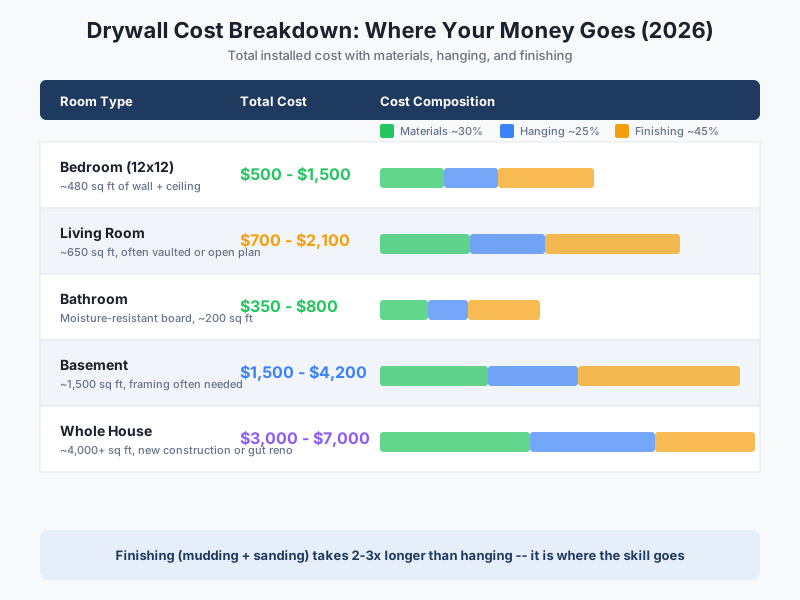
Drywall installation costs $1.50 to $3.50 per square foot in 2026, including hanging, taping, and finishing to a smooth Level 4 surface. A standard 12x12 bedroom runs $500-$1,500 depending on finish level and regional labor rates. For a whole house with roughly 2,000 square feet of wall and ceiling area, expect $3,000-$7,000 all in. Labor accounts for 50-70% of every drywall project, which means the finisher you hire has more impact on your total than the board type you choose.
Consider a representative basement finishing project: 1,100 square feet of open space below grade in a 1980s split-level. A typical drywall quote for this scope comes in around $4,200: $1,400 for materials (42 sheets of standard half-inch plus moisture-resistant board on exterior walls) and $2,800 for a two-man crew to hang, tape, mud, and sand to Level 4. The finisher generally spends more time on mudding and sanding than the hanger spends on the actual boards. That is the pattern every contractor already knows -- hanging drywall is the easy part. Finishing is where the skill and the money go.
Use our Drywall Calculator to estimate sheets, joint compound, tape, and total cost for your specific room dimensions before requesting quotes.
Drywall Cost at a Glance
The table below shows typical installed costs for drywall projects in 2026. These ranges include materials (sheets, joint compound, tape, screws) plus labor for hanging and finishing to Level 4.
| Project | Area | Cost Range | Cost Per Sq Ft |
|---|---|---|---|
| Single bedroom (12x12) | 450-550 sq ft | $500 - $1,500 | $1.10 - $2.70 |
| Living room (14x18) | 550-700 sq ft | $700 - $2,100 | $1.25 - $3.00 |
| Bathroom (small, 5x8) | 150-220 sq ft | $350 - $800 | $2.30 - $3.60 |
| Basement (600 sq ft floor) | 900-1,200 sq ft | $1,500 - $4,200 | $1.65 - $3.50 |
| Whole house (2,000 sq ft walls) | 2,000 sq ft | $3,000 - $7,000 | $1.50 - $3.50 |
| Garage (2-car, walls only) | 600-800 sq ft | $900 - $2,400 | $1.50 - $3.00 |
Tip
Wall area is not the same as floor area. A 12x12 room with 8-foot ceilings has 144 sq ft of floor but roughly 384 sq ft of wall area, plus another 144 sq ft if you include the ceiling. Always clarify which measurement a quote references -- some contractors quote per square foot of floor space, which inflates the apparent per-unit cost.
Drywall prices have climbed 3-5% between early 2025 and late 2026, driven primarily by gypsum supply chain costs and continued demand in the new construction market. If you are comparing quotes from early 2025 to current bids, that increase alone explains part of the gap.
Cost by Board Type
Standard half-inch drywall is the default for most residential walls, but specialized boards exist for bathrooms, garages, party walls, and home theaters. The material cost difference is significant -- specialty boards can double or triple your sheet costs.
| Board Type | Thickness | Material Cost (per sq ft) | Best For | Notes |
|---|---|---|---|---|
| Standard (regular) | 1/2" | $0.40 - $0.60 | Interior walls, bedrooms, living areas | Most common; ~$12-$15 per 4x8 sheet |
| Lightweight | 1/2" | $0.45 - $0.65 | Same as standard | 25% lighter; easier to hang on ceilings |
| Fire-resistant (Type X) | 5/8" | $0.50 - $0.80 | Garage-to-house walls, furnace rooms | Code-required in many attached garage walls; +20-35% vs standard |
| Moisture-resistant (green board) | 1/2" | $0.50 - $0.85 | Bathrooms, laundry rooms, kitchens | NOT for direct water contact; +25-40% vs standard |
| Mold-resistant (purple board) | 1/2" | $0.55 - $0.90 | Basements, humid climates | Fiberglass face resists mold growth |
| Soundproof (QuietRock) | 5/8" | $2.00 - $4.00 | Home theaters, bedrooms on shared walls | Viscoelastic polymer core; STC 50+ single layer |
| Cement board | 1/2" | $0.80 - $1.50 | Tile backer in showers | Not true drywall; included for comparison |
For a standard 12x12 bedroom with 384 sq ft of wall area, upgrading from standard to moisture-resistant board adds $40-$95 in materials. Upgrading to QuietRock adds $615-$1,305 -- a dramatic jump that is only justified for specific acoustic goals.
Info
Type X is often code-required, not optional. Most building codes mandate 5/8" Type X drywall on any wall between an attached garage and living space. Check your local code before assuming standard half-inch will pass inspection. A failed inspection means tearing out and replacing, which costs far more than the 20-35% material premium.
Finish Levels Explained (1-5)
The Gypsum Association defines five levels of drywall finish, and the level you choose directly affects labor cost. Most homeowners have never heard of these levels, but every professional finisher knows them.
| Level | What It Includes | Cost Per Sq Ft (finishing only) | Typical Use |
|---|---|---|---|
| 1 | Tape embedded in joint compound, no additional coats | $0.50 - $0.75 | Above ceilings (concealed plenum areas), garage interiors |
| 2 | One coat of compound over tape and fastener heads, tool marks OK | $0.75 - $1.00 | Tile backer where walls will be covered, utility rooms |
| 3 | Two coats over tape, one coat over fasteners, smooth but not perfect | $1.00 - $1.50 | Walls receiving heavy texture (knockdown, orange peel) |
| 4 | Three coats over tape, two over fasteners, sanded smooth | $1.50 - $2.00 | Standard for painted walls, most residential rooms |
| 5 | Level 4 plus full skim coat over entire surface | $2.00 - $2.50 | High-gloss paint, critical lighting (south-facing windows), upscale homes |
The jump from Level 3 to Level 4 adds $0.50-$0.75 per square foot, which on a 2,000 sq ft project means $1,000-$1,500 more in labor. Level 5 adds another $0.50 per square foot on top of that. Most residential projects land at Level 4. If your walls will receive flat or eggshell paint with standard lighting, Level 4 is sufficient. If you are using semi-gloss or high-gloss paint in a room with strong directional light, Level 5 prevents visible joint lines that show through sheen.
Warning
Texture does not hide bad finishing -- it reveals it differently. A common misconception is that knockdown or orange peel texture lets you skip finishing quality. In reality, texture applied over poor taping shows ridges and humps. Level 3 is the minimum for textured walls, and a skilled finisher still matters.
Labor Cost Breakdown
Labor represents 50-70% of every drywall project. The work divides into two distinct trades -- hanging and finishing -- and many drywall companies use different crews for each.
| Task | Cost Per Sq Ft | Time (per 500 sq ft) | What It Involves |
|---|---|---|---|
| Hanging | $0.85 - $1.25 | 4-6 hours | Cutting sheets, fastening to studs, fitting around outlets and windows |
| Taping (first coat) | $0.35 - $0.50 | 2-3 hours | Embedding paper or mesh tape in wet compound over joints |
| Mudding (second and third coats) | $0.40 - $0.60 | 3-5 hours | Feathering compound wider with each coat, covering fastener heads |
| Sanding | $0.15 - $0.25 | 2-3 hours | Dust control, smoothing compound flush with board surface |
| Priming | $0.10 - $0.20 | 1-2 hours | PVA primer seals paper face and compound for even paint absorption |
| Total finishing (tape + mud + sand + prime) | $1.00 - $1.50 | 8-13 hours | For Level 4 standard residential finish |
| Total labor (hang + finish) | $1.85 - $2.75 | 12-19 hours | Full scope, walls only, standard height |
A two-person hanging crew can hang 1,500-2,000 square feet of drywall per day on standard 8-foot walls with minimal obstructions. Finishing is slower because each coat of compound needs 24 hours of drying time between applications. A Level 4 finish requires three separate visits for mudding alone, plus a final sanding pass. This is why finishing takes longer on the calendar even though the active labor hours are comparable.
Ceiling work adds $0.50-$1.00 per square foot to labor because overhead lifting is physically demanding and slower. Some crews charge a flat ceiling surcharge rather than a per-square-foot premium.
Cost by Room
Room-level estimates help homeowners compare quotes and set realistic budgets. These ranges assume standard half-inch drywall, Level 4 finish, and 8-foot ceilings unless noted otherwise.
| Room | Typical Wall Area | Board Type | Installed Cost | Notes |
|---|---|---|---|---|
| Bedroom (12x12) | 384 sq ft walls | Standard 1/2" | $500 - $1,100 | Straightforward; few obstructions |
| Bedroom with ceiling | 528 sq ft total | Standard 1/2" | $700 - $1,500 | Ceiling adds $100-$250 |
| Bathroom (5x8) | 208 sq ft walls | Moisture-resistant | $500 - $900 | Green board costs more; small rooms have more cuts per sq ft |
| Kitchen | 300-450 sq ft | Moisture-resistant | $550 - $1,400 | Above-cabinet areas need careful fitting |
| Basement (600 sq ft floor) | 900-1,200 sq ft | Mold-resistant | $1,500 - $4,200 | Below-grade humidity demands mold-resistant board |
| Garage (2-car) | 600-800 sq ft | Type X (5/8") | $900 - $2,400 | Code-required fire rating on shared walls |
| Whole house (2,000 sq ft) | 2,000 sq ft | Mixed | $3,000 - $7,000 | Economies of scale reduce per-sq-ft cost |
Small rooms consistently cost more per square foot than large open spaces. A 5x8 bathroom has 208 square feet of wall but requires more cuts per sheet (around fixtures, plumbing, and vanity openings), and the board type is more expensive. A large open basement, by contrast, allows long uninterrupted runs with minimal waste.
Whole-house projects benefit from volume pricing. Most drywall contractors will discount per-square-foot rates by 10-20% for projects over 1,500 square feet because mobilization and setup costs are fixed regardless of project size.
Regional Cost Variation
Like all construction trades, drywall costs vary significantly by region. Labor rates are the primary driver -- drywall sheets cost roughly the same at any Home Depot in the country, but the installer hanging them earns very different wages depending on the local market.
| Region | Installed Cost Per Sq Ft | vs. National Average | Key Factors |
|---|---|---|---|
| Northeast | $2.25 - $3.75 | +15% to +25% | High labor costs; union markets in metro areas |
| Southeast | $1.25 - $2.50 | -10% to -20% | Lower labor costs; competitive contractor supply |
| Midwest | $1.50 - $2.75 | -5% to +5% | Moderate labor; varies widely between Chicago and rural areas |
| West Coast | $2.50 - $4.00 | +20% to +30% | CA, WA, OR all have elevated trade wages |
| Mountain West | $1.75 - $3.00 | +5% to +15% | Denver and Salt Lake trending higher; rural areas moderate |
| South Central | $1.25 - $2.50 | -15% to -5% | Texas, Oklahoma, Arkansas have strong labor supply |
A whole-house drywall project that costs $4,500 in Houston might run $6,500 in Chicago and $8,000 in the San Francisco Bay Area for identical scope and quality. The sheets cost the same -- it is the labor that creates a 40-60% spread between the cheapest and most expensive markets.
These ranges reflect 2026 pricing aggregated from Angi, HomeGuide, and HomeWyse.
Factors That Affect Your Drywall Cost
Beyond board type and finish level, several project-specific variables push costs up or down.
Ceiling Height
Standard 8-foot ceilings use 4x8 sheets hung horizontally -- the most efficient configuration. Nine-foot ceilings require 54-inch sheets or vertical hanging with butt joints, adding 10-15% to labor. Ten-foot and higher ceilings need scaffolding and longer boards, increasing labor by 15-25% and materials by 10-15%.
Number of Corners and Openings
Every door, window, electrical box, and inside corner requires cutting and fitting. A room with two doors and three windows generates far more waste and labor than an open basement wall with zero penetrations. Expect 10-15% material waste on standard rooms and 15-20% on rooms with many openings.
Texture Application
Textured finishes (knockdown, orange peel, skip trowel) add $0.30-$0.75 per square foot beyond the base finishing cost. Smooth finishes actually cost more in labor because they demand Level 4 or 5 precision. Texture hides minor imperfections but has its own application cost.
Access and Logistics
Tight staircases, narrow hallways, and upper floors without elevator access all increase labor time. Full 4x12 sheets are 12 feet long and difficult to maneuver through standard doorways. Contractors may charge $100-$300 in additional delivery and handling fees for difficult access situations.
Removal of Existing Drywall
If you are replacing rather than installing new, demolition and disposal add $0.50-$1.25 per square foot. Old drywall generates heavy debris -- a single 4x8 sheet weighs about 50 pounds -- and disposal fees vary by municipality. Some areas charge by weight at the landfill; others offer flat dumpster rates.
Insulation Behind the Board
While not a drywall cost per se, many projects pair drywall installation with insulation work. Batt insulation adds $0.50-$1.50 per square foot to the project. If you are already opening up walls, combining both trades at once saves on mobilization costs.
DIY vs. Professional
Drywall is one of the few construction trades where the DIY/professional cost gap is dramatic -- and the quality gap is equally dramatic.
| Factor | DIY | Professional |
|---|---|---|
| Material cost | $0.40-$0.60/sq ft | $0.40-$0.60/sq ft (same) |
| Labor cost | $0 (your time) | $1.85-$2.75/sq ft |
| Tool rental | $75-$200 (stilts, sander, lift) | Included |
| Total for 500 sq ft | $275-$500 | $925-$1,675 |
| Time investment | 30-50 hours | 12-20 hours (crew) |
| Finish quality | Level 2-3 (typical first-timer) | Level 4-5 |
| Calendar duration | 2-3 weekends | 3-5 days |
Hanging drywall is physically demanding but conceptually simple -- measure, cut, screw. Most DIYers can hang acceptable drywall with basic instruction. Finishing is another story entirely. Achieving a smooth, invisible joint takes years of practice. The compound must be applied in progressively wider, thinner coats, feathered perfectly at the edges, and sanded without gouging. First-timers almost always leave visible joint lines, humps over butt joints, and rough texture around fastener heads.
A practical middle ground: hang the drywall yourself and hire a professional finisher. You save 30-40% of the total labor cost (the hanging portion) while getting expert-quality joints and surfaces. Many drywall contractors will accept finish-only work, especially if the hanging was done to a reasonable standard.
Tip
If you DIY the hanging, use setting-type compound (hot mud) for the first tape coat. Pre-mixed compound takes 24 hours to dry, but 45-minute or 90-minute setting compound hardens by chemical reaction regardless of humidity. This lets you apply your first taping coat and begin the second coat the same day, cutting calendar time in half for that stage.
Frequently Asked Questions
How much does it cost to drywall a 12x12 room?
A 12x12 room with 8-foot ceilings has approximately 384 square feet of wall area. If you include the ceiling, that rises to 528 square feet. At the national average of $1.50-$3.50 per square foot installed, expect to pay $500-$1,500 for walls and ceiling with a Level 4 finish. Materials alone (14-18 sheets of standard half-inch, joint compound, tape, and screws) run $175-$300. The remaining $325-$1,200 is labor for hanging, taping, mudding, and sanding. Simpler rooms with no closets or minimal door and window openings land at the lower end. Rooms with walk-in closets, multiple windows, and textured finishes push toward the higher end. Getting three quotes from local contractors remains the most reliable way to pin down your specific cost within this range.
Is it cheaper to drywall or plaster walls?
Drywall is significantly cheaper than traditional three-coat plaster in nearly every scenario. Drywall installation runs $1.50-$3.50 per square foot while three-coat plaster over lath costs $5-$12 per square foot, primarily because plaster requires a specialized tradesperson and far more labor time. Each plaster coat must dry for 24-48 hours, and a three-coat application takes a full week of intermittent work versus 3-5 days for drywall. Veneer plaster -- a thin skim coat over blueboard -- splits the difference at $3-$6 per square foot and offers the hard, smooth surface that plaster lovers prefer. For renovation projects in older homes with existing plaster walls, patching with drywall is standard practice. Full replastering only makes sense in historic restoration or when matching existing plaster textures in visible transition areas.
How much does it cost to finish drywall per square foot?
Drywall finishing alone -- taping, mudding, sanding, and priming, without hanging -- costs $1.00-$1.50 per square foot for a standard Level 4 finish in 2026. Level 3 finishing (suitable for textured walls) runs $0.75-$1.25 per square foot. Level 5 finishing with a full skim coat costs $1.50-$2.50 per square foot. These rates assume the drywall is already hung properly with correct fastener spacing and no damaged edges. If the hanging was done poorly -- misaligned joints, protruding screws, gaps wider than 1/8 inch -- the finisher will charge extra to correct those issues before taping. On a whole-house project with 2,000 square feet of wall, finishing labor alone represents $2,000-$5,000 depending on level and regional rates.
How long does it take to drywall a room?
A professional two-person crew can hang drywall in a standard 12x12 bedroom in 3-4 hours. Finishing that same room takes 3-4 separate visits spread over 4-5 days: first tape coat (day 1), second mud coat (day 2 or 3), third coat (day 3 or 4), and sanding plus priming (day 4 or 5). Each coat needs 24 hours to dry before the next can be applied. Total active labor is roughly 8-12 hours for hanging and finishing combined, but calendar time stretches to nearly a full week because of drying periods. A whole-house project with 2,000 square feet of drywall typically takes a professional crew 7-10 business days from first board to final sanding. DIY timelines run 2-3 times longer due to slower production rates and the learning curve on finishing technique.
Should I use 1/2-inch or 5/8-inch drywall?
Standard 1/2-inch drywall is appropriate for most residential walls and ceilings with 16-inch on-center framing. It costs $0.40-$0.60 per square foot and weighs about 1.6 pounds per square foot. Use 5/8-inch drywall in three situations: fire-rated walls (attached garage to living space, furnace rooms, and party walls between units), ceilings with 24-inch on-center framing (5/8-inch resists sag where 1/2-inch will bow over time), and anywhere code requires it. Fire-rated 5/8-inch Type X costs $0.50-$0.80 per square foot, a 20-35% premium over standard half-inch. The extra weight -- about 2.2 pounds per square foot -- makes overhead installation harder, which is why ceiling work with 5/8-inch boards adds more labor cost. Always check local building codes before choosing thickness, because a failed inspection means removing and replacing sheets at your expense.
Can I install drywall over existing drywall?
Yes, layering new drywall over old is a valid technique and often cheaper than demolition and replacement. You avoid $0.50-$1.25 per square foot in removal costs and eliminate the mess and disposal fees of tearing out old boards. The new layer screws through the old layer into the studs, using longer 2-inch screws instead of standard 1-1/4-inch screws. However, there are important limitations. Adding a second layer reduces room dimensions by 1/2 inch on each wall (1 inch total loss in room width). Electrical boxes need extension rings to remain flush with the new surface. Door and window trim must be reinstalled or extended. The technique works best on walls with cosmetic damage (cracks, water stains, old texture) where the underlying board is still structurally sound. If the existing drywall has mold, water damage to the paper face, or crumbling gypsum core, it must come out rather than be covered. Your local code may also have specific requirements for layering in fire-rated assemblies.
Pricing data reflects national averages for 2026 and is sourced from Angi, HomeGuide, HomeWyse, and contractor estimates aggregated by Construct Estimates. Actual costs vary by location, project complexity, and contractor availability. Get at least three local quotes before committing to a project.
This article is provided for informational and educational purposes only. Content should not be considered professional financial, medical, legal, or other advice. Always consult a qualified professional before making important decisions. UseCalcPro is not responsible for any actions taken based on the information in this article.
Try These Calculators
Estimate drywall sheets, joint compound, screws, and tape for walls and ceilings. Enter room dimensions to get a complete material list for your project.
Estimate 2026 drywall install cost by square footage and finish level. Hang + finish runs $1.50 to $3.50 per sqft; 1,000 sqft job is $2,000 to $3,500.
Estimate 2026 tile installation cost by area, tile type, surface, pattern, and US region. Ceramic, porcelain, and stone run $7 to $50 per sqft installed.
Estimate 2026 tile installation labor cost per square foot. Labor alone runs $4-$12/sqft for standard ceramic and $10-$22/sqft for herringbone or mosaic.
Price 2026 bathroom tile installation cost by labor, underlayment, waterproofing, niches, and demo scope. Pure install runs $1,500 to $6,500 for 40-80 sqft.